
ᐅ Heat pump is not compatible with a hydronic (water-heated) fireplace.
Created on: 20 Oct 2023 18:54
J
Jessica388
Hello everyone,
I hope someone here can help us because our heating engineer doesn’t seem to be able to…
Key data
New build 2022 with 250 m² (2,691 ft²)
Heat pump Viessmann Vitocal 200-A
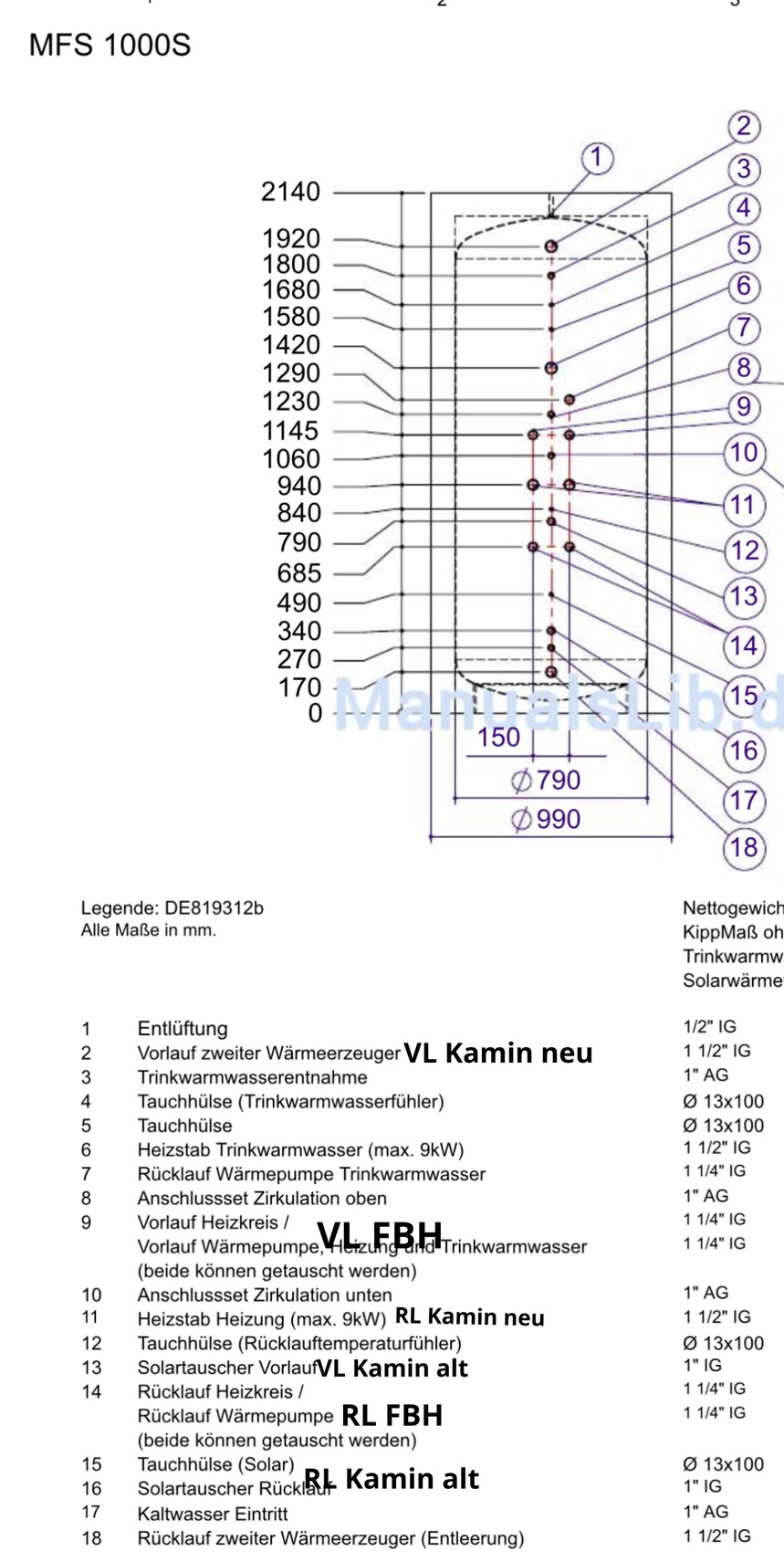
Multifunction storage tank MFS1000S
Water-heated stove with heating capacity on the water side of 8 kW
Photovoltaic system
Electric heating element
I am attaching the schematic of the storage tank layout.
The stove was initially connected under “old” and now it has been modified.
Everything works fine as long as the underfloor heating is off.
When the underfloor heating is on, our hot water temperature doesn’t exceed about 55°C (131°F).
When the underfloor heating is off, the temperature ranges between 65–75°C (149–167°F), either via the electric heating element during sunshine or by stoking the stove.
Now, however, this energy seems to be wasted. It can’t be that the underfloor heating requires 70°C (158°F) supply temperature to achieve a flow temperature of 35°C (95°F), right? The return water is only slightly cooler. So the water should only need to be heated by a maximum of 5°C (9°F).
We assume either a) something is still connected incorrectly, or b) the cold water from the underfloor heating causes such circulation that the hot water cools down within minutes.
What can be done about this?
Has anyone experienced similar problems?
Normally, we should almost run without electric power, but currently the heat pump switches on almost every hour to heat hot water…
I hope someone here can help us because our heating engineer doesn’t seem to be able to…
Key data
New build 2022 with 250 m² (2,691 ft²)
Heat pump Viessmann Vitocal 200-A
Multifunction storage tank MFS1000S
Water-heated stove with heating capacity on the water side of 8 kW
Photovoltaic system
Electric heating element
I am attaching the schematic of the storage tank layout.
The stove was initially connected under “old” and now it has been modified.
Everything works fine as long as the underfloor heating is off.
When the underfloor heating is on, our hot water temperature doesn’t exceed about 55°C (131°F).
When the underfloor heating is off, the temperature ranges between 65–75°C (149–167°F), either via the electric heating element during sunshine or by stoking the stove.
Now, however, this energy seems to be wasted. It can’t be that the underfloor heating requires 70°C (158°F) supply temperature to achieve a flow temperature of 35°C (95°F), right? The return water is only slightly cooler. So the water should only need to be heated by a maximum of 5°C (9°F).
We assume either a) something is still connected incorrectly, or b) the cold water from the underfloor heating causes such circulation that the hot water cools down within minutes.
What can be done about this?
Has anyone experienced similar problems?
Normally, we should almost run without electric power, but currently the heat pump switches on almost every hour to heat hot water…
R
Radfahrer26 Oct 2023 14:00@HeimatBauer
The single parent will really appreciate that.
It’s definitely worth a trip to the social services office.
The single parent will really appreciate that.
It’s definitely worth a trip to the social services office.
J
Jessica38828 Oct 2023 10:32Hello again!
Further questions / difficulties
If there is no demand for hot water, meaning no one is washing hands, showering, etc., how is it possible that the hot water temperature drops from 54 to 46 degrees Celsius (129 to 115 degrees Fahrenheit) within 1 hour and the heat pump switches on?
The last few nights have been really good thanks to the new settings. Yesterday, I stoked the stove from about 4 to 9 pm. Our living area was then very warm at 25 degrees Celsius (77 degrees Fahrenheit). In the buffer tank, however, there was no noticeable change; the hot water didn’t get warmer. On the contrary, during that time the heat pump switched on about every hour to produce hot water. Something doesn’t seem right here, does it?
The stove was supposed to support us and save electricity. Currently, we are burning wood but using more electricity when it’s running…
Further questions / difficulties
If there is no demand for hot water, meaning no one is washing hands, showering, etc., how is it possible that the hot water temperature drops from 54 to 46 degrees Celsius (129 to 115 degrees Fahrenheit) within 1 hour and the heat pump switches on?
The last few nights have been really good thanks to the new settings. Yesterday, I stoked the stove from about 4 to 9 pm. Our living area was then very warm at 25 degrees Celsius (77 degrees Fahrenheit). In the buffer tank, however, there was no noticeable change; the hot water didn’t get warmer. On the contrary, during that time the heat pump switched on about every hour to produce hot water. Something doesn’t seem right here, does it?
The stove was supposed to support us and save electricity. Currently, we are burning wood but using more electricity when it’s running…
K
KarstenausNRW28 Oct 2023 11:30Jessica388 schrieb:
If there is no demand for hot water, meaning no one is washing hands, showering, etc., how can the hot water temperature drop from 54°C (129°F) to 46°C (115°F) within 1 hour and cause the heat pump to turn on?Sounds like a continuously running circulation pump.Jessica388 schrieb:
The last few nights have been really good thanks to the new setting. Yesterday, I stoked the stove from about 4 PM to 9 PM. Our living area was then very warm at 25 degrees Celsius (77°F), but the buffer tank didn’t show any change, and the hot water didn’t get warmer; on the contrary, the heat pump switched on approximately every hour to produce hot water. Something doesn’t add up here, does it? That shouldn’t be the case. The supply and return connections and the temperature sensors were changed again, so maybe something went wrong? If there is no continuous hot water circulation running, the temperature shouldn’t drop. Unless the storage tank is only partially heated, for example 55 degrees Celsius (131°F) at the top and 35 degrees Celsius (95°F) at the bottom, then you would naturally get some equalization over time.
Is the heat from the stove not reaching the buffer tank at all? Is heat diverted at the three-way valve, and is the supply line from the stove to the buffer tank hot?
The stove feeds in at the top, so that should be noticeable in the hot water immediately.
Because the heating circuit is supplied directly via the heat pump, there can be delays or issues. It can take some time until the buffer is sufficiently charged so that after the hot water, the heating circuit also receives heat from the stove.
I’m not a heating installer or HVAC planner myself.
 Winniefred2 Nov 2023 15:29
Jessica388 schrieb:
Should I just let my food go bad? Sorry, but we don’t have a basement. Feel free to tell me how I can do it better or correctly. If you don’t have a cool and slightly humid basement like in older buildings, you can store food in an earth cellar, a cold garage, a drafty garden shed, or similar places. To my knowledge, long-term food storage is not feasible in a modern new build because the conditions simply aren’t right. Of course, you need to make sure that the food is stored safely to prevent access by animals. But this is definitely doable and has been working for centuries.
J
Jessica38812 Feb 2024 19:00I wanted to give you all an update.
After finally finding an external heating specialist, they were able to quickly identify that something was seriously wrong and that the electricity consumption was far too high.
Solution: our heating specialist connected the buffer tank according to the Viessmann scheme. The problem was that it is not actually a Viessmann buffer tank. And sure enough, following the instructions from the buffer tank manufacturer Alpha Innotec, everything worked exactly as we had envisioned. Electricity consumption was reduced by more than half, and when the wood stove is running, the heat pump no longer operates.
So, thanks to everyone who didn’t think we were crazy and helped us look for solutions!
After finally finding an external heating specialist, they were able to quickly identify that something was seriously wrong and that the electricity consumption was far too high.
Solution: our heating specialist connected the buffer tank according to the Viessmann scheme. The problem was that it is not actually a Viessmann buffer tank. And sure enough, following the instructions from the buffer tank manufacturer Alpha Innotec, everything worked exactly as we had envisioned. Electricity consumption was reduced by more than half, and when the wood stove is running, the heat pump no longer operates.
So, thanks to everyone who didn’t think we were crazy and helped us look for solutions!
Similar topics