
ᐅ Heat pump is not compatible with a hydronic (water-heated) fireplace.
Created on: 20 Oct 2023 18:54
J
Jessica388
Hello everyone,
I hope someone here can help us because our heating engineer doesn’t seem to be able to…
Key data
New build 2022 with 250 m² (2,691 ft²)
Heat pump Viessmann Vitocal 200-A
Multifunction storage tank MFS1000S
Water-heated stove with heating capacity on the water side of 8 kW
Photovoltaic system
Electric heating element
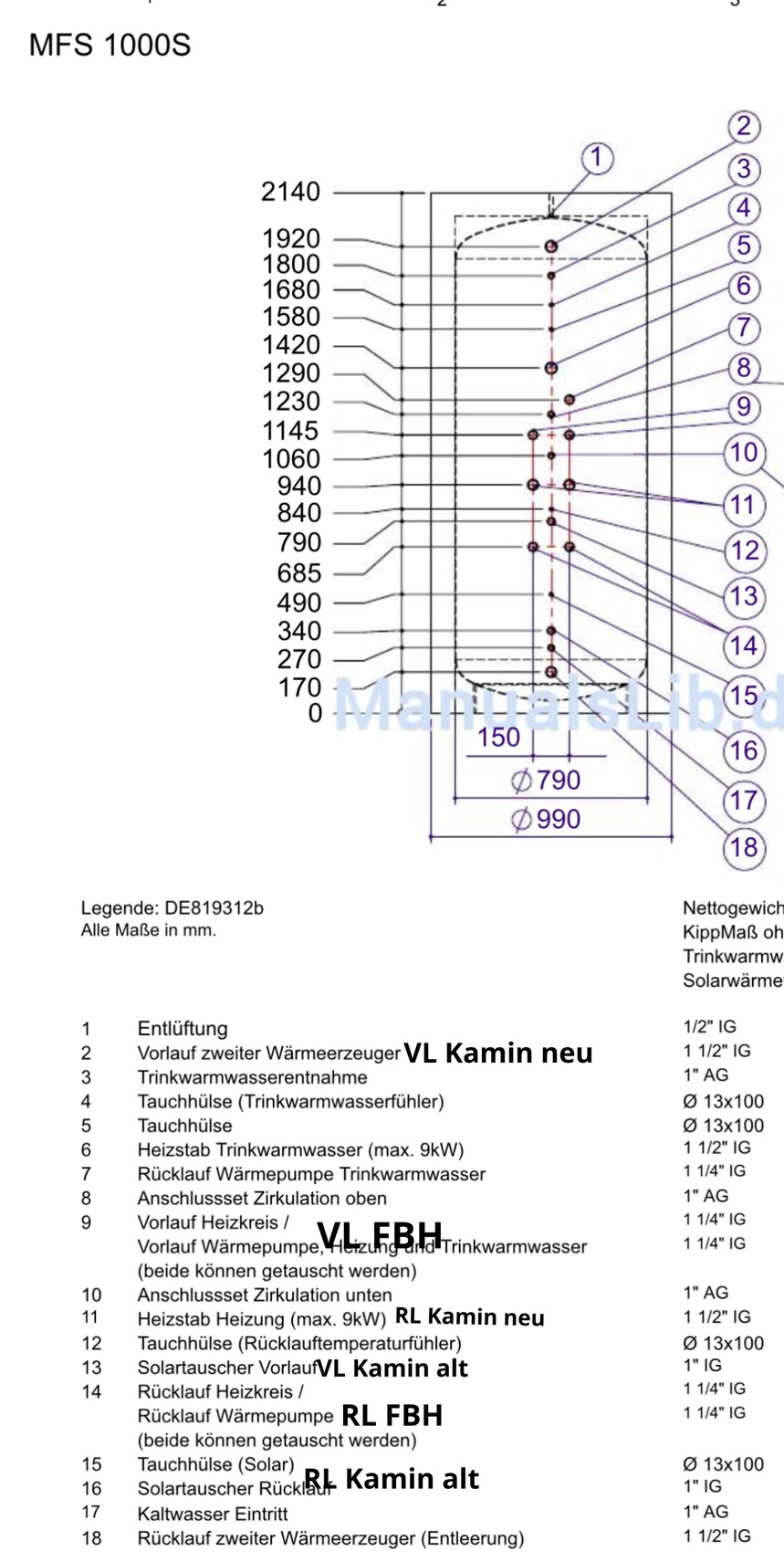
I am attaching the schematic of the storage tank layout.
The stove was initially connected under “old” and now it has been modified.
Everything works fine as long as the underfloor heating is off.
When the underfloor heating is on, our hot water temperature doesn’t exceed about 55°C (131°F).
When the underfloor heating is off, the temperature ranges between 65–75°C (149–167°F), either via the electric heating element during sunshine or by stoking the stove.
Now, however, this energy seems to be wasted. It can’t be that the underfloor heating requires 70°C (158°F) supply temperature to achieve a flow temperature of 35°C (95°F), right? The return water is only slightly cooler. So the water should only need to be heated by a maximum of 5°C (9°F).
We assume either a) something is still connected incorrectly, or b) the cold water from the underfloor heating causes such circulation that the hot water cools down within minutes.
What can be done about this?
Has anyone experienced similar problems?
Normally, we should almost run without electric power, but currently the heat pump switches on almost every hour to heat hot water…
I hope someone here can help us because our heating engineer doesn’t seem to be able to…
Key data
New build 2022 with 250 m² (2,691 ft²)
Heat pump Viessmann Vitocal 200-A
Multifunction storage tank MFS1000S
Water-heated stove with heating capacity on the water side of 8 kW
Photovoltaic system
Electric heating element
I am attaching the schematic of the storage tank layout.
The stove was initially connected under “old” and now it has been modified.
Everything works fine as long as the underfloor heating is off.
When the underfloor heating is on, our hot water temperature doesn’t exceed about 55°C (131°F).
When the underfloor heating is off, the temperature ranges between 65–75°C (149–167°F), either via the electric heating element during sunshine or by stoking the stove.
Now, however, this energy seems to be wasted. It can’t be that the underfloor heating requires 70°C (158°F) supply temperature to achieve a flow temperature of 35°C (95°F), right? The return water is only slightly cooler. So the water should only need to be heated by a maximum of 5°C (9°F).
We assume either a) something is still connected incorrectly, or b) the cold water from the underfloor heating causes such circulation that the hot water cools down within minutes.
What can be done about this?
Has anyone experienced similar problems?
Normally, we should almost run without electric power, but currently the heat pump switches on almost every hour to heat hot water…
RotorMotor schrieb:
Basically, I think the connection was better before than it is now.No, "new" is better. Because this:Buchsbaum schrieb:
The heat pump should have its own heating circuit. The photovoltaic system can support the heat pump well. Your fireplace can be useful for domestic hot water production. Running all three together through a buffer tank is generally difficult.Buchsbaum schrieb:
You can also separate the heat pump’s heating circuit from the buffer tank. Then it will run normally at first.is nonsense.The bivalent parallel heat generation with different supply temperatures and flow rates of the heat sources should ALWAYS be managed together via a buffer tank, which at the same time serves as a hydraulic separator. In manual or automated non-simultaneous operation, deviations are possible, but definitely not in this case. All sources feed into the buffer, and all consumers are supplied from the buffer.
The buffer connections should always be arranged from top to bottom according to descending temperature over the entire buffer height.
At the top is the hottest connection, meaning the supply line from the wood stove. During operation this should always be around 70°C (158°F). As can be seen in the diagram, the stove has a return temperature elevation. The small circuit controlled by the 3-way valve ensures that the water flowing through the stove is circulated internally until it reaches the minimum temperature before being “discharged.” This prevents the water in the stove from becoming too cold so that no condensation forms on the heat exchanger, thus avoiding corrosion.
The line to the stove can also be the “old” one, which would better utilize the buffer volume.
The rest of the connections also look good from the perspective of temperature stratification.
Jessica388 schrieb:
Yes, we even had that last year. It then makes huge banging noises and pumps cold water.Jessica388 schrieb:
But when we turned it on last week, I throttled it at 85 degrees and increased the pump’s flow rate so that it wouldn’t happen anymore.Automated stoves, like pellet or gas boilers, have a switch that can be flipped to shut off when the target temperature is reached. A wood stove, however, has fuel inside and the exhaust gases run through the heat exchanger. The wood stove cannot be switched off directly and is very slow to respond.
If temperatures get too high, cold water injection starts while simultaneously or immediately afterward the overpressure valve opens (this is the banging noise) and the excess water is discharged into the drain. In this case, energy is lost down the drain, but this is intentional. This can be avoided by only using the wood stove when heat release is assured.
Mycraft schrieb:
Your example shows very well why in a modern house with a heat pump, the installation of a water jacket in the chimney should be avoided.As a technically untrained layperson who has never worked with this, I would also be cautious.WilderSueden schrieb:
The question is, of course, how to get out of this situation most simply. For me, dismantling the water jacket sounds like the best solution, then properly setting up the heating system.Dismantling is not necessary, just a careful approach as described above: only use the stove when there is demand.Buchsbaum schrieb:
Is it a room-air-independent fireplace with its own air supply?More important for the solution: What color is it? Red fireplaces tend to overheat more than green ones. Green color is actually calming, especially as a spinach smoothie.Buchsbaum schrieb:
The problem is the buffer tank and not your heating system. Mistakes were made here.I am totally against the idea that only experts accredited beforehand by him/WHO/federal authorities should be allowed to comment on respective topics and all others should be silenced. Against this background, I appreciate your input, but would simply say: no.J
Jessica38823 Oct 2023 13:38dertill schrieb:
The pipe leading to the stove can also be the "old" one, which would make better use of the buffer volume. Thank you very much for your answers.
We also asked our heating engineers about using the "old pipe" because we think it makes the most sense, but according to them, it is not possible since the old connection would be a separate pipe circuit within the buffer...
J
Jessica38825 Oct 2023 07:46RotorMotor schrieb:
That’s already good news to start with!
Now, we might need to wait a bit and see how the temperatures behave inside the house.
Does it get uncomfortably warm or cold in certain rooms or even throughout the whole house?
If so, adjustments should be made specifically to the heating circuit distributors or the heating curve. So unfortunately, it is too cold in the bathroom right now (21.5°C / 71°F) and also in the living area without the stove…
In the bathroom, we would like it to be around 23-24°C (73-75°F).
What should we do now?
Increase the heating curve and the desired temperature setting?
R
RotorMotor25 Oct 2023 07:53Jessica388 schrieb:
So unfortunately, the bathroom is too cold now (21.5°C (70.7°F)) and also the living area without the stove…
In the bathroom, we would like it to be 23–24 degrees. First of all, in (modern) houses, having a large temperature difference between rooms is not really (practically) possible.
This is simply because the insulation is only on the outside, not between rooms.
So having everywhere at 21°C (70°F) and the bathroom at 24°C (75°F) will hardly be (practically) possible.
However, 22°C (72°F) throughout and 23°C (73°F) in the bathroom is definitely achievable! Perhaps even a bit more difference.
Jessica388 schrieb:
What should we do now?
Raise the heating curve and the target temperature? I would first start by raising the target temperature and only adjust the heating curve if it starts to get cold inside during very low outdoor temperatures.
It is important to keep all the room thermostats fully open at first.
J
Jessica38825 Oct 2023 08:04RotorMotor schrieb:
First of all, a general note: In (modern) houses, having a large temperature difference between rooms (meaningfully) is not really possible.
This is simply because the insulation is only on the exterior walls, not between the rooms.
So having 21°C (70°F) everywhere and 24°C (75°F) in the bathroom is hardly (sensibly) achievable.
But having 22°C (72°F) everywhere and 23°C (73°F) in the bathroom is definitely doable! Maybe even a bit more difference.
I would recommend starting by raising the target temperature first, and then adjusting the heating curve only when it starts to feel cold inside during very cold outdoor temperatures.
It’s important to keep the valves open in all rooms at first. Okay.
We’ve now set the rooms where we don’t need heating (storage, pantry, bedroom) to 2, the living room and bathroom to 6, and the rest to 4…
W
WilderSueden25 Oct 2023 08:102, 4, and 6 are not standardized values. You need to find out what exactly they represent. Our thermostats (Busch-Jäger) operate in 5-degree Celsius steps, meaning 2 corresponds to 10°C (50°F), 4 to 20°C (68°F), and 6 to 30°C (86°F). One wonders what the developers were thinking when they came up with this idea...
Similar topics