
ᐅ Is the construction of the basement wall and floor like this acceptable?
Created on: 24 Oct 2023 11:21
N
Narnulf1368
Hello everyone,
We are in the final stages of our house planning (which has now been ongoing for two years...), but we are about to submit the building permit / planning permission application!
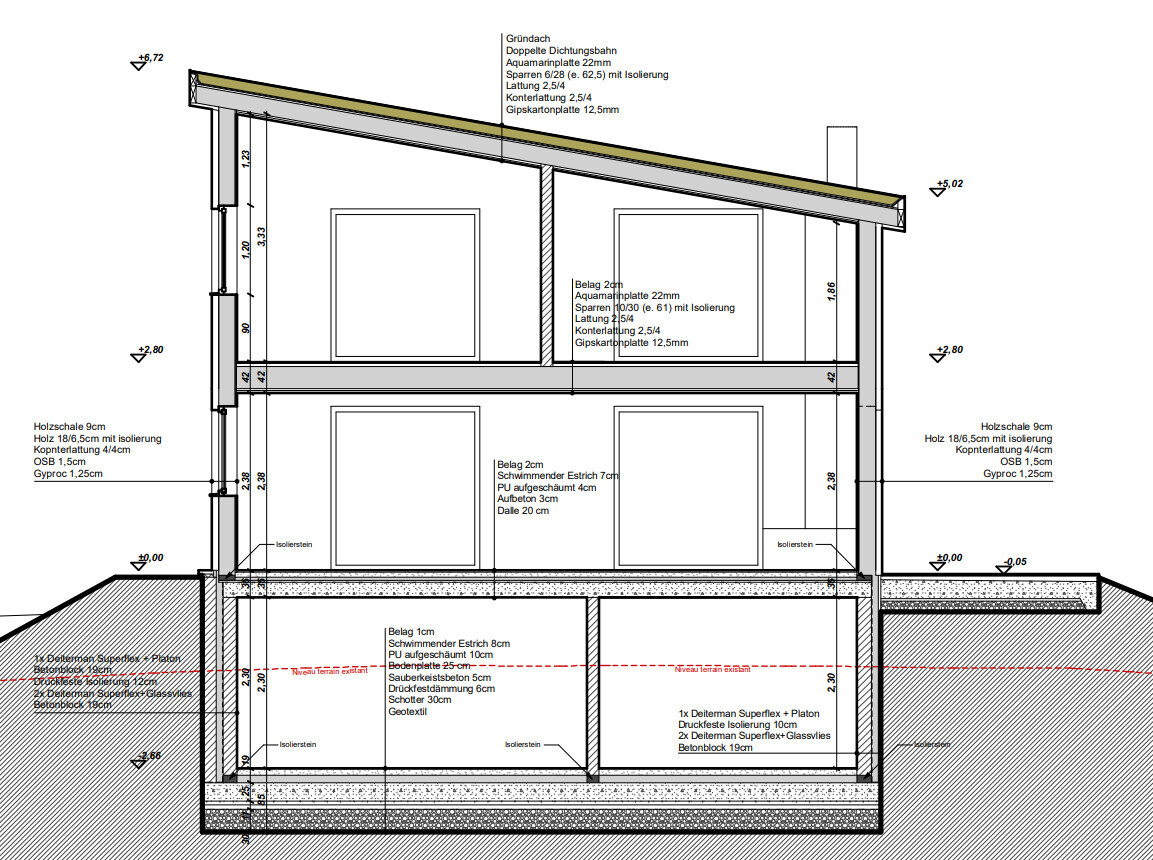
I have now received detailed plans from the architect and am uncertain about the construction of the basement walls and floor. Specifically, I notice that the insulation is on the outside of the walls, followed by the concrete, whereas for the floor, the concrete slab comes first and then the insulation. Although insulated blocks are planned, doesn’t that create a thermal bridge directly into the basement?
I’ve attached a picture.
Is that a type of waterproofing tank / cavity waterproofing?
Even though this is the basement subforum, is the roof structure okay as shown?
Thank you in advance!
We are in the final stages of our house planning (which has now been ongoing for two years...), but we are about to submit the building permit / planning permission application!
I have now received detailed plans from the architect and am uncertain about the construction of the basement walls and floor. Specifically, I notice that the insulation is on the outside of the walls, followed by the concrete, whereas for the floor, the concrete slab comes first and then the insulation. Although insulated blocks are planned, doesn’t that create a thermal bridge directly into the basement?
I’ve attached a picture.
Is that a type of waterproofing tank / cavity waterproofing?
Even though this is the basement subforum, is the roof structure okay as shown?
Thank you in advance!

hanghaus2023 schrieb:
A ceiling height of 2.36 m (7 ft 9 in) is a no-go.Nonsense. I have 14 cm (5.5 inches) more, my uncle in Baden-Württemberg only 2 cm (0.8 inches) more, and I have never felt too close to the ceiling at his place. Le Corbusier even considered 10 cm (4 inches) less to be ideal.https://www.instagram.com/11antgmxde/
https://www.linkedin.com/company/bauen-jetzt/
H
hanghaus202324 Oct 2023 13:5011ant schrieb:
Nonsense. I have 14cm (5.5 inches) more,Then you also have a standard ceiling height.
Oh, I forgot to mention something: on the left side of the plan, you have a rather interesting solution drawn in – it seems to be a kind of "double wall" design, with insulation applied as "cavity insulation." I assume there are (structural?) reasons for this approach, but as shown, it will be difficult to achieve a completely thermal-bridge-free construction. Check if the outer shell can be structurally separated from the foundation so that your "main floor slab" can be insulated all around.
As it stands now, it acts like a cooling fin from the floor slab to the ground, with an additional connection extending all the way to the outside air.
As it stands now, it acts like a cooling fin from the floor slab to the ground, with an additional connection extending all the way to the outside air.
hanghaus2023 schrieb:
Then you also have a standard ceiling height.That doesn’t matter. The fact is: I personally don’t need the extra 14 cm (5.5 inches) of ceiling height in my rooms. I wouldn’t want to have my window lintels any lower, but the roller shutter boxes could be designed differently if necessary.https://www.instagram.com/11antgmxde/
https://www.linkedin.com/company/bauen-jetzt/
N
Narnulf136824 Oct 2023 17:03Wow, first of all, thank you very much for all the replies! I didn’t expect so many responses in such a short time!
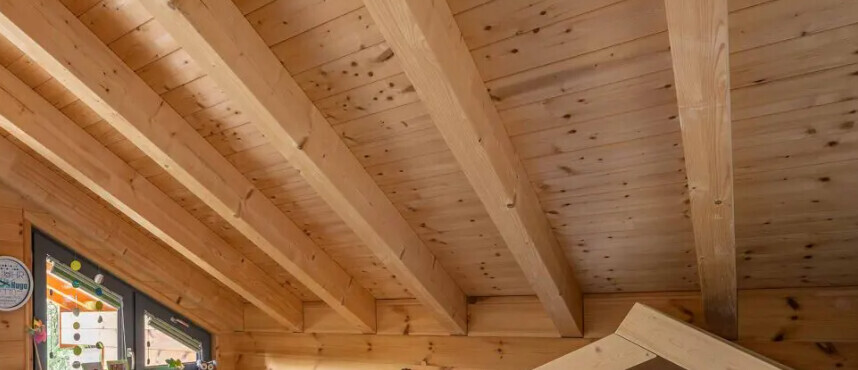
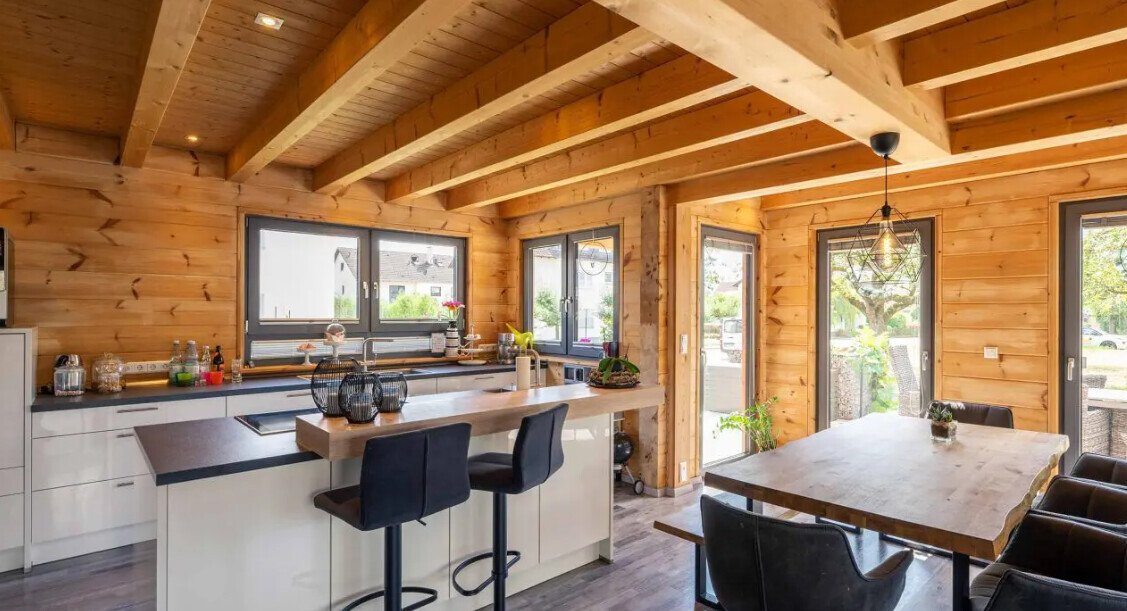
I should have mentioned that both the intermediate ceiling and the roof will have exposed beams, so the wood is visible from below. That means on the ground floor there will be no drywall, counter battens or battens. So, 9.25cm (3.6 inch) will be added up to the beams, and then another 30cm (12 inch) up to the ceiling. That would give us a ceiling height on the ground floor of 247.25cm (8 ft 1 in) or 277.25cm (9 ft 1 in), unless I’m mistaken about the orientation of the beams and battens.
On the upper floor there will be screed, which will reduce the ceiling height there, but that’s accounted for with the sloped ceilings.
There will also be exterior roof insulation under the green roof. The intermediate ceiling and the roof will look like in the attached pictures.
I’ll check again whether the beams are structurally necessary. As to why the architect has not yet included the final ceilings from the prefab manufacturer (Fullwood) in the design, I don’t know. I will follow up on that.
I will ask again, it could indeed be a typo. I also sent this to the structural builder for the basement and asked for his opinion.
The architect said that because of the thermal blocks (insulated blocks, labeled as insulating blocks in the drawing) there should be no problems with thermal bridges, but external floor insulation would also be feasible. I would personally prefer that too, so the whole basement is completely surrounded by insulation.
The insulation above the slab would probably be omitted if the entire basement is insulated from outside, right?
The groundwater level on the plot is not very deep. I wanted to build as high as possible to avoid having the basement constantly in water. Also, the terrain on the back side of the house is higher, so our terrace will be basically at ground level.
There were some problems that had little to do with our design but were caused by the previous architect’s incompetence and stubborn municipal officials. I will post again soon and present the new plans and
We have higher ceiling drops as stated, the plan is still incorrect.
Could you please explain that in a bit more detail? I’m not sure what you mean. Are you referring to the basement wall or the house wall?
hanghaus2023 schrieb:
The roof can be done that way. Whether the 28cm (11 inch) rafters are structurally necessary can’t really be said like this. That seems quite large to me.
Why is the support span on the ground floor so big? 30cm (12 inch) beams are quite expensive. It could be done much more cheaply with something like this.
A no-go is the ceiling height of 2.36m (7 ft 9 in).
I should have mentioned that both the intermediate ceiling and the roof will have exposed beams, so the wood is visible from below. That means on the ground floor there will be no drywall, counter battens or battens. So, 9.25cm (3.6 inch) will be added up to the beams, and then another 30cm (12 inch) up to the ceiling. That would give us a ceiling height on the ground floor of 247.25cm (8 ft 1 in) or 277.25cm (9 ft 1 in), unless I’m mistaken about the orientation of the beams and battens.
On the upper floor there will be screed, which will reduce the ceiling height there, but that’s accounted for with the sloped ceilings.
There will also be exterior roof insulation under the green roof. The intermediate ceiling and the roof will look like in the attached pictures.
I’ll check again whether the beams are structurally necessary. As to why the architect has not yet included the final ceilings from the prefab manufacturer (Fullwood) in the design, I don’t know. I will follow up on that.
Harakiri schrieb:
According to the description, 6cm (2.4 inch) of "rigid insulation" is planned under the slab. That’s not critical at first, but the thickness is ridiculous – a minimum of 14cm (5.5 inch) should be planned here (depending on energy efficiency targets, even more). I hope the note about "clean concrete" between slab and insulation is a typo – it should be under the insulation.
I will ask again, it could indeed be a typo. I also sent this to the structural builder for the basement and asked for his opinion.
Harakiri schrieb:
Make sure the slab edges are properly insulated – according to the drawing, they are currently not insulated (although the slab is shown very oddly) – meaning the insulation needs to run up the edges and also connect on top (possibly in a wedge shape) to the wall insulation.
The architect said that because of the thermal blocks (insulated blocks, labeled as insulating blocks in the drawing) there should be no problems with thermal bridges, but external floor insulation would also be feasible. I would personally prefer that too, so the whole basement is completely surrounded by insulation.
Harakiri schrieb:
In that case, the rigid PUR insulation above the slab could be made thinner (e.g. 60mm (2.4 inch) if the installations allow) – that would gain about 4cm (1.6 inch) in room height.
I find 12cm (4.7 inch) wall insulation pretty ambitious – more would be better.
The insulation above the slab would probably be omitted if the entire basement is insulated from outside, right?
hanse987 schrieb:
Why are you going so far above the original ground level with the ground floor, especially since the site is sloped on both sides?
The groundwater level on the plot is not very deep. I wanted to build as high as possible to avoid having the basement constantly in water. Also, the terrain on the back side of the house is higher, so our terrace will be basically at ground level.
11ant schrieb:
All the more unfortunate that you didn’t update us more often, especially since your concept apparently changed a lot since https://www.hausbau-forum.de/threads/wie-viel-dachueberstand-bei-holzhaus.45138/ ... and now you only show one problematic point instead of the whole house :-(
There were some problems that had little to do with our design but were caused by the previous architect’s incompetence and stubborn municipal officials. I will post again soon and present the new plans and
11ant schrieb:
Nonsense. I have 14cm (5.5 inch) more, my uncle in Baden-Württemberg only 2cm (0.8 inch) more, and I’ve never felt the ceiling was too low there. Le Corbusier even considered 10cm (4 inch) less ideal.
We have higher ceiling drops as stated, the plan is still incorrect.
Harakiri schrieb:
Oh, what I forgot or overlooked: on the left side of the plan, you got a rather interesting solution – seems like a kind of "double wall" is planned, with insulation as cavity insulation. I assume there are (structural?) reasons for this, but as shown it will be difficult to avoid thermal bridges. Check whether the outer layer can be built separately from the foundation so that the main slab can be insulated all around.
As it is now, it looks like a cooling fin from the slab to the soil with an additional connection to the outside air.
Could you please explain that in a bit more detail? I’m not sure what you mean. Are you referring to the basement wall or the house wall?
Narnulf1368 schrieb:
I will ask again, but it could be a typo. I also sent this to the rough builder for the basement and asked for his opinion. <...>
The architect said that the “kimm stones” (insulated blocks, called insulating blocks in the drawing) do not cause any issues regarding thermal bridges, but an external floor insulation would also be possible. Personally, I would prefer that. In other words, if the entire basement is fully enclosed with insulation.The insulating blocks do help somewhat, but if the slab extends beyond the wall (as suggested in the drawing), you will still have a significant thermal bridge (distance multiplied by the perimeter of the floor plan adds up). If I were in your position, I would insist on having the insulation correctly shown in the drawings— the basement builder might be conscientious and do it right anyway, but there’s no guarantee...
Attached is a sketch indicating where I see the gaps.
Narnulf1368 schrieb:
Would the insulation above the slab likely be omitted if the entire basement is insulated from the outside?Probably not. It depends on whether you plan to install underfloor heating in the basement or not. If so, you have, for example, connections to the heating circuit distributor that must run below the screed (or under the heating pipes)— alternatively, surface-mounted piping is possible but rarely preferred. The same applies to other supply lines (water, ventilation, possibly electrical) that are often installed directly on the slab. You can identify where the pipes might cross and their thickness there, and then choose your insulation layer height accordingly—this way, the pipes will be neatly embedded within the insulation layer. The insulation also serves as impact sound insulation, although this is less important for basement floors.
Alternatively, it’s possible to implement so-called concrete core activation, where the “underfloor heating” is integrated directly into the concrete slab (also known as a “Swedish slab”). This can eliminate the need for interior insulation and the screed—the slab surface is smoothed so you can lay your flooring directly on it. However, this requires thicker external insulation beneath the slab to retain the heat inside (at least 20 cm (8 inches) of XPS for passive houses). This approach mainly makes sense if you plan on using a heat pump for heating, as concrete core activation allows for lower supply temperatures, which is optimal for heat pumps (especially if summer cooling is also planned). This must be planned very early, as the pipes then need to be laid within the steel reinforcement (along with all other supply lines)—it requires thorough planning.
Narnulf1368 schrieb:
Could you please explain that a bit more? I’m not exactly sure what you mean. Are you referring to the basement wall or the house wall?I tried to highlight what I mean in attachment image no. 2—it concerns the basement wall on the left, where actually two layers are shown (outer layer 19 cm (7.5 inches) concrete block, then 12 cm (5 inches) insulation between, and then another 19 cm (7.5 inches) concrete block as inner layer). Without a continuous thermal break there, heat will (simplified) migrate beneath the insulating blocks and be transferred via the entire surface area of the outer layer to the soil and outside air. The insulation shown between will provide little or no benefit.
Whether this can be separated that easily, I don’t know, since we don’t know why this construction was selected or is necessary.
Similar topics