
ᐅ Heat pump is not compatible with a hydronic (water-heated) fireplace.
Created on: 20 Oct 2023 18:54
J
Jessica388
Hello everyone,
I hope someone here can help us because our heating engineer doesn’t seem to be able to…
Key data
New build 2022 with 250 m² (2,691 ft²)
Heat pump Viessmann Vitocal 200-A
Multifunction storage tank MFS1000S
Water-heated stove with heating capacity on the water side of 8 kW
Photovoltaic system
Electric heating element
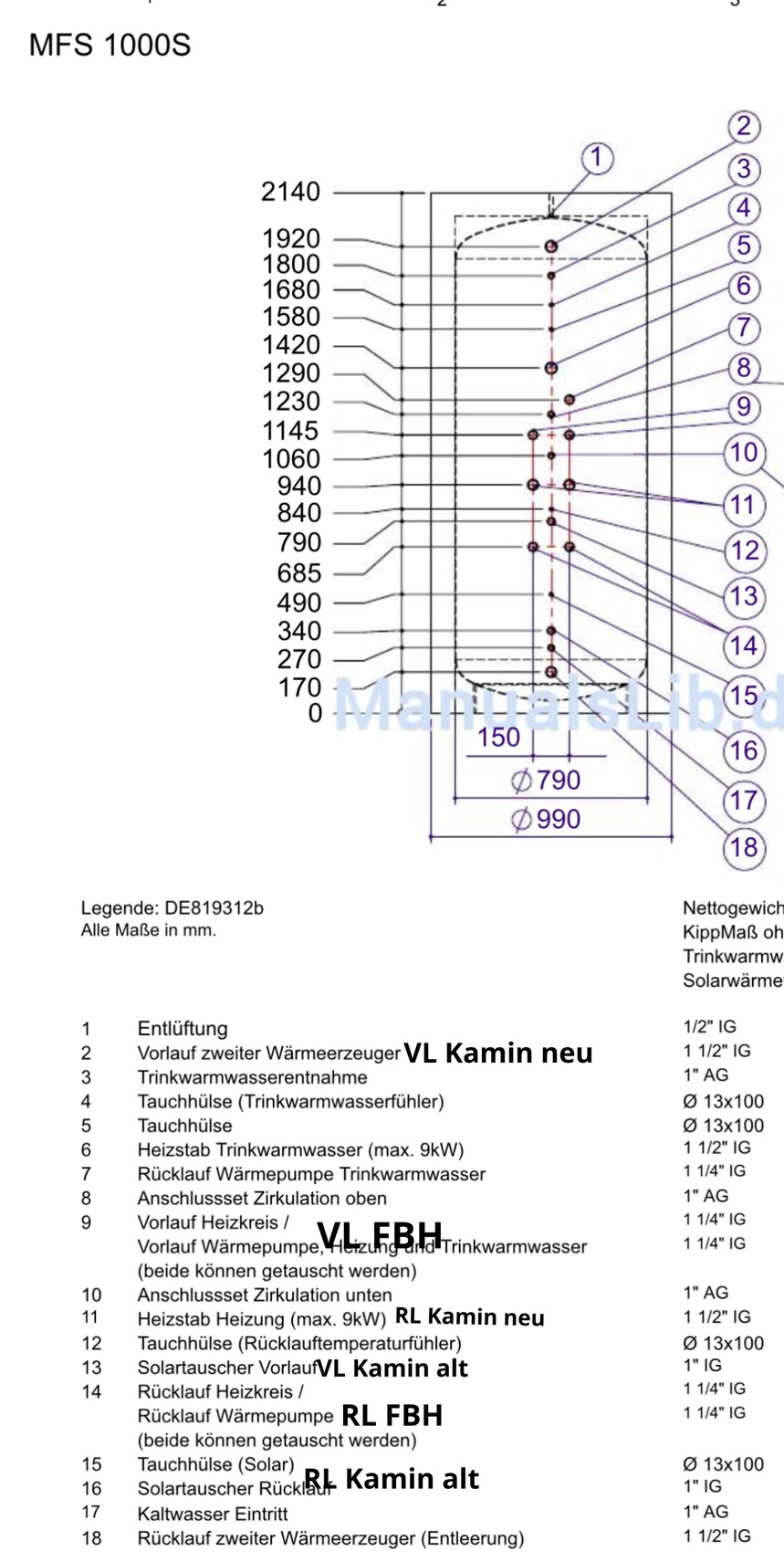
I am attaching the schematic of the storage tank layout.
The stove was initially connected under “old” and now it has been modified.
Everything works fine as long as the underfloor heating is off.
When the underfloor heating is on, our hot water temperature doesn’t exceed about 55°C (131°F).
When the underfloor heating is off, the temperature ranges between 65–75°C (149–167°F), either via the electric heating element during sunshine or by stoking the stove.
Now, however, this energy seems to be wasted. It can’t be that the underfloor heating requires 70°C (158°F) supply temperature to achieve a flow temperature of 35°C (95°F), right? The return water is only slightly cooler. So the water should only need to be heated by a maximum of 5°C (9°F).
We assume either a) something is still connected incorrectly, or b) the cold water from the underfloor heating causes such circulation that the hot water cools down within minutes.
What can be done about this?
Has anyone experienced similar problems?
Normally, we should almost run without electric power, but currently the heat pump switches on almost every hour to heat hot water…
I hope someone here can help us because our heating engineer doesn’t seem to be able to…
Key data
New build 2022 with 250 m² (2,691 ft²)
Heat pump Viessmann Vitocal 200-A
Multifunction storage tank MFS1000S
Water-heated stove with heating capacity on the water side of 8 kW
Photovoltaic system
Electric heating element
I am attaching the schematic of the storage tank layout.
The stove was initially connected under “old” and now it has been modified.
Everything works fine as long as the underfloor heating is off.
When the underfloor heating is on, our hot water temperature doesn’t exceed about 55°C (131°F).
When the underfloor heating is off, the temperature ranges between 65–75°C (149–167°F), either via the electric heating element during sunshine or by stoking the stove.
Now, however, this energy seems to be wasted. It can’t be that the underfloor heating requires 70°C (158°F) supply temperature to achieve a flow temperature of 35°C (95°F), right? The return water is only slightly cooler. So the water should only need to be heated by a maximum of 5°C (9°F).
We assume either a) something is still connected incorrectly, or b) the cold water from the underfloor heating causes such circulation that the hot water cools down within minutes.
What can be done about this?
Has anyone experienced similar problems?
Normally, we should almost run without electric power, but currently the heat pump switches on almost every hour to heat hot water…

This thread wins the award for the greatest potential to cause confusion in the forum. 😀
Could you please summarize again:
- How is the heating currently set? Basepoint? Slope? You can check everything in the heating system’s info menu, ideally without changing any settings.
- If this is a new build, has a hydraulic balancing been performed by the plumbing contractor? (this is mandatory)
- Has the plumbing contractor ever explained the system and its operation to you? If not, request this. It’s important.
- If you still have a warranty, why don’t you ask the plumbing company that installed the system (or the construction company) instead of others?
- What is the current flow temperature of the heat pump?
- I assume it is controlled by outdoor temperature, meaning it adjusts automatically depending on how cold it is outside? The problem with this setup always occurs when there is an additional heat source in one room that changes the demand – for example, a fireplace. Ideally, the installer should have taken this into account.
What completely puzzles me is why you are turning off the heating in all rooms except the bathroom and the room with the additional heat source?
I would rather turn up the room thermostats in all rooms except the one with the fireplace. Generally, shutting off individual room thermostats is detrimental to the efficiency of the heat pump.
Put simply, the heat pump heats the water hotter than necessary (wasting electricity) and then circulates it more slowly through the rooms (because the valves are closed). That doesn’t make much sense, does it?
Could you please summarize again:
- How is the heating currently set? Basepoint? Slope? You can check everything in the heating system’s info menu, ideally without changing any settings.
- If this is a new build, has a hydraulic balancing been performed by the plumbing contractor? (this is mandatory)
- Has the plumbing contractor ever explained the system and its operation to you? If not, request this. It’s important.
- If you still have a warranty, why don’t you ask the plumbing company that installed the system (or the construction company) instead of others?
- What is the current flow temperature of the heat pump?
- I assume it is controlled by outdoor temperature, meaning it adjusts automatically depending on how cold it is outside? The problem with this setup always occurs when there is an additional heat source in one room that changes the demand – for example, a fireplace. Ideally, the installer should have taken this into account.
What completely puzzles me is why you are turning off the heating in all rooms except the bathroom and the room with the additional heat source?
I would rather turn up the room thermostats in all rooms except the one with the fireplace. Generally, shutting off individual room thermostats is detrimental to the efficiency of the heat pump.
Put simply, the heat pump heats the water hotter than necessary (wasting electricity) and then circulates it more slowly through the rooms (because the valves are closed). That doesn’t make much sense, does it?
W
WilderSueden21 Oct 2023 10:00Jessica388 schrieb:
28 degreesAnd then you wonder about the excessive electricity and wood consumption?
Jessica388 schrieb:
Can you increase the supply temperature of the underfloor heating? Yes, but it won’t help you at all. It will only increase your energy consumption.
Jessica388 schrieb:
Why can the regulators be a problem? Since we wanted the bathroom to be the warmest, we set it to 6 there, and then the temperature was adjusted at the heater. The other rooms we were told to turn down. That was the instruction from the heating installer. And I don’t need any heating in the bedrooms. Also, there is no “off” option on the regulators – 1. Rotormotor has already explained it very well. You are heating the other rooms with just the bathroom and living room. Even if you don’t want to and have turned their regulators down. Thermodynamics doesn’t see it that way.
It looks like you have the typical house with a poorly or improperly adjusted heating system, combined with usage habits like those for radiators. But you are dealing with underfloor heating, which basically works the opposite way.
I’d bet a night setback temperature is also still programmed.
Your next steps should be:
- Hydraulic balancing
- Thermal balancing
However, this usually takes an entire heating season and you need someone experienced to carry it out.
Jessica388 schrieb:
Because, as I said, our theory is that the return flow with the cold water creates some kind of turbulence and that’s why the hot water cools down so quickly. Could that be? No, these are independent systems.
R
RotorMotor21 Oct 2023 10:06Oh, you could scroll further in the datasheet and there is actually an A16, which you apparently have.
With that unit, you could easily heat a multi-family house!
It probably consumes a lot of electricity and also cycles on and off frequently, but that would be the next challenge after you have the electricity consumption somewhat under control.
How do you measure the electricity consumption anyway?
So where does the 65 kWh consumption figure come from?
And yes, 28 degrees Celsius (82°F) would also be expensive for a wood chip or gas heating system.
That has nothing to do with the heat pump.
But as I said, first focus on the basics if you can’t find a heating technician:
Turn on the electric heating element only at subzero temperatures. For both heating and domestic hot water.
Set the heating curve reasonably, according to the instructions.
Set all room thermostats to sensible values, maybe 2 in the bedroom, and 3 or 4 in the other rooms, depending on the desired temperature.
Turn the bathroom thermostat up fully.
And then adjust the flow rates at the distribution manifolds, but maybe do that later.
With that unit, you could easily heat a multi-family house!
It probably consumes a lot of electricity and also cycles on and off frequently, but that would be the next challenge after you have the electricity consumption somewhat under control.
How do you measure the electricity consumption anyway?
So where does the 65 kWh consumption figure come from?
And yes, 28 degrees Celsius (82°F) would also be expensive for a wood chip or gas heating system.
That has nothing to do with the heat pump.
But as I said, first focus on the basics if you can’t find a heating technician:
Turn on the electric heating element only at subzero temperatures. For both heating and domestic hot water.
Set the heating curve reasonably, according to the instructions.
Set all room thermostats to sensible values, maybe 2 in the bedroom, and 3 or 4 in the other rooms, depending on the desired temperature.
Turn the bathroom thermostat up fully.
And then adjust the flow rates at the distribution manifolds, but maybe do that later.
J
Jessica38821 Oct 2023 10:07kati1337 schrieb:
This thread wins the award for the biggest potential for confusion in the forum. 😀
Could you please summarize again:
- How is the heating currently set? Base point? Slope? You can check all this on the heating system’s info menu, ideally without changing anything.
- If this is a new build, was a hydraulic balancing done by the plumber? (which is actually mandatory)
- Did the plumber ever explain the system and its operation to you? If not, request this. It’s important.
- If you still have a warranty, why not contact the plumbing company that installed the system (or the construction company) instead of others?
- What supply temperature is the heat pump currently running at?
- I assume it’s outdoor temperature-controlled, meaning it adjusts automatically depending on how cold it is outside? The problem with this setup is always when you have a room with an additional heat source that changes the demand – such as a fireplace. Actually, the installing company should have taken this into account.
What I really don’t understand is why you are turning off the heating in all rooms except the bathroom and the room with the additional heater?
I would rather turn up the room thermostats in all rooms except the one with the fireplace. In general, closing individual room thermostats is bad for the efficiency of the heat pump.
To put it simply: the heat pump then heats the water hotter than necessary (wasting electricity) and circulates it more slowly through the rooms (because the valves are closed). Doesn’t make much sense, right? I’m confused as well, so this fits perfectly!
So, I just checked these settings on the heating system:
Room temperature setpoint 19 degrees, reduced 17
Heating curve
Slope 0.8
Level O K
Supply temperature 27 degrees
Our heating engineer is here about once a week, trying different configurations, reconnecting etc., all without success.
The thermostats are turned down because it’s actually over 20 degrees in those rooms already, which is enough. The doors are always open. I just want it warmer in the bathroom, so it’s turned up there.
Jessica388 schrieb:
Slope 0.8Exactly! And I always struggle with my 0.4, thinking it might be too much.----------------------------------------------------------------------------------------------
Forget the idea that the heat pump heats individual rooms separately.
Think of your entire house with its rooms as one large water circuit.
Each room has an adjustable access point that controls how much water flows through it over a certain period.
The whole circuit is heated to a set temperature.
To bring a room to the desired temperature, you need to allow a certain amount of water into it, depending on the room size.
If all rooms were the same size, this would be simple—you just let the same amount of water flow into all of them.
But rooms are always different sizes, so you need to let in the amount of water that matches each room.
You control this through the access point (the manifold of the underfloor heating system, where you can adjust the flow rate).
Unfortunately, some rooms cannot accommodate enough water to reach the desired temperature (usually bathrooms, as they are smaller and require higher temperatures).
You can either create space for more water (by reducing the pipe spacing or using wall heating), or increase the water temperature.
Raising the temperature (this is the known supply temperature) will deliver the desired heat to the bathroom, but it will also warm the other rooms more.
So you have to reduce the water flow there until you reach the desired temperature.
This process is called thermal balancing.
However, there is a problem when outside temperatures drop and the heat output is no longer sufficient.
You could increase the water flow in every room, but then you would have to readjust everything carefully to make it fit again, and you would still be limited by smaller rooms where more water cannot flow.
But our heating system knows from the outdoor sensor that the outside temperature is falling.
So it increases the supply temperature to compensate.
Since all rooms were previously adjusted to their correct temperatures during the thermal balancing, this works.
This is the heating curve of the heating system, which defines how much the supply temperature must be adjusted as the outside temperature changes.
This is a simplified explanation, but it illustrates the basic principle.
Similar topics