
ᐅ Heat pump is not compatible with a hydronic (water-heated) fireplace.
Created on: 20 Oct 2023 18:54
J
Jessica388
Hello everyone,
I hope someone here can help us because our heating engineer doesn’t seem to be able to…
Key data
New build 2022 with 250 m² (2,691 ft²)
Heat pump Viessmann Vitocal 200-A
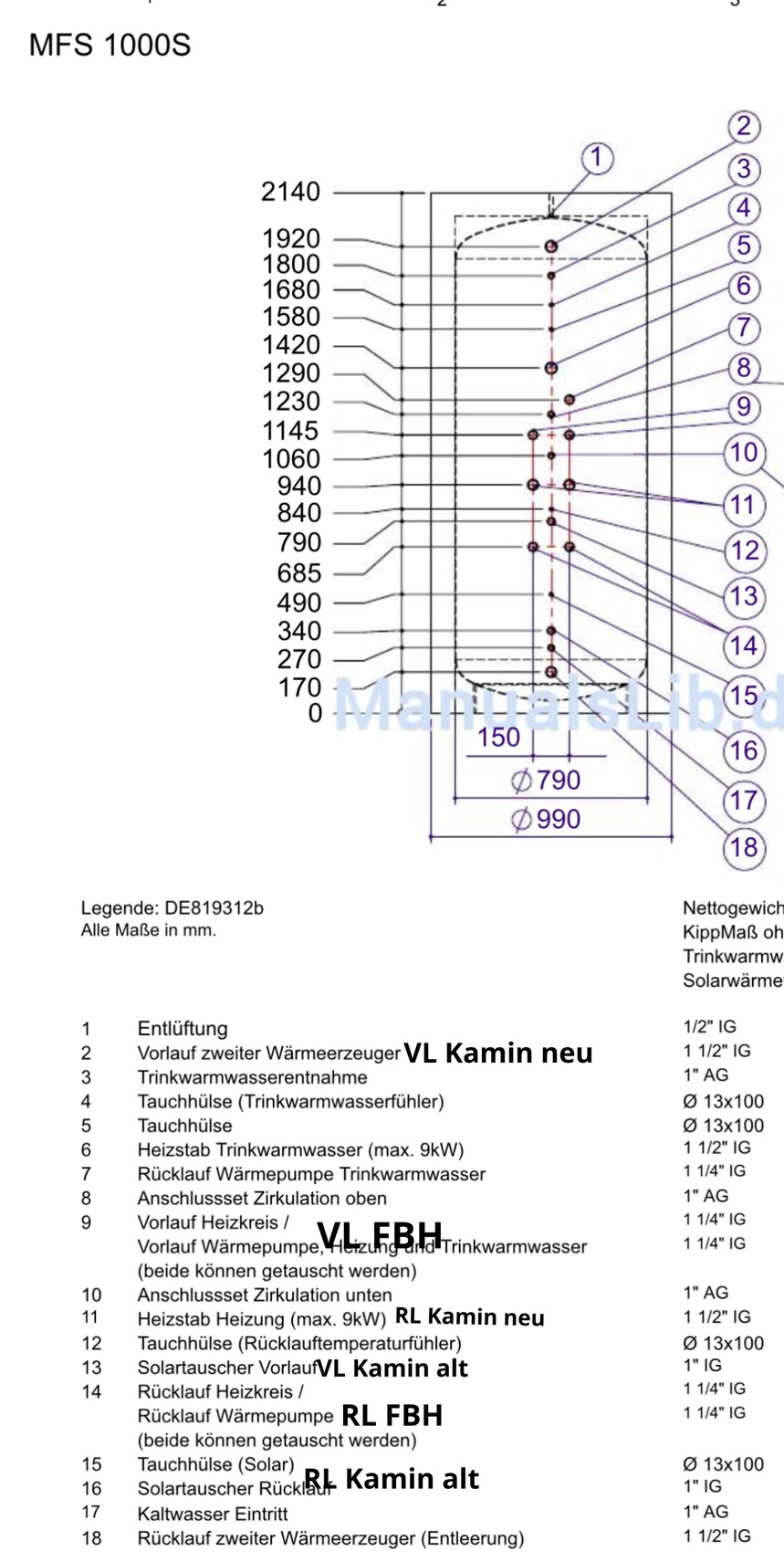
Multifunction storage tank MFS1000S
Water-heated stove with heating capacity on the water side of 8 kW
Photovoltaic system
Electric heating element
I am attaching the schematic of the storage tank layout.
The stove was initially connected under “old” and now it has been modified.
Everything works fine as long as the underfloor heating is off.
When the underfloor heating is on, our hot water temperature doesn’t exceed about 55°C (131°F).
When the underfloor heating is off, the temperature ranges between 65–75°C (149–167°F), either via the electric heating element during sunshine or by stoking the stove.
Now, however, this energy seems to be wasted. It can’t be that the underfloor heating requires 70°C (158°F) supply temperature to achieve a flow temperature of 35°C (95°F), right? The return water is only slightly cooler. So the water should only need to be heated by a maximum of 5°C (9°F).
We assume either a) something is still connected incorrectly, or b) the cold water from the underfloor heating causes such circulation that the hot water cools down within minutes.
What can be done about this?
Has anyone experienced similar problems?
Normally, we should almost run without electric power, but currently the heat pump switches on almost every hour to heat hot water…
I hope someone here can help us because our heating engineer doesn’t seem to be able to…
Key data
New build 2022 with 250 m² (2,691 ft²)
Heat pump Viessmann Vitocal 200-A
Multifunction storage tank MFS1000S
Water-heated stove with heating capacity on the water side of 8 kW
Photovoltaic system
Electric heating element
I am attaching the schematic of the storage tank layout.
The stove was initially connected under “old” and now it has been modified.
Everything works fine as long as the underfloor heating is off.
When the underfloor heating is on, our hot water temperature doesn’t exceed about 55°C (131°F).
When the underfloor heating is off, the temperature ranges between 65–75°C (149–167°F), either via the electric heating element during sunshine or by stoking the stove.
Now, however, this energy seems to be wasted. It can’t be that the underfloor heating requires 70°C (158°F) supply temperature to achieve a flow temperature of 35°C (95°F), right? The return water is only slightly cooler. So the water should only need to be heated by a maximum of 5°C (9°F).
We assume either a) something is still connected incorrectly, or b) the cold water from the underfloor heating causes such circulation that the hot water cools down within minutes.
What can be done about this?
Has anyone experienced similar problems?
Normally, we should almost run without electric power, but currently the heat pump switches on almost every hour to heat hot water…
J
Jessica38821 Oct 2023 09:24RotorMotor schrieb:
You hadn’t mentioned temperatures or anything else before, so everything looked as expected.
You probably mean 65 kWh?
That would be way too much per day, especially considering the high temperatures we’re still having.
I just assume your electric backup heater is active.
And probably too many room thermostats are closed, which leads to an overall supply temperature that is too high, which isn’t good for the heat pump.
So the usual: turn off the backup heater or lower the balance point significantly, hydraulic and thermal balancing, open ERR, etc.
Also, you might want to check what’s actually going on with your house.
A new build using 10 m³ (353 cubic feet) of wood seems to me not to be very airtight anyway. ;-)
How do you ventilate? Do you sleep with open windows, etc.? Sorry, of course I meant kWh.
The electric backup heater is off.
I just checked, the room thermostats in the bathroom and living room are set between 4 and 5, in all other rooms they are set to 1. Is that what you mean?
I’m not familiar with the other terms.
Do you know about this and can you help us?
Well, the wood consumption is because we wanted to save electricity and I generally like it warm. The electricity saving didn’t work out, but I usually had a comfortable 28°C (82°F) in the living room ;-)

Jessica388 schrieb:
Now the underfloor heating is on, and our hot water doesn’t exceed about 55 degrees Celsius (131°F). That can be adjusted in the settings. However, I would leave it as is, since every degree higher means more money out of your pocket. The heating system will then try to keep the water at the set temperature at all times, even when the stove is off and there is no sunlight.
Jessica388 schrieb:
When the underfloor heating is off, we have between 65-75 degrees Celsius (149-167°F), either due to the heating element when the sun is shining or by stoking the stove. That is also fine, as the surplus energy needs to go somewhere anyway.
Jessica388 schrieb:
But now it seems like this energy is just dissipating. It can’t be that the underfloor heating needs 70 degrees Celsius (158°F) for its supply temperature of 35 degrees Celsius (95°F)? The return water is only slightly cooler, so it must be heated by no more than 5 degrees Celsius (9°F). If the underfloor heating is set to a supply temperature of 35 degrees Celsius (95°F), then it will get that temperature. This initially has nothing to do with your domestic hot water production.
Jessica388 schrieb:
In the bathroom and living room, the room thermostats are set between 4 and 5, and in all other rooms at 1. Is that what you mean? That could be a problem.
J
Jessica38821 Oct 2023 09:43Mycraft schrieb:
This can be adjusted in the settings. However, I would leave it as is, because every degree higher means more money out of your pocket. The heating system will try to maintain the water temperature at the set level at all times, even when the furnace is off and there is no sunlight.
This is also fine since the excess energy needs to go somewhere.
If the underfloor heating is set to a flow temperature of 35°C (95°F), it will get that temperature. This initially has nothing to do with your domestic hot water supply.
That could be a problem.Can the flow temperature of the underfloor heating be increased? Because, as mentioned, our theory is that the return flow with the cold water creates some turbulence, which causes the hot water to cool down so quickly. Could that be the case?Why could this be a problem with the valves? Since we wanted the bathroom the warmest, we were told to set it to 6 in the bathroom, and then the heating temperature was adjusted accordingly. For the other rooms, we were told to turn the valves down. That was the heating engineer’s instruction. And I don’t need heating in the bedrooms. Also, since there is no off position on the valves – 1.
R
RotorMotor21 Oct 2023 09:46Jessica388 schrieb:
Yes, sorry, of course kWh.
The electric heating element is off. That doesn’t quite add up.
Which exact Vitocal model do you have? There are versions A04 to A10.
Even the largest model should use a maximum of 2.77 kW under normal conditions at A-7/35.
Without the heating element, such consumption levels can only occur if the unit is running at full power continuously, and then you would have 30 degrees Celsius (86°F) throughout the entire house.
Jessica388 schrieb:
I just checked – the room thermostats in the bathroom and living room are set between 4 and 5, while all other rooms are at 1. Is that what you mean? That’s a problem. You’re basically trying to heat the entire house through the bathroom thermostat.
That makes the heat pump like an engine running at full throttle while you’re pulling the handbrake on three out of four wheels and wonder why you’re not moving forward.
You need to remember that the house is insulated only on the outside, not between the rooms.
Jessica388 schrieb:
Are you familiar with this and can help us? Yes, but you’ll either have to deal with it yourself or bring in an expert to set the basic parameters, such as adjusting the electric heating element, heating curve, hydraulic balancing, and so on.
B
Buchsbaum21 Oct 2023 09:49There are recurring issues with heat pumps since this is a very complex subject.
In your case, I see a completely wrong heating concept or rather the wrong components. However, you should consult a specialist. Not every heating technician has the necessary expertise for this.
Nevertheless, I see a problem with your buffer tank because the hot water is generated using an electric instantaneous water heater. Additionally, the hot water tank only stores 56 liters (15 gallons). Given this, I am not surprised by the high electricity consumption.
How many people live in the house? How much hot water is consumed daily?
And 250 sqm (2,700 sq ft) of living space needs to be heated first, even with good insulation.
In your case, I see a completely wrong heating concept or rather the wrong components. However, you should consult a specialist. Not every heating technician has the necessary expertise for this.
Nevertheless, I see a problem with your buffer tank because the hot water is generated using an electric instantaneous water heater. Additionally, the hot water tank only stores 56 liters (15 gallons). Given this, I am not surprised by the high electricity consumption.
How many people live in the house? How much hot water is consumed daily?
And 250 sqm (2,700 sq ft) of living space needs to be heated first, even with good insulation.
J
Jessica38821 Oct 2023 09:52RotorMotor schrieb:
This doesn’t really add up.
Which exact Vitocal model do you have? They range from A04 to A10.
Even the larger model should only require about A-7/35 max 2.77 kW under normal conditions.
Without the electric heater, you can only reach such high temperatures if the unit runs at the highest setting continuously, and then you’d have 30 degrees Celsius (86°F) throughout the entire house.
That’s the problem. You’re trying to heat your entire house only through the bathroom.
This is like running an engine at full throttle while engaging the handbrake on three out of four wheels—you wonder why you’re not moving forward.
Keep in mind that the house is insulated only on the outside, not between rooms.
Yes, but you will either have to deal with this yourself or bring in a professional who can set the basic parameters, such as electric heater settings, heating curve, hydraulic balancing, and so on. Here’s a picture.
I would like to have the professional come because we neither have the time nor the desire to waste any more energy on this. But nobody is coming. I’ve contacted all heating companies in the area, and no one will come because we still have a warranty. Even though we said we would pay for it.
Similar topics