
Hello everyone,
some background on my questions:
I am currently exploring the possibility of converting our house from a gas heating system to a heat pump. It might sound completely crazy for a house that is just under 7 years old, but this could be funded and financed as an “energy renovation project” together with a photovoltaic system through KFW 261. That could actually make it economically very attractive.
I am still in the evaluation phase and have started initial discussions with heating and solar experts.
This immediately raised some questions for me, because the first offers are quite contradictory to the principles I often see discussed here in the forum:
The insulation level of the house is about KFW 55 standard; however, the overall standard was not met back then due to the gas heating system. The heating demand is around 12,000-13,000 kWh for a total of 270 square meters (2,900 square feet). There is underfloor heating throughout, including the basement.
Best regards,
Andreas
some background on my questions:
I am currently exploring the possibility of converting our house from a gas heating system to a heat pump. It might sound completely crazy for a house that is just under 7 years old, but this could be funded and financed as an “energy renovation project” together with a photovoltaic system through KFW 261. That could actually make it economically very attractive.
I am still in the evaluation phase and have started initial discussions with heating and solar experts.
This immediately raised some questions for me, because the first offers are quite contradictory to the principles I often see discussed here in the forum:
- Buffer tank (heating water) – Question: What exactly is the purpose of this and when does it make sense? So far, no seller has been able to clearly answer this, although the technical answer is simple: it should act as a hysteresis to reduce short cycling of the heat pump. The general idea is understandable, but I don’t really see how 100 liters (35 gallons) of buffer tank help when just the volume of my underfloor heating system already exceeds 200 liters (70 gallons), plus the large mass of screed acting as thermal storage. The current gas heating system works fine without a heating buffer tank.
- Heat pump capacity and modulation – the first quotes naturally come with absurdly oversized heat pumps because they only consider the total heated area of 270 square meters (2,900 square feet). When I point out that 12 or even 16 kW seems excessive, the answer is always: “It can modulate down from 3 to 12 kW.” That’s fine, but exactly this modulation is often warned against. So question: why is modulating down performance considered a problem? Is this the short cycling that people warn about? Technically, modulation means the entire system, including the compressor and all components, runs slower. But then the question arises how efficient it still is.
The insulation level of the house is about KFW 55 standard; however, the overall standard was not met back then due to the gas heating system. The heating demand is around 12,000-13,000 kWh for a total of 270 square meters (2,900 square feet). There is underfloor heating throughout, including the basement.
Best regards,
Andreas

We also have thermostatic radiator valves (TRVs) in the new build, simply to have the option to regulate the temperature. In most rooms, we have the valves fully open, and the flow rate settings control the rest. This was done by the professional company. However, in some rooms, such as the office, we have turned the heating off completely. The heat generated by the ventilation system (controlled mechanical ventilation) and the waste heat from the computers is enough to warm the room. Often, this even makes the room several degrees too warm.
The storage room is also turned off, as my potatoes don’t need a warm space. However, the room is so small and the door is opened so frequently that you don’t notice much difference.
Since in winter it’s possible that we may need to heat the office or storage room occasionally, we have the TRVs installed. I don’t want to adjust the heating circuit (HKV) myself if our heating habits change, as the professional company performed the hydraulic balancing.
In the bathroom, we have electric towel warmers that can be used to add extra heat if you want the room a bit warmer. I like to switch them on when I want a cozy towel, but often it gets too warm for me if they run just during a bath.
The storage room is also turned off, as my potatoes don’t need a warm space. However, the room is so small and the door is opened so frequently that you don’t notice much difference.
Since in winter it’s possible that we may need to heat the office or storage room occasionally, we have the TRVs installed. I don’t want to adjust the heating circuit (HKV) myself if our heating habits change, as the professional company performed the hydraulic balancing.
In the bathroom, we have electric towel warmers that can be used to add extra heat if you want the room a bit warmer. I like to switch them on when I want a cozy towel, but often it gets too warm for me if they run just during a bath.

Hello,
At some point, I increased the circulation pump speed for the heating system. After that, the temperature difference dropped significantly, and since then the bathroom has been properly warm. I don’t remember the exact delta T offhand. I’ll have to keep an eye on it soon. Looking at the weather forecast, we’ll probably turn on the heating during next week.
I also noticed the discrepancy between consumption and heating load. I don’t know which outdoor temperature the plumber originally assumed. It might have been -20°C (-4°F), and the conversion based on "full load hours" could be using a different value. Or maybe our south-facing windows make that much difference. We manage without heating when it’s down to -5°C (23°F) at night and around +5°C (41°F) with sunshine during the day.
A quick question about heating load and heat pump sizing:
The heating load is usually calculated for -10°C (14°F). The heat pump’s capacity is mostly stated at +7°C (45°F), for example 9 kW. But at -7°C (19°F), it drops to about 7 kW (Panasonic Aquarea). So doesn’t that mean the heat pump is technically undersized? I find it hard to compare these performance figures because they sometimes apparently include electric backup heaters in their ratings. Otherwise, I can’t explain why, for example, the Viessmann Vitocell 250 delivers higher heating capacity at -7°C (19°F) than at +7°C (45°F)—8.1 kW at +7°C and 11.1 kW at -7°C.
I’ve already told the energy consultant that his price is way too high. Now it seems he’s offended. Thanks for the information that 8,000 € is the KfW maximum amount.
Officially, it is a consultancy firm that includes a heating specialist. Probably the heating specialist was the original operator and later added energy consulting. However, this is the same person who asked for almost 43,000 € for a heat pump installation. Crazy!
Best regards,
Andreas
dertill schrieb:
If you reduce the temperature difference (delta T) with the heat pump from 37/29 to 35/31, there is still enough flow for the heat pump to deliver the same heat output, and the heat pump will work more efficiently.
Regarding the heating load: It looks like the calculation was done correctly. I can't say if the values are accurate, but they should be. Why your energy consumption is lower than expected based on the heating load can’t be determined from a distance and with the documents provided.
With additional insulation on the top, the heating load shouldn’t exceed 9 kW. Even in the current condition, a 9 kW heat pump would be sufficient.
Many 9 kW models can modulate down to the same or nearly the same level as 5-7 kW units. It’s basically the same technology with different power electronics.
About the energy consultant: 8,000 € is the KfW maximum limit. It makes sense for certain projects with full renovations aiming for a KfW Efficiency House standard. You are right that this is completely over the top in your case.
And why is the energy consultant selling/installing heat pumps??
At some point, I increased the circulation pump speed for the heating system. After that, the temperature difference dropped significantly, and since then the bathroom has been properly warm. I don’t remember the exact delta T offhand. I’ll have to keep an eye on it soon. Looking at the weather forecast, we’ll probably turn on the heating during next week.
I also noticed the discrepancy between consumption and heating load. I don’t know which outdoor temperature the plumber originally assumed. It might have been -20°C (-4°F), and the conversion based on "full load hours" could be using a different value. Or maybe our south-facing windows make that much difference. We manage without heating when it’s down to -5°C (23°F) at night and around +5°C (41°F) with sunshine during the day.
A quick question about heating load and heat pump sizing:
The heating load is usually calculated for -10°C (14°F). The heat pump’s capacity is mostly stated at +7°C (45°F), for example 9 kW. But at -7°C (19°F), it drops to about 7 kW (Panasonic Aquarea). So doesn’t that mean the heat pump is technically undersized? I find it hard to compare these performance figures because they sometimes apparently include electric backup heaters in their ratings. Otherwise, I can’t explain why, for example, the Viessmann Vitocell 250 delivers higher heating capacity at -7°C (19°F) than at +7°C (45°F)—8.1 kW at +7°C and 11.1 kW at -7°C.
I’ve already told the energy consultant that his price is way too high. Now it seems he’s offended. Thanks for the information that 8,000 € is the KfW maximum amount.
Officially, it is a consultancy firm that includes a heating specialist. Probably the heating specialist was the original operator and later added energy consulting. However, this is the same person who asked for almost 43,000 € for a heat pump installation. Crazy!
Best regards,
Andreas
Yes, the Panasonic Aquarea LT 9 kW only delivers about 7.5 kW plus the backup heater in practice. Alternatively, there is the 9 kW TCAP model (I believe not yet available as Generation L, only J). However, it cycles on and off more frequently because its minimum output is twice as high.
I would recommend double-checking the heat load calculation, especially whether the design temperature matches the climate / NAT for your location. Based on your descriptions, I would suggest going with the 9 kW LT model (or a similar one from another manufacturer with comparable performance). This is without guarantee, since I cannot assess the situation remotely.
I would advise against using advisors who are attached to an installation company. That might work for individual measures or a standalone heating system replacement, but considering the costs involved, it’s not recommended.
I would recommend double-checking the heat load calculation, especially whether the design temperature matches the climate / NAT for your location. Based on your descriptions, I would suggest going with the 9 kW LT model (or a similar one from another manufacturer with comparable performance). This is without guarantee, since I cannot assess the situation remotely.
I would advise against using advisors who are attached to an installation company. That might work for individual measures or a standalone heating system replacement, but considering the costs involved, it’s not recommended.

andimann schrieb:
The heat pump’s capacity is usually specified at around +7°C (45°F), for example 9 kW. But at -7°C (19°F), it’s only about 7 kW (Panasonic Aquarea). Important: you need the heating capacity at below-zero temperatures, not at +7°C (45°F). Manufacturers should actually be required to present the heating capacity curve as a priority. No one benefits from the top efficiency and performance values stated at A7/W35.
OWLer schrieb:
Important. You need the heating capacity for subzero temperatures, not +7°C (45°F). Manufacturers should actually be required to show the heating performance curve prominently. No one benefits from the top efficiency and performance values at A7/W35. I’m not sure if A7/W35 is that irrelevant. In Germany, much of the winter is actually close to A7, and days below that temperature are more the exception than the rule. With climate change and delayed action, these conditions will likely become more important in the future—excluding extreme weather events.
To illustrate what I mean, using February 2022 as an example:
The average temperature was 4.22°C (39.6°F), yet in the warmer areas there were 24 out of 28 days with temperatures around or above 7°C (45°F).
kati1337 schrieb:
I’m not sure if A7/W35 is really that uninteresting.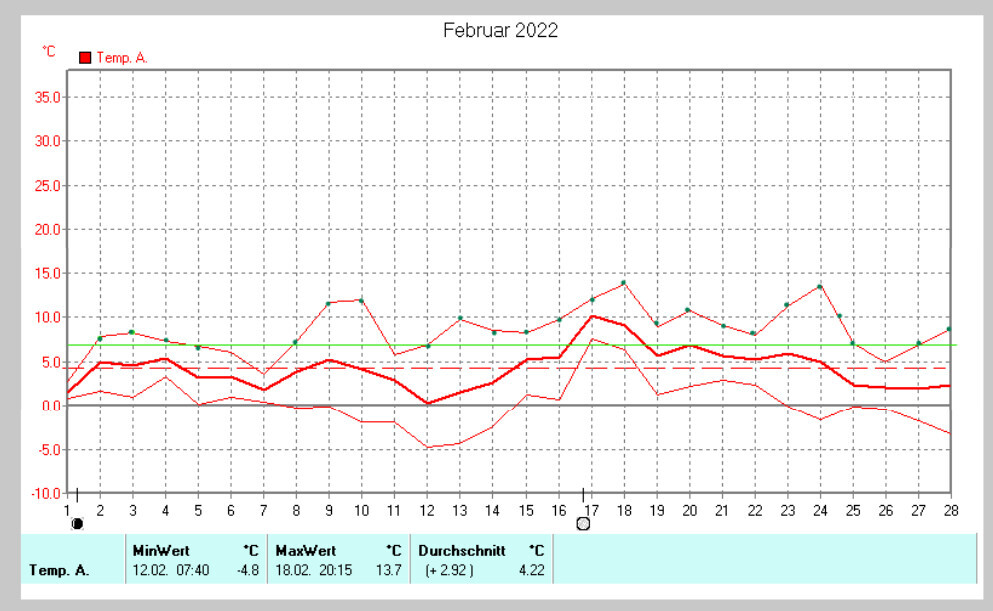
Not at all. But the manufacturers usually specify the maximum output, not the minimum possible output or maximum throttling.
Similar topics