
ᐅ The support bracket for the concrete staircase was cut off. How can this be repaired?
Created on: 14 Oct 2023 18:16
D
domino55
Hello,
my construction company decided to install two prefabricated concrete staircases with a lower angle at once (apparently to only rent a larger crane once).
Staircase 1: Ground floor -> 1st floor and Staircase 2: 1st floor -> upper floor.
The ceiling of the ground floor and the masonry of the 1st floor were already completely finished. The prefabricated elements of the hollow-core slab were placed on the 1st floor.
See House_Section_GroundFloor_and_1stFloor.JPG.
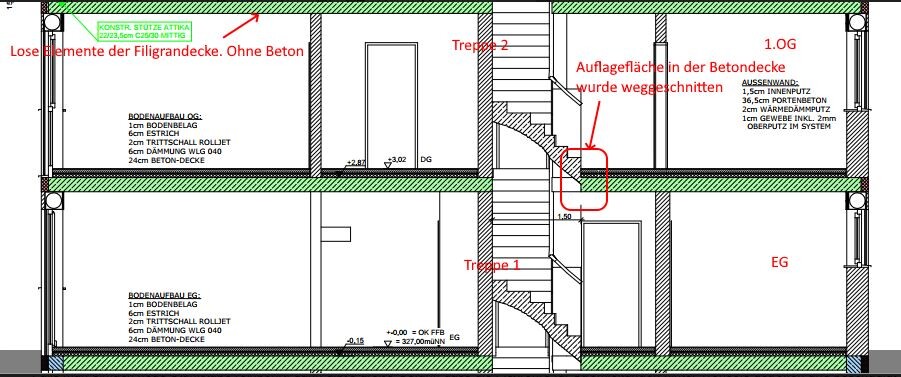
Staircase 1 could not be installed because the staircase bearing point (corbel) in the floor of the 1st floor was in the way. There was not enough space to maneuver (to tilt the staircase in order to rotate the axis). The construction company cut about 12 cm (5 inches) from the support point in the concrete slab and then installed the staircase from ground floor to 1st floor. For the second staircase, this cut corbel is now missing. The lower support on the staircase measures 11 cm (4.3 inches).
What can I demand here?
I have requested that a new concrete staircase be manufactured with a correspondingly wider lower support. The construction company refuses; they want to somehow "repair" the concrete slab and install the staircase on it. Allegedly, the structural engineer of the precast concrete plant where the stairs were manufactured approved this.
So far, I have only received a preliminary hand-drawn sketch from this "structural engineer":

I notice that his sketch shows less reinforcement than was already cut out. If new steel rods are simply drilled in, there is a high risk that the electrical conduit behind the corbel will be hit and damaged.
I would like to know if I am obliged to accept his proposal or if, for example, I can insist on a new staircase.
my construction company decided to install two prefabricated concrete staircases with a lower angle at once (apparently to only rent a larger crane once).
Staircase 1: Ground floor -> 1st floor and Staircase 2: 1st floor -> upper floor.
The ceiling of the ground floor and the masonry of the 1st floor were already completely finished. The prefabricated elements of the hollow-core slab were placed on the 1st floor.
See House_Section_GroundFloor_and_1stFloor.JPG.
Staircase 1 could not be installed because the staircase bearing point (corbel) in the floor of the 1st floor was in the way. There was not enough space to maneuver (to tilt the staircase in order to rotate the axis). The construction company cut about 12 cm (5 inches) from the support point in the concrete slab and then installed the staircase from ground floor to 1st floor. For the second staircase, this cut corbel is now missing. The lower support on the staircase measures 11 cm (4.3 inches).
What can I demand here?
I have requested that a new concrete staircase be manufactured with a correspondingly wider lower support. The construction company refuses; they want to somehow "repair" the concrete slab and install the staircase on it. Allegedly, the structural engineer of the precast concrete plant where the stairs were manufactured approved this.
So far, I have only received a preliminary hand-drawn sketch from this "structural engineer":
I notice that his sketch shows less reinforcement than was already cut out. If new steel rods are simply drilled in, there is a high risk that the electrical conduit behind the corbel will be hit and damaged.
I would like to know if I am obliged to accept his proposal or if, for example, I can insist on a new staircase.
K
k-man202114 Oct 2023 22:14In my opinion, such a rough sketch is worth nothing; it needs a stamp and signature so you can verify whether it was actually signed by a structural engineer. The risk would be too high for me in this case; I would consult an expert.
H
hanghaus202315 Oct 2023 10:52In my opinion, the sketch is exactly what I would plan. It is sufficient for the company. Why is it not for you?
Extending the staircase is nonsense. You would have the same problem. In my opinion, it is better to cast concrete on the rough surface.
Extending the staircase is nonsense. You would have the same problem. In my opinion, it is better to cast concrete on the rough surface.
hanghaus2023 schrieb:
In my opinion, the sketch is exactly what I would plan. It is sufficient for the company. Why isn’t it for you? I am not a professional and I am trying to clarify what is correct/possible. Even if the solution is sufficient, it is not what I ordered.
My thought (the numbers are purely made up by me for explanation): if I order the ceiling and stairs with reinforcement calculated and ordered, for example, with a safety factor of 10, and the construction company then delivers a repair with a safety factor of 5, I consider the order incomplete.
Also, I am sure that several flexible conduits for electrical wiring installed directly behind the corbel will be damaged.
hanghaus2023 schrieb:
Extending the stairs is nonsense. You have the same problem there. In my opinion, it is better to cast concrete onto the rough surface. What problem would I then have? Fortunately, I added reinforcement myself behind the corbel (in addition to the reinforcement plan). The remaining area in the concrete slab is not weaker than the original bearing surface/corbel.
k-man2021 schrieb:
In my opinion, such a scrap piece of paper is worth nothing; it needs a stamp and signature so you can verify whether it was really signed by a structural engineer. The risk would be too high for me at such a point; I would get an expert involved. The construction company says that a “proper” document from the concrete plant will arrive on Monday. I’m trying to find a building surveyor, but it’s very difficult on such short notice. That’s why I’m trying to clarify here whether this kind of repair is common practice or if the construction company is trying to take advantage of me.

domino55 schrieb:
My thought (the numbers are purely hypothetical for explanation): if I order the ceiling and staircase reinforcement, for example, calculated and ordered with a safety factor of 10, and the construction company then delivers a repair with a safety factor of 5, I would consider the order not fully completed. It depends on the contract – it has already been suggested that it might have been something like "build the shell as cheap as possible."
domino55 schrieb:
That’s why I’m trying to find out whether such a repair is common practice or if the construction company is trying to deceive me. Whether cut corners and further botching are common depends on the level of the hired construction company. If your contractor is a labor exploiter, then definitely yes.
https://www.instagram.com/11antgmxde/
https://www.linkedin.com/company/bauen-jetzt/
H
hanghaus202315 Oct 2023 13:32It is clear that the company made a mistake there. Who authorized the removal of the ledge?
If they are incapable of fitting the staircase correctly, they should install the stairs before the ceiling above is poured.
The defect can be fixed, which the company has also offered to do. Requesting a new staircase is an unreasonable demand.
If they are incapable of fitting the staircase correctly, they should install the stairs before the ceiling above is poured.
The defect can be fixed, which the company has also offered to do. Requesting a new staircase is an unreasonable demand.
Similar topics