
Hello everyone,
some background on my questions:
I am currently exploring the possibility of converting our house from a gas heating system to a heat pump. It might sound completely crazy for a house that is just under 7 years old, but this could be funded and financed as an “energy renovation project” together with a photovoltaic system through KFW 261. That could actually make it economically very attractive.
I am still in the evaluation phase and have started initial discussions with heating and solar experts.
This immediately raised some questions for me, because the first offers are quite contradictory to the principles I often see discussed here in the forum:
The insulation level of the house is about KFW 55 standard; however, the overall standard was not met back then due to the gas heating system. The heating demand is around 12,000-13,000 kWh for a total of 270 square meters (2,900 square feet). There is underfloor heating throughout, including the basement.
Best regards,
Andreas
some background on my questions:
I am currently exploring the possibility of converting our house from a gas heating system to a heat pump. It might sound completely crazy for a house that is just under 7 years old, but this could be funded and financed as an “energy renovation project” together with a photovoltaic system through KFW 261. That could actually make it economically very attractive.
I am still in the evaluation phase and have started initial discussions with heating and solar experts.
This immediately raised some questions for me, because the first offers are quite contradictory to the principles I often see discussed here in the forum:
- Buffer tank (heating water) – Question: What exactly is the purpose of this and when does it make sense? So far, no seller has been able to clearly answer this, although the technical answer is simple: it should act as a hysteresis to reduce short cycling of the heat pump. The general idea is understandable, but I don’t really see how 100 liters (35 gallons) of buffer tank help when just the volume of my underfloor heating system already exceeds 200 liters (70 gallons), plus the large mass of screed acting as thermal storage. The current gas heating system works fine without a heating buffer tank.
- Heat pump capacity and modulation – the first quotes naturally come with absurdly oversized heat pumps because they only consider the total heated area of 270 square meters (2,900 square feet). When I point out that 12 or even 16 kW seems excessive, the answer is always: “It can modulate down from 3 to 12 kW.” That’s fine, but exactly this modulation is often warned against. So question: why is modulating down performance considered a problem? Is this the short cycling that people warn about? Technically, modulation means the entire system, including the compressor and all components, runs slower. But then the question arises how efficient it still is.
The insulation level of the house is about KFW 55 standard; however, the overall standard was not met back then due to the gas heating system. The heating demand is around 12,000-13,000 kWh for a total of 270 square meters (2,900 square feet). There is underfloor heating throughout, including the basement.
Best regards,
Andreas

Hello again,
I have now dug deeper into my documents and even found something that can be interpreted as a room-by-room heating load calculation:
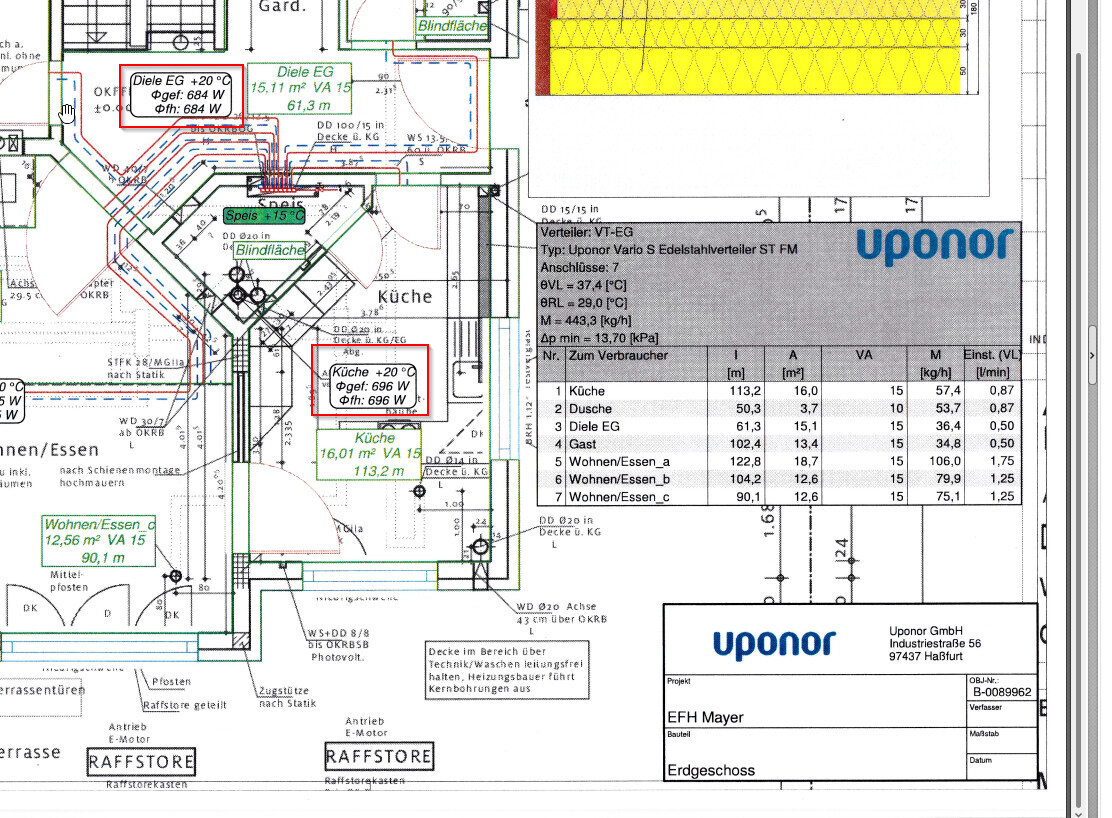
Am I correct in understanding that the 684 W in the hallway or the 696 W in the kitchen represent the heating load for each room? When I add everything up, I get:
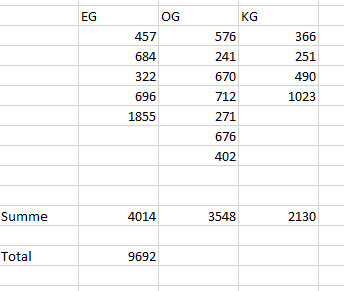
So, a total of 9.7 kW altogether—is that realistic?
Best regards,
Andreas
I have now dug deeper into my documents and even found something that can be interpreted as a room-by-room heating load calculation:
Am I correct in understanding that the 684 W in the hallway or the 696 W in the kitchen represent the heating load for each room? When I add everything up, I get:
So, a total of 9.7 kW altogether—is that realistic?
Best regards,
Andreas

Looks reasonable. Since it is planned with a supply temperature of 37°C (99°F), it naturally requires more heating output. Also, 10/15cm (4/6 inches) insulation thickness is definitely not optimal but not a disaster either.
Do you have the flow rates as well? On the ground floor, it’s 443 l/h (1.95 gallons per minute). That will definitely reach heat pump levels of around 1200 l/h (5.29 gallons per minute) and up. The goal is actually a low temperature difference, which you’ve specified as 8.4°C (15°F)? That’s quite challenging for a heat pump.
You can recalculate this and also check if it’s designed for the correct natural gas flow rate. Especially if the insulation is going to be increased anyway. It doesn’t cost much at an engineering office.
I’m not involved with the subsidy programs anymore. Is this all urgent? Otherwise, you could try to increase the flow rate over the winter to minimize the temperature difference and then see how far you can lower the heating curve.
Do you have the flow rates as well? On the ground floor, it’s 443 l/h (1.95 gallons per minute). That will definitely reach heat pump levels of around 1200 l/h (5.29 gallons per minute) and up. The goal is actually a low temperature difference, which you’ve specified as 8.4°C (15°F)? That’s quite challenging for a heat pump.
You can recalculate this and also check if it’s designed for the correct natural gas flow rate. Especially if the insulation is going to be increased anyway. It doesn’t cost much at an engineering office.
I’m not involved with the subsidy programs anymore. Is this all urgent? Otherwise, you could try to increase the flow rate over the winter to minimize the temperature difference and then see how far you can lower the heating curve.
S
stjoob_at10 Oct 2023 14:53After living in the house for several years and knowing your actual gas consumption, I would always prefer that over a calculated estimate when sizing the heat pump. So, 6-7 kW is sufficient. If you are diligent, ask the manufacturer for the performance curves/diagrams of the heat pump. This way, you can choose the air-to-water heat pump optimally. It is important that it can modulate down as much as possible.
A heating buffer tank and an electronic reset regulator (ERR) should have no place in a new build with underfloor heating and only lead to higher investment and operating costs. The only case where a buffer tank might be acceptable for you is a small, serial buffer in the return line for the defrosting process.
A heating buffer tank and an electronic reset regulator (ERR) should have no place in a new build with underfloor heating and only lead to higher investment and operating costs. The only case where a buffer tank might be acceptable for you is a small, serial buffer in the return line for the defrosting process.
I still don’t quite understand why one should completely do without ERR. For example, I don’t always want to heat my bedroom. The same applies to the office on days when I work from home. The bathrooms, on the other hand, might need a bit more heating than the other rooms. What is the advantage of completely foregoing ERR?
K
KarstenausNRW11 Oct 2023 08:13Karlsson schrieb:
I still don’t fully understand why one should completely avoid ERR. For example, I don’t want to always heat my bedroom. The same goes for the office on days when I work from home. The bathrooms might need a bit more heating than other rooms. What is the advantage of giving up ERR entirely? The advantage is that you set the heating correctly from the start and avoid unnecessary components. The temperature is controlled directly via the flow rate or properly adjusted (and considered in the design of the underfloor heating system during new construction).
When temperatures are correctly set (hydraulic and thermal balancing), you won’t need ERR anymore because everything is working well. By the way, not heating the home office on certain days is energy-wise illogical and especially not practical with underfloor heating. In a new or well-insulated house, it’s hardly feasible anyway.
As a visual analogy using a car: The heat pump is the engine, and the ERR are the brakes. So you drive full throttle and keep your foot on the accelerator. At the same time, you notice you are going too fast. But instead of easing off the gas, you also hit the brakes.
Karlsson schrieb:
I still don’t quite understand why one should completely do without ERR. For example, I don’t want to heat my bedroom all the time. The same goes for the office on the days I work from home. The bathrooms might need a bit more heating than the other rooms. What is the advantage of giving up ERR altogether?There is a mantra about completely avoiding ERR. But it’s not a rule.
You already have ERR anyway, so the cost-saving aspect when purchasing doesn’t apply.
I would always recommend ERR for bedrooms and other secondary rooms that you sometimes prefer cooler.
The setting of the base temperature (21°C (70°F) in living areas, 22-24°C (72-75°F) in the bathroom) should ideally not be managed by the ERR, but rather by having the heating system automatically heat the room only to the desired temperature. This works well only with low flow temperatures around 30°C (86°F). At 37°C (99°F) or above, it gets difficult because without throttling via the ERR, the heating will continue to release heat into the room, even if, for example, the room temperature is already above the set point due to solar gain.
No worries: A heat pump also works fine with ERR and buffer tanks, and even with 37°C (99°F) flow temperature (at -10°C (14°F) outside). However, in your case, I would skip the buffer tank.
If you reduce the temperature spread of the heat pump from 37/29°C (99/84°F) to 35/31°C (95/88°F), there will be sufficient flow for the heat pump at the same heat output, which is better for the system.
Regarding the heating load: It looks like the calculation was done correctly. I can’t say if the values are accurate, but they probably are. Why your consumption is lower than what matches the heating load cannot be determined remotely with the documents provided.
With additional insulation on the upper floor, the heating load will not exceed 9 kW. Even in the current state, a 9 kW heat pump would be sufficient.
Many 9 kW models are able to modulate down to the same or nearly the same levels as 5-7 kW units. They use the same technology with different power electronics.
About the energy consultant: 8 kW is the maximum value for KfW support. That makes sense for appropriate projects involving complete renovation to KfW Efficiency House standards. You are right in thinking that this is way over the top in your case.
And why is the energy consultant selling/installing heat pumps??
Similar topics