
ᐅ Balanced Mechanical Ventilation Vallox ValloPlus 350MV – Experiences, User Guide?
Created on: 8 Oct 2023 08:12
K
kati1337
Good morning forum community,
Since our plumber stood us up again last Friday regarding the introduction to the equipment, I’m reaching out to you all.
Does anyone have the ventilation unit mentioned above and could help us with some settings?
We have a relatively high electricity consumption at night and have partly traced it back to the ventilation system. We are now trying to optimize it but have not yet received proper instruction on the device.
First, I searched online for a manual and found one, but the information there is very basic. It basically only explains how to use arrow keys within menus, but not what the settings mean. Especially the “special settings” menu is hardly explained at all.
Does anyone know if there is a better or professional manual for this device and, if so, where I can find it?
Furthermore, I am unsure which settings we should apply. The house is still new, and we currently have very high humidity. I want to reduce it. In our old house, I used to run a dehumidifier in the living areas for some time. This time, I wanted to try if it would work with just the ventilation system. However, within the first month, I barely managed to reduce the humidity. Maybe I have the wrong settings.
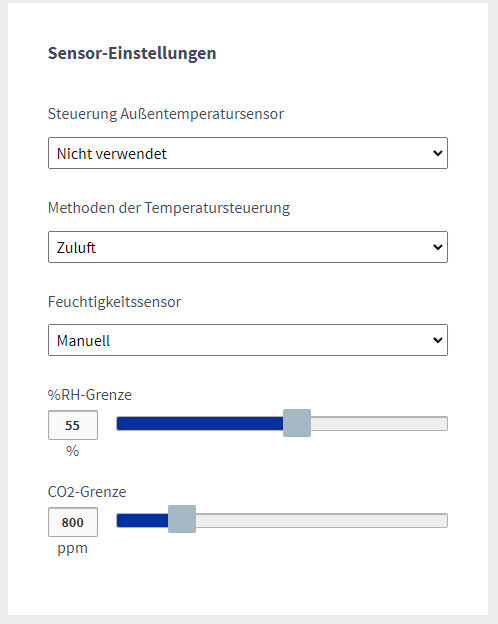
For the sensor settings, I lowered the relative humidity (%RH) limit to 55% and set the sensor to “manual.” Only when set to “manual” can I adjust the threshold. If I set it to 55% and then switch it back to “automatic” above, the RH limit resets to a much higher value.
So I assume manual is correct? But I would still like the ventilation to automatically reduce humidity during operation if the measured value exceeds the threshold.
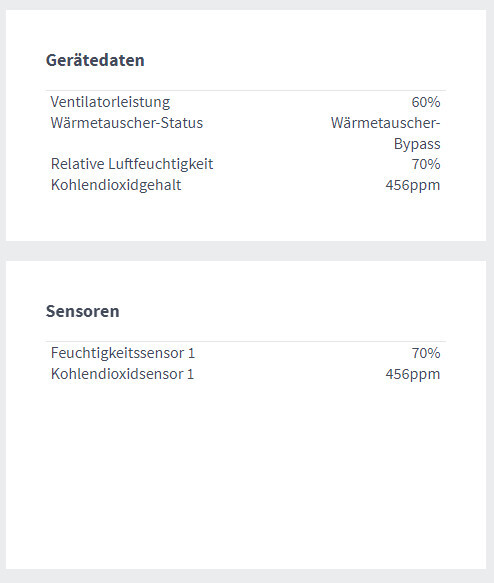
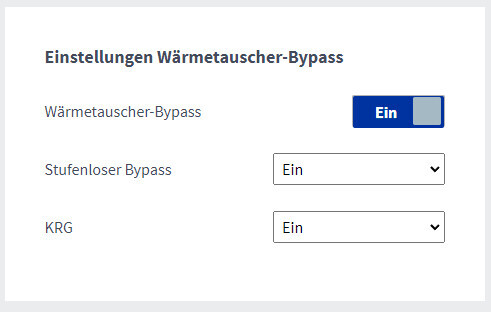
Currently, the humidity is at 70%, which is much too high for me. Also, in the device data, you can see the heat exchanger is set to the heat exchanger bypass. I assume that’s not useful since we are heating now. Should I therefore switch the bypass slider to “off” in the “special settings” menu until next summer?
There are also these “heating settings”:
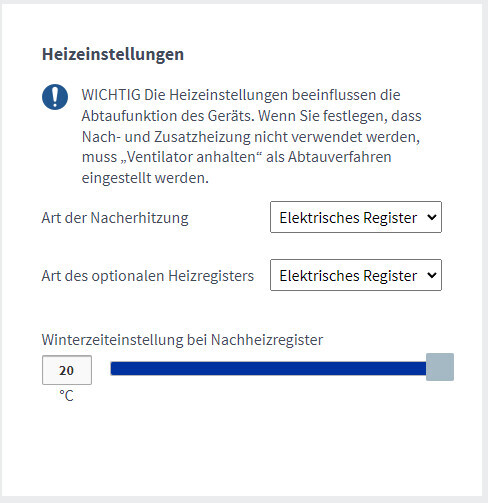
They are set to the values configured after commissioning. Is this reasonable? I have no idea what these are for. Our previous ventilation system was part of a combined unit with an air-to-water heat pump, so I don’t think it had anything like this.
And lastly, these profiles you can switch between:
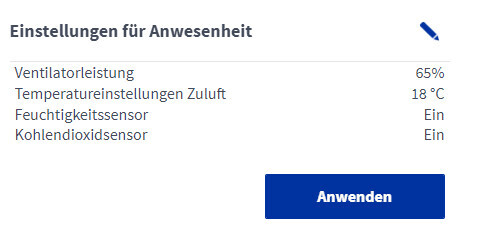
All profiles have the supply air temperature set to 18°C (64°F). I read somewhere that it might make energetic sense to heat the rest via underfloor heating. However, I don’t want to lower it any further because I don’t want to risk a draft overnight if cold air blows into the room over the bed.
The basic fan settings are currently 50% for both exhaust and supply air – I neither know if that makes sense nor if these settings are applied anywhere. Because in the “present” profile, it is set to 65%. Which value is active then, or when is the basic setting ever used?
I would be very grateful for your advice on optimizing this.
Since our plumber stood us up again last Friday regarding the introduction to the equipment, I’m reaching out to you all.
Does anyone have the ventilation unit mentioned above and could help us with some settings?
We have a relatively high electricity consumption at night and have partly traced it back to the ventilation system. We are now trying to optimize it but have not yet received proper instruction on the device.
First, I searched online for a manual and found one, but the information there is very basic. It basically only explains how to use arrow keys within menus, but not what the settings mean. Especially the “special settings” menu is hardly explained at all.
Does anyone know if there is a better or professional manual for this device and, if so, where I can find it?
Furthermore, I am unsure which settings we should apply. The house is still new, and we currently have very high humidity. I want to reduce it. In our old house, I used to run a dehumidifier in the living areas for some time. This time, I wanted to try if it would work with just the ventilation system. However, within the first month, I barely managed to reduce the humidity. Maybe I have the wrong settings.
For the sensor settings, I lowered the relative humidity (%RH) limit to 55% and set the sensor to “manual.” Only when set to “manual” can I adjust the threshold. If I set it to 55% and then switch it back to “automatic” above, the RH limit resets to a much higher value.
So I assume manual is correct? But I would still like the ventilation to automatically reduce humidity during operation if the measured value exceeds the threshold.
Currently, the humidity is at 70%, which is much too high for me. Also, in the device data, you can see the heat exchanger is set to the heat exchanger bypass. I assume that’s not useful since we are heating now. Should I therefore switch the bypass slider to “off” in the “special settings” menu until next summer?
There are also these “heating settings”:
They are set to the values configured after commissioning. Is this reasonable? I have no idea what these are for. Our previous ventilation system was part of a combined unit with an air-to-water heat pump, so I don’t think it had anything like this.
And lastly, these profiles you can switch between:
All profiles have the supply air temperature set to 18°C (64°F). I read somewhere that it might make energetic sense to heat the rest via underfloor heating. However, I don’t want to lower it any further because I don’t want to risk a draft overnight if cold air blows into the room over the bed.
The basic fan settings are currently 50% for both exhaust and supply air – I neither know if that makes sense nor if these settings are applied anywhere. Because in the “present” profile, it is set to 65%. Which value is active then, or when is the basic setting ever used?
I would be very grateful for your advice on optimizing this.

Ramona13 schrieb:
You have installed split air conditioning units, doesn’t it make sense to use them specifically for dehumidifying? 🙂 That’s a good point. We also received the manuals for those yesterday. Let’s see if they can dehumidify specifically without cooling. I think they probably can.

But shouldn’t (or must?) such a system be balanced?
The mechanical ventilation with heat recovery is designed and installed based on calculations (number of exhaust and supply air vents per room with specified target airflows). Then the vents are preset "by feel." Afterwards, the system should be balanced using an anemometer (this usually takes two rounds because of the iterative process — adjusting one vent changes the airflow in the others).
P.S. Our plumber didn’t balance the system either due to staff shortages but lent us the anemometer ;-)
I’m a layperson, so this is how I understood the explanations from our plumber...
P.P.S. I still don’t understand the cryptic labeling of the strange buttons on our mechanical ventilation unit (Maico), but it is much easier to configure via a web interface. Isn’t there a similar interface for your system? (-> try downloading "Advanced IP Scanner" for example from "heise," scan the network, and try to access the mechanical ventilation unit using default login credentials found online...)
The mechanical ventilation with heat recovery is designed and installed based on calculations (number of exhaust and supply air vents per room with specified target airflows). Then the vents are preset "by feel." Afterwards, the system should be balanced using an anemometer (this usually takes two rounds because of the iterative process — adjusting one vent changes the airflow in the others).
P.S. Our plumber didn’t balance the system either due to staff shortages but lent us the anemometer ;-)
I’m a layperson, so this is how I understood the explanations from our plumber...
P.P.S. I still don’t understand the cryptic labeling of the strange buttons on our mechanical ventilation unit (Maico), but it is much easier to configure via a web interface. Isn’t there a similar interface for your system? (-> try downloading "Advanced IP Scanner" for example from "heise," scan the network, and try to access the mechanical ventilation unit using default login credentials found online...)

i_b_n_a_n schrieb:
But still, shouldn’t (or must) such a system be balanced?
Mechanical ventilation with heat recovery is designed and installed based on calculations (number of exhaust and supply air vents per room with specified target air volumes). Then the vents are roughly pre-set. Afterwards, the system should be balanced using an anemometer (usually takes two rounds due to iterative process — adjusting one vent changes the airflow in others...). This is how an engineer would expect it to be done, for example. However, I have never seen this with general contractors/developers/builders. I suspect that someone only borrows an anemometer to check if the customer persistently complains about noise or drafts. Even then, I’d guess that in more than 50% of cases they simply reduce the airflow rate.
@kati1337 Do you mean the preheater coil? Does your mechanical ventilation system simply shut off when it freezes? Last winter, our preheater coil caused about 30 kWh of extra electricity consumption during frost periods. I found that quite acceptable.
I would also recommend reviewing the enthalpy heat exchanger. It allows you to keep the system running automatically during winter without causing dehydration — at least if you close the windows after showering and hang laundry indoors.
In the past, we always ran on automatic boost mode—even in winter. I start to worry about "too low humidity" when it drops below 50, but currently I don’t get below 65.
I’m not sure about the preheating coil—on our system, the settings say heating coil / reheating. However, the plumber said we don’t have one.
According to him, they have adjusted and calibrated the valves. This, like many things, happened while we were away, but unless he lied to my face (which I don’t believe), they did that.
By now, we also have a web interface for the ventilation system, which is indeed easier to use than the menu in the basement. However, it offers the same settings options.
I’m not sure about the preheating coil—on our system, the settings say heating coil / reheating. However, the plumber said we don’t have one.
According to him, they have adjusted and calibrated the valves. This, like many things, happened while we were away, but unless he lied to my face (which I don’t believe), they did that.
By now, we also have a web interface for the ventilation system, which is indeed easier to use than the menu in the basement. However, it offers the same settings options.
Similar topics