
ᐅ Unique floor plan or just a standard layout with a basement?
Created on: 8 Oct 2023 22:40
F
FamilieForestF
FamilieForest8 Oct 2023 22:40Hello dear floor plan experts,
I’ll get straight to the point and start with the questionnaire:
Development Plan / Restrictions
Plot size – approx. 1000m² (to be subdivided)
Slope – approx. 60cm (2 ft) height difference over 10m (approximate building area)
Location – Bavaria (Franconia)
Some details are unknown because there is no development plan (e.g., floor area ratio, plot ratio, building area, building line and boundary, edge development, etc.)
Roof style / design / orientation according to surroundings – but really almost everything is present in the neighborhood.
Client Requirements
Style, roof design, building type – Single-family house – preferably hip roof / clipped hip roof, possibly also gable roof with high knee wall, not just rectangular
Basement, floors – Basement + ground floor + upper floor
Number of people, ages – 2 adults (31, 32) and one child (2 years) + 2nd child not excluded
Space requirements for ground floor and upper floor –
Ground floor: Living-dining room adjacent to kitchen (separate room, preferably with large sliding door to dining room), pantry connected to kitchen, 1 office with sofa bed (10m² (108 sq ft)), WC and shower
Upper floor: 2 children's rooms (preferably equal size, at least 14m² (150 sq ft)), master bedroom, walk-in closet (separate from bedroom), 1 bathroom
Basement: Study (+ sofa bed), workshop (craft room), technical room, storage space
Office use: family or home office? – I work permanently from home, my husband 2 days per week
Guests per year – 4 (family from farther away, so although “only” 4, more frequent during the year)
Open or closed architecture – rather closed, but spacious living/dining area
Conservative or modern construction – good question?
Open kitchen, kitchen island – closed kitchen, considering the size / closed-off kitchen probably no island, possibly an extended kitchen counter with 3 bar stools?
Number of dining seats – 8 in the dining room, 3-4 bar stools in the kitchen
Fireplace – maybe
Music/stereo wall – no
Balcony, roof terrace – not essential, but okay if it fits well
Garage, carport – preferably double garage, but probably initially nothing due to costs, then double carport
Utility garden, greenhouse – not planned yet
Other wishes / special features / daily routine, also reasons why some things should or should not be included – We need storage space + a second study, hence the desire for a basement, beautiful south-facing view, therefore living/dining area faces south, entrance on the east (street side), no rectangular box-shaped house – preferably something “special” like a corner annex or bay window
House Design
Who is the designer? Architect
What do you particularly like? Why? – Coatroom and shower/WC on the ground floor take up little space and are functional – orientation towards street + north side also good, pantry adjacent to kitchen with passage through kitchen cabinet wall, dining room layout facing south (planned corner glazing at the dining table), room sizes nice
What don’t you like? Why? – We miss the “special touch,” kitchen space feels wasted, staircase possibly too large?
Price estimate from architect/planner: 750,000€ (approx. $810,000) including basement (prefabricated house manufacturer’s offer)
Personal price limit for house including equipment: 650,000€ (approx. $700,000)
Preferred heating technology: Underfloor heating / photovoltaic system
If you have to do without, which details / additional features:
You can do without: Hip roof, sauna and shower in basement, hobby/workshop room
You cannot do without: Basement, photovoltaic system, pantry, 2nd study, storage space, plus energy (also with regard to KFW 300 funding)
Why did the design turn out the way it is? For example:
Which wishes were implemented exactly by the architect? It was implemented 1:1 exactly as we said without the architect’s own ideas or objections.
We were recommended the architect from the prefabricated house company and planned together, but now we are being strongly advised against the basement (we have poor soil conditions, so a waterproof concrete shell must be planned, and the basement costs about 130,000€ (approx. $140,000) plus incidental construction costs). However, we are not satisfied yet because the cost estimate far exceeds our budget. The fact is: As it is now, we cannot afford it, even though some parameters (650k budget, no rectangular shape, basement) were clearly communicated from the start. Now we are being asked either to leave out the basement (we already reduced it to just a useful basement) or to make the house rectangular on the upper floors (9 x 11m (30 x 36 ft) – so the “annex” removed).
Do you perhaps have recommendations regarding providers – maybe with our many wishes we simply cannot afford to build a house with Luxhaus, and we need to reduce scope to a “mid-range” manufacturer... A “low budget” option (Massa Haus, Allkauf Haus, Okal Haus) is not an option if it compromises quality.
What we hope for now are critical reviews of our floor plan and ideas for the “special something.” Also an assessment of whether a basement really makes no sense in our case. Are there alternative floor plans that really include storage space? If we add 2 rooms on the upper floor + ground floor instead of a basement, we will probably also reach the 130,000€ the basement would cost. Unfortunately, we only discovered this great forum now and already hired (through recommendation) an architect, but we hope with your help we can still “save something.”
Thanks so much in advance!
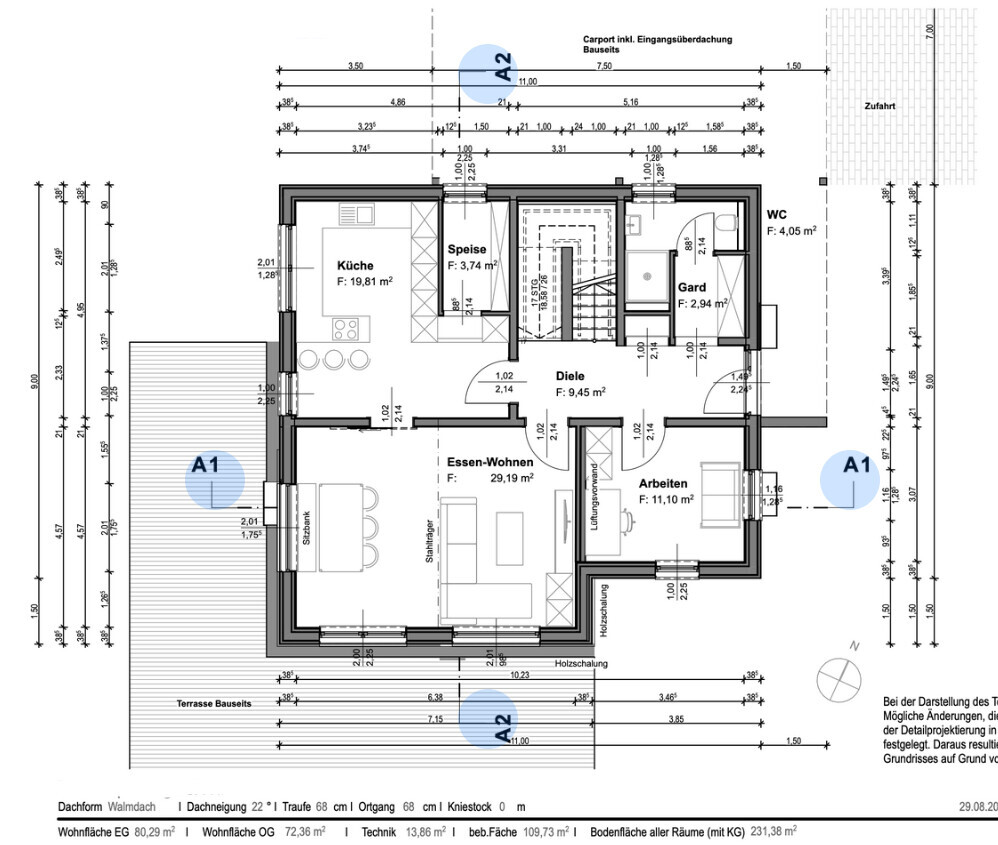
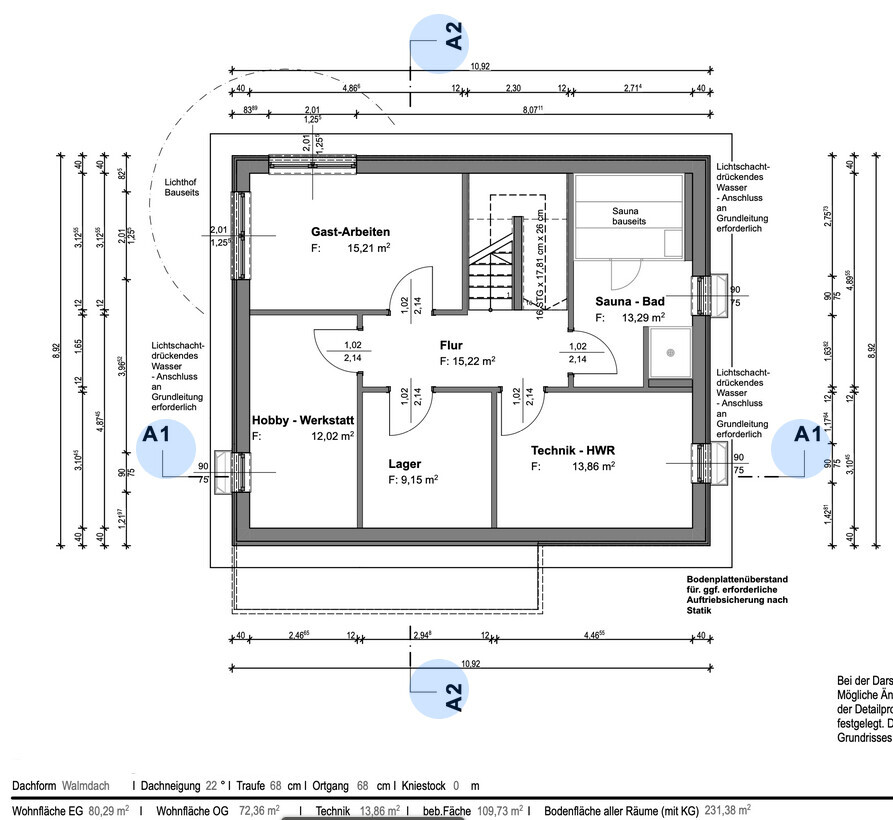
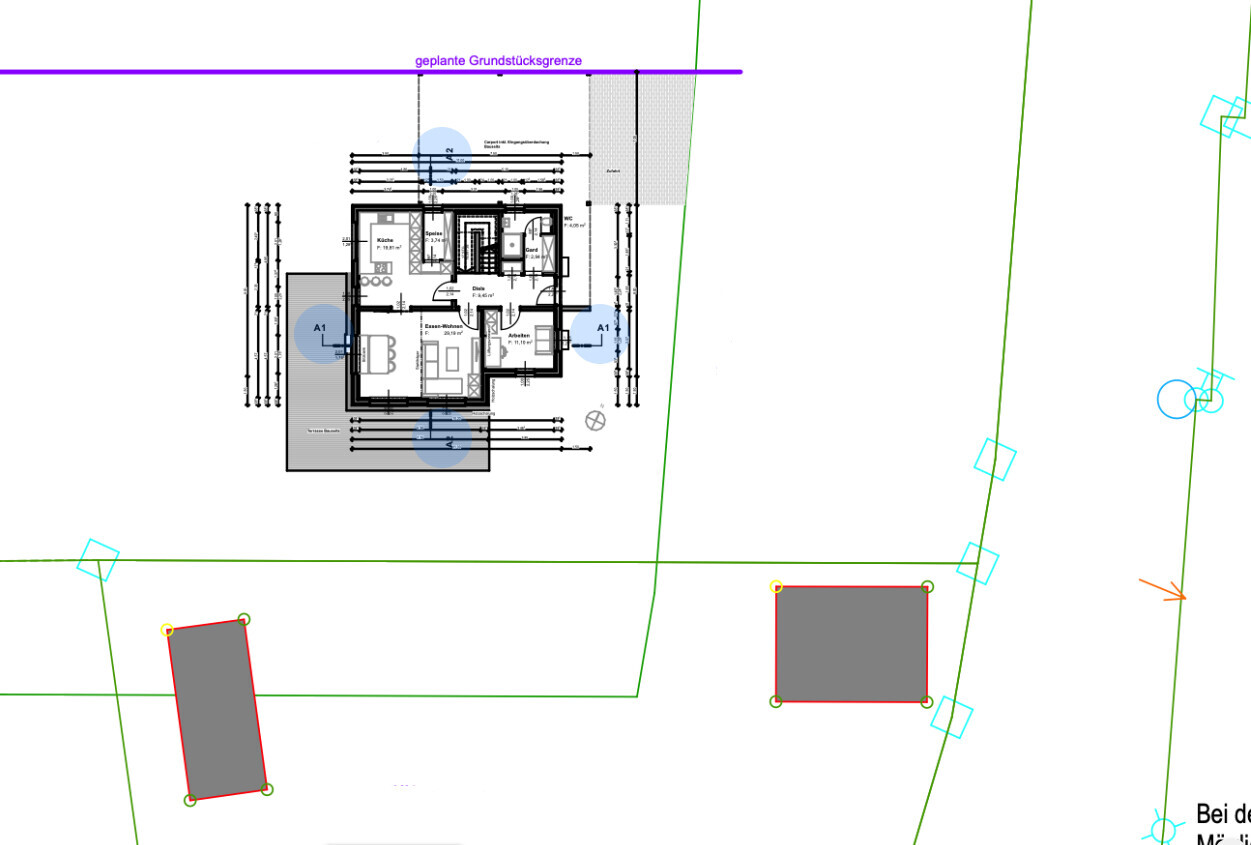
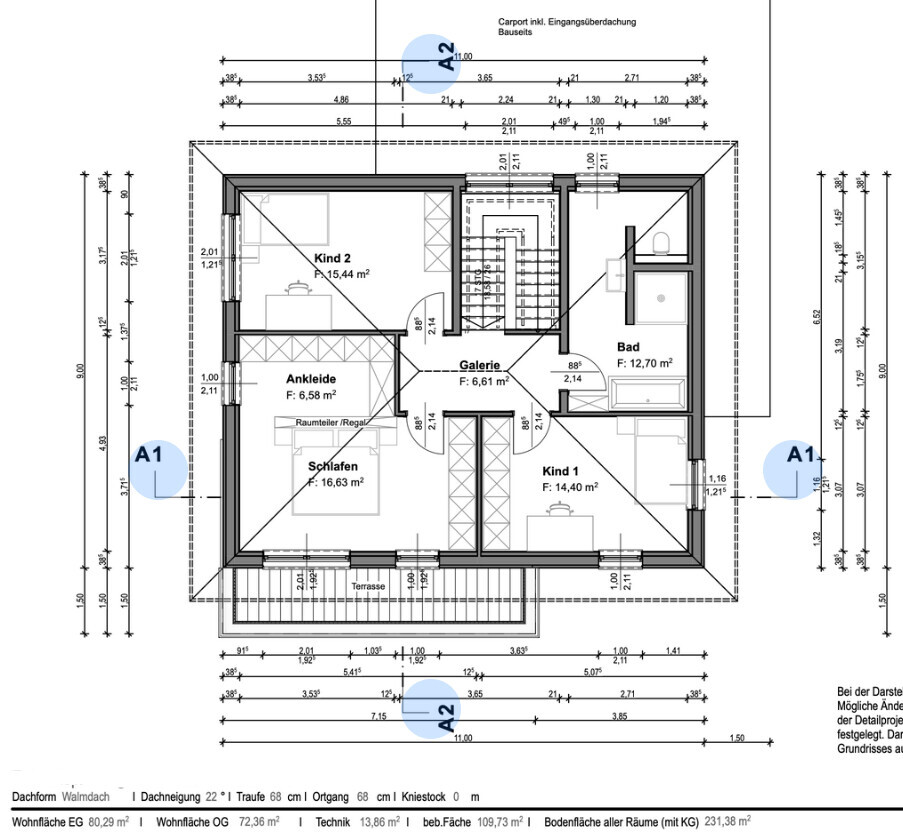
I’ll get straight to the point and start with the questionnaire:
Development Plan / Restrictions
Plot size – approx. 1000m² (to be subdivided)
Slope – approx. 60cm (2 ft) height difference over 10m (approximate building area)
Location – Bavaria (Franconia)
Some details are unknown because there is no development plan (e.g., floor area ratio, plot ratio, building area, building line and boundary, edge development, etc.)
Roof style / design / orientation according to surroundings – but really almost everything is present in the neighborhood.
Client Requirements
Style, roof design, building type – Single-family house – preferably hip roof / clipped hip roof, possibly also gable roof with high knee wall, not just rectangular
Basement, floors – Basement + ground floor + upper floor
Number of people, ages – 2 adults (31, 32) and one child (2 years) + 2nd child not excluded
Space requirements for ground floor and upper floor –
Ground floor: Living-dining room adjacent to kitchen (separate room, preferably with large sliding door to dining room), pantry connected to kitchen, 1 office with sofa bed (10m² (108 sq ft)), WC and shower
Upper floor: 2 children's rooms (preferably equal size, at least 14m² (150 sq ft)), master bedroom, walk-in closet (separate from bedroom), 1 bathroom
Basement: Study (+ sofa bed), workshop (craft room), technical room, storage space
Office use: family or home office? – I work permanently from home, my husband 2 days per week
Guests per year – 4 (family from farther away, so although “only” 4, more frequent during the year)
Open or closed architecture – rather closed, but spacious living/dining area
Conservative or modern construction – good question?
Open kitchen, kitchen island – closed kitchen, considering the size / closed-off kitchen probably no island, possibly an extended kitchen counter with 3 bar stools?
Number of dining seats – 8 in the dining room, 3-4 bar stools in the kitchen
Fireplace – maybe
Music/stereo wall – no
Balcony, roof terrace – not essential, but okay if it fits well
Garage, carport – preferably double garage, but probably initially nothing due to costs, then double carport
Utility garden, greenhouse – not planned yet
Other wishes / special features / daily routine, also reasons why some things should or should not be included – We need storage space + a second study, hence the desire for a basement, beautiful south-facing view, therefore living/dining area faces south, entrance on the east (street side), no rectangular box-shaped house – preferably something “special” like a corner annex or bay window
House Design
Who is the designer? Architect
What do you particularly like? Why? – Coatroom and shower/WC on the ground floor take up little space and are functional – orientation towards street + north side also good, pantry adjacent to kitchen with passage through kitchen cabinet wall, dining room layout facing south (planned corner glazing at the dining table), room sizes nice
What don’t you like? Why? – We miss the “special touch,” kitchen space feels wasted, staircase possibly too large?
Price estimate from architect/planner: 750,000€ (approx. $810,000) including basement (prefabricated house manufacturer’s offer)
Personal price limit for house including equipment: 650,000€ (approx. $700,000)
Preferred heating technology: Underfloor heating / photovoltaic system
If you have to do without, which details / additional features:
You can do without: Hip roof, sauna and shower in basement, hobby/workshop room
You cannot do without: Basement, photovoltaic system, pantry, 2nd study, storage space, plus energy (also with regard to KFW 300 funding)
Why did the design turn out the way it is? For example:
Which wishes were implemented exactly by the architect? It was implemented 1:1 exactly as we said without the architect’s own ideas or objections.
We were recommended the architect from the prefabricated house company and planned together, but now we are being strongly advised against the basement (we have poor soil conditions, so a waterproof concrete shell must be planned, and the basement costs about 130,000€ (approx. $140,000) plus incidental construction costs). However, we are not satisfied yet because the cost estimate far exceeds our budget. The fact is: As it is now, we cannot afford it, even though some parameters (650k budget, no rectangular shape, basement) were clearly communicated from the start. Now we are being asked either to leave out the basement (we already reduced it to just a useful basement) or to make the house rectangular on the upper floors (9 x 11m (30 x 36 ft) – so the “annex” removed).
Do you perhaps have recommendations regarding providers – maybe with our many wishes we simply cannot afford to build a house with Luxhaus, and we need to reduce scope to a “mid-range” manufacturer... A “low budget” option (Massa Haus, Allkauf Haus, Okal Haus) is not an option if it compromises quality.
What we hope for now are critical reviews of our floor plan and ideas for the “special something.” Also an assessment of whether a basement really makes no sense in our case. Are there alternative floor plans that really include storage space? If we add 2 rooms on the upper floor + ground floor instead of a basement, we will probably also reach the 130,000€ the basement would cost. Unfortunately, we only discovered this great forum now and already hired (through recommendation) an architect, but we hope with your help we can still “save something.”
Thanks so much in advance!
F
FamilieForest8 Oct 2023 23:36hanse987 schrieb:
What immediately stands out to me is the access from the bedroom to the terrace. There will be a noticeable step down to the terrace there. Are you aware of this?No, we hadn’t realized that so far. How can you tell so quickly that a step will be necessary there?According to the prefab house representative, the terrace will have to be omitted anyway due to budget and the basement, so it would be a rectangle WITHOUT the terrace/balcony on top.

Finally, newcomers who find their way to the questionnaire on their own – thank you for that!
If I understand correctly, you have planned a house with the provider Luxhaus as a custom design with an architect arranged by them, and you have made several missteps along the way. This has now led to the (in my professional opinion, quite foreseeable) consequence of having to hit the brakes on costs and rethink plans at a relatively late "planning stage." This is unfortunate considering the originally not even bad floor plans, which under the newly understood circumstances are practically no longer usable. If these floor plans actually came from you, “all the worse” – do not try to salvage any part of them in your next attempt!
Let me start with the plot, which we do not really know because you unfortunately have not shown terrain elevations in either the site plan or the elevations. These elevations, however, speak more loudly than your personal preference in deciding whether to build a basement or not, and whether a cheaper alternative would need to be used instead (compare this also with the 11ant basement rule, which can be found here in the forum’s internal search or externally with the quote “With or without basement: a rule as a decision-making tool”). Also, simply calling about a third of your living room an "extension" and wanting to make it negotiable will not work.
Likewise, switching your provider to Allkauf Haus, Massa Haus, or Okal Haus will not get you any further. Allkauf Haus and Massa Haus are suppliers of shell houses. These would be my last choice for implementing individual designs – you would be better off choosing a catalog model from an “economy but turnkey” manufacturer instead. And secondly, shell houses only pay off for skilled, versatile do-it-yourselfers. Anyone aiming for a turnkey house will ultimately pay more using a shell house provider. Okal Haus would be a more suitable manufacturer in terms of finish level, although I would describe it as “a recommendation from my numb feet.” If you are searching without bias toward construction methods, you are welcome to come to me – but if you are fixed on timber frame panel construction (why, anyway?), then go to a “prefabricated house expert” (or in Bavaria, Andreas Zink) and at least get manufacturer-neutral advice.
With an architect, you should first complete phases 1 and 2 according to HOAI (called “Module A” in my “Building a house roadmap, also for you: the HOAI phase model!”). When focusing on prefabricated houses, for example, look up “A better place” for this. Within this framework, the basement question and the further alignment of budget and volume are clarified clearly before any drawing begins. Approach the architect with a list of requirements and wishes, but under no circumstances with your own drafts – no matter how convinced you might be (even “rightly so”). And: you must be absolutely crazy to consider going with the cheapest option just because you are vainly afraid of a simple rectangular design! If you know what you’re doing, a house doesn’t have to be expensive to look good.
https://www.instagram.com/11antgmxde/
https://www.linkedin.com/company/bauen-jetzt/
If I understand correctly, you have planned a house with the provider Luxhaus as a custom design with an architect arranged by them, and you have made several missteps along the way. This has now led to the (in my professional opinion, quite foreseeable) consequence of having to hit the brakes on costs and rethink plans at a relatively late "planning stage." This is unfortunate considering the originally not even bad floor plans, which under the newly understood circumstances are practically no longer usable. If these floor plans actually came from you, “all the worse” – do not try to salvage any part of them in your next attempt!
Let me start with the plot, which we do not really know because you unfortunately have not shown terrain elevations in either the site plan or the elevations. These elevations, however, speak more loudly than your personal preference in deciding whether to build a basement or not, and whether a cheaper alternative would need to be used instead (compare this also with the 11ant basement rule, which can be found here in the forum’s internal search or externally with the quote “With or without basement: a rule as a decision-making tool”). Also, simply calling about a third of your living room an "extension" and wanting to make it negotiable will not work.
Likewise, switching your provider to Allkauf Haus, Massa Haus, or Okal Haus will not get you any further. Allkauf Haus and Massa Haus are suppliers of shell houses. These would be my last choice for implementing individual designs – you would be better off choosing a catalog model from an “economy but turnkey” manufacturer instead. And secondly, shell houses only pay off for skilled, versatile do-it-yourselfers. Anyone aiming for a turnkey house will ultimately pay more using a shell house provider. Okal Haus would be a more suitable manufacturer in terms of finish level, although I would describe it as “a recommendation from my numb feet.” If you are searching without bias toward construction methods, you are welcome to come to me – but if you are fixed on timber frame panel construction (why, anyway?), then go to a “prefabricated house expert” (or in Bavaria, Andreas Zink) and at least get manufacturer-neutral advice.
With an architect, you should first complete phases 1 and 2 according to HOAI (called “Module A” in my “Building a house roadmap, also for you: the HOAI phase model!”). When focusing on prefabricated houses, for example, look up “A better place” for this. Within this framework, the basement question and the further alignment of budget and volume are clarified clearly before any drawing begins. Approach the architect with a list of requirements and wishes, but under no circumstances with your own drafts – no matter how convinced you might be (even “rightly so”). And: you must be absolutely crazy to consider going with the cheapest option just because you are vainly afraid of a simple rectangular design! If you know what you’re doing, a house doesn’t have to be expensive to look good.
FamilieForest schrieb:Before you wonder what can clearly be rejected just because, from an amateur’s perspective, the surroundings appear as a colorful mix: be smart and submit a building inquiry! Show here a reasonably large (100 meters (330 feet), preferably more) section of the cadastral map or aerial image (don’t forget: blurring or similar only gets in the way of helping), then with experience one can usually already recognize “de facto building envelopes” or similar.
Some things are unknown because there is no zoning plan (e.g., floor area ratio, gross floor area ratio, building envelope, building line and boundary line, edge development, …)
Roof shape / style / orientation to surroundings – but there is really almost EVERYTHING in the neighborhood.
hanse987 schrieb:I do not follow your observation (I believe, for probably the first time).
What immediately catches my eye is the exit from the bedroom to the terrace. There will be a nice step down to the terrace. Are you aware of this?
https://www.instagram.com/11antgmxde/
https://www.linkedin.com/company/bauen-jetzt/
11ant schrieb:
I don’t quite follow your point (I think this might be the first time) (?)The height of the floor-to-ceiling doors on the upper floor is marked as 2.11 meters (7 ft). The two doors in the bedroom leading out to the (roof) terrace are marked as 1.92 meters (6 ft 4 in). I now believe that the top edge of all the doors is actually at the same height.
Without having looked at the floor plan, you’re describing a situation similar to where we were about 1.5 years ago.
We had planned our wishes with one, or after thorough research, two different prefab house manufacturers. The result was about €100,000 (approximately $110,000) over our budget (we would have spent our contingency right at the beginning).
I then tried to find a construction company for our basement to estimate the price. A local builder in our town (who was highly recommended and has a good reputation) was able to help. The owner said he could build the same house for €100,000 (approximately $110,000) less, but as a traditional masonry home. That’s what we did, and we are fully satisfied.
My impression is that many prefab house manufacturers (not all, but certainly many) have strict constraints, and if you don’t fit into those, you end up paying more. For example, the exposed timber roof frame. The prefab house salesman said: “That will cost a fortune; forget it with your budget.” Of course, it doesn’t fit through their production process, so it requires extra work. With the masonry builder, the response was: “It’s actually a bit cheaper. The carpenter does the roof frame right away, so we don’t need a drywall installer or a ceiling in the attic.”
To anyone who feels offended, I’m just describing my situation and do not intend to recommend or start a discussion about which building method is better or worse. It can be the other way around for anyone at any time.
We had planned our wishes with one, or after thorough research, two different prefab house manufacturers. The result was about €100,000 (approximately $110,000) over our budget (we would have spent our contingency right at the beginning).
I then tried to find a construction company for our basement to estimate the price. A local builder in our town (who was highly recommended and has a good reputation) was able to help. The owner said he could build the same house for €100,000 (approximately $110,000) less, but as a traditional masonry home. That’s what we did, and we are fully satisfied.
My impression is that many prefab house manufacturers (not all, but certainly many) have strict constraints, and if you don’t fit into those, you end up paying more. For example, the exposed timber roof frame. The prefab house salesman said: “That will cost a fortune; forget it with your budget.” Of course, it doesn’t fit through their production process, so it requires extra work. With the masonry builder, the response was: “It’s actually a bit cheaper. The carpenter does the roof frame right away, so we don’t need a drywall installer or a ceiling in the attic.”
To anyone who feels offended, I’m just describing my situation and do not intend to recommend or start a discussion about which building method is better or worse. It can be the other way around for anyone at any time.