
ᐅ Single-family house of approximately 200 sqm with a double garage on a trapezoidal lot
Created on: 5 May 2023 15:45
M
Mucuc18
Hello dear house building forum community!
After carefully reading along for a while, I would now like to share our current design for constructive feedback.
Below are the usual details; south is at the bottom of the site plan:
Development Plan / Restrictions
Plot size | 512sqm (5509 sq ft)
Slope | No
Site coverage ratio | 160sqm (1722 sq ft) building footprint allowed for main building (+140sqm (1507 sq ft) overrun permitted for other structures)
Number of parking spaces | min. 1.5
Roof type | SD / WD or similar (mansard roofs are common in the area)
Maximum heights / limits | Ridge height 9.4m (31 ft) | Eaves height 6.5m (21 ft)
Additional requirements | Setbacks of 0.4 times the building height on two sides, 0.8 times the building height on other sides
Client Requirements
Architectural style, roof shape, building type | classic mansard-hipped roof, somewhat modern interpretation
Basement, floors | Ground floor, first floor, attic + basement
Number of occupants, ages | 2 (30 yrs, 33 yrs) + 1 (0 yrs) + occasional visitors
Space needs on ground floor, first floor | approx. 80–90sqm (860–970 sq ft) each for ground and first floors
Office | 1 office space needed for home office
Guest accommodation per year | to be determined, sometimes longer visits
Open or closed layout | rather open, but with adequate sound insulation and privacy
Conservative or modern construction | rather modern
Open kitchen, kitchen island | large open kitchen with island is important
Seating for dining | 4–6 seats regularly available, with option to extend
Fireplace | yes
Music / stereo wall | no, flexible hi-fi system
Balcony, roof terrace | no
Garage, carport | double garage
Utility garden, greenhouse | garden with beds and 2–3 trees, enclosed by hedge
House Design
Planner: architect & own ideas/drawings
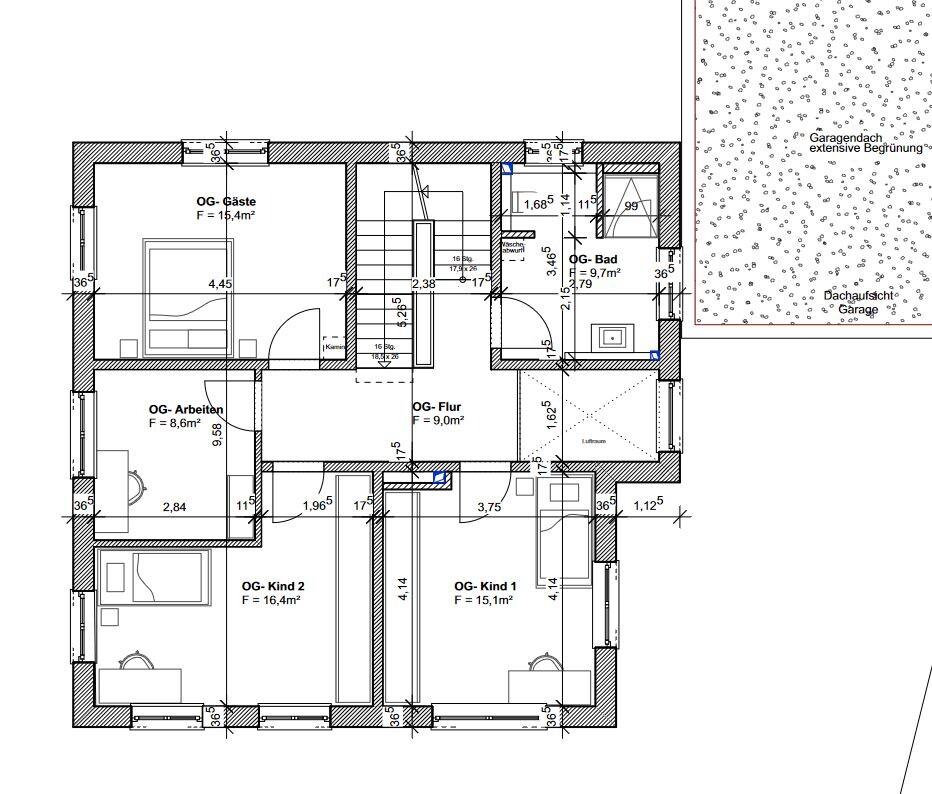
What do you like most? Why? Separate parents’ floor, spacious open living area, straight staircase, number of rooms on first floor (flexibility), sufficient wardrobe space, staircase separated from living room
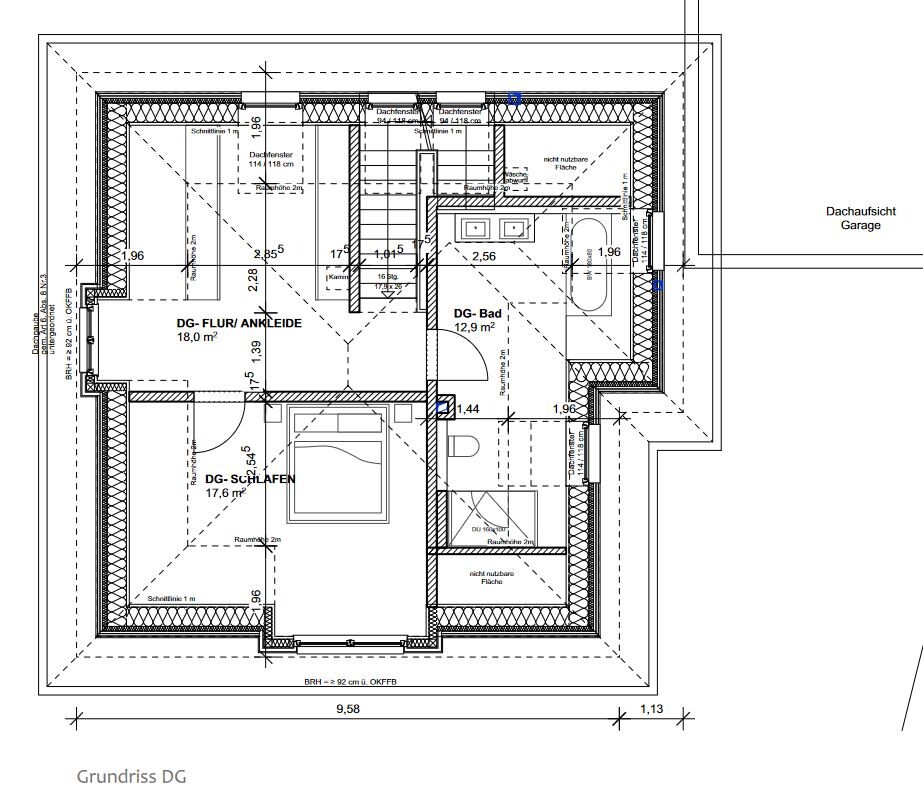
What do you dislike? Why? Location possibilities for heat pump outdoor unit, attic possibly has somewhat excessive space that might not be used efficiently (sloping ceilings)
Cost estimate by architect/planner: none so far
Budget for house including equipment: 1.4–1.5 million
Preferred heating technology: air-to-water heat pump
If you have to give up something, which details/features
- can be omitted: fireplace, pool, possibly double garage
- cannot be omitted: preferably a “large” garden
Why was the design developed this way? For example,
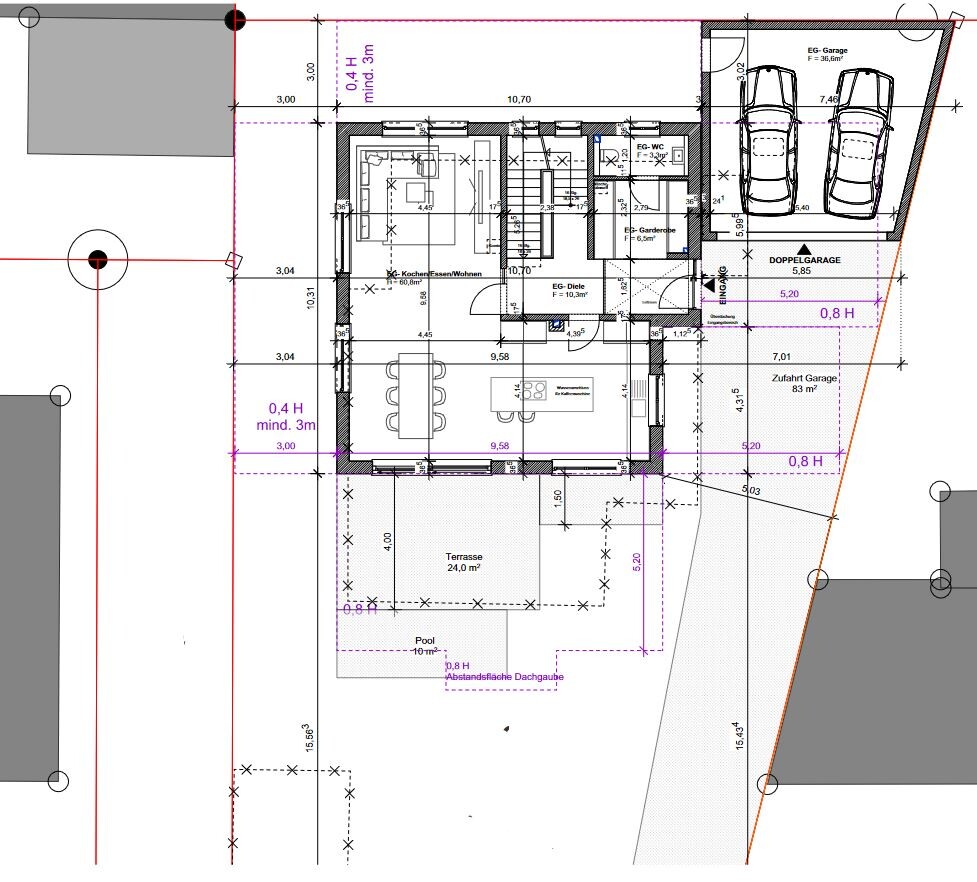
A mix of own ideas and architect’s input, along with several rounds of improvements over recent weeks. The main focus is on maintaining as much contiguous garden space as possible on a relatively small lot. Therefore, a setback on the east side is planned to comply with setbacks on the trapezoidal plot. The three floors plus basement help keep the house footprint small and separate the parents’ area from the children/guest area. We feel our wishes are well implemented in the current floor plan. Minor details such as window dimensions still need adjustment (e.g., equal-sized windows on the first floor west side, possibly a slightly larger sliding door on the ground floor, etc.).
What is the most important / basic question about the floor plan in 130 characters?
Do you see potential for improvement that we should consider or any no-gos we need to rethink? We are quite happy with the current status but appreciate input on aspects we may have overlooked or rationalized too optimistically.
Ground Floor
First Floor
Attic
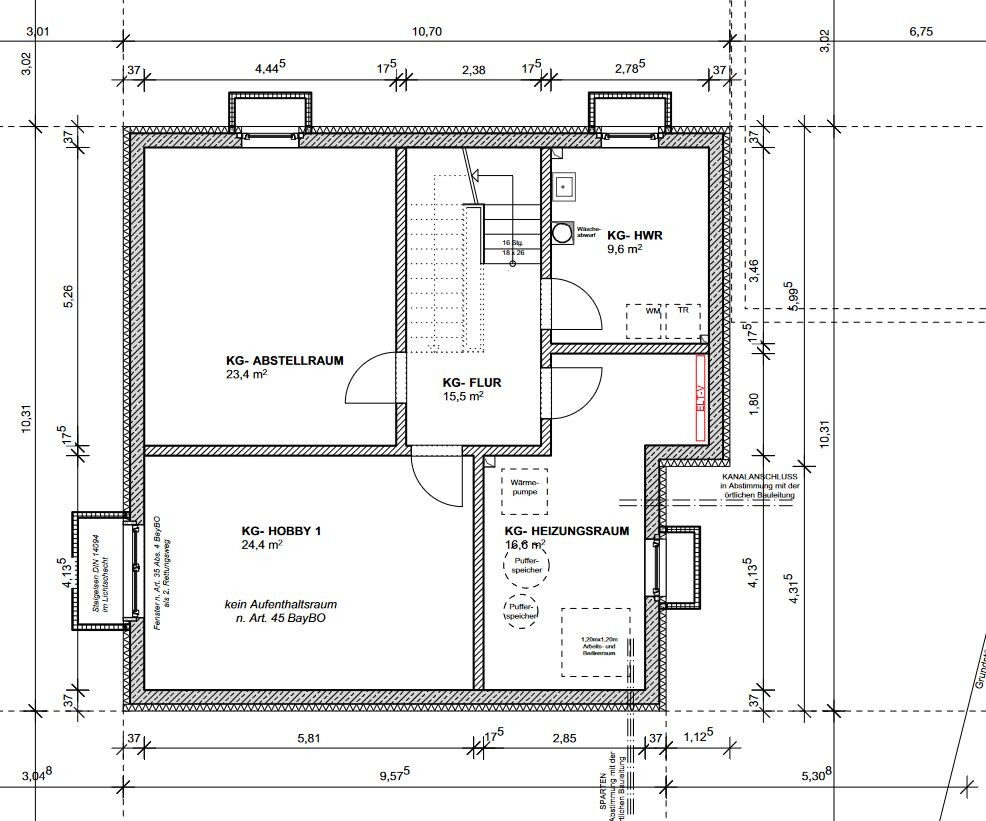
Basement
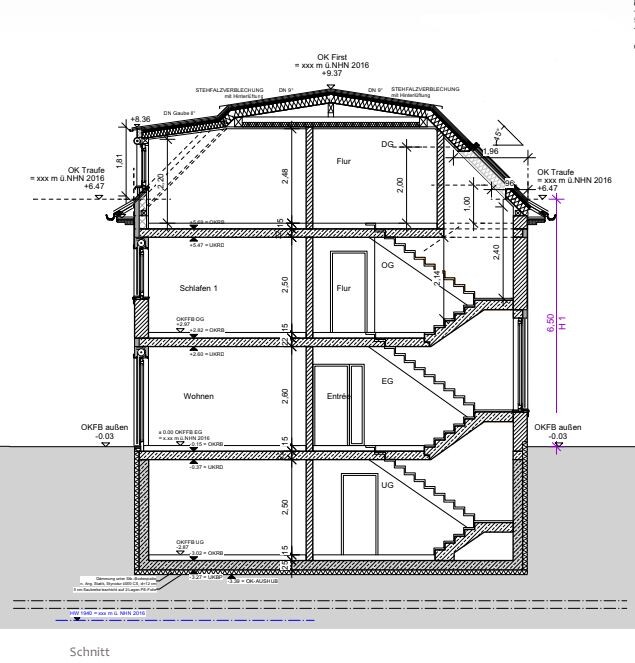
Section
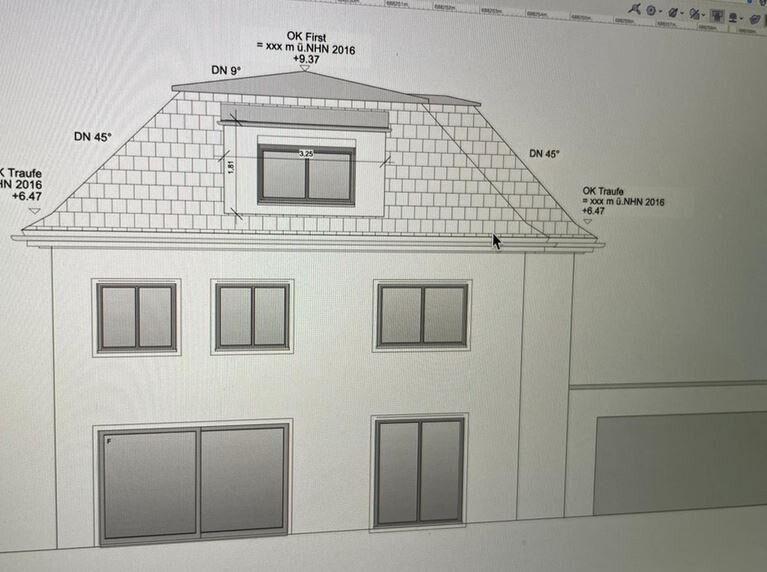
South Elevation
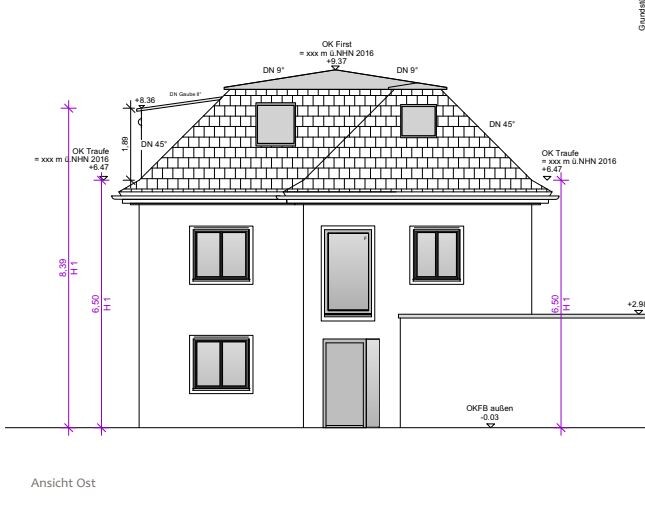
East Elevation
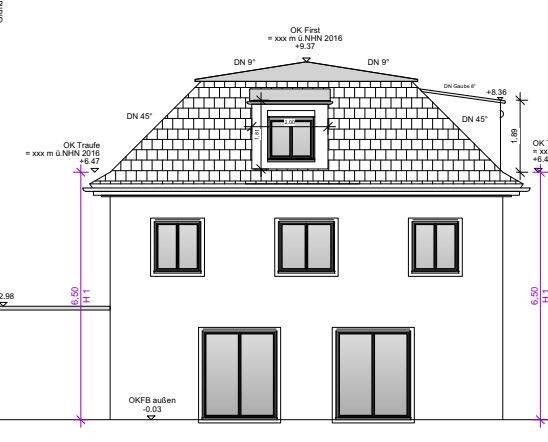
West Elevation
After carefully reading along for a while, I would now like to share our current design for constructive feedback.
Below are the usual details; south is at the bottom of the site plan:
Development Plan / Restrictions
Plot size | 512sqm (5509 sq ft)
Slope | No
Site coverage ratio | 160sqm (1722 sq ft) building footprint allowed for main building (+140sqm (1507 sq ft) overrun permitted for other structures)
Number of parking spaces | min. 1.5
Roof type | SD / WD or similar (mansard roofs are common in the area)
Maximum heights / limits | Ridge height 9.4m (31 ft) | Eaves height 6.5m (21 ft)
Additional requirements | Setbacks of 0.4 times the building height on two sides, 0.8 times the building height on other sides
Client Requirements
Architectural style, roof shape, building type | classic mansard-hipped roof, somewhat modern interpretation
Basement, floors | Ground floor, first floor, attic + basement
Number of occupants, ages | 2 (30 yrs, 33 yrs) + 1 (0 yrs) + occasional visitors
Space needs on ground floor, first floor | approx. 80–90sqm (860–970 sq ft) each for ground and first floors
Office | 1 office space needed for home office
Guest accommodation per year | to be determined, sometimes longer visits
Open or closed layout | rather open, but with adequate sound insulation and privacy
Conservative or modern construction | rather modern
Open kitchen, kitchen island | large open kitchen with island is important
Seating for dining | 4–6 seats regularly available, with option to extend
Fireplace | yes
Music / stereo wall | no, flexible hi-fi system
Balcony, roof terrace | no
Garage, carport | double garage
Utility garden, greenhouse | garden with beds and 2–3 trees, enclosed by hedge
House Design
Planner: architect & own ideas/drawings
What do you like most? Why? Separate parents’ floor, spacious open living area, straight staircase, number of rooms on first floor (flexibility), sufficient wardrobe space, staircase separated from living room
What do you dislike? Why? Location possibilities for heat pump outdoor unit, attic possibly has somewhat excessive space that might not be used efficiently (sloping ceilings)
Cost estimate by architect/planner: none so far
Budget for house including equipment: 1.4–1.5 million
Preferred heating technology: air-to-water heat pump
If you have to give up something, which details/features
- can be omitted: fireplace, pool, possibly double garage
- cannot be omitted: preferably a “large” garden
Why was the design developed this way? For example,
A mix of own ideas and architect’s input, along with several rounds of improvements over recent weeks. The main focus is on maintaining as much contiguous garden space as possible on a relatively small lot. Therefore, a setback on the east side is planned to comply with setbacks on the trapezoidal plot. The three floors plus basement help keep the house footprint small and separate the parents’ area from the children/guest area. We feel our wishes are well implemented in the current floor plan. Minor details such as window dimensions still need adjustment (e.g., equal-sized windows on the first floor west side, possibly a slightly larger sliding door on the ground floor, etc.).
What is the most important / basic question about the floor plan in 130 characters?
Do you see potential for improvement that we should consider or any no-gos we need to rethink? We are quite happy with the current status but appreciate input on aspects we may have overlooked or rationalized too optimistically.
Ground Floor
First Floor
Attic
Basement
Section
South Elevation
East Elevation
West Elevation
H
HeimatBauer4 Oct 2023 08:0711ant schrieb:
For good reason, I recommend as the only fully valid option to always look for and hire an architectural firm directly, without going through a general contractor.This means specifically:
1. I find an architect who fits me and my project.
2. What exactly does this architect provide? Are we talking about these service phases? I have never dealt with those before (at least not consciously).
3. Then where do I take this? To the general contractor? And how do I find a general contractor who simply says, "Sure, give me the plans and I will build it"?
I am still unclear about how the interaction works between me, the architect, and the construction company carrying out the work, and I want to avoid actual problems (the architect plans something that is not feasible to build) or excuses (“the other side is to blame”).
The posts show me how unusual and hard it is for you to imagine that an architect could simply make a serious mistake in the design of a straightforward single-family home.
I wasn’t able to quote everything here, so first, a more detailed explanation of exactly where things went wrong.
The development plan is standard, nothing unusual and leaves little room for interpretation. It allows a building footprint of 150 sqm (1,615 sq ft). The planned house is somewhere around 100-110 sqm (1,076-1,184 sq ft) without checking precisely again. So maximizing the footprint was definitely not the goal here.
Now, here is exactly where it failed:
The setback distances were not calculated correctly according to the Bavarian Building Code (BayBO). They are 0.8H on two sides and 0.4H on the other two sides.
The dimension H, according to BayBO, is defined by the height of the wall (the intersection of the wall with the roof covering) + 1/3 of the roof height. The underlined part was simply unknown to the architect. The roof was ignored entirely in his calculation.
The setback area calculated by the architect was thus 5.2 meters (17 ft), instead of the approximately 5.9 meters (19 ft) that should have been maintained. Keep in mind, I had to look this up in the BayBO myself because even after feedback from the building authority, the architect did not really understand where the problem was coming from.
The second point is that, while this alone would not have immediately invalidated the floor plan, it further illustrates why we no longer want to work with this planner:
The development plan clearly states that the reference point for the maximum ridge height of 9.5 meters (31 ft) is the middle of the street in front of the property. Our planner, however, used the natural ground level of the property as the reference, resulting in a shortfall of 12 cm (5 inches).
These two issues are simply incompetence (a Bavarian architect should know BayBO) and a lack of effort to read the development plan properly. There were a few other errors during the planning process which I managed to identify in time, though. The demand that the building permit application must be absolutely correct and checked multiple times apparently didn’t help.
Unfortunately, the design is not salvageable for us as is. The remedy suggested by the architect was to shift the building footprint toward the center of the lot, at the expense of the garden which is very important to us. That would create a north-facing garden, which wouldn’t really deserve the name — not only because it’s on the north side (which isn’t necessarily bad) but also for other reasons, it would be quite unattractive. Also, under those conditions, we could have planned completely differently — one of the most important points in the planning was to preserve as much unbuilt garden space as possible on the more attractive side of the plot. A simple shift in the building footprint would combine all the current downsides from compromised planning with all the potential disadvantages of a new design.
Even though it might look like it from the floor plan, we did not want to squeeze out anything extra 😉
We love gardens, but a larger lot was not financially feasible. That’s why a more compact footprint was chosen. A larger building would have been allowed, though.
As I said, we planned nothing outrageous. A preliminary building inquiry was made for totally uncritical matters (e.g., garage positioning) and was approved by the community as “completely uncritical.” The community is cooperative, friendly, and informative. Nothing even remotely critical caused the building permit to fail, it was solely mistakes by the architect. I claim to know the relevant regulations in the development plan and BayBO quite well by now. The only fault I see on our side was trusting the planner to correctly calculate setbacks as valid throughout Bavaria. If I have to analyze every single dimension, including the related legal text, I might as well quit my own job and become an architect myself.
Probably true, but not really applicable to us.
We hired a university-educated architect, with a fee not exactly according to HOAI but also nowhere near the 2k-5k range you sometimes see for “draftsman” plans.
We didn’t want to plan a “jack-of-all-trades” house. We had a spatial program that fit perfectly, totally unproblematic, on the plot. Plus, the requirement to keep as much open space as possible for garden and kids on the nicer side of the property.
We didn’t want a granny flat for the rare possibility that the great cousin might live in temporarily 20 years from now. We didn’t want accessible design for 40 years in the future. We omitted things like a shower without a door or curtain because they didn’t fit. In summary, nothing crazy except a single-family home with as much garden as possible.
Of course, we are a bit “down” right now emotionally since we had already pictured ourselves in this house. The kitchen was planned and offers were obtained from three kitchen studios, for example. We expected approval of our building permit days ago (it was submitted in June).
Next steps:
Processing the past:
We are now demanding a refund of the fees already paid (75% was paid including the submission of the building permit) plus compensation for the costs of the surveying commissioned by the architect. Also damages for the cost of the building permit application itself (likely in the mid four-digit range).
Future planning:
There are two trees on the plot that must be cut down. This has been cleared and will be approved. However, felling is only allowed after the building permit is granted. As is well known, this is only possible between March and the end of September.
We are under some time pressure since we need the building permit before March 2024 to cut the trees in time.
As mentioned, I now know the plot very well myself (not least because I never fully trusted the architect). At the moment we see two options:
1. Hire a “real” architect as suggested by @11ant for the restart. We spoke to several last year before deciding. One is a serious candidate and is only 1-2 km (1-1.2 miles) from the lot — though it’s unclear whether he would also be available for construction supervision. The downside is the price. The approval planning would be charged according to HOAI and would exceed 30,000 Euros just for the building permit.
2. Hire a “cheaper” planner/architect and be heavily involved in the design ourselves (by now, I’m sure this makes @11ant raise an eyebrow — sorry for that). As I said, I now believe I know very well what is possible on the property and what is not. After a year of planning, I have some insight into sight lines, botched work (thanks @11ant), and more. I have a recommendation for someone from northern Germany who would do this via online planning. Costs would be around 4,000-5,000 Euros. Alternatively, we could ask one of the online intermediaries like “A-better-place architects.”
What do you think? 😉
I wasn’t able to quote everything here, so first, a more detailed explanation of exactly where things went wrong.
The development plan is standard, nothing unusual and leaves little room for interpretation. It allows a building footprint of 150 sqm (1,615 sq ft). The planned house is somewhere around 100-110 sqm (1,076-1,184 sq ft) without checking precisely again. So maximizing the footprint was definitely not the goal here.
Now, here is exactly where it failed:
The setback distances were not calculated correctly according to the Bavarian Building Code (BayBO). They are 0.8H on two sides and 0.4H on the other two sides.
The dimension H, according to BayBO, is defined by the height of the wall (the intersection of the wall with the roof covering) + 1/3 of the roof height. The underlined part was simply unknown to the architect. The roof was ignored entirely in his calculation.
The setback area calculated by the architect was thus 5.2 meters (17 ft), instead of the approximately 5.9 meters (19 ft) that should have been maintained. Keep in mind, I had to look this up in the BayBO myself because even after feedback from the building authority, the architect did not really understand where the problem was coming from.
The second point is that, while this alone would not have immediately invalidated the floor plan, it further illustrates why we no longer want to work with this planner:
The development plan clearly states that the reference point for the maximum ridge height of 9.5 meters (31 ft) is the middle of the street in front of the property. Our planner, however, used the natural ground level of the property as the reference, resulting in a shortfall of 12 cm (5 inches).
These two issues are simply incompetence (a Bavarian architect should know BayBO) and a lack of effort to read the development plan properly. There were a few other errors during the planning process which I managed to identify in time, though. The demand that the building permit application must be absolutely correct and checked multiple times apparently didn’t help.
K a t j a schrieb:
Isn’t there any way to fix the design? How wrong were the calculations? Do you want to scrap it just because of this?
Unfortunately, the design is not salvageable for us as is. The remedy suggested by the architect was to shift the building footprint toward the center of the lot, at the expense of the garden which is very important to us. That would create a north-facing garden, which wouldn’t really deserve the name — not only because it’s on the north side (which isn’t necessarily bad) but also for other reasons, it would be quite unattractive. Also, under those conditions, we could have planned completely differently — one of the most important points in the planning was to preserve as much unbuilt garden space as possible on the more attractive side of the plot. A simple shift in the building footprint would combine all the current downsides from compromised planning with all the potential disadvantages of a new design.
ypg schrieb:
Is it really so bad that you need a new architect immediately? Without reading all posts: wasn’t it that you exactly knew what you wanted to get out of the lot (I mean, who voluntarily builds four stories?) and the architect was just your extended arm?
Even though it might look like it from the floor plan, we did not want to squeeze out anything extra 😉
We love gardens, but a larger lot was not financially feasible. That’s why a more compact footprint was chosen. A larger building would have been allowed, though.
11ant schrieb:
The situation here is that the builders pursue a construction project with a building volume taller than the existing buildings (and the neighborhood). As the Bavarians so nicely put it, you “never ever” do this without securing a preliminary building inquiry to ensure you are on an approvable course. This obviously was not done here — driving the planning as far as execution level was a waste of everyone’s time. This shows and punishes the typical “starting in third gear” approach of general contractor planning—had it been done properly, this insight would have come already at “Module A.” The disastrous disappointment is a “sure” consequence of unprofessional conduct (for which of course the client is hardly entirely blameless). What is needed here is a self-critical adjustment of expectations and a realistic reassessment before a new broom could sweep better.
As I said, we planned nothing outrageous. A preliminary building inquiry was made for totally uncritical matters (e.g., garage positioning) and was approved by the community as “completely uncritical.” The community is cooperative, friendly, and informative. Nothing even remotely critical caused the building permit to fail, it was solely mistakes by the architect. I claim to know the relevant regulations in the development plan and BayBO quite well by now. The only fault I see on our side was trusting the planner to correctly calculate setbacks as valid throughout Bavaria. If I have to analyze every single dimension, including the related legal text, I might as well quit my own job and become an architect myself.
11ant schrieb:
What layperson builders imagine is often not really bad, and even a naive focus on the wrong details (in terms of their relevance) is the bigger but not really evil problem. At number one is the “fear of missing out,” which in combination with the toxic belief “you only build once” makes builders try to squeeze too many wishes into their small house.
To give credit to the general contractor “architects”: quite a few first drafts (i.e., before the client wanted to squeeze in a kid’s bathroom or similar) were better than the final messed-up version, and most often approvals fail on overly complex knee walls, dormers, and the like. Not everything the draftsman produces is rubbish — they just shouldn’t talk clients out of their wishes. The “black Peter” usually lies with the building authorities.
Probably true, but not really applicable to us.
We hired a university-educated architect, with a fee not exactly according to HOAI but also nowhere near the 2k-5k range you sometimes see for “draftsman” plans.
We didn’t want to plan a “jack-of-all-trades” house. We had a spatial program that fit perfectly, totally unproblematic, on the plot. Plus, the requirement to keep as much open space as possible for garden and kids on the nicer side of the property.
We didn’t want a granny flat for the rare possibility that the great cousin might live in temporarily 20 years from now. We didn’t want accessible design for 40 years in the future. We omitted things like a shower without a door or curtain because they didn’t fit. In summary, nothing crazy except a single-family home with as much garden as possible.
Of course, we are a bit “down” right now emotionally since we had already pictured ourselves in this house. The kitchen was planned and offers were obtained from three kitchen studios, for example. We expected approval of our building permit days ago (it was submitted in June).
Next steps:
Processing the past:
We are now demanding a refund of the fees already paid (75% was paid including the submission of the building permit) plus compensation for the costs of the surveying commissioned by the architect. Also damages for the cost of the building permit application itself (likely in the mid four-digit range).
Future planning:
There are two trees on the plot that must be cut down. This has been cleared and will be approved. However, felling is only allowed after the building permit is granted. As is well known, this is only possible between March and the end of September.
We are under some time pressure since we need the building permit before March 2024 to cut the trees in time.
As mentioned, I now know the plot very well myself (not least because I never fully trusted the architect). At the moment we see two options:
1. Hire a “real” architect as suggested by @11ant for the restart. We spoke to several last year before deciding. One is a serious candidate and is only 1-2 km (1-1.2 miles) from the lot — though it’s unclear whether he would also be available for construction supervision. The downside is the price. The approval planning would be charged according to HOAI and would exceed 30,000 Euros just for the building permit.
2. Hire a “cheaper” planner/architect and be heavily involved in the design ourselves (by now, I’m sure this makes @11ant raise an eyebrow — sorry for that). As I said, I now believe I know very well what is possible on the property and what is not. After a year of planning, I have some insight into sight lines, botched work (thanks @11ant), and more. I have a recommendation for someone from northern Germany who would do this via online planning. Costs would be around 4,000-5,000 Euros. Alternatively, we could ask one of the online intermediaries like “A-better-place architects.”
What do you think? 😉
The processing time for posts is really too short...
The good thing is, hopefully, the new plan will be even better than the failed one! 🙂
The new design I have in mind is two stories plus a basement. The ground floor will be planned larger than the upper floor so that the building can still be positioned relatively far to the north, despite the somewhat larger footprint (and still comply with the setback requirements, since only the ground floor triggers shorter setback distances). The garage will then be a single garage and will be placed a bit closer to the street.
The good thing is, hopefully, the new plan will be even better than the failed one! 🙂
The new design I have in mind is two stories plus a basement. The ground floor will be planned larger than the upper floor so that the building can still be positioned relatively far to the north, despite the somewhat larger footprint (and still comply with the setback requirements, since only the ground floor triggers shorter setback distances). The garage will then be a single garage and will be placed a bit closer to the street.

HeimatBauer schrieb:
I am still not clear on how the collaboration between myself, the architect, and the construction company actually works, and I want to avoid real issues (for example, the architect designing something that cannot be practically built) or excuses ("the other side is to blame"). I have already explained this in several posts here (most of them less than a year ago, which you can find via the forum search using keywords like mainly house building schedule and Gerddieter — who unfortunately continues to ignore my private messages, but to whom I am still very thankful @Gerddieter). By the way, I am also grateful to you for this template, which allows me to provide a helpful answer for many other readers. That’s why I’ll address it again here despite some repetition:
HeimatBauer schrieb:
Specifically, this means:
1. I look for an architect that suits me and my project.
2. What exactly do they produce for me? Are we talking about those service phases? I haven’t had any experience with those so far (at least not consciously).
3. Then where do I go with this? To a general contractor? And how do I find a general contractor who just says: “Sure, give me the plans, I’ll build it”? 1. You look for an architect (or have one found for you; I work nationwide, and there are several consultants like me). “Suitable for your project” usually means, for most users of this forum, someone who specializes and has experience primarily in single-family house construction. If it’s about a renovation and you are from North Rhine-Westphalia, you’ll find @wpic here in the forum (other architects from the local community have not yet made themselves known to me, and I can recommend this one). For couchsurfing information seekers, it can be a bit tricky: a typical suitable single-family house architect usually does not just have an office where they are the only professional, but often still has a dusty “home page” — sometimes even a creepily retro one on T-online — and almost always stays under the radar if you try to find them via “reviews.” A fun fact: I also coach architects on search engine pessimization, in case they absolutely don’t want to be found by just anyone ;-)
2. The architect creates exactly what you need — with one exception: service phases 1 and 2 (which I call “Module A” in my “House Building Schedule, also for you: the HOAI phase model!”) will only be skipped by a serious architect if they have already been thoroughly completed by another conscientious architect. A good architect for you will always offer all service phases (1 through 8; service phase 9 is generally dispensable for a single-family home for own use). Sometimes they involve a specialized colleague for service phase 8, but at least until phase 5 they usually work themselves. Architects of the type “@Gerddieter warns about” regularly offer only phases 1 to 4 — which is not proof but a strong indication of weak detail planning and unrealistic cost estimates.
3. After working with your architect, you do not immediately go to a general contractor (GC) to commission them. Instead, you first complete only “Module A” with the architect; at the end of this step, you have a preliminary design. This is where the most important step comes in, which I call the “proofing phase”: it is a period of about six to eight weeks of contemplation and reflection. During this time, you distance yourself from your fixation on the building idea to break your tunnel vision. At the end of this phase, you can spontaneously and instinctively decide whether you want to continue working with this architect. Unconsciously, you will have done a kind of mourning process — peacefully letting go of ideas that could not be incorporated into the preliminary design. This is very important; otherwise, these ideas haunt you, keep resurfacing, and you will repeatedly want to integrate them. A striking example of this pattern can be found in the thread by Princess @Shiny86 https://www.hausbau-forum.de/threads/grundrissoptimierung-stadtvilla-aufschuettueberlegung.33680/ (stairs moved back and forth, downspout moved and moved back, children's bathroom squeezed in and wall layout next to the master bathroom endlessly debated, wall between cloakroom and pantry shifted fifty-seven times and balanced with facade symmetry — really nothing left out to drive the poor draftsman crazy). Coming to terms with the status alea iacta est [the die is cast] is an essential foundation for structured further work with the architect to achieve a design that is straightforward to implement with minimal complications.
The proofing phase is a break both for you and your architect, but not a waste of time: at the beginning of it, you will have sent out the preliminary design — the architect as a preliminary building application (building permit inquiry / planning permission inquiry) to the building authority, and you to four or five (no more!) general contractors from both camps (timber frame and masonry). This initial step serves solely to identify early on which construction method is more cost-effective in your specific case and at this stage only provides a non-binding price orientation. At the end of the proofing, you will have received responses that provide valuable guidance for adjusting the course of your project. I don’t want to go through all possible scenarios here — so let’s assume the situation shows that timber construction is more cost-effective for implementing your house design: then your next contract with your architect would not cover the entire “Module B” but only service phase 3 as their own scope of work, plus their cooperation with a house provider who then comes in during service phase 4. On this point, I agree with many “prefabricated house experts” that duplicate work in service phase 4 should be avoided. In the other case (if masonry turns out to be cheaper), you proceed with your architect as the next step through the full “Module B,” that is up to and including service phase 5, and you would generally continue directly with “Module C.” As a smart building client, you never, ever, under no circumstances approach a general contractor instead of a formal tender; you only allow bidders from your tender to apply for a contract covering one or more or all packages as general contractor. Anyone who cannot print their own money should NEVER commission “a part of the house without proper quantity and measure determination and/or selections before signing.” If you want to build a shell-and-core house or a nearly finished prefabricated house, you may already bundle the entire shell construction into one package with your architect during the tender.
If there was only one way to Rome, advisers like me wouldn’t be needed, and you could just choose inflexible architects. The builder — whether general contractor, shell construction GC, or otherwise — builds your masonry house according to the architect’s detailed planning but more often designs the details themselves in timber construction. A penny-pinching do-it-yourselfer who takes the drawing package from the building permit application directly to a GC is likely to end up with rough-in installations boxed in with drywall * — in a free country, everyone is the architect of their own misfortune (and often spectacularly overspends to boot). The GC who gets such a stamped document will build every planning error without batting an eye (the building authority only complains about regulatory violations; permissible narrowings pass unnoticed).
*) which is very “decorative” underground and really yummy from the Wife Acceptance Factor perspective *LOL*
(This answer took a bit longer, so I still have to read what the OP has written in the meantime.)
https://www.instagram.com/11antgmxde/
https://www.linkedin.com/company/bauen-jetzt/
I don’t find your zoning plan situation ordinary at all: firstly, because if I remember correctly, it is already a fairly densely built-up area (and probably older than the plan itself), so despite the zoning plan, there is an infill situation similar to a §34 area, which in my opinion clearly indicates that a preliminary inquiry is advisable; and secondly, because building with a mansard roof is not a standard case. A mansard roof inherently always has potential conflicts with modern zoning plans, which are, in this respect, somewhat “culturally biased,” as they parametrically tend to exclude mansard, barrel, and even half-hipped roofs. The critical issue with a mansard roof is that it does not have singular, clearly defined eave and ridge heights. In this context, conflicts over height limits almost arise automatically, and unfortunately, setbacks and heights are interconnected. Even the pitch of the lower slope can be a source of debate regarding how the roof should be included in the height calculation. Depending on the construction, the lower slope may be treated similarly to a knee wall. As culturally valuable and personally appealing as I find this roof type, I can fully understand why builders and their architects may be apprehensive about it.
1. If you’re building in Munich, you will find @Muc1985 here (though I’m not sure if your project would not be peanuts for their, in my opinion, highly recommendable architectural firm) and @gregman22 (whose architect is personally not on my must-meet list). I would not choose anyone charging the full HOAI rate who does not meet my rule of thumb “3+5=8.”
2. From my perspective, “A better Place” is not an intermediary but a cooperative of architects (although I still haven’t fully understood how they are connected legally). I don’t know how well they do masonry work — I only hear about them in connection with the “prefab house expert,” who, in my perception, specializes in wooden prefab builders.
https://www.instagram.com/11antgmxde/
https://www.linkedin.com/company/bauen-jetzt/
Mucuc18 schrieb:
As mentioned, I actually know the plot very well myself by now (not least because I never really fully trusted the architect). So at the moment, we see two options:
1. Hire a “real” architect as suggested by @11ant for a fresh start; we spoke with several last year before the decision was made. One of them would be quite suitable and is located just 1-2 meters (yards) away from the plot — though it is questionable whether he would also be available for site management, etc. The downside would be the price. The permit planning would be billed according to HOAI and would exceed 30k just for the building permit application.
2. Hire a “more affordable” planner/architect and be heavily involved in the design yourself (at this point, @11ant probably raises an eyebrow — sorry for that). As I said, I now feel I have a very clear idea of what is possible on the plot and what isn’t. After a year of planning and so on, I am somewhat familiar with sightlines, poor workmanship risks (thanks, @11ant), and the like. I have someone recommended by acquaintances from northern Germany who could handle this via online planning. Costs here would be around 4k-5k. Alternatively, one could try one of the online intermediaries like “A-better-place architects.”
1. If you’re building in Munich, you will find @Muc1985 here (though I’m not sure if your project would not be peanuts for their, in my opinion, highly recommendable architectural firm) and @gregman22 (whose architect is personally not on my must-meet list). I would not choose anyone charging the full HOAI rate who does not meet my rule of thumb “3+5=8.”
2. From my perspective, “A better Place” is not an intermediary but a cooperative of architects (although I still haven’t fully understood how they are connected legally). I don’t know how well they do masonry work — I only hear about them in connection with the “prefab house expert,” who, in my perception, specializes in wooden prefab builders.
https://www.instagram.com/11antgmxde/
https://www.linkedin.com/company/bauen-jetzt/
11ant schrieb:
I don’t find your zoning plan situation at all standard: firstly, if I remember correctly, it is an already quite densely built-up area (and probably older than the plan itself), so despite the zoning plan, there is an integration situation similar to a §34 zone, which in my opinion clearly indicates a need for a preliminary inquiry; and secondly, because a mansard roof is not a typical case. [...] Certainly correct. In fact, the construction of the mansard roof was also clarified through a preliminary inquiry and was considered one of the "completely unproblematic" issues, since several similar buildings exist in the immediate vicinity. In the Bavarian Building Code (BayBO), such "more specialized" roof types and their required setback distances are now quite clearly regulated (wall height plus one third of the roof height on the eave sides for roof pitches under 70 degrees). The general contractor appointed by the architect also mostly builds mansard roofs.
If the problem had been caused by such a "special request" situation on our part, I would certainly be more understanding.
Similar topics