
ᐅ Single-family house of approximately 200 sqm with a double garage on a trapezoidal lot
Created on: 5 May 2023 15:45
M
Mucuc18
Hello dear house building forum community!
After carefully reading along for a while, I would now like to share our current design for constructive feedback.
Below are the usual details; south is at the bottom of the site plan:
Development Plan / Restrictions
Plot size | 512sqm (5509 sq ft)
Slope | No
Site coverage ratio | 160sqm (1722 sq ft) building footprint allowed for main building (+140sqm (1507 sq ft) overrun permitted for other structures)
Number of parking spaces | min. 1.5
Roof type | SD / WD or similar (mansard roofs are common in the area)
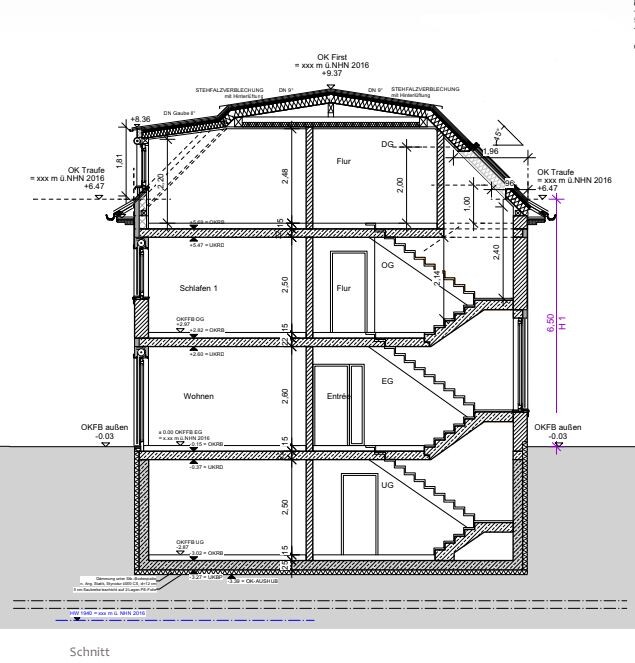
Maximum heights / limits | Ridge height 9.4m (31 ft) | Eaves height 6.5m (21 ft)
Additional requirements | Setbacks of 0.4 times the building height on two sides, 0.8 times the building height on other sides
Client Requirements
Architectural style, roof shape, building type | classic mansard-hipped roof, somewhat modern interpretation
Basement, floors | Ground floor, first floor, attic + basement
Number of occupants, ages | 2 (30 yrs, 33 yrs) + 1 (0 yrs) + occasional visitors
Space needs on ground floor, first floor | approx. 80–90sqm (860–970 sq ft) each for ground and first floors
Office | 1 office space needed for home office
Guest accommodation per year | to be determined, sometimes longer visits
Open or closed layout | rather open, but with adequate sound insulation and privacy
Conservative or modern construction | rather modern
Open kitchen, kitchen island | large open kitchen with island is important
Seating for dining | 4–6 seats regularly available, with option to extend
Fireplace | yes
Music / stereo wall | no, flexible hi-fi system
Balcony, roof terrace | no
Garage, carport | double garage
Utility garden, greenhouse | garden with beds and 2–3 trees, enclosed by hedge
House Design
Planner: architect & own ideas/drawings
What do you like most? Why? Separate parents’ floor, spacious open living area, straight staircase, number of rooms on first floor (flexibility), sufficient wardrobe space, staircase separated from living room
What do you dislike? Why? Location possibilities for heat pump outdoor unit, attic possibly has somewhat excessive space that might not be used efficiently (sloping ceilings)
Cost estimate by architect/planner: none so far
Budget for house including equipment: 1.4–1.5 million
Preferred heating technology: air-to-water heat pump
If you have to give up something, which details/features
- can be omitted: fireplace, pool, possibly double garage
- cannot be omitted: preferably a “large” garden
Why was the design developed this way? For example,
A mix of own ideas and architect’s input, along with several rounds of improvements over recent weeks. The main focus is on maintaining as much contiguous garden space as possible on a relatively small lot. Therefore, a setback on the east side is planned to comply with setbacks on the trapezoidal plot. The three floors plus basement help keep the house footprint small and separate the parents’ area from the children/guest area. We feel our wishes are well implemented in the current floor plan. Minor details such as window dimensions still need adjustment (e.g., equal-sized windows on the first floor west side, possibly a slightly larger sliding door on the ground floor, etc.).
What is the most important / basic question about the floor plan in 130 characters?
Do you see potential for improvement that we should consider or any no-gos we need to rethink? We are quite happy with the current status but appreciate input on aspects we may have overlooked or rationalized too optimistically.
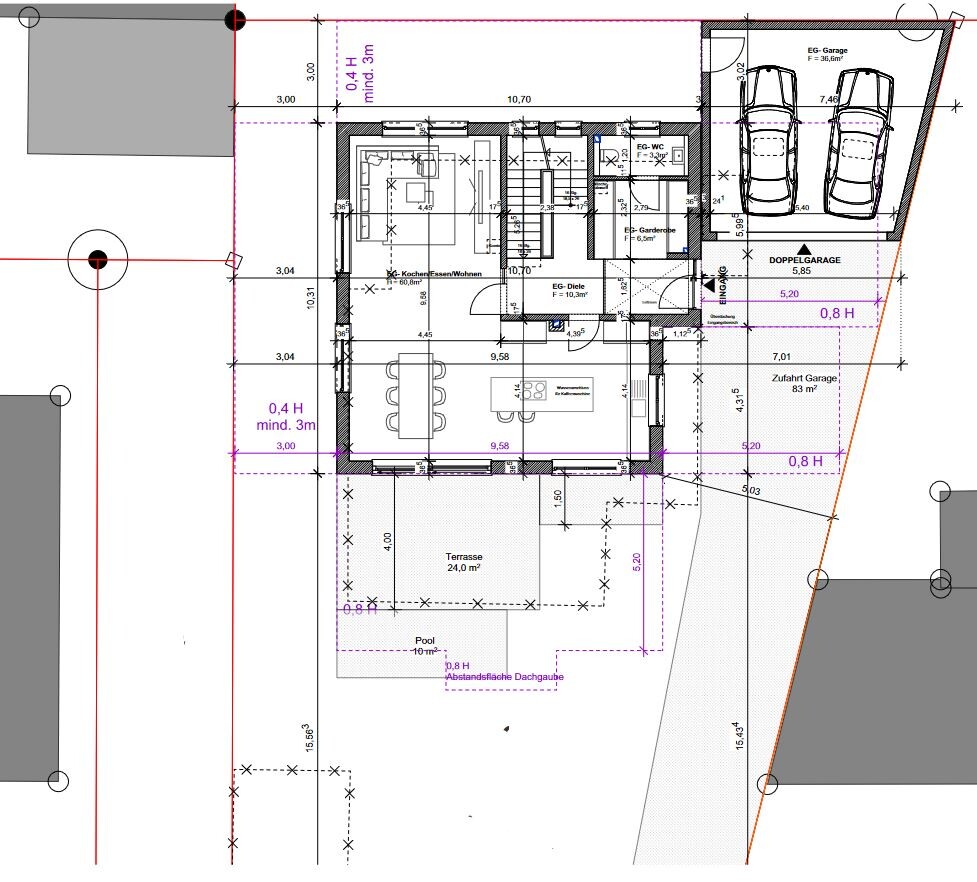
Ground Floor
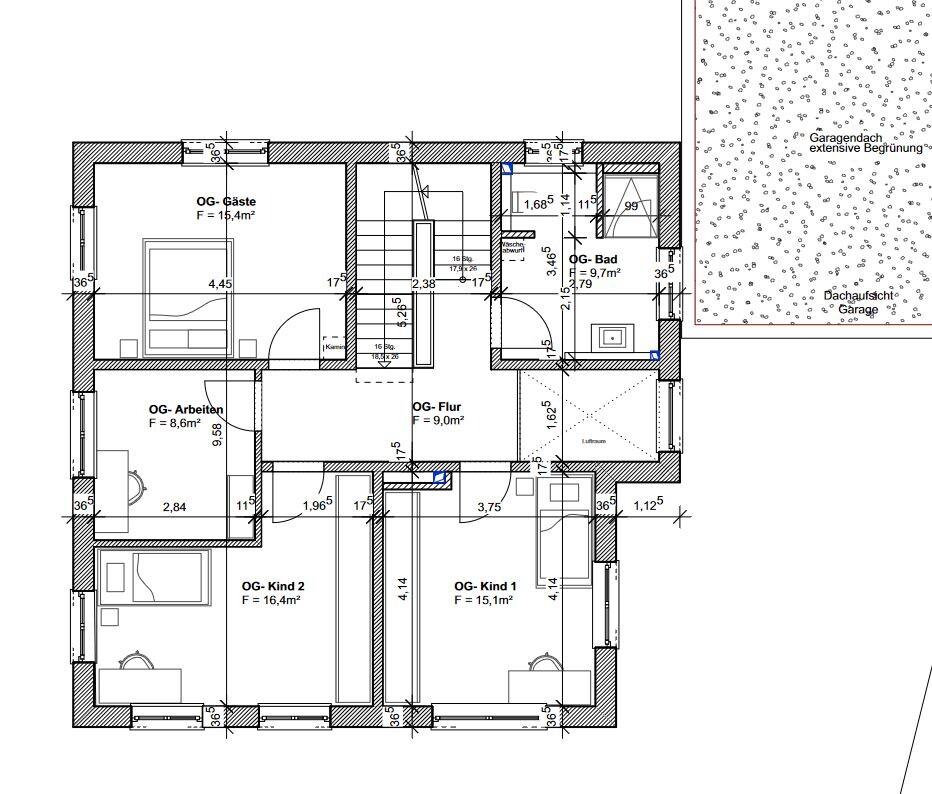
First Floor
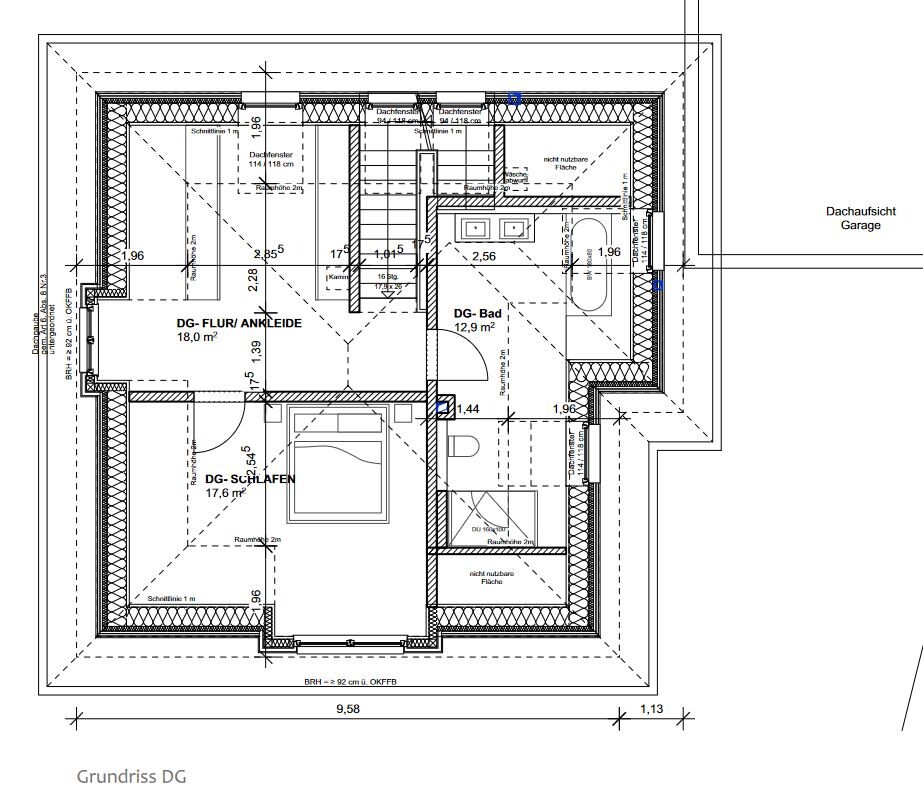
Attic
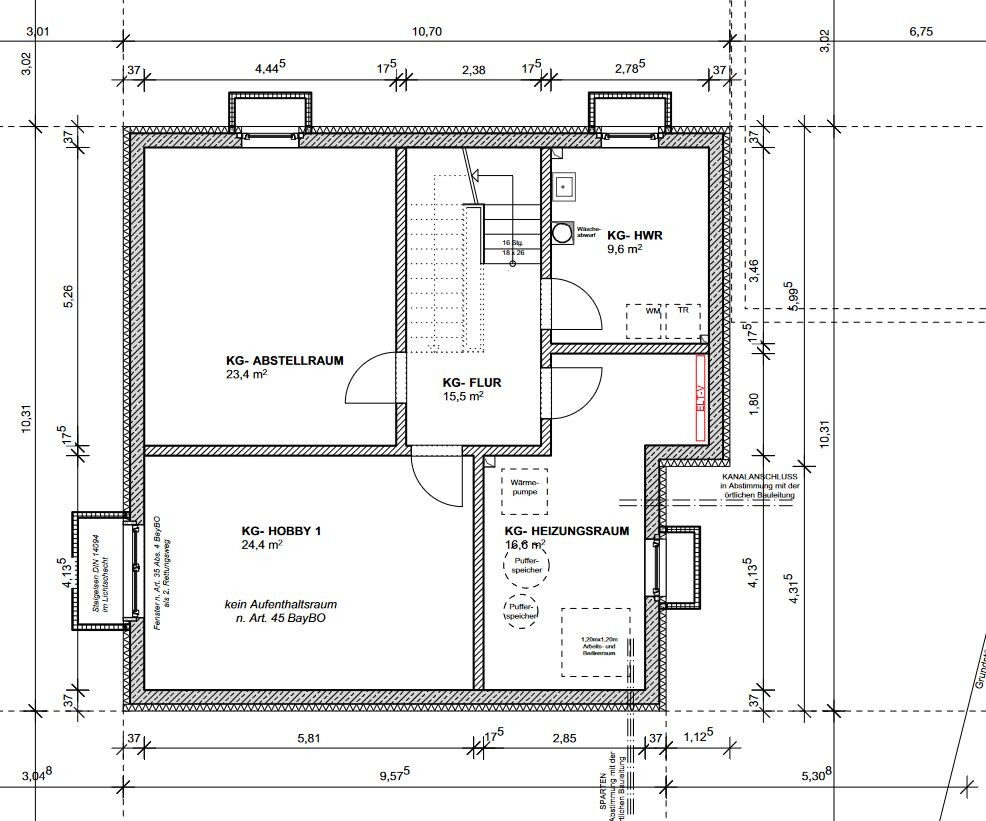
Basement
Section
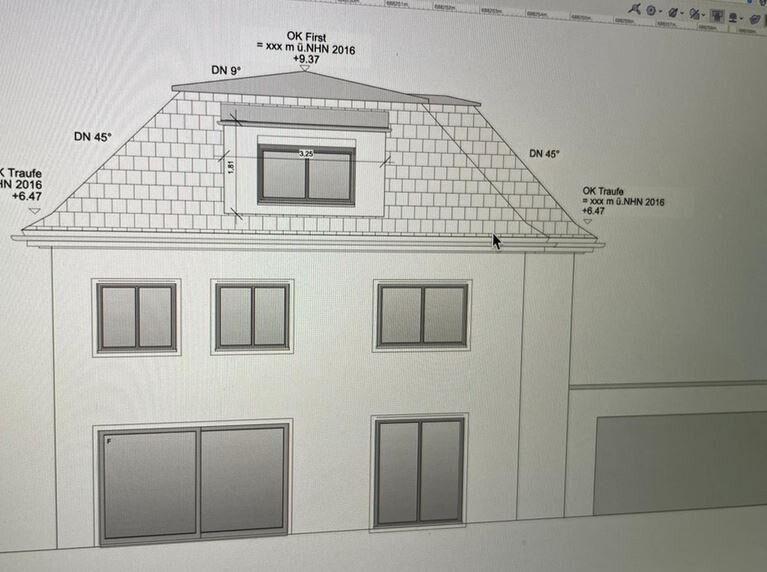
South Elevation
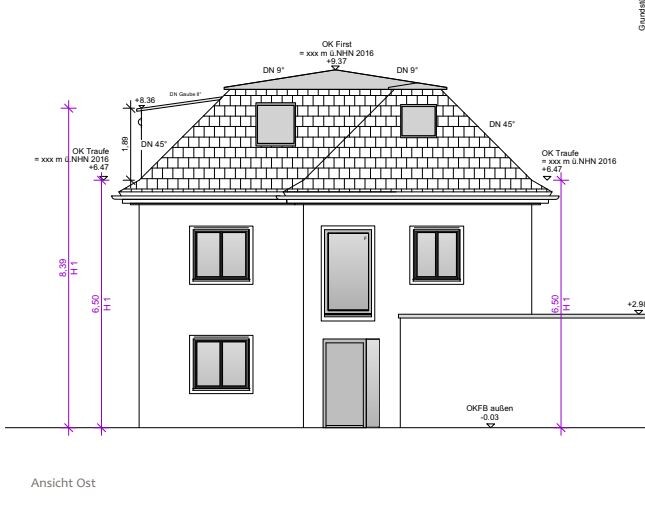
East Elevation
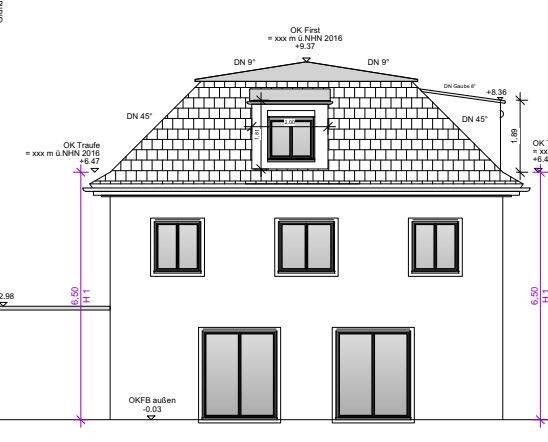
West Elevation
After carefully reading along for a while, I would now like to share our current design for constructive feedback.
Below are the usual details; south is at the bottom of the site plan:
Development Plan / Restrictions
Plot size | 512sqm (5509 sq ft)
Slope | No
Site coverage ratio | 160sqm (1722 sq ft) building footprint allowed for main building (+140sqm (1507 sq ft) overrun permitted for other structures)
Number of parking spaces | min. 1.5
Roof type | SD / WD or similar (mansard roofs are common in the area)
Maximum heights / limits | Ridge height 9.4m (31 ft) | Eaves height 6.5m (21 ft)
Additional requirements | Setbacks of 0.4 times the building height on two sides, 0.8 times the building height on other sides
Client Requirements
Architectural style, roof shape, building type | classic mansard-hipped roof, somewhat modern interpretation
Basement, floors | Ground floor, first floor, attic + basement
Number of occupants, ages | 2 (30 yrs, 33 yrs) + 1 (0 yrs) + occasional visitors
Space needs on ground floor, first floor | approx. 80–90sqm (860–970 sq ft) each for ground and first floors
Office | 1 office space needed for home office
Guest accommodation per year | to be determined, sometimes longer visits
Open or closed layout | rather open, but with adequate sound insulation and privacy
Conservative or modern construction | rather modern
Open kitchen, kitchen island | large open kitchen with island is important
Seating for dining | 4–6 seats regularly available, with option to extend
Fireplace | yes
Music / stereo wall | no, flexible hi-fi system
Balcony, roof terrace | no
Garage, carport | double garage
Utility garden, greenhouse | garden with beds and 2–3 trees, enclosed by hedge
House Design
Planner: architect & own ideas/drawings
What do you like most? Why? Separate parents’ floor, spacious open living area, straight staircase, number of rooms on first floor (flexibility), sufficient wardrobe space, staircase separated from living room
What do you dislike? Why? Location possibilities for heat pump outdoor unit, attic possibly has somewhat excessive space that might not be used efficiently (sloping ceilings)
Cost estimate by architect/planner: none so far
Budget for house including equipment: 1.4–1.5 million
Preferred heating technology: air-to-water heat pump
If you have to give up something, which details/features
- can be omitted: fireplace, pool, possibly double garage
- cannot be omitted: preferably a “large” garden
Why was the design developed this way? For example,
A mix of own ideas and architect’s input, along with several rounds of improvements over recent weeks. The main focus is on maintaining as much contiguous garden space as possible on a relatively small lot. Therefore, a setback on the east side is planned to comply with setbacks on the trapezoidal plot. The three floors plus basement help keep the house footprint small and separate the parents’ area from the children/guest area. We feel our wishes are well implemented in the current floor plan. Minor details such as window dimensions still need adjustment (e.g., equal-sized windows on the first floor west side, possibly a slightly larger sliding door on the ground floor, etc.).
What is the most important / basic question about the floor plan in 130 characters?
Do you see potential for improvement that we should consider or any no-gos we need to rethink? We are quite happy with the current status but appreciate input on aspects we may have overlooked or rationalized too optimistically.
Ground Floor
First Floor
Attic
Basement
Section
South Elevation
East Elevation
West Elevation
Mucuc22 schrieb:
Can anyone recommend an architect around Munich who ideally knows the BayBO (Bavarian Building Code) and is able to accurately interpret development plans? Is it really that bad that you need a new architect right away?
Without reviewing all the previous posts: wasn’t it the case that you know exactly what you want to get out of the plot (I mean, who voluntarily builds four stories?) and the architect was basically your extended arm?

Mucuc22 schrieb:
However, the incorrect setback area on the east side completely derails the planning.
So we are back to square one (but hopefully much wiser now).
Can anyone recommend an architect around Munich (who ideally knows the BayBO building code and is able to correctly interpret development plans)? I usually find architects professionally, see post #39.
K a t j a schrieb:
Do you want to fire them immediately because of this? Yes, of course:
Mucuc22 schrieb:
Quick update. After a lot of fiddling with the floor plan, the building permit application was submitted a few months ago. The floor plan is as shown in #1 with some minor changes.
Result: The building permit application as submitted is not approvable. The architect miscalculated the setback areas and also used the wrong reference point for the building height. The latter might still have been manageable. If I remember correctly, this was done by the contract architect of a general contractor not yet under contract, and the quality of both the planning and the “result” (meaning the non-approvable design) speaks for itself. I have already pointed out some careless and shoddy details, without claiming to be exhaustive. The situation here is that the clients intend to construct a building with a larger height and volume compared to the existing structure and the neighborhood. Something like that—as the Bavarians like to say—is “never ever” done without securing a building enquiry or preliminary consultation to confirm that the project is on an approvable track. Obviously, this was not done here—the effort to develop the design to the execution level was a waste of time for everyone involved. This clearly reveals the typical “starting in third gear” approach common in general contractor planning—if done correctly, the current valuable insights would have been gained already during the preliminary phase (“Module A”). The disastrous disappointment is a “certain” consequence of the unprofessional process (for which, of course, the client cannot be considered entirely blameless). A critical reassessment of expectations within realistic boundaries is necessary here before a fresh start can be more successful.
https://www.instagram.com/11antgmxde/
https://www.linkedin.com/company/bauen-jetzt/
W
Wugler19783 Oct 2023 11:0611ant schrieb:
As I’ve mentioned professionally before, see post #39.
Yes, of course:
If I remember correctly, the contract architect here was working for a general contractor (GU) who was not yet under contract, and the quality of both the planning and the "result" (in terms of the design not being approvable) speaks for itself. I already pointed out some sloppy, shoddy details, even without claiming to be exhaustive. The situation here is that the clients intend to build a volume higher than the existing building and surrounding neighborhood. Something like this is (as they say in Bavaria) "never ever" done without securing a preliminary building inquiry to ensure the project is on an approvable track. Obviously, this was not done here – pushing the planning all the way to the execution level was a waste of time for everyone involved. This shows and punishes the typical “starting out in third gear” approach often seen with general contractor plans – if done properly, the current insights would have been gained already during "Module A." The disastrous disappointment is a "certain" consequence of unprofessional conduct (for which, of course, the client cannot be entirely blameless). A self-critical adjustment of expectations within a realistic framework is needed here before a new broom can sweep more effectively. Beautifully summarized, and quite a blow to an already downcast client. (shakes head)
Wugler1978 schrieb:
Beautifully summed up and giving a homeowner who’s on the ground a strong wake-up call.Exactly, a valuable nudge away from the wrong direction.Wugler1978 schrieb:
(shaking head)Why is that?I am a consultant, not a masseur. My job is to advise building families well to get them into their own home. If I feel that a homeowner is not sufficiently aware of their own contribution to a disaster and, with the attitude "the idiot miscalculated," would go to another architect with the same unchanged approach, then new disappointment would be created and more time wasted. What kind of jerk would I be if I took pride in having gotten off easy as a nice back-pat giver?
Medicine that tastes good doesn’t help.
And the fact remains that you don’t get “dishwasher-proof” quality from a general contractor’s contract architect—even if they are not an inclusive planner and you receive a separate invoice for their services. The discount price (for planning services) has to come from somewhere. That’s why I only look for architects without quotation marks ;-)
https://www.instagram.com/11antgmxde/
https://www.linkedin.com/company/bauen-jetzt/

11ant schrieb:
And the fact remains that you won’t get “dishwasher-proof” quality from a general contractor’s architect— even if they are not an in-house planner and you receive a separate invoice for their services. The discount price (for the planning services) has to come from somewhere. That’s why I only look for architects without quotation marks ;-) I can accept that there are architects of different price categories. But shouldn’t you also expect a standard general contractor’s architect to be able to design a 2.5-story building according to the site development plan requirements? When exactly then does the “average” architect begin? A single-family home is more or less the lowest category, isn’t it? Below that is just a catalog house.
K a t j a schrieb:
I can understand that there are architects in different price categories. Above all, there are architects in different performance categories, but even more varied are the top-down orders. For the general contractor (GC), the instruction to their employed or contracted architects is: "Don’t scare off my clients with your pessimism," followed by "Don’t disrupt the fast process" and "Those who slow down, lose."
K a t j a schrieb:
But shouldn’t you expect even a standard GC architect to be able to plan a 2.5-story house according to the zoning ordinance requirements? When exactly does the "average" architect start? The independent architect, who is personally selected and appointed by the building owner, starts right from the beginning — that is, they start in first gear, not third. They take the time to read the entire zoning ordinance (not just the land-use template) and recommend a preliminary building enquiry at the slightest suspicion that it is required. In this case, there would have been clear indications for that.
K a t j a schrieb:
A single-family house is pretty much the lowest category, isn’t it? Below that is only a catalog or production home. “Isn’t it?” is the correct answer. By the way, a catalog home is neither simpler nor free of work for an architect, but simply significantly more reliably built with fewer complications.
The GC architect is above all cheaper because they omit “Module A,” reduce design phase 5 (detailed design) to the absolute minimum necessary, and substantially save on fees through a special arrangement that cuts professional liability insurance costs.
https://www.instagram.com/11antgmxde/
https://www.linkedin.com/company/bauen-jetzt/
Similar topics