
ᐅ Heat Pump for New Single-Family Home Built to Energy Efficiency Standard 55
Created on: 1 Oct 2023 14:51
T
ToBu1991Hello dear forum members,
I am currently working with the company Lehner Haus from Heidenheim to build my prefabricated timber-frame house. During the plan review, the topic of which air-to-water heat pump to use came up. I tried to get some information beforehand, but I would still appreciate hearing your opinions.
First, a few details about the build itself. The plan is for an Efficiency House 55 with about 200 sqm (2,150 sq ft) of living space. I am attaching the plans as well. A floor heating system is planned for all rooms except the pantry and technical room. Four people will live in the house. I would describe our usage habits as normal or average. At the moment, nobody spends 30 minutes straight in the shower. The bathtub is currently used about every two weeks. Of course, this may change as my children get older. Temperature-wise, the bedroom is kept rather cool. The living room is around 20–21°C (68–70°F). The bathroom is naturally a bit warmer, and at least the upstairs bathroom will have a towel radiator.
Lehner Haus offers two heat pump providers: Vaillant and Viessmann. Currently, the price includes a Vaillant Arotherm Split 105/5 AS, a 300-liter (79 gallon) hot water storage tank, and a compact buffer tank VWZ MPS40. A complete heating load calculation is not yet available. However, a rough preliminary estimate by the company indicated that the heating system is oversized and that a 75/5 AS or 85/5 AS would likely be sufficient. They also recommended switching from the aroTherm Split to an aroTherm Plus. Lehner Haus’s current recommendation is a Vaillant aroTherm Plus 75/6 A S2.
Here, I am uncertain whether this will be sufficient, and I also wonder why a much larger heat pump was originally offered. In various online posts, I read that heat pumps are sometimes undersized, causing inefficient operation because they have to run at "high load." But I also see the opposite advice that heat pumps should not be planned too large. As a layperson, it is also difficult for me to compare which heat pump is better (Split or Plus). As far as I understand, the Plus model is more efficient and quieter. But is it worth the extra cost? And does Viessmann maybe offer comparable cheaper units or better models for the same price? Viessmann also won at Stiftung Warentest in the current issue. Of course, only Lehner Haus can tell me the final price.
Removing the heat pump from Lehner Haus’s scope of work is unfortunately not an option for me, since I would then have to exclude both the underfloor heating and the entire plumbing installation as well (it’s apparently the same team).
Could you possibly help me here and give recommendations on what the right choice is? I need to make a final decision at the beginning of November.
Many thanks,
Best regards,
ToBu1991
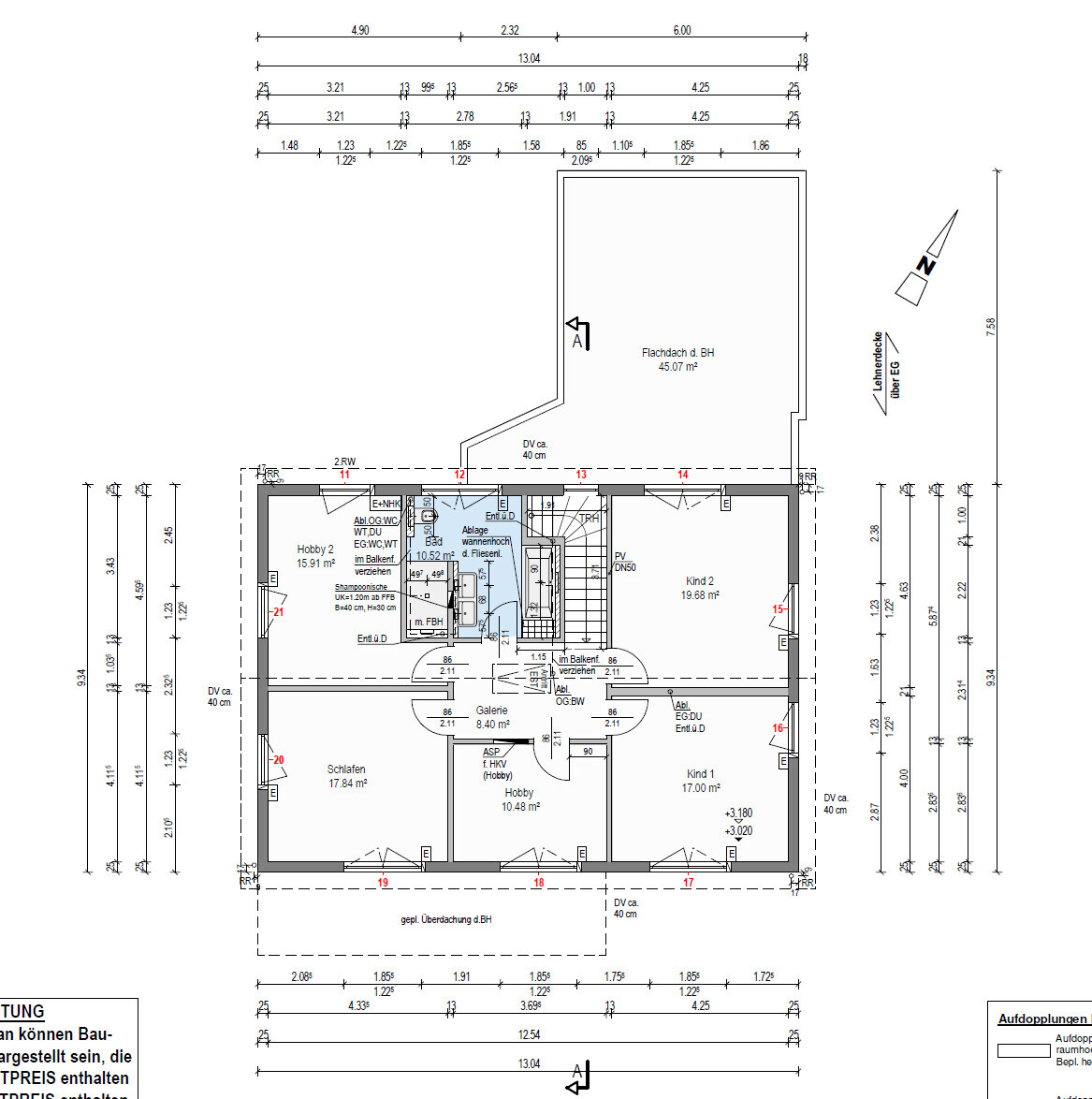
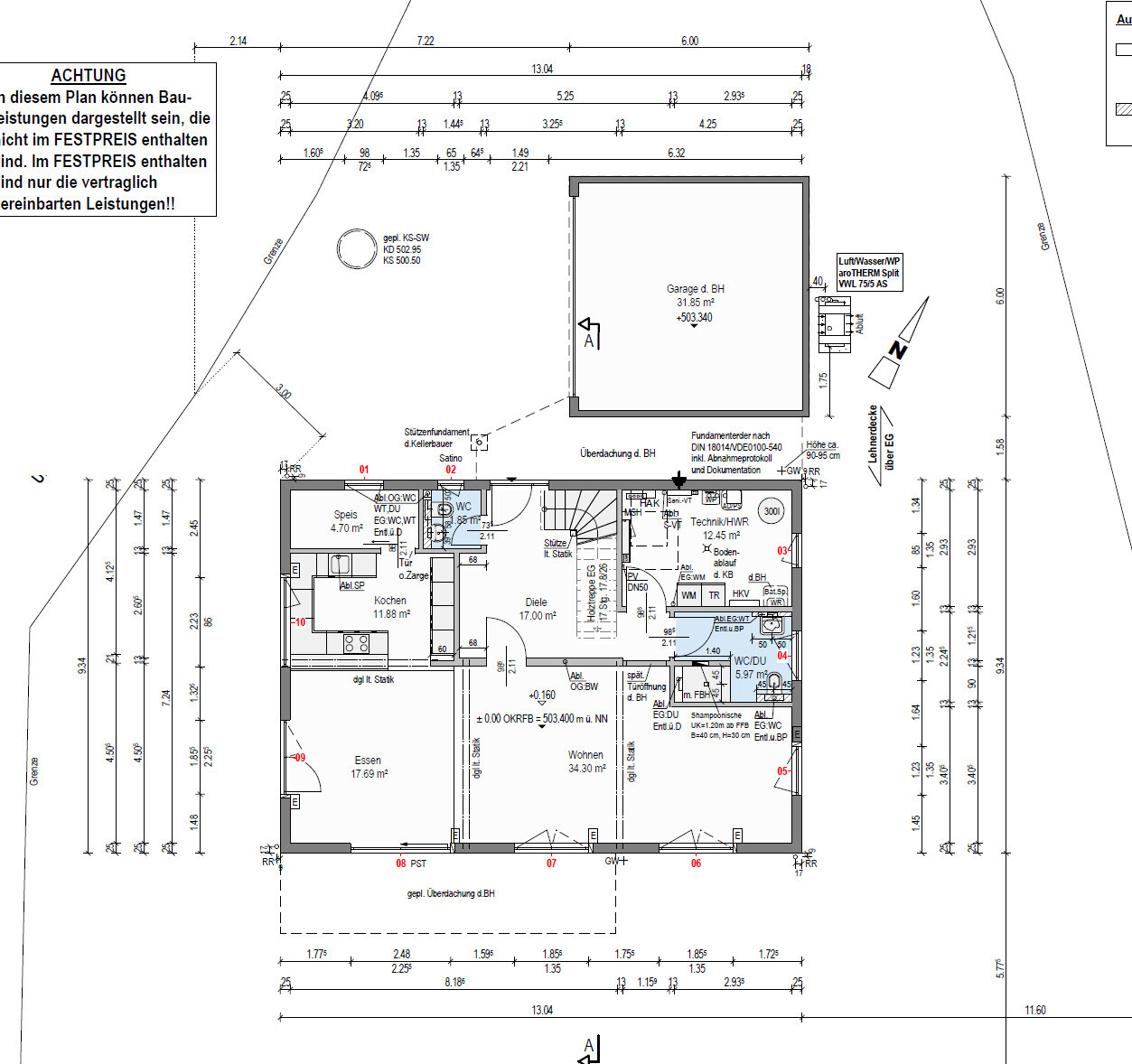
I am currently working with the company Lehner Haus from Heidenheim to build my prefabricated timber-frame house. During the plan review, the topic of which air-to-water heat pump to use came up. I tried to get some information beforehand, but I would still appreciate hearing your opinions.
First, a few details about the build itself. The plan is for an Efficiency House 55 with about 200 sqm (2,150 sq ft) of living space. I am attaching the plans as well. A floor heating system is planned for all rooms except the pantry and technical room. Four people will live in the house. I would describe our usage habits as normal or average. At the moment, nobody spends 30 minutes straight in the shower. The bathtub is currently used about every two weeks. Of course, this may change as my children get older. Temperature-wise, the bedroom is kept rather cool. The living room is around 20–21°C (68–70°F). The bathroom is naturally a bit warmer, and at least the upstairs bathroom will have a towel radiator.
Lehner Haus offers two heat pump providers: Vaillant and Viessmann. Currently, the price includes a Vaillant Arotherm Split 105/5 AS, a 300-liter (79 gallon) hot water storage tank, and a compact buffer tank VWZ MPS40. A complete heating load calculation is not yet available. However, a rough preliminary estimate by the company indicated that the heating system is oversized and that a 75/5 AS or 85/5 AS would likely be sufficient. They also recommended switching from the aroTherm Split to an aroTherm Plus. Lehner Haus’s current recommendation is a Vaillant aroTherm Plus 75/6 A S2.
Here, I am uncertain whether this will be sufficient, and I also wonder why a much larger heat pump was originally offered. In various online posts, I read that heat pumps are sometimes undersized, causing inefficient operation because they have to run at "high load." But I also see the opposite advice that heat pumps should not be planned too large. As a layperson, it is also difficult for me to compare which heat pump is better (Split or Plus). As far as I understand, the Plus model is more efficient and quieter. But is it worth the extra cost? And does Viessmann maybe offer comparable cheaper units or better models for the same price? Viessmann also won at Stiftung Warentest in the current issue. Of course, only Lehner Haus can tell me the final price.
Removing the heat pump from Lehner Haus’s scope of work is unfortunately not an option for me, since I would then have to exclude both the underfloor heating and the entire plumbing installation as well (it’s apparently the same team).
Could you possibly help me here and give recommendations on what the right choice is? I need to make a final decision at the beginning of November.
Many thanks,
Best regards,
ToBu1991
R
RotorMotor1 Oct 2023 15:41ToBu1991 schrieb:
A complete heating load calculation is not yet available. Then choose the heating system only once that is done.
ToBu1991 schrieb:
In various posts online, you can read that heat pumps were planned too small and therefore operate inefficiently because they have to run at "too high" power. However, you also find opposite statements that the heat pump should not be oversized. The heat pump needs to be properly sized.
If it is "too large" and especially cannot modulate down enough, it will short cycle—turning on and off frequently. This significantly reduces its lifespan.
If it is too weak, the electric heating element (backup heater) has to come in during very cold temperatures, which increases electricity costs.
For example, we have a 7.5 kW Vaillant heat pump for just under 200m² (2150 sq ft), and it is clearly oversized. We chose it only because it was heavily subsidized at the time by Bafa.
K
KarstenausNRW1 Oct 2023 16:37ToBu1991 schrieb:
In various posts online, you sometimes read that heat pumps are undersized and therefore operate inefficiently because they have to run at "full power" too often. On the other hand, there are also opposite statements saying that heat pumps shouldn’t be oversized. Explanation:
A heating load calculation is based on the standard outdoor temperature, for example, maybe -15°C (5°F). However, this temperature occurs on very few days, if at all. So, the heating system – in this case the heat pump – usually only needs to work at a fraction of its capacity.
If the heat pump is oversized and cannot modulate down far enough, it will start short cycling. That means it turns on, pumps heat into the house, and then turns off again. This is not good for the unit. If the heat pump is the right size or slightly smaller than required, it will operate 95-98% of the year within its optimal performance range. If the heat pump is so small that it can’t maintain the temperature at -15°C (5°F) over several days (meaning daily temperatures at -15°C), then an auxiliary heater (electric backup) is needed.
In my region, I do not recall the standard design temperatures being reached anymore. Maybe just as an occasional cold snap at night. This does not bother the heat pump because the house would have to cool down significantly before the auxiliary heater is used.
Experience shows that using a correctly sized or slightly smaller heat pump provides very good and especially efficient results.
ToBu1991 schrieb:
Also, as a layperson, it is difficult for me to compare which heat pump is better (split or plus). As far as I understand, the Plus model is more efficient and quieter. Is it worth the extra cost? The Plus model is primarily designed for older buildings or renovations. I cannot think of a single reason to install this model in a new build, unless it is cheaper.
Otherwise, wait for the room-by-room heating load calculation and then look for the unit that fits those requirements.
R
RotorMotor1 Oct 2023 18:08KarstenausNRW schrieb:
The Plus is actually designed as a unit for older buildings / renovations. I can’t think of a single reason to install it in new construction. Unless it was cheaper.
The Plus is simply a completely different unit. A monoblock where water is circulated instead of refrigerant lines.
More efficient and uses a more modern refrigerant.
K
KarstenausNRW1 Oct 2023 18:47RotorMotor schrieb:
The Plus model is simply a completely different device.
A monoblock system where water is circulated instead of refrigerant lines.
More efficient and uses a more modern refrigerant. I understand that already. But for new construction, I don’t need a heat pump designed for 55°C (131°F) supply temperature – that is specifically for older buildings or renovations. A “standard” heat pump is sufficient for me. I also personally prefer monoblocks and have installed two myself.
Otherwise, see
Hello everyone,
First of all, thanks for the informative replies.
I understood that I need to wait for the heating load calculation before making the final decision. I was more looking for an initial assessment of whether the mentioned models would even be suitable.
I will also upload the heating load calculation as soon as I have it.
The Plus model costs me between 2,000 and 3,000 euros more depending on the model (75/105) compared to the Split. If it doesn’t really offer any added value, I’m happy to skip it.
I’m also open to other models from both manufacturers (Vaillant/Viessmann) if that makes sense. Are there any other reasonable options here, or is the aroTherm Split basically the most sensible choice?
First of all, thanks for the informative replies.
I understood that I need to wait for the heating load calculation before making the final decision. I was more looking for an initial assessment of whether the mentioned models would even be suitable.
I will also upload the heating load calculation as soon as I have it.
The Plus model costs me between 2,000 and 3,000 euros more depending on the model (75/105) compared to the Split. If it doesn’t really offer any added value, I’m happy to skip it.
I’m also open to other models from both manufacturers (Vaillant/Viessmann) if that makes sense. Are there any other reasonable options here, or is the aroTherm Split basically the most sensible choice?
Similar topics