
ᐅ Evaluation of Solar Power System Proposal with Battery Storage
Created on: 26 Sep 2023 13:02
D
Dachshund90
Hello everyone,
After several inquiries and offers, I now have what I consider the most cost-effective offer (see details below). I am still unsure about the "necessity" of the battery storage. I believe there is no clear "yes" or "no" answer here.
Based on your experience and what is known so far, is the payback of the battery storage guaranteed within the warranty period? I don’t think the battery will make you rich or poor, but you can make the most sensible decision now.
How do you evaluate the offer and the components in general? Does anyone perhaps have a comparable system and experience to share?
Photovoltaic system 11.9 kWp with 9.6 kWh battery storage
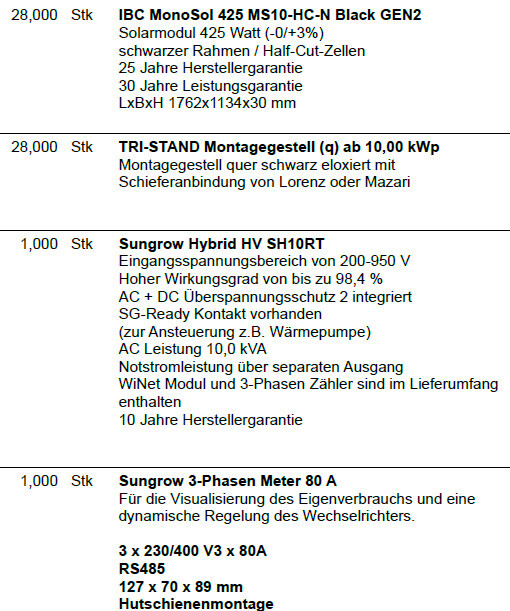
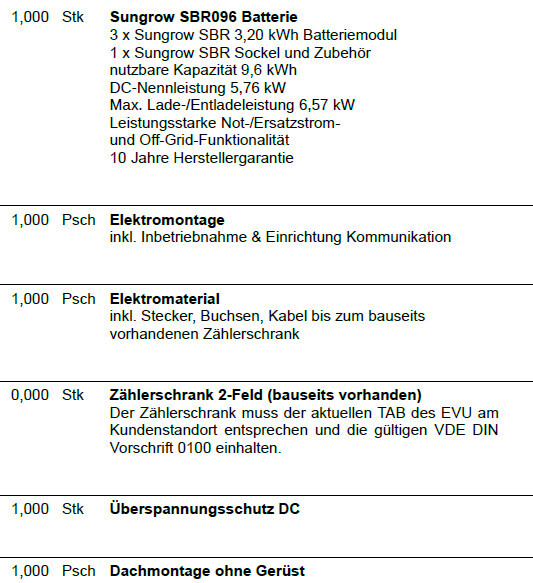
Total price just under 24,500 € (euros)
Best regards
After several inquiries and offers, I now have what I consider the most cost-effective offer (see details below). I am still unsure about the "necessity" of the battery storage. I believe there is no clear "yes" or "no" answer here.
Based on your experience and what is known so far, is the payback of the battery storage guaranteed within the warranty period? I don’t think the battery will make you rich or poor, but you can make the most sensible decision now.
How do you evaluate the offer and the components in general? Does anyone perhaps have a comparable system and experience to share?
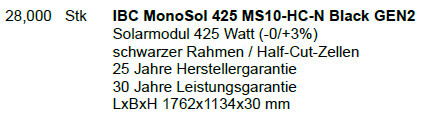
Photovoltaic system 11.9 kWp with 9.6 kWh battery storage
Total price just under 24,500 € (euros)
Best regards
Buchsbaum schrieb:
And ask photovoltaic system owners about the actual yield in August 2023 and the related forecasts. Expected yield (without considering partial shading until 12 noon): 3,307 kWh
Yield 2021: 2,701 kWh
Yield 2022: 3,174 kWh
Yield 2023: 2,844 kWh
So, what now? This is neither dramatic nor surprising. This year had comparatively poor weather. August isn’t actually that good, despite what you might think because of the summer weather. It’s often very hot in August, and heat reduces the performance of the modules. Additionally, the sun is already lower in the sky.
My best month so far was May 2022 with 4,002 kWh.
B
Buchsbaum30 Sep 2023 22:48It’s great that you provide specific numbers. Thank you!
You have a large feed-in system, not just a 10 kWp system. As you yourself mentioned, your system is significantly below the expected yield.
That’s exactly what I meant – forecasts are one thing, actual results are another.
My system has 7.2 kWp, the inverter is rated at 6 kW, and the system usually delivers a realistic output of 4.5 to 5 kWp. Sometimes, like in May, it nearly reaches the 6 kW. But it’s not the case that if you build a 10 kWp system, you will get 10 kW output just because the sun is shining. That’s simply not how it works.
Even if you do get 8 kW from the roof, what do you do with that? A normal household can’t really use that much power. A battery would be fully charged in roughly 2 hours. Feeding electricity back into the grid from small systems doesn’t really make much sense either.
With my 7.2 kWp system and a 10 kW battery, I still feed about 2,500 kWh into the grid annually. That earns me about 200 euros per year. It’s negligible. Without my battery, I would feed in around 4,500 kWh, which also doesn’t make a big difference.
My system is clearly too small for charging an electric car.
Moreover, the car would have to be at home during the day to charge, which usually isn’t the case. I rarely drive at night.
What would really help is a battery solution provided by the grid operator. I could feed electricity into the grid in summer and draw it again in winter.
That way, I could be self-sufficient even with a smaller system, and it would be cost-neutral. But we are still a long way from that.
You have a large feed-in system, not just a 10 kWp system. As you yourself mentioned, your system is significantly below the expected yield.
That’s exactly what I meant – forecasts are one thing, actual results are another.
My system has 7.2 kWp, the inverter is rated at 6 kW, and the system usually delivers a realistic output of 4.5 to 5 kWp. Sometimes, like in May, it nearly reaches the 6 kW. But it’s not the case that if you build a 10 kWp system, you will get 10 kW output just because the sun is shining. That’s simply not how it works.
Even if you do get 8 kW from the roof, what do you do with that? A normal household can’t really use that much power. A battery would be fully charged in roughly 2 hours. Feeding electricity back into the grid from small systems doesn’t really make much sense either.
With my 7.2 kWp system and a 10 kW battery, I still feed about 2,500 kWh into the grid annually. That earns me about 200 euros per year. It’s negligible. Without my battery, I would feed in around 4,500 kWh, which also doesn’t make a big difference.
My system is clearly too small for charging an electric car.
Moreover, the car would have to be at home during the day to charge, which usually isn’t the case. I rarely drive at night.
What would really help is a battery solution provided by the grid operator. I could feed electricity into the grid in summer and draw it again in winter.
That way, I could be self-sufficient even with a smaller system, and it would be cost-neutral. But we are still a long way from that.
Buchsbaum schrieb:
Your system is, as you yourself wrote, clearly below the projected yield. Where did I write that? In the worst year so far, 18% below the projection during a rainy month. Also, I pointed out that the projection isn’t realistic because it doesn’t take existing shading into account. I don’t think that’s bad. And even so, in good months I’m actually above the projection. Now in September 2023: projection 2,362 kWh, yield 2,637 kWh.
Buchsbaum schrieb:
What would help us further is an energy storage solution from the grid operator. I feed electricity into the grid in summer and withdraw it in winter. That would make me self-sufficient even with a smaller system and cost-neutral. But we are miles away from that. Why is that? Because it’s purely an unrealistic selfish idea. For that to work, generation and demand would have to balance across the broad population and throughout the year. But in practice, EVERYONE wants to feed in during summer and withdraw in winter. Where is the grid operator supposed to put the electricity in summer and where to get it from in winter? “In a storage solution,” you would probably answer. Well, such a solution does not exist because it’s not profitable—just like a home battery that would last until winter would be unprofitable.

Boy, boy, you’re contradicting yourself. First, you say storage is great and indispensable, now you’re actually saying the opposite.
No idea what kind of data you’re throwing around... I don’t understand your rambling.
Now to the numbers: My system, currently still 6.5 kWp (kilowatt peak) ;-), has generated exactly 18,205 kWh (kilowatt-hours) in almost 2 years (from October 21, 2021, to today). Of that, I was able to consume 8,072 kWh myself (ground-source heat pump, one electric car since 11/2021, another since 02/2023). In total, I have consumed 17,729 kWh, fed 6,681 kWh back into the grid, and drawn 9,657 kWh.
August 2023, with 780 kWh, was indeed not the best month; that was June with 1,087 kWh. There is plenty in summer anyway, so that’s not a problem. Winter is critical. (P.S. Due to mandatory requirements for KfW40+ standard, I have a small battery with just under 4 kWh (kilowatt-hours) capacity, but I’m glad to have it. At “normal” prices, this battery usually doesn’t pay off.)
No idea what kind of data you’re throwing around... I don’t understand your rambling.
Now to the numbers: My system, currently still 6.5 kWp (kilowatt peak) ;-), has generated exactly 18,205 kWh (kilowatt-hours) in almost 2 years (from October 21, 2021, to today). Of that, I was able to consume 8,072 kWh myself (ground-source heat pump, one electric car since 11/2021, another since 02/2023). In total, I have consumed 17,729 kWh, fed 6,681 kWh back into the grid, and drawn 9,657 kWh.
August 2023, with 780 kWh, was indeed not the best month; that was June with 1,087 kWh. There is plenty in summer anyway, so that’s not a problem. Winter is critical. (P.S. Due to mandatory requirements for KfW40+ standard, I have a small battery with just under 4 kWh (kilowatt-hours) capacity, but I’m glad to have it. At “normal” prices, this battery usually doesn’t pay off.)
Buchsbaum schrieb:
With my system of 7.2 kWp and 10 kW battery storage, I still feed 2500 kWh into the grid. That brings me 200 euros per year.
Not worth much. Without my battery, I would feed about 4500 kWh into the grid. That doesn’t change much financially either. That’s simply because your battery is too large for the system. With 4500 kWh fed into the grid, the system pays for itself comfortably. Plus, there is the savings from reduced energy consumption.
Last year, I fed 18,830 kWh into the grid. That brought 1,750 euros in compensation, plus 1,120 euros saved on energy consumption.
B
Buchsbaum1 Oct 2023 11:02Fuchur schrieb:
With 4500 kWh feed-in, the system pays for itself quite comfortably. 4500 x €0.08 per kWh equals €360 feed-in tariff per year in my case. That’s €7,200 in feed-in tariff over 20 years. That doesn’t add up to a comfortable payback.
In my case, the battery saves me 2000 kWh less grid consumption, which means about €800 savings annually. It paid off after 6 years.
I don’t see what the problem is. Solar PV systems in Germany are heavily subsidized. Batteries are too. Modules with a 430 heat pump are available for €100, and 10 kW batteries already cost around €4,000. Solar power has never been this affordable.
Anyway. I made a simple calculation for myself. I have €10,000 in savings. Until last year, I had an electricity bill of €1,800. My system cost €10,000. Now I only pay about €60 for electricity. That means annual savings of €1,200.
Over 20 years, that’s a saving of €24,000, plus the current estimated €3,200 in feed-in tariff.
No financing costs, just €40 per year for system insurance. The battery and modules have 10 and 20 years warranty, respectively.
What else is there to calculate? For me, it adds up and I’m satisfied.
Similar topics