
ᐅ Evaluation of Solar Power System Proposal with Battery Storage
Created on: 26 Sep 2023 13:02
D
Dachshund90
Hello everyone,
After several inquiries and offers, I now have what I consider the most cost-effective offer (see details below). I am still unsure about the "necessity" of the battery storage. I believe there is no clear "yes" or "no" answer here.
Based on your experience and what is known so far, is the payback of the battery storage guaranteed within the warranty period? I don’t think the battery will make you rich or poor, but you can make the most sensible decision now.
How do you evaluate the offer and the components in general? Does anyone perhaps have a comparable system and experience to share?
Photovoltaic system 11.9 kWp with 9.6 kWh battery storage
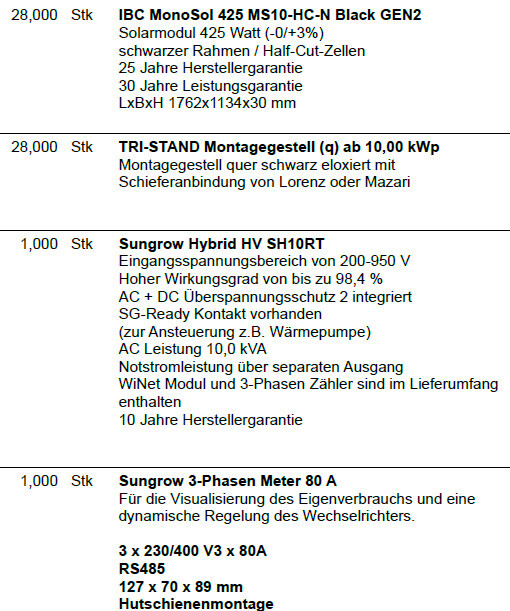
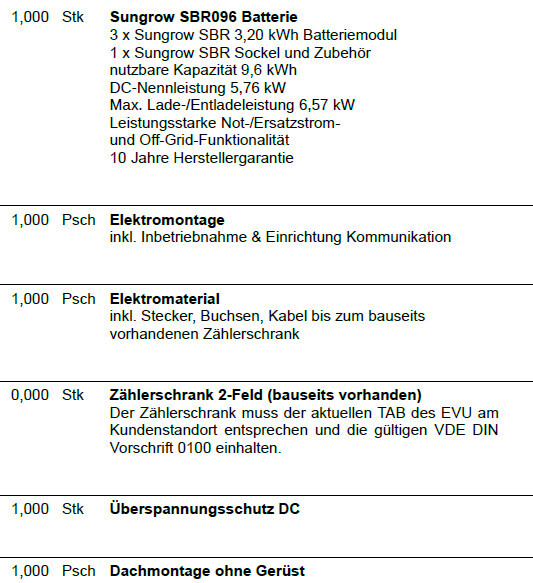
Total price just under 24,500 € (euros)
Best regards
After several inquiries and offers, I now have what I consider the most cost-effective offer (see details below). I am still unsure about the "necessity" of the battery storage. I believe there is no clear "yes" or "no" answer here.
Based on your experience and what is known so far, is the payback of the battery storage guaranteed within the warranty period? I don’t think the battery will make you rich or poor, but you can make the most sensible decision now.
How do you evaluate the offer and the components in general? Does anyone perhaps have a comparable system and experience to share?
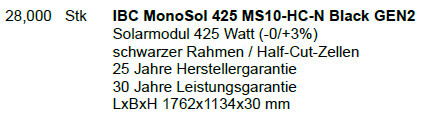
Photovoltaic system 11.9 kWp with 9.6 kWh battery storage
Total price just under 24,500 € (euros)
Best regards
R
RotorMotor29 Sep 2023 06:52An initial estimate using PVGIS shows 950 kWh on SE and 680 kWh on NW per kWp per year.
For more precise values, you would need the region, the exact orientation angle of the house (I looked at 50 degrees), and the area where the house is located.
But it is already clear that the SE side should be fully utilized, so it should be checked whether adding another row is possible.
The NW side, on the other hand, is unlikely to be cost-effective.
It would have to be about 30 percent cheaper than the SE side.
So, could you provide quotes for the SE side as fully covered as possible, and also for SE + NW fully covered?
For more precise values, you would need the region, the exact orientation angle of the house (I looked at 50 degrees), and the area where the house is located.
But it is already clear that the SE side should be fully utilized, so it should be checked whether adding another row is possible.
The NW side, on the other hand, is unlikely to be cost-effective.
It would have to be about 30 percent cheaper than the SE side.
So, could you provide quotes for the SE side as fully covered as possible, and also for SE + NW fully covered?
D
Dachshund9029 Sep 2023 12:05RotorMotor schrieb:
An initial estimate with PVGIS shows 950 kWh on the SE and 680 on the NW per kWp per year.
For more accurate values, you would need the exact region, the precise orientation angle of the house (I looked at 50 degrees), and the area where the house is located.
But you can already see that the SE side should definitely be fully covered, so it’s worth checking if an additional row fits.
NW, on the other hand, is unlikely to be cost-effective.
It would have to be about 30 percent cheaper than SE.
So, request quotes again for SE as fully covered as possible and SE+NW fully covered?Hello RotorMotor, thanks for your help. I don’t have the exact orientation angle, but according to the site plan, we should be close to 50 degrees. We are located in the Marburg-Biedenkopf district. Since we have a nice view, the sun shines more or less unobstructed, only setting behind a forest about 100 m (330 feet) away in the evening.
I will ask for a new offer with more panels. One thing I’m wondering: does it still make sense to install some modules on the NW side to generate some electricity in the evening for our own use, even if it is less efficient? I think in the late afternoon there is usually a higher demand for electricity, and depending on the season, the sun may have already disappeared from the SE side.
Best regards
R
RotorMotor29 Sep 2023 21:22Dachshund90 schrieb:
Hello RotorMotor.
Thank you for your help. I don’t have the exact tilt angle, but I think, according to the open space plan, we should be around 50 degrees. We are located in the Marburg-Biedenkopf district. Since we have a nice view, the sun shines more or less unobstructed, only setting behind a forest about 100m (330 feet) away in the evening. Then my estimates should be pretty accurate.
Dachshund90 schrieb:
I will request a quote again with more panels. One thing I’m still wondering: does it still make sense to have some modules facing northwest to generate a bit of electricity in the evening for self-consumption, even if it’s less efficient? I suspect it’s generally not very worthwhile to install just a few panels facing north.
Because that would reduce overall generation by about 20%.
Whether this reduced output can be compensated by higher self-consumption is debatable, but not impossible.
However, this can be tested using PVGIS. Simply set it to daily data and try different tilt angles for various months.
B
Buchsbaum30 Sep 2023 10:08Once again.
You can calculate however you want, but after about four weeks, you will regret having installed a photovoltaic system without a battery storage.
That will be when your electricity meter starts running backward and you have to draw expensive power from the grid.
And I’m telling you, your frustration will begin within just a few days. Also because, in most cases, the calculations do not match the actual yield.
For a system that feeds electricity purely into the grid to be worthwhile, you need to exceed 30 kWp.
Anything less is just a game.
And when electricity prices rise to 60 cents and above in a few years, and everyone starts demanding battery storage, will you want to upgrade?
But by all means, listen to all the nonsense and skip the battery storage. I have one and I’m happy with it. But you will remember my words.
You can calculate however you want, but after about four weeks, you will regret having installed a photovoltaic system without a battery storage.
That will be when your electricity meter starts running backward and you have to draw expensive power from the grid.
And I’m telling you, your frustration will begin within just a few days. Also because, in most cases, the calculations do not match the actual yield.
For a system that feeds electricity purely into the grid to be worthwhile, you need to exceed 30 kWp.
Anything less is just a game.
And when electricity prices rise to 60 cents and above in a few years, and everyone starts demanding battery storage, will you want to upgrade?
But by all means, listen to all the nonsense and skip the battery storage. I have one and I’m happy with it. But you will remember my words.
R
RotorMotor30 Sep 2023 10:31Buchsbaum schrieb:
You can calculate however you want, but after 4 weeks at the latest you’ll regret installing a photovoltaic system without storage.
That is when your electricity meter starts running and you have to draw expensive power from the grid. Electricity meters no longer run backwards.
So there is no reason to regret that.
Buchsbaum schrieb:
For a feed-in-only system to be worthwhile, you need to go above 30 kWp.
Anything less is just a toy. More is always better, but you set no real limits.
The real toy here is your storage.
Buchsbaum schrieb:
But by all means, listen to all the nonsense talkers and skip the storage. I have one and I’m happy with it. But you will remember my words later. Yes, better not listen to those who bring formulas, simulations, and calculations.
Gut feelings from emotional people who strictly refuse to share any data about their own system are much more reliable.
But it’s good to hear that you’re happy!
B
Buchsbaum30 Sep 2023 10:53From what I have heard, there are currently significant delivery delays for digital electricity meters, which are exclusively sourced from China. Many photovoltaic systems are therefore still not operational or face long waiting times before commissioning. There are still plenty of analog electricity meters spinning. We are a high-tech country, after all.
Can you really simulate the weather? Three weeks of fog or sunshine in November can be very close together—often just a few kilometers apart.
With only a few centimeters (inches) of snow on the panels, the output is zero. And ask photovoltaic owners about the actual yield in August 2023 and the forecasts for that period.
Can you really simulate the weather? Three weeks of fog or sunshine in November can be very close together—often just a few kilometers apart.
With only a few centimeters (inches) of snow on the panels, the output is zero. And ask photovoltaic owners about the actual yield in August 2023 and the forecasts for that period.
Similar topics