
ᐅ Evaluation of Solar Power System Proposal with Battery Storage
Created on: 26 Sep 2023 13:02
D
Dachshund90
Hello everyone,
After several inquiries and offers, I now have what I consider the most cost-effective offer (see details below). I am still unsure about the "necessity" of the battery storage. I believe there is no clear "yes" or "no" answer here.
Based on your experience and what is known so far, is the payback of the battery storage guaranteed within the warranty period? I don’t think the battery will make you rich or poor, but you can make the most sensible decision now.
How do you evaluate the offer and the components in general? Does anyone perhaps have a comparable system and experience to share?
Photovoltaic system 11.9 kWp with 9.6 kWh battery storage
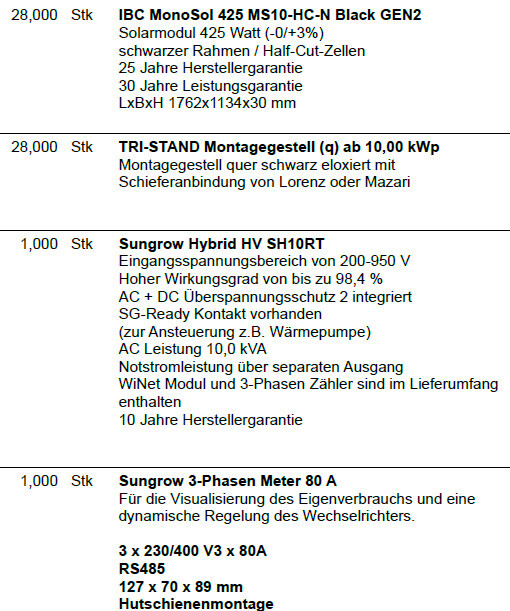
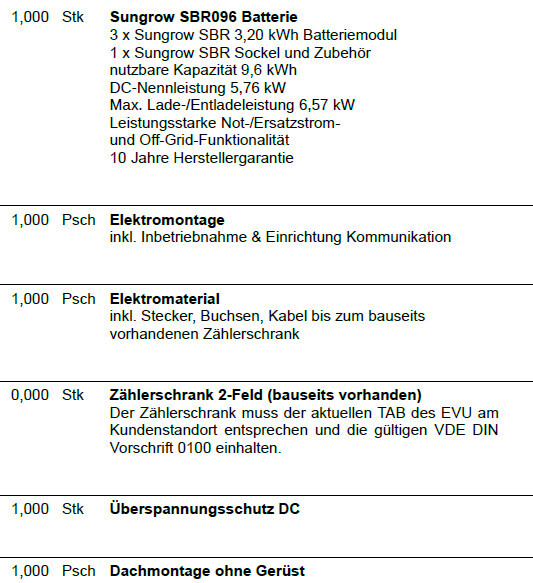
Total price just under 24,500 € (euros)
Best regards
After several inquiries and offers, I now have what I consider the most cost-effective offer (see details below). I am still unsure about the "necessity" of the battery storage. I believe there is no clear "yes" or "no" answer here.
Based on your experience and what is known so far, is the payback of the battery storage guaranteed within the warranty period? I don’t think the battery will make you rich or poor, but you can make the most sensible decision now.
How do you evaluate the offer and the components in general? Does anyone perhaps have a comparable system and experience to share?
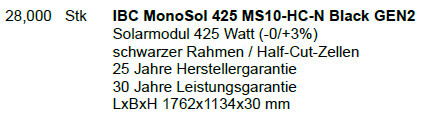
Photovoltaic system 11.9 kWp with 9.6 kWh battery storage
Total price just under 24,500 € (euros)
Best regards
R
RotorMotor27 Sep 2023 12:58Dachshund90 schrieb:
Hello everyone.
The storage system costs 5800€.
How can I best estimate when it will approximately pay off?That depends on the number of cycles you can achieve or need, and also on electricity prices.
Here is an example for 200 cycles per year and 10 years of use:
5800€ / (9kWh x 200 cycles/year x 10 years) = 0.32€/kWh, plus lost feed-in tariff of 0.08€/kWh, resulting in €0.40/kWh for the storage.
Currently, electricity can be bought again at around €0.30/kWh, so the payback period is about 11 years.
For 150 cycles per year:
5800€ / (9kWh x 150 cycles/year x 10 years) = 0.43€/kWh, plus lost feed-in tariff of 0.08€/kWh, resulting in €0.51/kWh for the storage.
Currently, electricity is still easily available for about €0.30/kWh, so the payback period is about 14 years.
There are also conversion losses and similar factors of a few percent to consider.
And now you also have to take into account that the 5800€ should earn interest, and that electricity prices will rise.
At the moment, I would simply assume these effects roughly balance each other out. But of course, this is just an estimate.
D
Dachshund9027 Sep 2023 15:25RotorMotor schrieb:
This depends on the number of cycles you can achieve or need, as well as the electricity prices.
Here’s an example for 200 cycles per year and 10 years of use:
€5800 / (9kWh x 200 cycles/year x 10 years) = €0.32/kWh, plus lost feed-in tariff of €0.08/kWh, resulting in €0.40/kWh from the storage.
Currently, electricity can easily be obtained for €0.30/kWh, so the payback period is about 11 years.
With 150 cycles per year:
€5800 / (9kWh x 150 cycles/year x 10 years) = €0.43/kWh, plus lost feed-in tariff of €0.08/kWh, resulting in €0.51/kWh from the storage.
Currently, electricity can easily be obtained for €0.30/kWh, so the payback period is about 14 years.
There are also conversion losses and other factors of a few percent.
And now you actually have to consider that the €5800 also needs to be financed, and that electricity prices will rise.
At the moment, I would just guess that these effects balance each other out. But of course, that is only a rough estimate.Sorry, my brain is working a bit slowly right now. How do you go from cents per kWh to the payback period? So in the end, it’s a bet on the durability of the storage system?!
W
WilderSueden27 Sep 2023 15:43The calculation confuses me as well, with both lifespan and amortization included. I would approach it differently:
Assumption:
150 cycles per year at 10 kWh → 1500 kWh per year from the storage system
Grid electricity costs 30 cents, feed-in tariff 8 cents
Charging and discharging losses are not considered
The storage then saves 1500 kWh * (30c - 8c) = €330 annually, meaning it amortizes after about 17.6 years.
At 200 cycles, this amounts to €440 per year or 13.2 years amortization time.
The storage is worthwhile if it remains usable after amortization.
The durability of the storage system is the big question. After 10 years, capacity loss is to be expected. On the other hand, the storage doesn’t suddenly fail at a certain date (though this can happen in principle). Storage units are now often advertised with 10,000 cycles, which would last a very long time.
This calculation is more of a rough estimate. Interest is not included, electricity prices are assumed constant, and cycles per year are fixed. For example, with electricity prices around 40 cents/kWh, even 150 cycles would mean amortization after 12 years. Conversely, if you believe those advocating cheap renewable energy at well below 30 cents/kWh, a storage system would definitely not be economically viable.
Assumption:
150 cycles per year at 10 kWh → 1500 kWh per year from the storage system
Grid electricity costs 30 cents, feed-in tariff 8 cents
Charging and discharging losses are not considered
The storage then saves 1500 kWh * (30c - 8c) = €330 annually, meaning it amortizes after about 17.6 years.
At 200 cycles, this amounts to €440 per year or 13.2 years amortization time.
The storage is worthwhile if it remains usable after amortization.
The durability of the storage system is the big question. After 10 years, capacity loss is to be expected. On the other hand, the storage doesn’t suddenly fail at a certain date (though this can happen in principle). Storage units are now often advertised with 10,000 cycles, which would last a very long time.
This calculation is more of a rough estimate. Interest is not included, electricity prices are assumed constant, and cycles per year are fixed. For example, with electricity prices around 40 cents/kWh, even 150 cycles would mean amortization after 12 years. Conversely, if you believe those advocating cheap renewable energy at well below 30 cents/kWh, a storage system would definitely not be economically viable.
R
RotorMotor27 Sep 2023 15:45Dachshund90 schrieb:
Sorry, my brain is a bit slow right now. How do you get from the cents/kWh to the payback period? Sorry, I probably should have explained that more clearly.
I rearranged the formula and used 30 cents/kWh, which is what you pay when you buy electricity instead of taking it from the storage system:
€5800 / (9 kWh × 150 cycles/year × €0.30/kWh)
But now that you ask again, I realize I didn’t factor in the lost feed-in tariff.
So actually, you only save 0.22 cents/kWh by using stored electricity instead of buying it.
That correctly results in: €5800 / (9 kWh × 150 cycles/year × €0.22/kWh) = 19.5 years
Dachshund90 schrieb:
So it’s basically a bet on the storage system’s lifespan?! Yes, and on the future development of electricity prices.
But as you often read, a storage system apparently involves a lot of emotions.
The feeling of consuming your own electricity (which often isn’t really the case, because the consumer may be on a different phase than the generation), the feeling of giving others less of your “own” electricity, and so on seem for many people to outweigh rational considerations.

RotorMotor schrieb:
At the moment, electricity can easily be obtained again for 30 cents per kWh.But that is at best the dirty kind. It is likely that people investing money in photovoltaics and storage systems are not only looking for savings but also focus on clean energy, and therefore would not buy non-renewable electricity.
If you value genuine green electricity without certificate trading, you are more likely to pay starting from 40 cents per kWh.
K
KarstenausNRW27 Sep 2023 16:34WilderSueden schrieb:
Grid electricity costs 30 cents,100% green electricity is currently available for at least 24.66 cents. Contract signed two weeks ago. Even from the municipal utility company and not some mailbox energy provider.Similar topics