
ᐅ Electrical Planning / Lighting Design / Networking for New Construction – Experiences?
Created on: 20 Sep 2023 17:50
G
Gregor_K
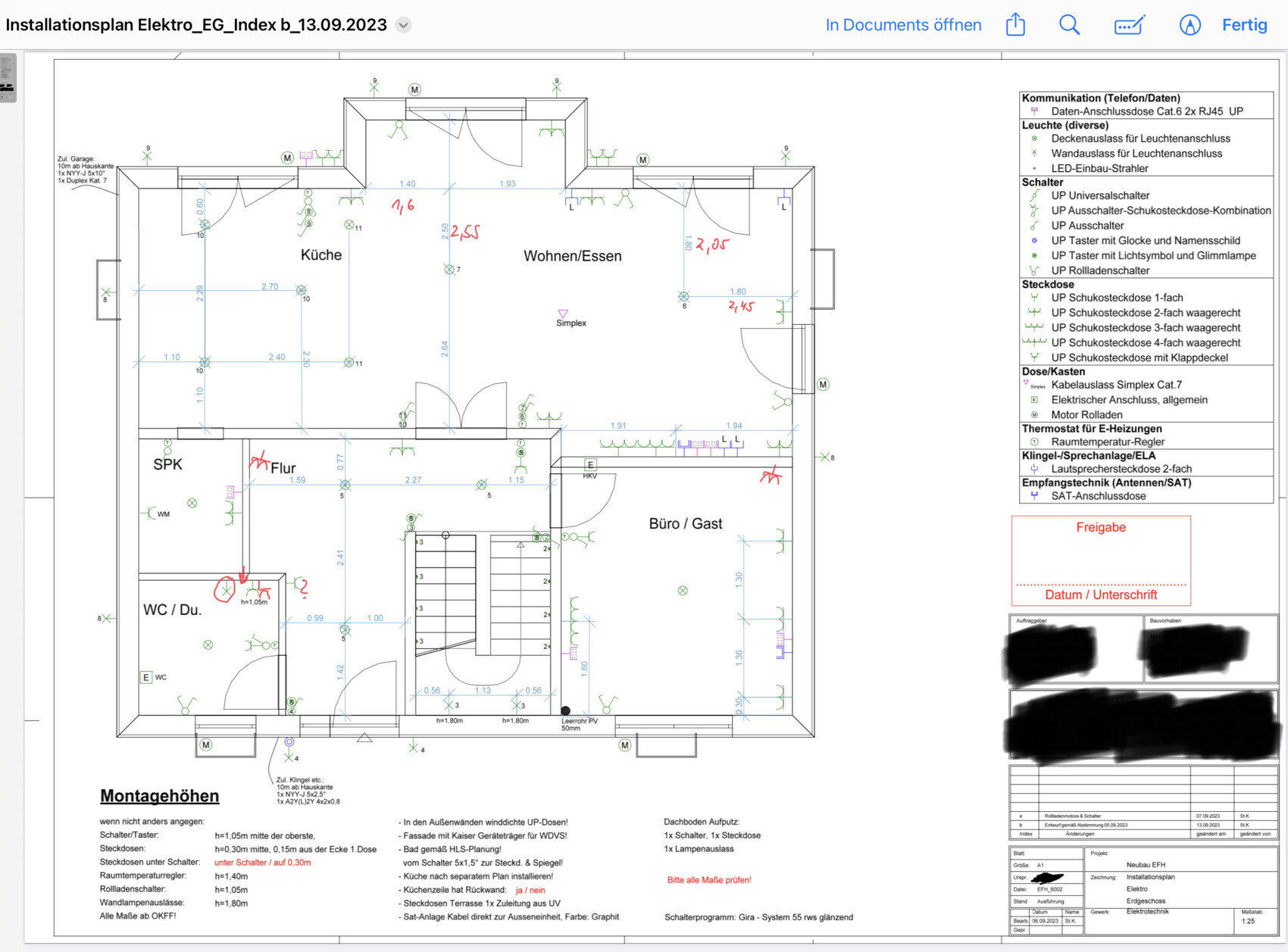
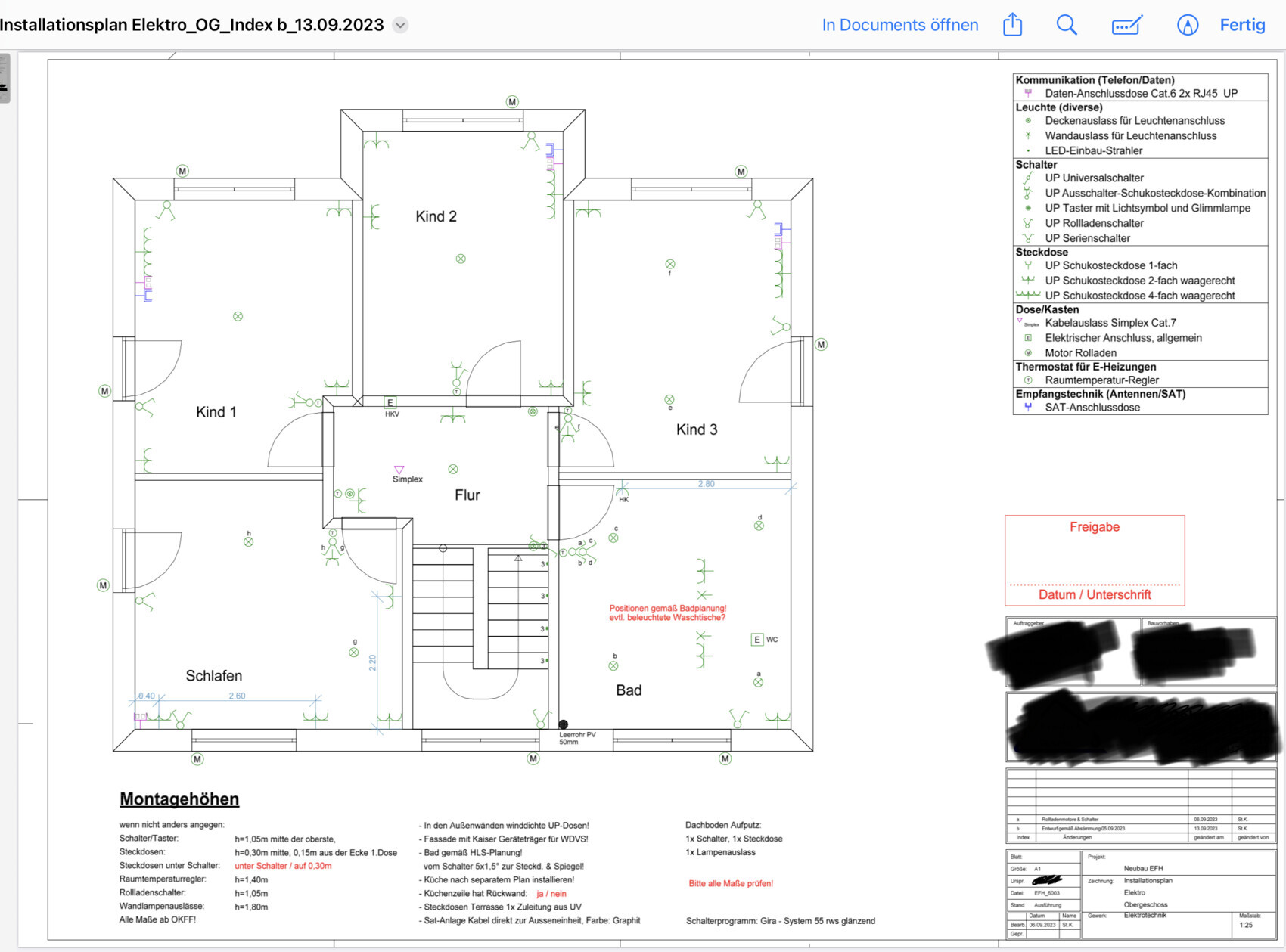
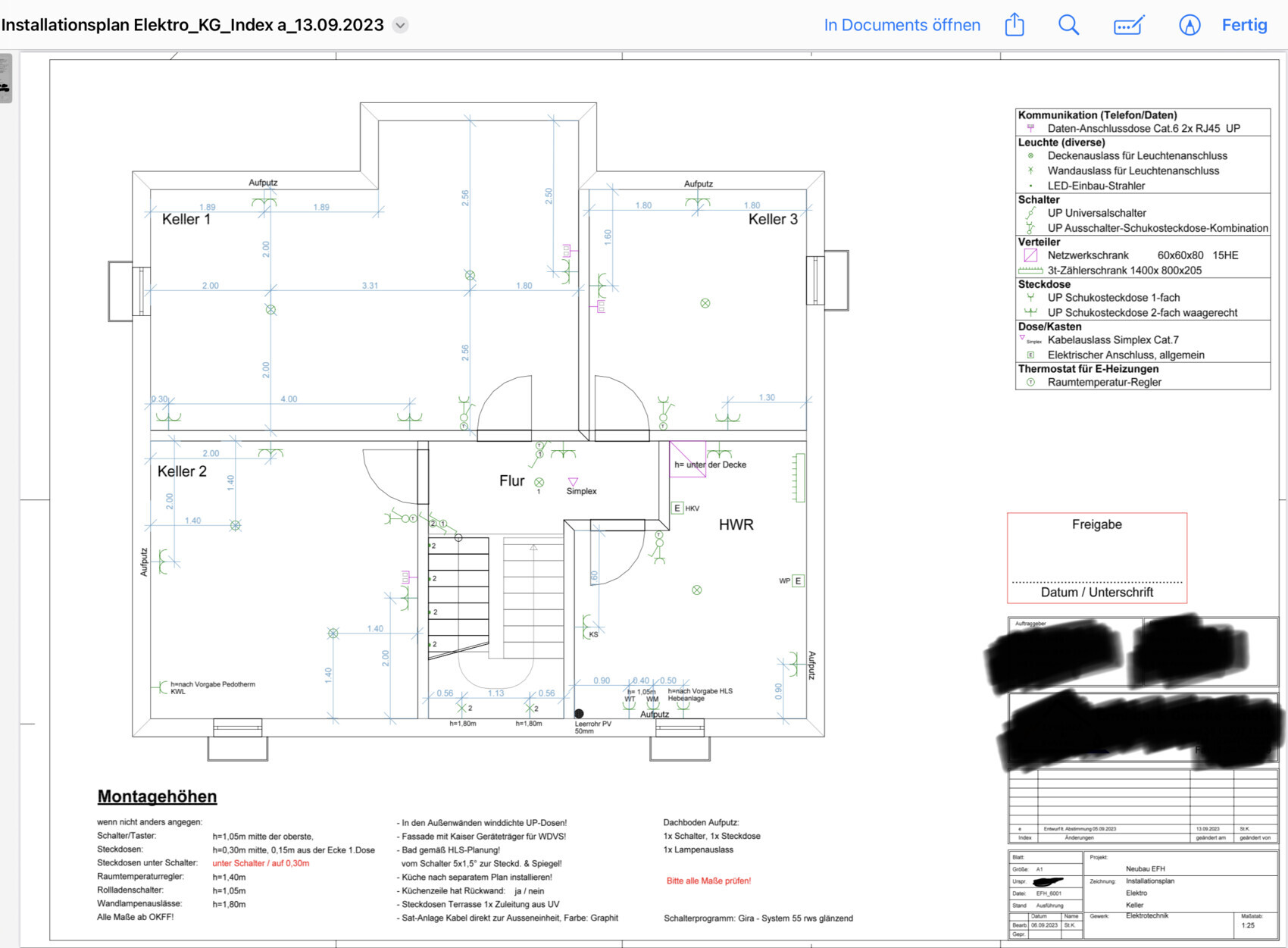
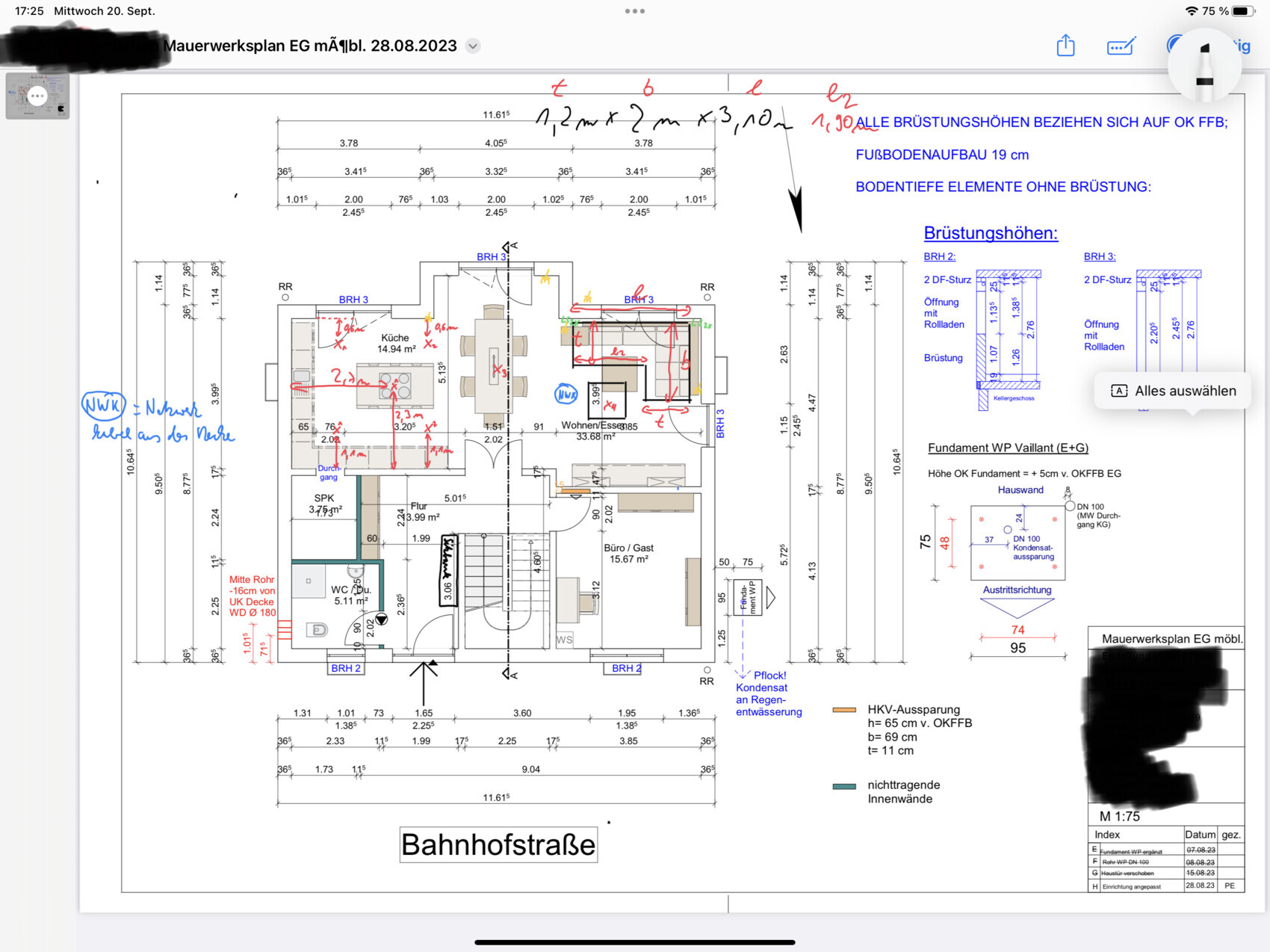
We recently had the electrical planning meeting. During this process, the following plan was created. Unfortunately, no furniture is shown, so I have also included a floor plan with furniture. This is our first time doing something like this. I would appreciate your feedback, as I am sure you can provide valuable advice and some helpful suggestions.
I am particularly uncertain about the kitchen, main bathroom, and staircase areas.
About the house:
- 3 floors: basement + ground floor + upper floor
- approximately 258 sqm (2773 sq ft) of living space on each of the 3 floors
- ceiling height on ground and upper floors: about 2.55 m (8.4 ft)
- ceiling height in basement: about 2.38 m (7.8 ft)
Questions:
Should I really install 5 ceiling light outlets in the kitchen? Although a lot of light is needed, I wonder if this might be too many.
What do you think about the wall outlets in the staircase area?
For rooms of at least 16 sqm (172 sq ft), I have always planned two ceiling outlets. Do you think it is also necessary if the room is, for example, 16.5 sqm (178 sq ft)?
Should I run a cable for illuminated washbasins?
Is a 50 mm (2 inches) empty conduit sufficient for photovoltaics?
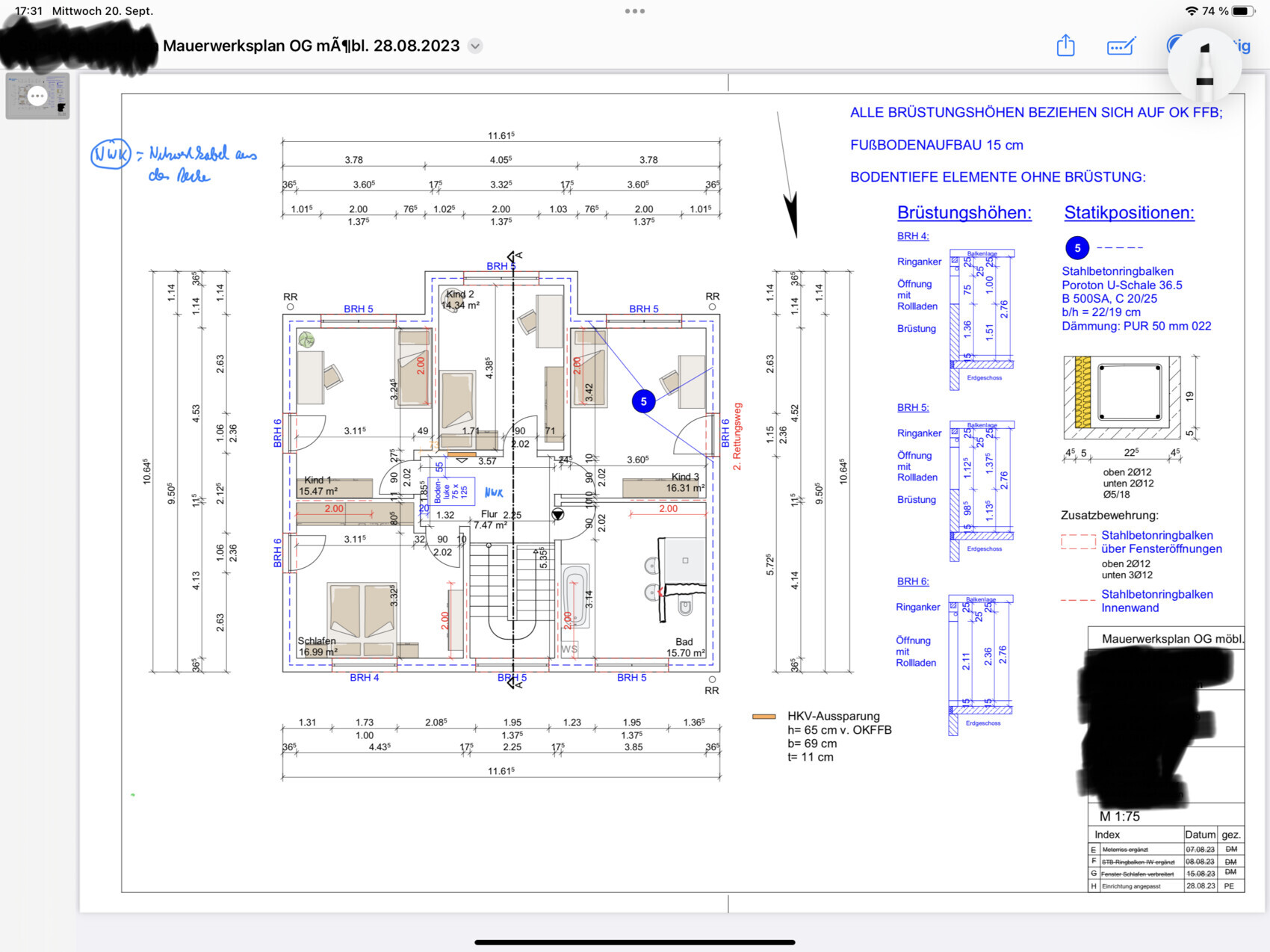
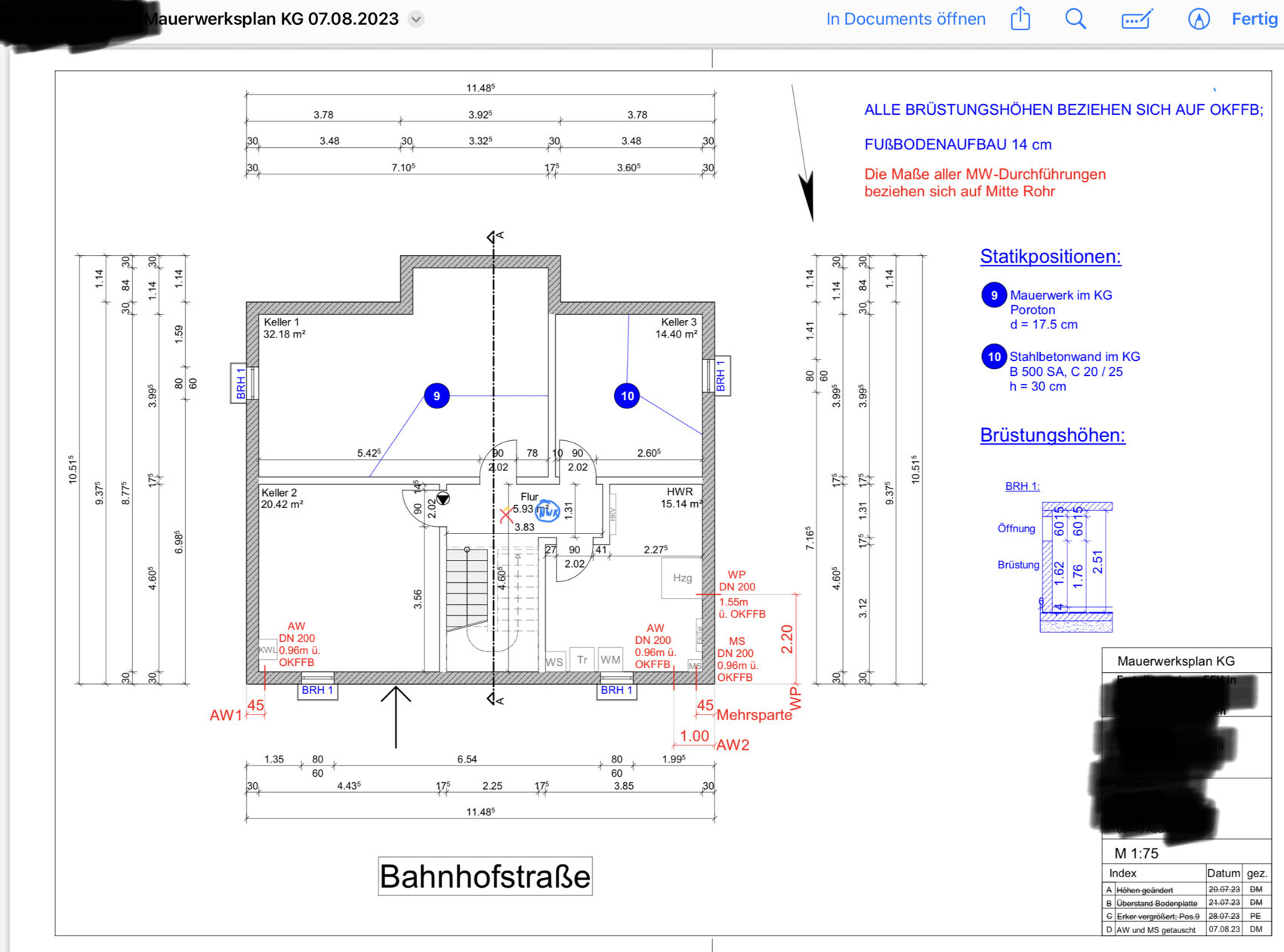
I am particularly uncertain about the kitchen, main bathroom, and staircase areas.
About the house:
- 3 floors: basement + ground floor + upper floor
- approximately 258 sqm (2773 sq ft) of living space on each of the 3 floors
- ceiling height on ground and upper floors: about 2.55 m (8.4 ft)
- ceiling height in basement: about 2.38 m (7.8 ft)
Questions:
Should I really install 5 ceiling light outlets in the kitchen? Although a lot of light is needed, I wonder if this might be too many.
What do you think about the wall outlets in the staircase area?
For rooms of at least 16 sqm (172 sq ft), I have always planned two ceiling outlets. Do you think it is also necessary if the room is, for example, 16.5 sqm (178 sq ft)?
Should I run a cable for illuminated washbasins?
Is a 50 mm (2 inches) empty conduit sufficient for photovoltaics?
Gregor_K schrieb:
The network cables come out of the ceiling as standard cables. I would screw a UniFi access point to the ceiling and connect it via RJ45 with PoE. Does the ceiling need to be suspended for this? If only the cable without a socket comes out of the ceiling, then you have the problem of where to connect the cable, since access points usually have only a very small cavity on the back. You can put a field-installable connector on the cable, but it is so bulky that you won’t be able to plug it into the access point. Typically, a keystone module is installed on the cable, and then a short patch cable connects the keystone jack to the access point. The rest of the cable, the keystone module, and the patch cable are hidden inside the socket, with the access point mounted on top. With a suspended ceiling, you don’t need a socket because the cable can be pushed back into the ceiling cavity. Didn’t you gather any information beforehand?
Gregor_K schrieb:
I wanted to have a network socket outdoors in case someone wants to work on the terrace. 🙂 Maybe this can also be solved via Wi-Fi, but honestly, I don’t know how good the Wi-Fi quality is through Poroton bricks. How should I secure this network socket? If someone plugs in their laptop at night, they would have direct access to your entire network. Do you want that? Access to the network sockets must be prevented. Either you install the network sockets inside a lockable cabinet, or you set up a RADIUS server in your network. The easiest solution would be to install an outdoor access point. I would mount it at a height that requires a ladder to reach.
ypg schrieb:
I don’t understand the ceiling outlets in the kitchen (or elsewhere, e.g., bathroom) at all. Some of them look like billiard balls scattered randomly around the room. When you place more outlets, you usually work with grids or halves, diagonals, equal wall spacings, central lines, thirds, or whatever. But you can’t avoid some kind of logic if you don’t want it to look awkward.
And yes, planning can get really exhausting. I based the planning of the ceiling outlets on the kitchen layout. For example, a kitchen cabinet is 60cm (24 inches) deep and the distance between the kitchen island and the cabinet is 1m (39 inches). Half of that is 0.6m + 0.5m = 1.1m (43 inches). This means the ceiling outlet is exactly centered between the kitchen island and the cabinet.
I’m not sure what you mean by grids, halves, diagonals. Could you explain that in more detail, preferably with an example?
ypg schrieb:
Basically, in the kitchen you should already think about what you want to achieve with so many outlets. We don’t know whether you really like spots or just think there need to be recessed lights everywhere. Tracks are flexible. Do you know what is supposed to be above the stove?
You usually illuminate the countertop under or integrated in the wall units. These are then included in the kitchen order and only need one outlet per row because they are connected in series. To be honest, I’m still not sure what we want to do here.
Idea 1: My first thought was to install 4 recessed spotlights and a larger lamp above the cooktop. I don’t want to install a dropped ceiling (yet) because our ceiling height is only about 2.55m (8 feet 4 inches). So I would go for surface-mounted spots.
Idea 2: Simply distribute 3 ceiling fixtures with relatively high light output, around 1900 lumens, across the room. Above the cooktop, a nice range hood.
Idea 3: A dropped ceiling with many recessed spots and a larger lamp in the center.
What do you think? I am currently leaning toward idea 2.
ypg schrieb:
In bedrooms, I would plan one central ceiling outlet and 2 sockets for a bedside lamp and a floor lamp.
The bigger the room, the more outlets you need. That’s why I don’t understand your question.
Child 3’s room is fine with one ceiling outlet just like Child 1’s. Same for the bedroom. But if you want to light the wardrobe, I would distribute four spots along the height of the window parallel to the wardrobe; the fourth one centered in front of the door, and place the others evenly spaced. A chest of drawers is fine with a table lamp.
Definitely. This light is more important than harsh ceiling light.
It’s similar for us, but we still have a 160cm (63 inches) bed. Similar because a chest of drawers is planned on the right side as it is for us. Pull the chest of drawers away from the wall and then place the bed centered to it. Switches should also be centered with the bed. And if all that changes and the chest of drawers is removed or the bed is moved because it looks better that way, that’s fine and not a problem. The DIN 18015-2 standard specifies how many ceiling outlets a room should have. That’s why I asked about the 16.5m² (178 sq ft). According to the standard, every room over 16m² (172 sq ft) should have 2 ceiling outlets.
hanse987 schrieb:
If only the cable without a junction box comes out of the ceiling, then you have the problem of where to connect the cable because most access points only have a very small cavity on the back. You can put a field-terminable connector on a structured cable, but it is so bulky that you won’t be able to plug it into the access point. Usually, you install a keystone module onto the structured cable and then use a short patch cable to connect to the access point. The rest of the structured cable, keystone module, and patch cable are hidden inside the junction box, over which the access point is mounted. With a suspended ceiling, you don’t need a junction box because the cable can be pushed back into the ceiling cavity. Didn’t you get any information beforehand?Not really yet. My “networking days” are some years behind me. In a pinch, I would have said I’d just connect the access point directly to the structured cable. Of course, that’s not a clean solution. How would you solve this?
hanse987 schrieb:
If someone connects their laptop at night, they get direct access to your entire network. Do you want that? Access to the network outlets must be prevented. Either install the network outlets in a lockable box or configure a RADIUS server in your network. The easiest option would be to install an outdoor access point. I’d mount it at a height where at least a ladder is needed to reach it.Good point! Of course, I don’t want that. My idea was to create a virtual network (VLAN) for the outdoor area that only has internet access. But that’s not ideal either. Would it be better to leave it out altogether?
Gregor_K schrieb:
Idea 2: Simply distribute 3 ceiling lights with relatively high brightness in the room, e.g. 1900 lumens. Above the cooktop, a nice extractor hood.I mentioned in my example: ceiling light is not task lighting. You need light close to the work surface and your hands. If you plan for an extractor hood, you don’t need additional light there because it is integrated into the hood.
As I said before, this is all inconsistent.
Why is there no task lighting planned in the kitchen design?
Gregor_K schrieb:
I based the ceiling outlet planning on the kitchen layout. For example, the kitchen cabinet is 60cm (24 inches) deep, and the distance between the kitchen island and the cabinet is 1m (39 inches). Half of that totals 0.6m (24 inches) + 0.5m (20 inches) = 1.1m (43 inches). So, the ceiling outlet is exactly centered between the island and the cabinet. And what exactly is this light supposed to illuminate? Lighting design is also part of kitchen planning, focusing on where light is needed on the worktop.
X
xMisterDx22 Sep 2023 08:02Why not just install an access point, outside or inside on the wall, that you only turn on when you’re working outdoors?
Our children's rooms are about 15.5m² (167 ft²), and I don’t see the point of having two ceiling outlets there.
The older child has a chandelier, and if I put five 8-watt LED bulbs in it, you’d think you were standing on a sunny beach in Dubai in the middle of the night...
I have two outlets in the 40m² (430 ft²) living room.
There will be a floor lamp by the desk and a bedside lamp by the bed anyway. The dressing table has integrated lighting — how much more light do you really need?
In the kitchen, there are usually wall cabinets, right? Lighting strips are often recessed there. Otherwise, pendants are common, especially above islands or open peninsulas, sometimes with a breakfast bar. You want light where you’re chopping, not hanging 2.5m (8 ft) above.
For general lighting—especially if you can see from the living room into the kitchen—consider indirect lighting, like a wall sconce that isn’t visible from the living room.
If you’re putting this much thought into it and it obviously matters to you, you should consult a lighting designer.
Our children's rooms are about 15.5m² (167 ft²), and I don’t see the point of having two ceiling outlets there.
The older child has a chandelier, and if I put five 8-watt LED bulbs in it, you’d think you were standing on a sunny beach in Dubai in the middle of the night...
I have two outlets in the 40m² (430 ft²) living room.
There will be a floor lamp by the desk and a bedside lamp by the bed anyway. The dressing table has integrated lighting — how much more light do you really need?
In the kitchen, there are usually wall cabinets, right? Lighting strips are often recessed there. Otherwise, pendants are common, especially above islands or open peninsulas, sometimes with a breakfast bar. You want light where you’re chopping, not hanging 2.5m (8 ft) above.
For general lighting—especially if you can see from the living room into the kitchen—consider indirect lighting, like a wall sconce that isn’t visible from the living room.
If you’re putting this much thought into it and it obviously matters to you, you should consult a lighting designer.
Similar topics