
ᐅ Evaluating the Proposal and Technology of a Photovoltaic System
Created on: 30 Jan 2023 12:00
H
hanghaus2023
Hello,
I am planning to equip my house with a photovoltaic system.
Electricity consumption: 7100 kWh per year
Southwest orientation, roof pitch 45 degrees
Most affordable photovoltaic offer:
23 * modules
Jolywood JW-HD108N-420W (frame: black, backsheet: glass)
- Best price-performance ratio: high nominal power of 420 W per module and an efficiency of 21.51%.
- Linear power warranty for 30 years (minimum 87.4% after this period).
- 25 years product warranty from the manufacturer.
- Half-cut cells: two separate cell areas connected in series reduce shading losses.
- Front and back glass with anti-reflective technology.
23 * modules DC installation including scaffolding
1 * Sungrow SBR096 9.6 kWh
- High-voltage lithium iron phosphate battery with multi-level protection concept and comprehensive safety certifications.
- Up to 30A continuous charge and discharge current with high efficiency and 100% usable energy.
- Plug & Play, no wiring required between individual battery modules.
- Of the total price, €4,476.16 net is allocated to the battery storage.
1 * Sungrow Hybrid SH8.0RT
- Three-phase hybrid inverter for residential use.
- Fast charging/discharging to easily manage consumption peaks.
- High self-consumption through optimized integrated energy management system.
- Remote firmware updates and customizable settings.
- Quick and easy installation, commissioning via smartphone.
1 * AC installation for Sungrow SBR096 9.6 kWh battery with Sungrow inverter(s)
According to the provider, the meter cabinet does not incur any additional costs.
Note:
The cost for the required additional electricity meter is not included in the purchase price. Your local grid operator is responsible for installing this meter and will charge you separately for this service.
Net price: €26,192
The provider is relatively new to the market and has 150 ***** reviews on Google.
Previously, I received offers with lower specifications starting above €50,000.
Is there anything to consider regarding taxes?
Honestly, I have no expertise in this area. Is there an expert here who can technically and financially evaluate the most affordable offer for me?
Thank you very much for your help from
hanghaus2023
I am planning to equip my house with a photovoltaic system.
Electricity consumption: 7100 kWh per year
Southwest orientation, roof pitch 45 degrees
Most affordable photovoltaic offer:
23 * modules
Jolywood JW-HD108N-420W (frame: black, backsheet: glass)
- Best price-performance ratio: high nominal power of 420 W per module and an efficiency of 21.51%.
- Linear power warranty for 30 years (minimum 87.4% after this period).
- 25 years product warranty from the manufacturer.
- Half-cut cells: two separate cell areas connected in series reduce shading losses.
- Front and back glass with anti-reflective technology.
23 * modules DC installation including scaffolding
1 * Sungrow SBR096 9.6 kWh
- High-voltage lithium iron phosphate battery with multi-level protection concept and comprehensive safety certifications.
- Up to 30A continuous charge and discharge current with high efficiency and 100% usable energy.
- Plug & Play, no wiring required between individual battery modules.
- Of the total price, €4,476.16 net is allocated to the battery storage.
1 * Sungrow Hybrid SH8.0RT
- Three-phase hybrid inverter for residential use.
- Fast charging/discharging to easily manage consumption peaks.
- High self-consumption through optimized integrated energy management system.
- Remote firmware updates and customizable settings.
- Quick and easy installation, commissioning via smartphone.
1 * AC installation for Sungrow SBR096 9.6 kWh battery with Sungrow inverter(s)
According to the provider, the meter cabinet does not incur any additional costs.
Note:
The cost for the required additional electricity meter is not included in the purchase price. Your local grid operator is responsible for installing this meter and will charge you separately for this service.
Net price: €26,192
The provider is relatively new to the market and has 150 ***** reviews on Google.
Previously, I received offers with lower specifications starting above €50,000.
Is there anything to consider regarding taxes?
Honestly, I have no expertise in this area. Is there an expert here who can technically and financially evaluate the most affordable offer for me?
Thank you very much for your help from
hanghaus2023
R
RotorMotor19 Sep 2023 11:31What advantage do all those people expect from using their vehicle battery "bidirectionally"?
I just don’t see any.
Unless it’s about genuine grid support.
In that case, control should lie with the grid operators, not private individuals.
Except for the scenario mentioned by @xMisterDx.
Because in my environment, there are several companies that offer free charging.
And then what happens exactly is that batteries get charged at work and discharged at home.
And that is truly an ecological and economic disaster.
And a few more details:
Do you have any data to support that?
I know several companies where friends work that each have at least 8 charging stations.
Where do you get that nonsense?
If the employer allows you to charge for free, that is obviously not theft.
First come, first served.
Currently, no tax applies for charging a car.
Otherwise, a "taxable benefit" is still cheaper, since it only involves taxes, compared to the employee paying for electricity themselves.
They currently don’t interfere and won’t in the future either.
No, it’s very realistic.
With all the company cars, nobody cares about battery wear, nobody cares about inverter losses, they just enjoy not having to buy electricity from the provider. And this just wastes energy...
Where exactly are we shooting ourselves in the foot?
By not allowing energy waste and pointless BEV battery wear?
I see it differently!
I just don’t see any.
Unless it’s about genuine grid support.
In that case, control should lie with the grid operators, not private individuals.
Except for the scenario mentioned by @xMisterDx.
Because in my environment, there are several companies that offer free charging.
And then what happens exactly is that batteries get charged at work and discharged at home.
And that is truly an ecological and economic disaster.
And a few more details:
andimann schrieb:
- Hardly any employer will provide _free_ charging options for a larger number of electric cars. Maybe 1-3 spots to appear environmentally friendly, but no more than that.
Do you have any data to support that?
I know several companies where friends work that each have at least 8 charging stations.
andimann schrieb:
- Such behavior would simply be theft and correspondingly a serious labour law issue. It would be the same as taking pencils and printer paper from the office to resell.
Where do you get that nonsense?
If the employer allows you to charge for free, that is obviously not theft.
andimann schrieb:
Usually, such behavior is restrained by colleagues who also want to charge and ask why the electric car is empty every day despite only commuting between office and home.
First come, first served.
sysrun80 schrieb:
It won’t be free because that alone counts as a "taxable benefit." Anyone who wants to deal with that tax hassle, go ahead.
Currently, no tax applies for charging a car.
Otherwise, a "taxable benefit" is still cheaper, since it only involves taxes, compared to the employee paying for electricity themselves.
sysrun80 schrieb:
As long as the government stays out of it, I think everything is fine.
They currently don’t interfere and won’t in the future either.
kati1337 schrieb:
Exactly. The fear that someone might sneak a small benefit through the back door with bidirectional charging is a typical German concern.
No, it’s very realistic.
With all the company cars, nobody cares about battery wear, nobody cares about inverter losses, they just enjoy not having to buy electricity from the provider. And this just wastes energy...
kati1337 schrieb:
Simply ridiculous, and we’re shooting ourselves in the foot again.
Where exactly are we shooting ourselves in the foot?
By not allowing energy waste and pointless BEV battery wear?
I see it differently!
Apart from the car, I believe it is becoming increasingly important to adapt to variable electricity tariffs. Home energy storage systems are a great help in this regard. For example, I can imagine setting aside a certain percentage of the storage capacity as a grid reserve for the utility company in exchange for payment. Alternatively, smart controls could be used to charge the storage during low electricity price periods and use it during peak times—especially in winter.
Here is an example – Our electricity price today (hourly variable):
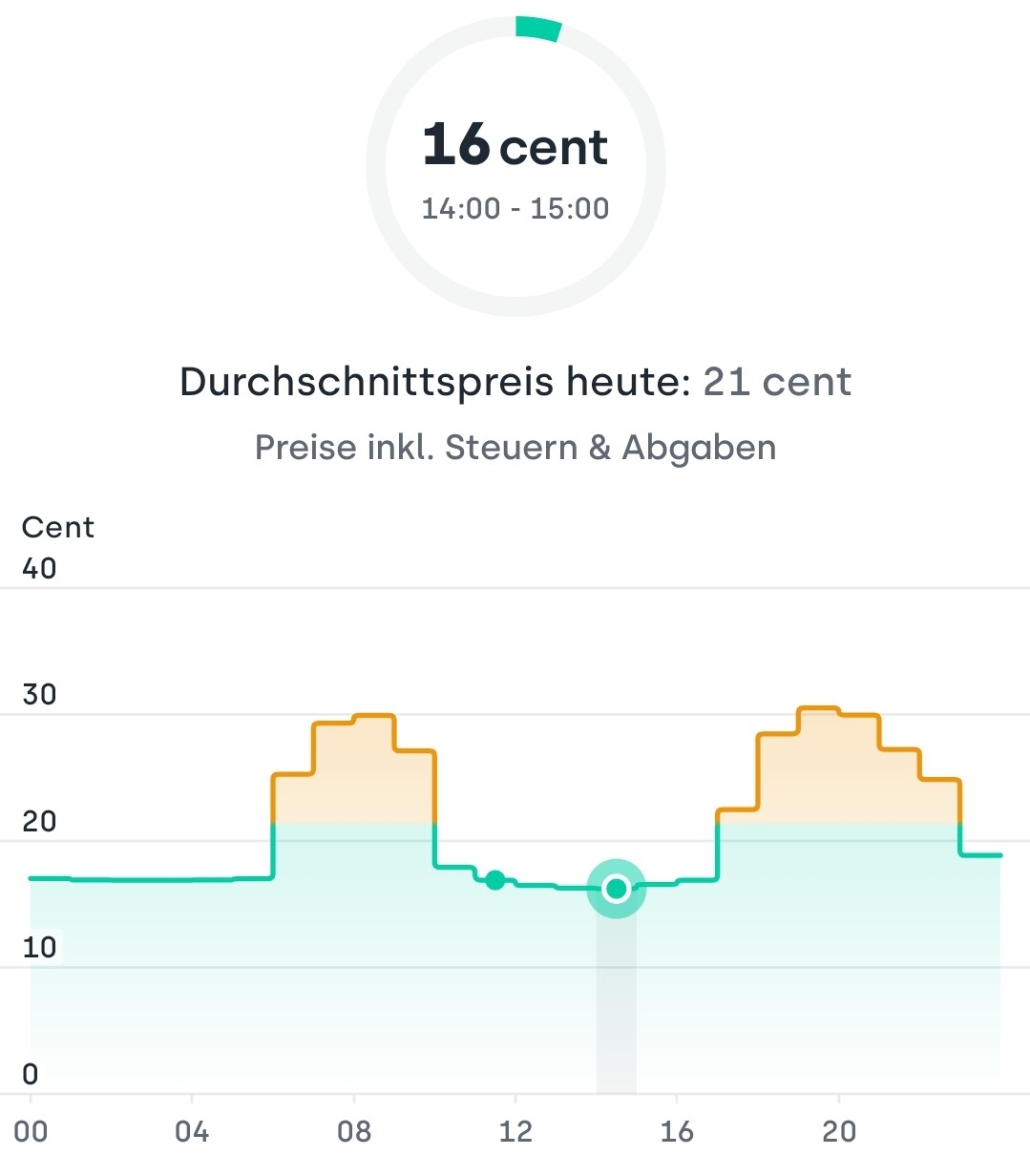
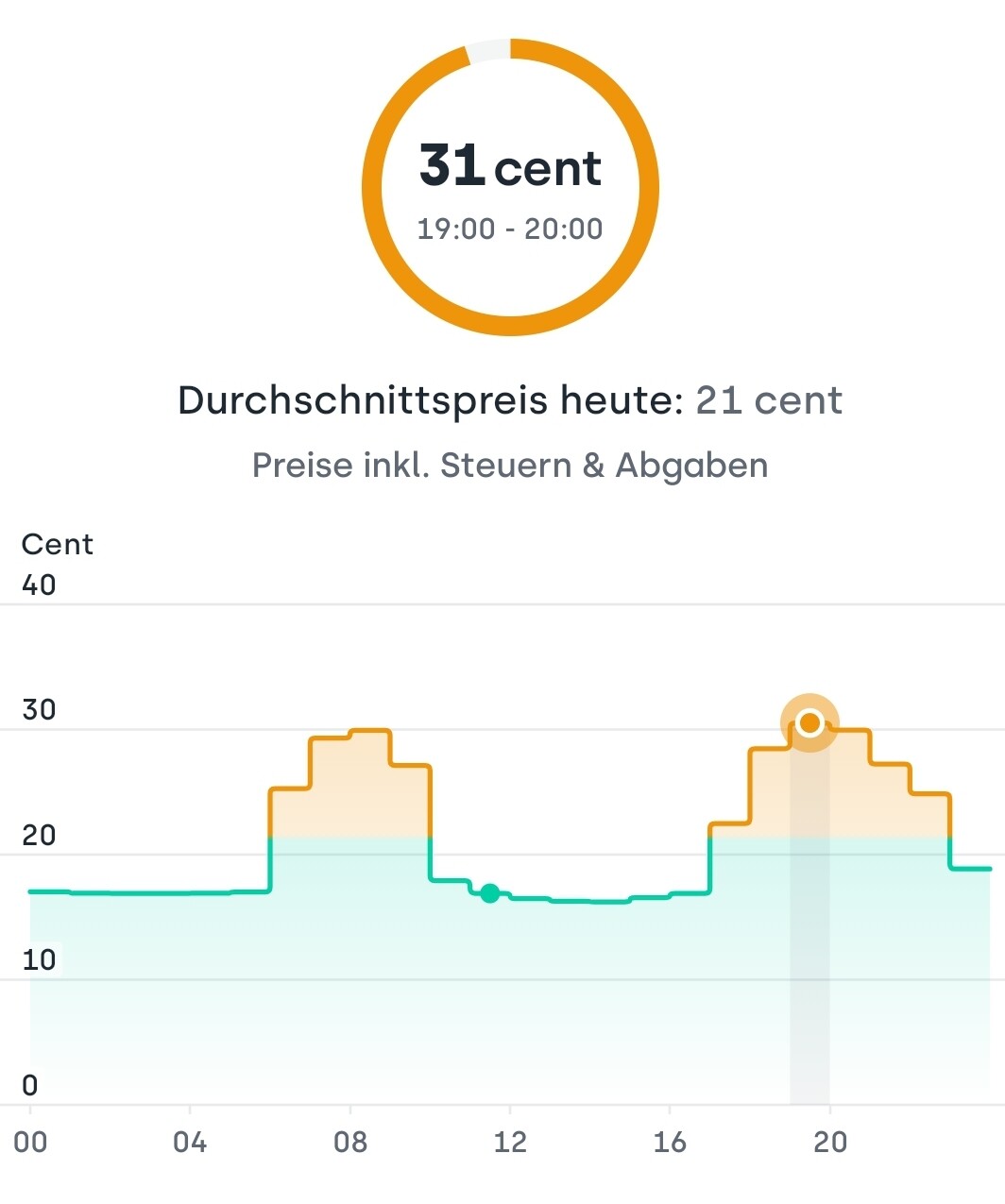
Solar yield today is rather low – but there is a lot of wind. Difference of 15 cents. Currently, the washing machine and dishwasher are running. Why not charge the home battery fully from the grid now and avoid the 31 cents this evening?
By the way, the net price is currently 0 cents – the 16 cents are purely charges (taxes, grid fees, etc.).
Solar yield today is rather low – but there is a lot of wind. Difference of 15 cents. Currently, the washing machine and dishwasher are running. Why not charge the home battery fully from the grid now and avoid the 31 cents this evening?
By the way, the net price is currently 0 cents – the 16 cents are purely charges (taxes, grid fees, etc.).
RotorMotor schrieb:
By preventing energy waste and pointless wear on EV batteries?I see energy waste when wind turbines are shut down to protect the grid. We cannot avoid more variable tariffs. The question is whether we build storage systems centrally or decentrally. I believe it will be a combination of both. As for the role of electric vehicles in this - well.
R
RotorMotor19 Sep 2023 11:56sysrun80 schrieb:
Solar yield is rather low today – but there’s plenty of wind. The price difference is 15 cents. Right now, the washing machine and dishwasher are running. Why not charge the home battery from the grid now and avoid the 31 cents price this evening? If you already have a battery, you can definitely do such experiments.
But buying one just for this is still questionable.
If you fully cycle a 7 kWh battery every day for 10 years,
that adds up to a maximum of 25 MWh (which is actually unrealistically high ;-)). With an initial cost of 5000 €, that comes to about 20 cents per kWh.
In your example, the price difference you can benefit from is only 16 cents. So it’s not really worth it.
sysrun80 schrieb:
I see energy waste when wind turbines are shut down to protect the grid. We won’t get around more variable tariffs. The question is whether we build storage centrally or decentralized. I think it will be a combination. To what extent electric vehicles play a role – well. Whether storage is installed centrally or decentralized doesn’t matter. What’s important is that it is controlled sensibly, not just because someone thinks they can save 10 cents.
But really based on the needs of the grid.
I cannot understand how storage systems could be subsidized with public funds without being fully grid-supportive.
If you look at how most private batteries are simply charged fully in the morning and discharged at night, this actually causes more problems for the grid during morning hours than it helps. :-(
RotorMotor schrieb:
Whether installed centrally or decentrally doesn’t matter. What’s important is that it’s controlled sensibly and not just because someone thinks they can save 10 cents. It should really be based on the necessity for the grid.
I find it completely baffling how storage systems could be subsidized with public funds without being fully grid-supportive.But that is already reflected in the price. And price-based (variable) control is exactly what helps here. The price is low because there is a surplus and high because power plants need to be ramped up. And yes: If I can make 10 cents in winter because the storage is idle capital anyway, I will do it. This very difference prevents wind turbines from being shut down.
RotorMotor schrieb:
If you look at the fact that most private storage systems are simply charged in the morning and discharged at night, that causes more problems for the grid in the morning hours than it helps. :-(I don’t understand that. Can you explain in detail?
Aside from that, storage systems are becoming cheaper and cheaper.
Similar topics