
ᐅ Mineral Wool Insulation vs. Wood Fiber Insulation in Prefabricated Houses
Created on: 17 Sep 2023 19:14
C
Catibu74Hello dear forum members,
we have planned a prefabricated house with the company Weiss and are currently deciding which wall construction to choose.
The options are the “Klimawand” or the “Klimawand Natur.”
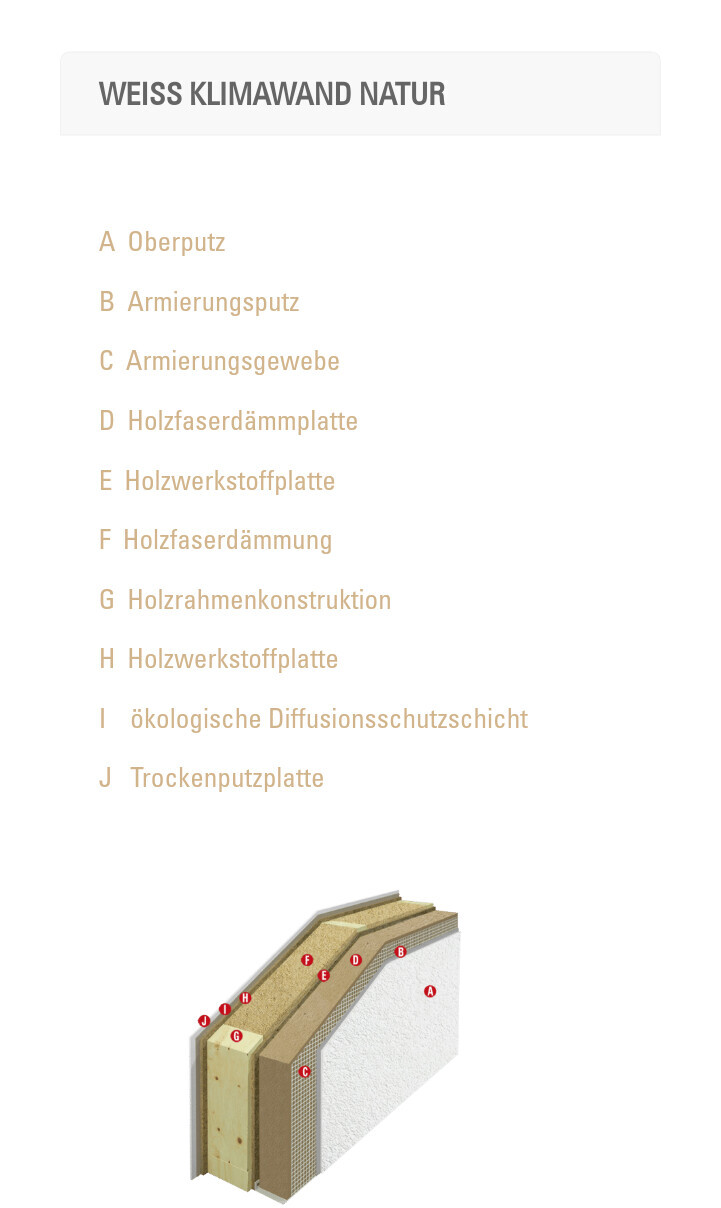
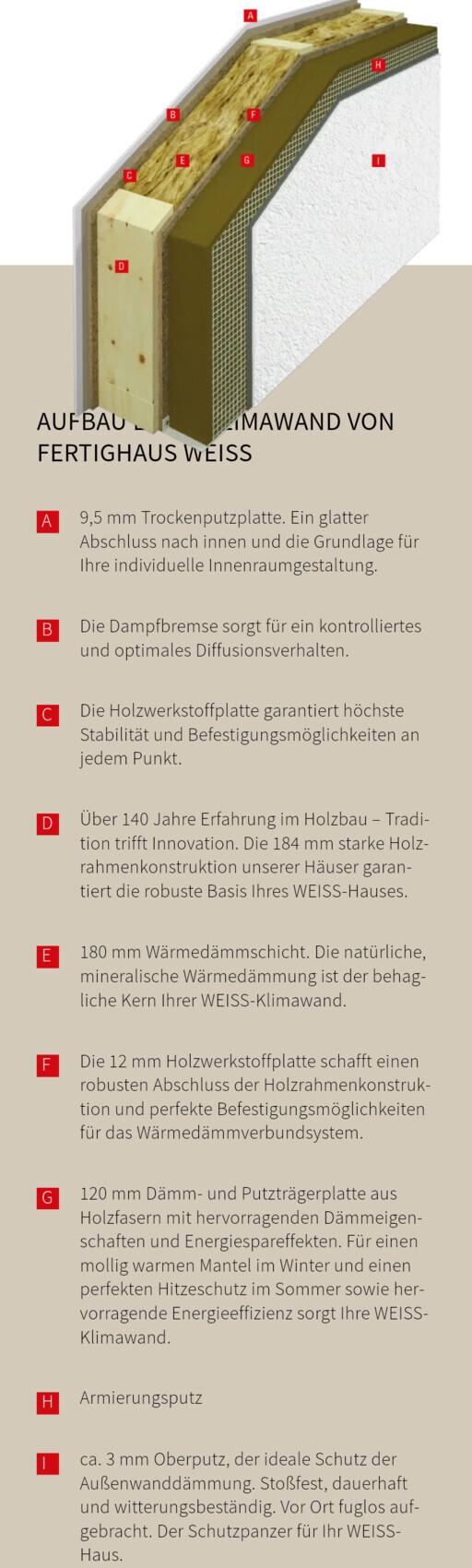
The difference is that in one case a mineral insulation material is used within the timber frame construction, and in the other a wood fiber insulation board.
What advantages and disadvantages would you see?
Healthy living is important to us.
The Klimawand Natur costs an additional 12€ per m² (12€ per square meter).
Kind regards
we have planned a prefabricated house with the company Weiss and are currently deciding which wall construction to choose.
The options are the “Klimawand” or the “Klimawand Natur.”
The difference is that in one case a mineral insulation material is used within the timber frame construction, and in the other a wood fiber insulation board.
What advantages and disadvantages would you see?
Healthy living is important to us.
The Klimawand Natur costs an additional 12€ per m² (12€ per square meter).
Kind regards
K
KarstenausNRW17 Sep 2023 19:40Mineral fiber is less flammable, but wood fiber also burns in a quite controlled manner.
Wood fiber provides better sound insulation and improved protection against summer heat.
Mineral wool requires a lot of energy for production, whereas wood fiber uses renewable raw materials and needs less energy to manufacture.
Wood fiber is considerably more expensive.
The living comfort or the "healthy living" you mentioned is essentially the same with both materials (except for minor details mentioned above). You won’t notice any difference at all. You could also insulate with EPS or build monolithically. It’s all the same, at least when you live inside.
Wood fiber provides better sound insulation and improved protection against summer heat.
Mineral wool requires a lot of energy for production, whereas wood fiber uses renewable raw materials and needs less energy to manufacture.
Wood fiber is considerably more expensive.
The living comfort or the "healthy living" you mentioned is essentially the same with both materials (except for minor details mentioned above). You won’t notice any difference at all. You could also insulate with EPS or build monolithically. It’s all the same, at least when you live inside.
The key difference is already implied in the name. Although wood fiber insulation boards are not entirely "natural," the majority of the material is of natural origin. However, they are treated with fire retardants. This results in lower energy consumption during the production of the insulation material. Mineral fibers, on the other hand, require high temperatures and sometimes high pressure, which leads to a worse environmental footprint. This difference will not affect your daily life inside the house.
Sound insulation is also effective with the traditional construction method; the main focus for improvement there would rather be on windows and connection points.
What matters is that in both cases you have 12 cm (5 inches) of wood fiber on the exterior. Compared to EPS, which could be used as an alternative, this material provides good sound insulation and a high thermal storage capacity. As a result, temperature fluctuations in the exterior plaster during winter and summer are reduced. This leads to fewer cracks in the long term and especially less algae growth. Algae tend to appear after five or more years, once the "pesticides" (which are not allowed on any European farmland but may be undisclosed ingredients in the plaster) have been washed out by rain.
Sound insulation is also effective with the traditional construction method; the main focus for improvement there would rather be on windows and connection points.
What matters is that in both cases you have 12 cm (5 inches) of wood fiber on the exterior. Compared to EPS, which could be used as an alternative, this material provides good sound insulation and a high thermal storage capacity. As a result, temperature fluctuations in the exterior plaster during winter and summer are reduced. This leads to fewer cracks in the long term and especially less algae growth. Algae tend to appear after five or more years, once the "pesticides" (which are not allowed on any European farmland but may be undisclosed ingredients in the plaster) have been washed out by rain.

Catibu74 schrieb:
Healthy living is important to us.
The Klimawand Natur costs an additional 12€ per m² (per square meter). Per square meter of living or wall area?
Free yourself from the romantic idea of "breathing" walls in the sense that your family would inhale outdoor air through the exterior wall like through a COVID face mask. No air passes through the wall! – the "climate" only affects the wall indirectly or metaphorically, meaning how the wall interacts with thermal conditions during heat transfer. For the insulation material – which in either case is not spun by silkworms – the rest of the wall assembly behaves not like a tea bag, but like a castor container. So, the insulating effect could just as safely be achieved using recycled paper from newspapers without causing any harm to the residents. Also, no gas transfer of binders is expected through a gypsum board.
The relevant difference here corresponds more to the U-values of the respective wall assemblies: this value relates to the duration over which the temperature difference between inside and outside passes through, and thus to the phase shift of outdoor temperature fluctuations. Whether the interior smells of mineral wool or freshly cut wood will make no difference either to human noses or measuring sensors. None of this passes through!
As an "old 68er," I am always surprised how much of the slogan "jute instead of plastic" still exists today in the minds of young homebuilders after more than forty years. Whether this should make me more pleased or alarmed, I am still undecided.
https://www.instagram.com/11antgmxde/
https://www.linkedin.com/company/bauen-jetzt/
W
WilderSueden18 Sep 2023 14:5311ant schrieb:
It would be possible to achieve the same insulating effect just as safely with recycled paper from tabloids and mass-market newspapers, without the residents becoming stupid because of it. That doesn’t sound nearly as good as saying "cellulose insulation."
11ant schrieb:
As an "old 68er," I’m always surprised how much of the “Venceremos” spirit behind the slogan "jute instead of plastic" still lingers in the minds of young home builders after more than forty years. Whether I should be happy or concerned about this, I’m still undecided. Somehow, different builders need to distinguish themselves. The topic of healthy living environments alongside environmental protection is a welcome vehicle for that. Whether it actually is better or just seems so is not really important.
Given the price difference compared to the wood fiber option, I would tend to choose the latter. Spending €2500 (approximately $2700) more on a house build can certainly be wasted less sensibly, and even if the internal insulation no longer contributes much to heat protection, it certainly won’t hurt. Overall, I find it more consistent to use wood fiber in both layers of insulation instead of a half-and-half approach.
WilderSueden schrieb:
I also find it more consistent overall to use wood fiber insulation in both layers, instead of splitting it half and half.At least within one sandwich, I think it’s good to maintain as much monolithic structure as possible. Any successive layering of materials with different thermal conductivities adds complexity and potential risks that are hardly studied. This even applies to the same material, just with different densities.https://www.instagram.com/11antgmxde/
https://www.linkedin.com/company/bauen-jetzt/
Similar topics