
S
Serena_Neubau17 Aug 2023 13:24Hello everyone,
We are currently planning a city villa and discussing wall construction with our architect. Our architect tends to take a pragmatic and cost-conscious approach. However, we have specific aesthetic preferences and sufficient budget.
The wall structure is currently planned as follows:
Calcium silicate brick 17.50 cm (7 inches)
Insulation 16.00 cm (6 inches)
Air gap ???
Basement concrete
Ground floor facing brick, dimensions 490x90x40 mm (19x3.5x1.6 inches)
Upper floor aerated concrete/plaster
For the upper floor, we would prefer plaster. Our architect initially suggested an external thermal insulation composite system (ETICS / external wall insulation). However, we want a cavity wall construction.
In addition, we do not want an aluminum drip edge.
The ground floor facing bricks have a special dimension with a depth (thickness) of only 9 cm (3.5 inches). Our idea was to place a sample aerated concrete block on top of this and then plaster over it. However, aerated concrete blocks are available only in 7.5 cm (3 inches) or 10 cm (4 inches) thickness. Would a 7.5 cm block plus 2.5 cm (1 inch) plaster be sufficient, or could this cause issues with frost resistance? Or would it be better to use calcium silicate bricks to keep the same system? What do you think?
To avoid using an aluminum profile, one could use an invisible plastic profile with a drip edge, which is available from several manufacturers. Of course, the transition between the facing brick and the plaster would need to be properly sealed to prevent water ingress.
Finally, there is the question of whether an air gap of 1–2 cm (0.4–0.8 inches) should be installed between the insulation and the facing brick/plaster.
At the moment, our architect has not found a solution, so we turn to the community for advice.
I look forward to hearing your assessments and experiences.
We are currently planning a city villa and discussing wall construction with our architect. Our architect tends to take a pragmatic and cost-conscious approach. However, we have specific aesthetic preferences and sufficient budget.
The wall structure is currently planned as follows:
Calcium silicate brick 17.50 cm (7 inches)
Insulation 16.00 cm (6 inches)
Air gap ???
Basement concrete
Ground floor facing brick, dimensions 490x90x40 mm (19x3.5x1.6 inches)
Upper floor aerated concrete/plaster
For the upper floor, we would prefer plaster. Our architect initially suggested an external thermal insulation composite system (ETICS / external wall insulation). However, we want a cavity wall construction.
In addition, we do not want an aluminum drip edge.
The ground floor facing bricks have a special dimension with a depth (thickness) of only 9 cm (3.5 inches). Our idea was to place a sample aerated concrete block on top of this and then plaster over it. However, aerated concrete blocks are available only in 7.5 cm (3 inches) or 10 cm (4 inches) thickness. Would a 7.5 cm block plus 2.5 cm (1 inch) plaster be sufficient, or could this cause issues with frost resistance? Or would it be better to use calcium silicate bricks to keep the same system? What do you think?
To avoid using an aluminum profile, one could use an invisible plastic profile with a drip edge, which is available from several manufacturers. Of course, the transition between the facing brick and the plaster would need to be properly sealed to prevent water ingress.
Finally, there is the question of whether an air gap of 1–2 cm (0.4–0.8 inches) should be installed between the insulation and the facing brick/plaster.
At the moment, our architect has not found a solution, so we turn to the community for advice.
I look forward to hearing your assessments and experiences.

Serena_Neubau schrieb:
The wall construction is currently planned as follows:
Calcium silicate brick 17.50 cm (7 inches) # Insulation 16.00 cm (6 inches) # Air gap ???
Basement concrete # Ground floor facing brick dimensions 490x90x40 mm (19x3.5x1.6 inches) # Upper floor aerated concrete/plaster According to your post https://www.hausbau-forum.de/threads/kfw-foerderung-klimafreundliches-wohngebaeude-ab-maerz-2023.44890/page-13#post-628614, you are building with Viebrockhaus. Therefore, I don’t understand your whole line of questioning, since this builder knows what they are doing. Also, I would never, under any circumstances, alter a proven wall system. If you are already building a custom design with Viebrockhaus, then at least stick to the tried-and-tested principles for essential construction details. They even manage transitions between different facade types, for example, at the normal parapet height of the upper floor rather than at the ground/upper floor boundary.
Serena_Neubau schrieb:
Lastly, the question whether an air gap of 1–2 cm (0.4–0.8 inches) should be installed between insulation and facing brick/plaster. An air gap behind plaster is not feasible at all, as Siemens wall ties are not expected to be available for the foreseeable future due to the chip shortage. An air gap behind facing brick requires a self-supporting cladding shell, which I do not see as achievable with a special 90 mm (3.5 inches) thick format. Therefore, I strongly advise you to stick to the proven and experience-based compatible types of facing brick. Going with custom or “haute couture” brick that is only available in the entire city will bring you serious problems.
https://www.instagram.com/11antgmxde/
https://www.linkedin.com/company/bauen-jetzt/
S
Serena_Neubau17 Aug 2023 21:31We are no longer building with Viebrockhaus. However, we have willingly shared their statements within the community.
That said, we looked at Viebrockhaus's concept of a mixed facade on one side. They use 11.5 cm (4.5 inches) deep bricks and place somewhat smaller concrete blocks on top of them. This front wall is then secured with stainless steel anchors. It is unclear whether there is an air layer in between. Of course, this will be discussed with all involved professionals.
Some experience or information from the community would be helpful. That is what this forum is for, after all. At least, I have not yet found anything on this topic here in the forum.
That said, we looked at Viebrockhaus's concept of a mixed facade on one side. They use 11.5 cm (4.5 inches) deep bricks and place somewhat smaller concrete blocks on top of them. This front wall is then secured with stainless steel anchors. It is unclear whether there is an air layer in between. Of course, this will be discussed with all involved professionals.
Some experience or information from the community would be helpful. That is what this forum is for, after all. At least, I have not yet found anything on this topic here in the forum.
Serena_Neubau schrieb:
We are no longer building with Viebrockhaus. However, we were happy to share their statements within the community. We also took a look at Viebrockhaus’s concept with the mixed facade on the website gertudsvilla eu. That’s a shame, I couldn’t find it either. Links are not allowed here – can you tell me which search terms you used to find it? Is that a supplier’s website?
Serena_Neubau schrieb:
They use 11.5 cm (4.5 inches) deep bricks and place slightly smaller aerated concrete blocks on top. This front wall is then secured with stainless steel anchors. It’s not clear if there is an air gap in between. Yes, that is possible – but I wouldn’t do it that way in your case: if the boundary is supposed to be at the transition between the ground floor and the upper floor, you can handle that differently. It is more practical to build the upper floor with aerated concrete blocks and position those walls slightly further outward. However, your architect should have clear ideas about this detail if you want it to turn out well.
Personally, I would always build a house in the Viebrockhaus style with Viebrockhaus (or with Gussek Haus if it does not have to be a masonry house). If you “copy” a Viebrockhaus or Gussek Haus with another builder, you will be in the same price range but end up with a provider who has less experience with this “style” (see “11ant #StoneMantra”).
Serena_Neubau schrieb:
A bit of experience or information from the community wouldn’t hurt. That’s what the forum is for, right? At least I haven’t found anything about this here on the forum so far. You will find little on this here – to my recollection, only @Golfi90 has built a house with that look. My tips, as I said, are:
1. Build with a contractor who regularly offers this type of facade in their portfolio, and
2. let them do it as they have experience with, including
3. choosing a brick format that fits their usual wall construction without modifications.
https://www.instagram.com/11antgmxde/
https://www.linkedin.com/company/bauen-jetzt/
K
KarstenausNRW17 Aug 2023 23:19Alternative suggestion:
- Ground floor with brick veneer, but not such thick insulation. Use foil-coated PUR, which is significantly thinner than classic EPS. An air gap is unnecessary.
- Upper floor with ETICS (External Thermal Insulation Composite System). Use EPS there, so the wall will be thicker.
==> no fuss, no aluminum drip edge, desired appearance
P.S. In my previous property, we also had a similar combination – 2DF brick veneer on the ground floor, ETICS on the upper floor (but recessed). I still really like the look today.
- Ground floor with brick veneer, but not such thick insulation. Use foil-coated PUR, which is significantly thinner than classic EPS. An air gap is unnecessary.
- Upper floor with ETICS (External Thermal Insulation Composite System). Use EPS there, so the wall will be thicker.
==> no fuss, no aluminum drip edge, desired appearance
P.S. In my previous property, we also had a similar combination – 2DF brick veneer on the ground floor, ETICS on the upper floor (but recessed). I still really like the look today.
S
Serena_Neubau18 Aug 2023 10:19@11ant
We visited Gertudisvilla in Euskirchen. Just search for it online.
Here is a photo related to this.
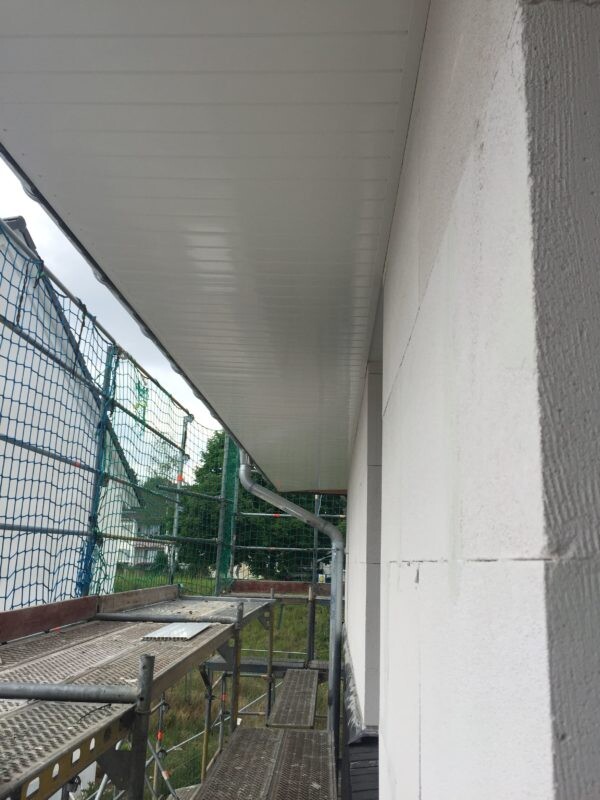
Unfortunately, I can’t send a private message to @Golfi90 yet because we don’t have enough posts. He might be able to help us with how Schmiedhaus built their structure. Their facade looks like the one we want.
@KarstenausNRW
That could be another option. The question is whether it can be built without thermal bridges.
We visited Gertudisvilla in Euskirchen. Just search for it online.
Here is a photo related to this.
Unfortunately, I can’t send a private message to @Golfi90 yet because we don’t have enough posts. He might be able to help us with how Schmiedhaus built their structure. Their facade looks like the one we want.
@KarstenausNRW
That could be another option. The question is whether it can be built without thermal bridges.
Similar topics