
ᐅ House Construction Planning: Timber Frame House, Log Cladding, Single-Slope Roof
Created on: 15 Aug 2023 09:12
P
PaswinaDear Forum,
I would like to present our house plan here for discussion. If I’m in the wrong forum, please feel free to move this post 🙂 Thanks! I usually read more than I post, so please forgive any beginner’s mistakes 🙂
In spring 2023, we received a letter from our landlord complaining about various issues. These apparently had been bothering him for a long time, which led us to believe that living together in this “multigenerational complex” no longer made sense for us. The neighborhood relationship is “poisoned.” However, the rental market in our city is completely crazy. My mother is often quickly enthusiastic about owning a home, so she spent a lot of free time searching for building areas for us. And she found one! In a small village of about 2,500 inhabitants in the middle of Rheinhessen, close to the highway and a train station, allowing me to manage my two days of office work without an expensive diesel car. The schools in the neighboring communities were also looking for teachers, so my girlfriend will start her new job there in September. Once the house is built and we’ve moved next year, her commute by train will only be 5 minutes.
Back to the building area. Around that time, I often read in the newspaper that some building plots were being returned. But building was never really an option for us, so we had relatively little equity. I emailed the mayor to ask if there was still a plot available. His answer: “Choose one!” He sent the plan, and we went there to see the plots in person. We focused on a small 320 sqm (3,444 sq ft) plot on the edge of the fields. However, when we tried to reserve it after a few days, the mayor unfortunately dashed our hopes: that plot had since been reserved by someone else! Slightly disappointed, we looked at the plan again and searched for the next best plot. This one was immediately €40,000 (about $44,000) more expensive... but at that point, we had no idea what everything would cost 🙂 We reserved this plot promptly and received confirmation of our reservation.
Meanwhile, I diligently ordered catalogs from many timber house builders. My girlfriend quickly decided it would be a timber house. Many houses from various manufacturers are truly beautiful, but unfortunately, also unaffordable for us. So we quickly focused on Talishaus as our first choice. Number two was Helios wooden houses from Hattstedt (about 10 minutes from Husum, where Talishaus is located). We also contacted Talishaus and received two offers: one for a bungalow (for the smaller plot) and another for a two-story house with a shed roof, as we currently live in a small house with a shed roof. But the prices brought us back down to reality again. So I picked a 1.5-story house from the Helios catalog and requested an offer for it.
We know the company Helios because my mother built with them in 2015. She said from the start that she had compared many offers and kept coming back to Helios. With each new offer I requested from other builders, it became more and more likely that we would build with Helios as well.
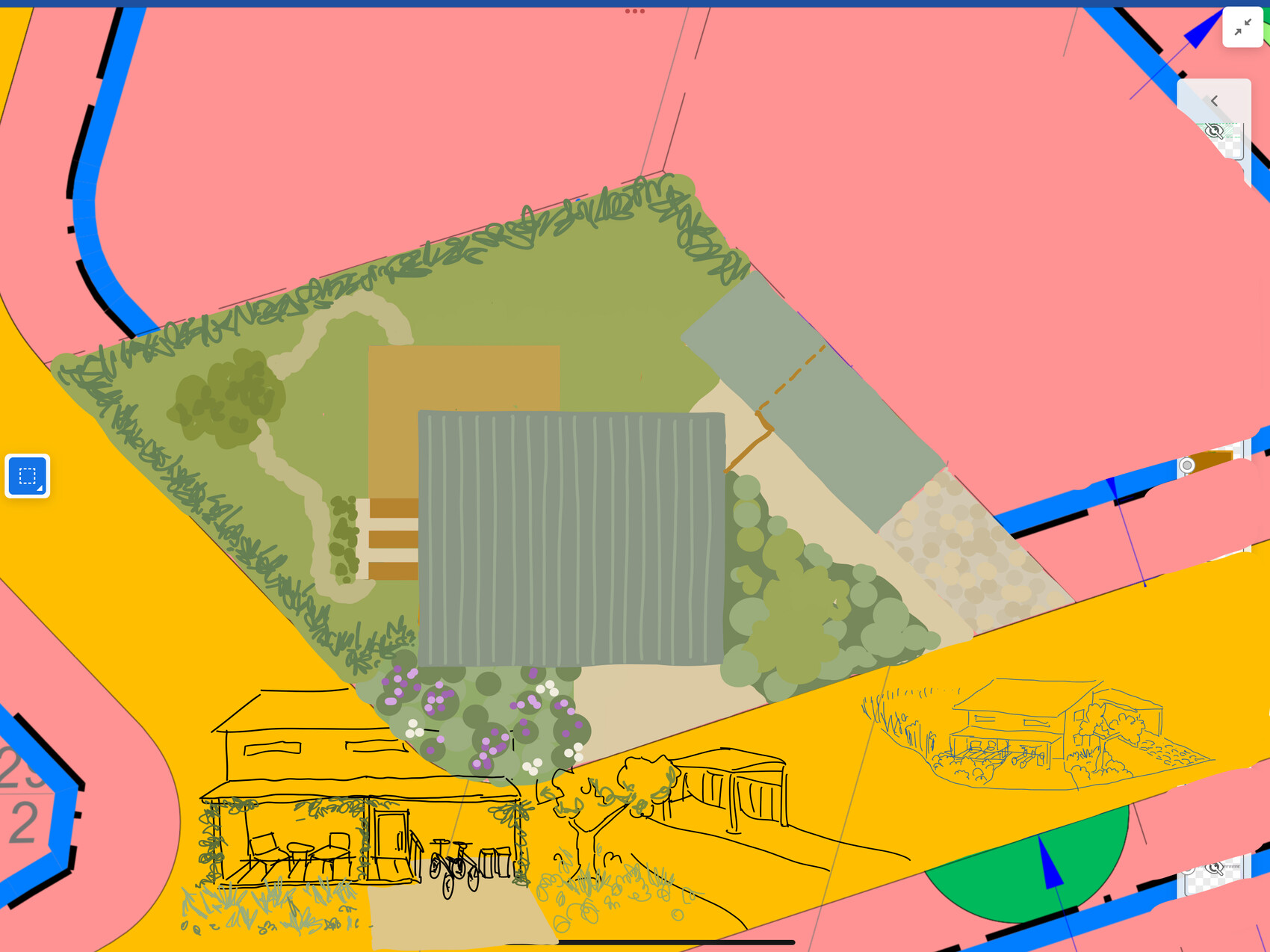
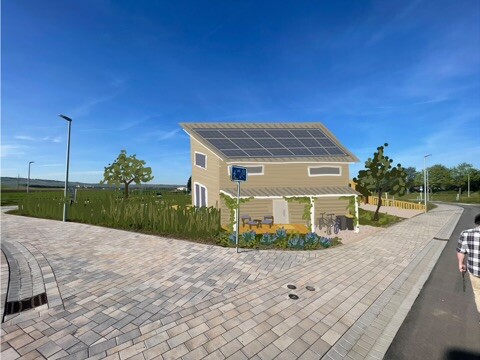
The contact is always friendly and helpful. The company has only five employees, so you always speak directly to the senior manager. We like their houses, the floor plans can be customized without any problems (which is always possible with timber houses), and the shed roof is also an option. Since my girlfriend is an art teacher, she visualized our house ideas for us. (I have attached two images; I’m not sure if they belong in the middle of the text or at the end).
Because our preferred plot allows it and the development plan doesn’t specify ridge direction, we want to orient the shed roof southwards. We also tried placing the house directly against the left or right boundary but didn’t like it. The development plan limits the maximum height to 7 m (23 ft) for houses with a roof pitch under 15°. The high side reaches 7 m (23 ft) with an interior height of 3.23 m (10 ft 7 in), and the low side is 2.32 m (7 ft 7 in) inside. We are also planning a small porch on the south side with space for bikes and possibly trash bins. We plan to add a seating area in the remaining space later.
It was clear to us, also because of the limited equity, that we definitely want to build with subsidies. Initially, we considered KfW with QNG certification, but the more offers and information I collected, the more we focused on the usual “climate-friendly new construction” without QNG.
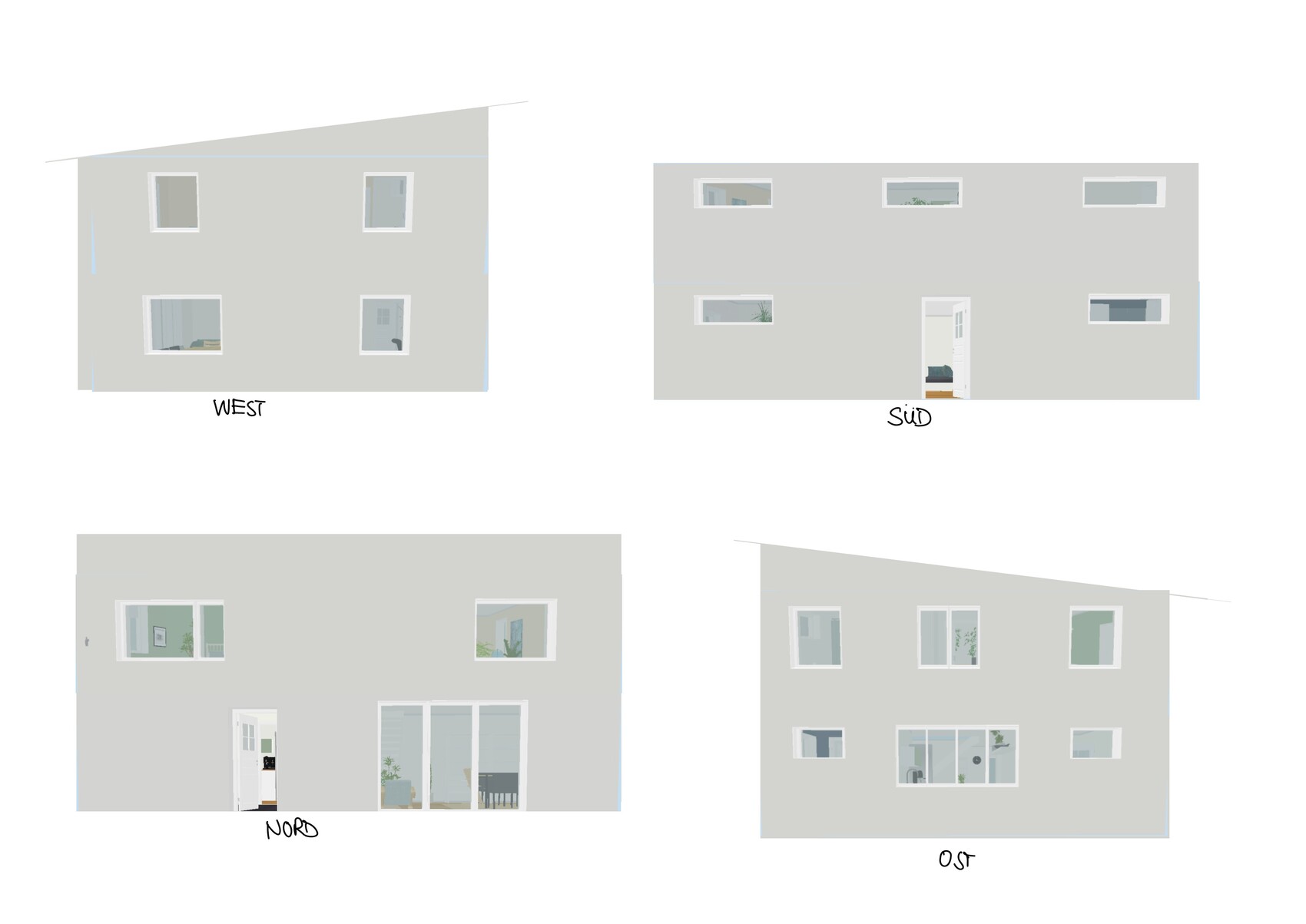
The floor plan was from the very first version by the builder, but it only shares the exterior dimensions with the current plan. The attached house elevation was also drawn by my girlfriend and was mostly relevant for the window layout (the labeling of compass directions and house sides is correct, but the roof isn’t!).
We will probably receive the Helios plans soon, which will help us visualize everything better – I’ll update here then 🙂
Last week, we visited the company in person and met the window maker, the stair builder, and spoke with the electrician. We also had a short house tour with the junior manager, who just finished building a house.
Enough talking, here’s the house info:
Exterior walls:
- Pine log cladding 70x145 mm (3x6 inches) with chalet milling, with exposed end grain wood protected by solid wood covers
- Remmers HK glaze
- 16 mm (0.6 in) ventilation strip
- 16 mm (0.6 in) DWD board as wind barrier
- 200 mm (8 in) timber frame with insulation WLG 032 (thermal conductivity)
- 15 mm (0.6 in) OSB for vapor barrier
- Installation cavity 40x60 mm (1.5x2.4 in) with 60 mm (2.4 in) insulation WLG 035
- 12.5 mm (0.5 in) gypsum board
Roof:
- Shed roof 7° pitch
- 1 m (3.3 ft) roof overhang
- Cladding 19x96 mm (0.75x3.75 in) profiled wood
- Glaze included
- DWD board as roof sheathing, counter battens 25x40 mm (1x1.6 in), smooth-edged boards 21x195 mm (0.8x7.7 in)
- Anthracite trapezoidal sheet metal roofing
- Zinc gutter
- 240 mm (9.5 in) insulation WLG 032
- 40 mm (1.6 in) mineral wool insulation
- 40x60 mm (1.5x2.4 in) battens
- Vapor barrier
Interior walls:
- 60x80 mm (2.4x3.1 in) structural timber
- 12.5 mm (0.5 in) gypsum fiberboard
- 60 mm (2.4 in) soundproof mineral wool insulation
- Water-resistant gypsum board in bathrooms/WC
Ceiling:
- Rough-sawn boards 24 mm (1 in)
- 100 mm (4 in) mineral wool insulation
- 12.5 mm (0.5 in) gypsum fiberboard
Note: We’re currently considering exposed beams in the ground floor...
Windows/doors:
- Rekord company from Itzehoe
- quadro! blue for KfW 40 standard
- 86 mm (3.4 in) installation depth
- RC2N security class
- Exterior and interior window sills and cladding included
Package price: €115,950 (about $128,000)
External sealing installation: €35,900 (about $40,000)
Complete assembly: €69,650 (about $77,000)
Energy-efficient foundation slab €22,000 (about $24,300) (including slab for porch, which might be omitted)
Carport 3.5 m x 8 m (11.5 x 26 ft) with shed 3.5 m x 2.5 m (11.5 x 8 ft): €7,250 (about $8,000)
Electrical installation according to our requirements: €22,000 (about $24,300) (including Cat 7 network in living rooms, wall box preparation, and power supply to shed/carport)
Sanitary installation according to our requirements: approx. €16,000 (about $17,700) (2 showers, 2 toilets, 1 bathtub, 1 standard sink on the ground floor, and 1 large sink on the upper floor – sinks will be sourced by us separately)
Building application including structural calculation, energy saving regulations, energy certificate: €3,500 (about $3,900)
Externally contracted or self-purchased:
- Earthworks (budgeting €10,000)
- Infrared heating €5,500 (offered at €9,500)
- Photovoltaic system 20 kWp with 10 kWh battery, offer €32,000
- Floors (solid wood planks as plank flooring, if feasible) €6,000
- Domestic water heat pump €2,500
- 10,000-liter (2,642 gallon) cistern €4,000
- Energy efficiency expert €8,250
That’s the house in a nutshell.
The photovoltaic system is this large because a) we oriented the house to the south for this purpose, b) it’s the only thing that generates income, and c) otherwise, we would have to install a green roof. We also plan to green the porch roof. An electric car is planned in the medium term. We initially planned a ventilation system, but it was dropped for cost reasons; currently, I’m looking into decentralized ventilation systems. An air conditioning system was also planned but cut for budget reasons.
I think that’s it. Let the discussion begin 🙂
Thanks!
Best regards,
Paswina

I would like to present our house plan here for discussion. If I’m in the wrong forum, please feel free to move this post 🙂 Thanks! I usually read more than I post, so please forgive any beginner’s mistakes 🙂
In spring 2023, we received a letter from our landlord complaining about various issues. These apparently had been bothering him for a long time, which led us to believe that living together in this “multigenerational complex” no longer made sense for us. The neighborhood relationship is “poisoned.” However, the rental market in our city is completely crazy. My mother is often quickly enthusiastic about owning a home, so she spent a lot of free time searching for building areas for us. And she found one! In a small village of about 2,500 inhabitants in the middle of Rheinhessen, close to the highway and a train station, allowing me to manage my two days of office work without an expensive diesel car. The schools in the neighboring communities were also looking for teachers, so my girlfriend will start her new job there in September. Once the house is built and we’ve moved next year, her commute by train will only be 5 minutes.
Back to the building area. Around that time, I often read in the newspaper that some building plots were being returned. But building was never really an option for us, so we had relatively little equity. I emailed the mayor to ask if there was still a plot available. His answer: “Choose one!” He sent the plan, and we went there to see the plots in person. We focused on a small 320 sqm (3,444 sq ft) plot on the edge of the fields. However, when we tried to reserve it after a few days, the mayor unfortunately dashed our hopes: that plot had since been reserved by someone else! Slightly disappointed, we looked at the plan again and searched for the next best plot. This one was immediately €40,000 (about $44,000) more expensive... but at that point, we had no idea what everything would cost 🙂 We reserved this plot promptly and received confirmation of our reservation.
Meanwhile, I diligently ordered catalogs from many timber house builders. My girlfriend quickly decided it would be a timber house. Many houses from various manufacturers are truly beautiful, but unfortunately, also unaffordable for us. So we quickly focused on Talishaus as our first choice. Number two was Helios wooden houses from Hattstedt (about 10 minutes from Husum, where Talishaus is located). We also contacted Talishaus and received two offers: one for a bungalow (for the smaller plot) and another for a two-story house with a shed roof, as we currently live in a small house with a shed roof. But the prices brought us back down to reality again. So I picked a 1.5-story house from the Helios catalog and requested an offer for it.
We know the company Helios because my mother built with them in 2015. She said from the start that she had compared many offers and kept coming back to Helios. With each new offer I requested from other builders, it became more and more likely that we would build with Helios as well.
The contact is always friendly and helpful. The company has only five employees, so you always speak directly to the senior manager. We like their houses, the floor plans can be customized without any problems (which is always possible with timber houses), and the shed roof is also an option. Since my girlfriend is an art teacher, she visualized our house ideas for us. (I have attached two images; I’m not sure if they belong in the middle of the text or at the end).
Because our preferred plot allows it and the development plan doesn’t specify ridge direction, we want to orient the shed roof southwards. We also tried placing the house directly against the left or right boundary but didn’t like it. The development plan limits the maximum height to 7 m (23 ft) for houses with a roof pitch under 15°. The high side reaches 7 m (23 ft) with an interior height of 3.23 m (10 ft 7 in), and the low side is 2.32 m (7 ft 7 in) inside. We are also planning a small porch on the south side with space for bikes and possibly trash bins. We plan to add a seating area in the remaining space later.
It was clear to us, also because of the limited equity, that we definitely want to build with subsidies. Initially, we considered KfW with QNG certification, but the more offers and information I collected, the more we focused on the usual “climate-friendly new construction” without QNG.
The floor plan was from the very first version by the builder, but it only shares the exterior dimensions with the current plan. The attached house elevation was also drawn by my girlfriend and was mostly relevant for the window layout (the labeling of compass directions and house sides is correct, but the roof isn’t!).
We will probably receive the Helios plans soon, which will help us visualize everything better – I’ll update here then 🙂
Last week, we visited the company in person and met the window maker, the stair builder, and spoke with the electrician. We also had a short house tour with the junior manager, who just finished building a house.
Enough talking, here’s the house info:
Exterior walls:
- Pine log cladding 70x145 mm (3x6 inches) with chalet milling, with exposed end grain wood protected by solid wood covers
- Remmers HK glaze
- 16 mm (0.6 in) ventilation strip
- 16 mm (0.6 in) DWD board as wind barrier
- 200 mm (8 in) timber frame with insulation WLG 032 (thermal conductivity)
- 15 mm (0.6 in) OSB for vapor barrier
- Installation cavity 40x60 mm (1.5x2.4 in) with 60 mm (2.4 in) insulation WLG 035
- 12.5 mm (0.5 in) gypsum board
Roof:
- Shed roof 7° pitch
- 1 m (3.3 ft) roof overhang
- Cladding 19x96 mm (0.75x3.75 in) profiled wood
- Glaze included
- DWD board as roof sheathing, counter battens 25x40 mm (1x1.6 in), smooth-edged boards 21x195 mm (0.8x7.7 in)
- Anthracite trapezoidal sheet metal roofing
- Zinc gutter
- 240 mm (9.5 in) insulation WLG 032
- 40 mm (1.6 in) mineral wool insulation
- 40x60 mm (1.5x2.4 in) battens
- Vapor barrier
Interior walls:
- 60x80 mm (2.4x3.1 in) structural timber
- 12.5 mm (0.5 in) gypsum fiberboard
- 60 mm (2.4 in) soundproof mineral wool insulation
- Water-resistant gypsum board in bathrooms/WC
Ceiling:
- Rough-sawn boards 24 mm (1 in)
- 100 mm (4 in) mineral wool insulation
- 12.5 mm (0.5 in) gypsum fiberboard
Note: We’re currently considering exposed beams in the ground floor...
Windows/doors:
- Rekord company from Itzehoe
- quadro! blue for KfW 40 standard
- 86 mm (3.4 in) installation depth
- RC2N security class
- Exterior and interior window sills and cladding included
Package price: €115,950 (about $128,000)
External sealing installation: €35,900 (about $40,000)
Complete assembly: €69,650 (about $77,000)
Energy-efficient foundation slab €22,000 (about $24,300) (including slab for porch, which might be omitted)
Carport 3.5 m x 8 m (11.5 x 26 ft) with shed 3.5 m x 2.5 m (11.5 x 8 ft): €7,250 (about $8,000)
Electrical installation according to our requirements: €22,000 (about $24,300) (including Cat 7 network in living rooms, wall box preparation, and power supply to shed/carport)
Sanitary installation according to our requirements: approx. €16,000 (about $17,700) (2 showers, 2 toilets, 1 bathtub, 1 standard sink on the ground floor, and 1 large sink on the upper floor – sinks will be sourced by us separately)
Building application including structural calculation, energy saving regulations, energy certificate: €3,500 (about $3,900)
Externally contracted or self-purchased:
- Earthworks (budgeting €10,000)
- Infrared heating €5,500 (offered at €9,500)
- Photovoltaic system 20 kWp with 10 kWh battery, offer €32,000
- Floors (solid wood planks as plank flooring, if feasible) €6,000
- Domestic water heat pump €2,500
- 10,000-liter (2,642 gallon) cistern €4,000
- Energy efficiency expert €8,250
That’s the house in a nutshell.
The photovoltaic system is this large because a) we oriented the house to the south for this purpose, b) it’s the only thing that generates income, and c) otherwise, we would have to install a green roof. We also plan to green the porch roof. An electric car is planned in the medium term. We initially planned a ventilation system, but it was dropped for cost reasons; currently, I’m looking into decentralized ventilation systems. An air conditioning system was also planned but cut for budget reasons.
I think that’s it. Let the discussion begin 🙂
Thanks!
Best regards,
Paswina
C
Costruttrice15 Aug 2023 09:39Hello @Paswina, welcome to the forum!
You have chosen a lovely spot in Rheinhessen.
I can’t comment on the house details, but one thing I noticed is that the house, as currently drawn, exceeds the building boundary, so it will need to be set back further.
Are you even allowed to position the house at an angle on the corner lot? For example, where I live, that’s not permitted—houses must be aligned in a row, either parallel to one street or the other at the intersection.
To discuss the floor plan in detail, having the exact measurements would be helpful.
You have chosen a lovely spot in Rheinhessen.
I can’t comment on the house details, but one thing I noticed is that the house, as currently drawn, exceeds the building boundary, so it will need to be set back further.
Are you even allowed to position the house at an angle on the corner lot? For example, where I live, that’s not permitted—houses must be aligned in a row, either parallel to one street or the other at the intersection.
To discuss the floor plan in detail, having the exact measurements would be helpful.

That was quick 🙂
I already have a few initial questions...
- Have you purchased the plot of land yet?
- What are the building boundaries like? The continuous 1-meter (3 feet) roof overhang has quite an impact on the floor area ratio.
- You budgeted 10,000 EUR for excavation work—do you have a soil report? That can easily go wrong, as 10,000 EUR is very, very little.
- Does the slab budget include everything all-inclusive, including the base slab and insulation? If so, hats off—that would be almost cheaper than my 9x10m (30x33 ft) slab (materials at employee purchase price and a good rate from the concrete contractor).
- You can completely forget about QNG with DIY work... The small module is relatively easy, but note that not all banks currently finance the KfW modules.
- What is your total budget? Have you had a bank run the numbers on what you can afford?
- Who calculated the costs for the following trades? Do you have a background in construction and can do much of it yourself? Or will everything be contracted out? Have you already obtained quotes?
- When is the planned start of construction?
- At the latest, @11ant will ask this: Can you share the zoning plan as a keyword to search on Google? That way, we can get a better idea if it even fits your plans.
- Structural engineer/architect/energy consultant: Are you arranging those yourself, or is the manufacturer providing them?
I already have a few initial questions...
- Have you purchased the plot of land yet?
- What are the building boundaries like? The continuous 1-meter (3 feet) roof overhang has quite an impact on the floor area ratio.
- You budgeted 10,000 EUR for excavation work—do you have a soil report? That can easily go wrong, as 10,000 EUR is very, very little.
- Does the slab budget include everything all-inclusive, including the base slab and insulation? If so, hats off—that would be almost cheaper than my 9x10m (30x33 ft) slab (materials at employee purchase price and a good rate from the concrete contractor).
- You can completely forget about QNG with DIY work... The small module is relatively easy, but note that not all banks currently finance the KfW modules.
- What is your total budget? Have you had a bank run the numbers on what you can afford?
- Who calculated the costs for the following trades? Do you have a background in construction and can do much of it yourself? Or will everything be contracted out? Have you already obtained quotes?
- When is the planned start of construction?
- At the latest, @11ant will ask this: Can you share the zoning plan as a keyword to search on Google? That way, we can get a better idea if it even fits your plans.
- Structural engineer/architect/energy consultant: Are you arranging those yourself, or is the manufacturer providing them?
H
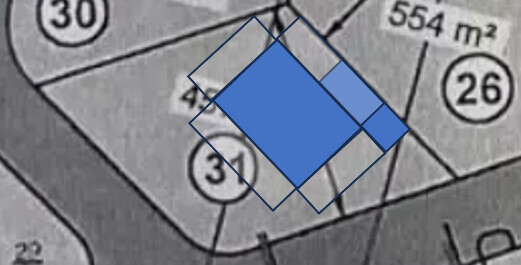
hanghaus202315 Aug 2023 10:13How big is the house? I drew a house measuring 12 by 7.5 meters (39 by 25 feet) including setback areas. I have rarely seen edge development longer than 9 meters (30 feet) in any building zone. Please share what the zoning plan requires.
hanghaus2023 schrieb:
How large is the house? I once marked out a house with setback distances measuring 12 by 7.5 meters (39 by 25 feet). I have hardly seen perimeter development longer than 9 meters (30 feet) in any building area. Why don’t you share what the zoning plan specifies?
He wrote in my thread 8 by 11 meters (26 by 36 feet).
Hello both of you!
@Costruttrice
The house measures 8x11m (26x36 feet) externally. We tried to fit it into the building envelope with scale, and it seems to have worked. According to how we want to position it, we can go up to 9x12m (30x39 feet). But the builder will properly plot it in with the site plan (or have it done), and then it will be “final.” The development plan should allow this; I haven’t read anything to the contrary.
@-LotteS-
- The plot hasn’t been purchased yet, only reserved. We want to buy it only once the house is fully planned and the financing is in place. Since the government confirmed last week that the WEF 300 isn’t very well received and they want to revise it, we’re waiting on that — maybe it will become more attractive for us. As currently designed, we can apply for the KfW funding only in 2024, because then we will be under the taxable income threshold of 60,000 Euro (around $64,000).
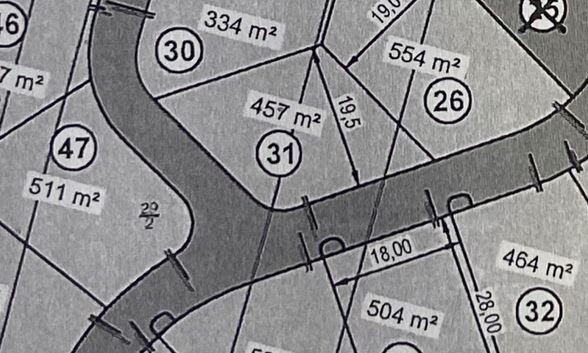
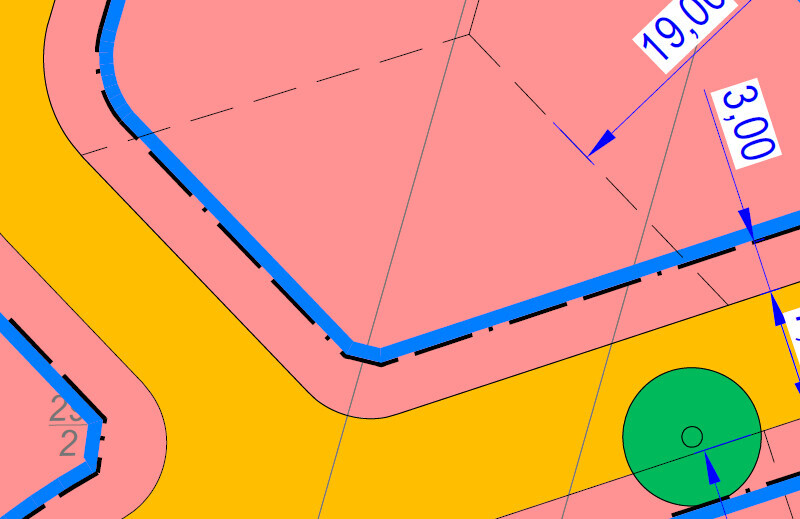
- There is a 3m (10 feet) construction boundary all around; it’s easier to see on the development plan. I tried to attach it, but it’s a PDF. Here is an excerpt:
- The 10,000 Euro (about $11,000) estimate comes from the Talishaus offer; unfortunately, it remains a “rough estimate” until I get the geotechnical report, and for that, I need to own the plot 🙂
- Insulation is included in the foundation slab, but I don’t think the below-ground waterproofing (or drainage pipe, often called “KG” in German) is included—at least I can’t find it mentioned in the offer. Likely the waterproofing or drainage pipes are offered by the earthworks contractor. The foundation slab offer is basically from the top edge of the gravel/sand/base layer upwards.
- Our current total budget is 520,000 Euro (around $560,000), including a 30,000 Euro (around $32,000) contingency. Waiting for the new offer now.
- Follow-up trades? All figures are either from the house builder’s offer or other quotes I have collected. The only estimates still in my calculation are the earthworks and interior painting, which my partner will do.
- Construction start currently depends only on the KfW funding, and the latest completion date should be July/August 2024, because our little one will have a kindergarten place in the town then 🙂
- Structural engineer and architect are arranged through the house builder; energy consultant through us.
- You can find the development plan under: Neubaugebiet Armsheim Im Pfad. On the municipality’s website under “Downloads.”
@Costruttrice
The house measures 8x11m (26x36 feet) externally. We tried to fit it into the building envelope with scale, and it seems to have worked. According to how we want to position it, we can go up to 9x12m (30x39 feet). But the builder will properly plot it in with the site plan (or have it done), and then it will be “final.” The development plan should allow this; I haven’t read anything to the contrary.
@-LotteS-
- The plot hasn’t been purchased yet, only reserved. We want to buy it only once the house is fully planned and the financing is in place. Since the government confirmed last week that the WEF 300 isn’t very well received and they want to revise it, we’re waiting on that — maybe it will become more attractive for us. As currently designed, we can apply for the KfW funding only in 2024, because then we will be under the taxable income threshold of 60,000 Euro (around $64,000).
- There is a 3m (10 feet) construction boundary all around; it’s easier to see on the development plan. I tried to attach it, but it’s a PDF. Here is an excerpt:
- The 10,000 Euro (about $11,000) estimate comes from the Talishaus offer; unfortunately, it remains a “rough estimate” until I get the geotechnical report, and for that, I need to own the plot 🙂
- Insulation is included in the foundation slab, but I don’t think the below-ground waterproofing (or drainage pipe, often called “KG” in German) is included—at least I can’t find it mentioned in the offer. Likely the waterproofing or drainage pipes are offered by the earthworks contractor. The foundation slab offer is basically from the top edge of the gravel/sand/base layer upwards.
- Our current total budget is 520,000 Euro (around $560,000), including a 30,000 Euro (around $32,000) contingency. Waiting for the new offer now.
- Follow-up trades? All figures are either from the house builder’s offer or other quotes I have collected. The only estimates still in my calculation are the earthworks and interior painting, which my partner will do.
- Construction start currently depends only on the KfW funding, and the latest completion date should be July/August 2024, because our little one will have a kindergarten place in the town then 🙂
- Structural engineer and architect are arranged through the house builder; energy consultant through us.
- You can find the development plan under: Neubaugebiet Armsheim Im Pfad. On the municipality’s website under “Downloads.”
Similar topics