
ᐅ Floor plan design for a single-family house, 165 sqm, without a basement, on a 400 sqm plot
Created on: 10 Aug 2023 09:33
M
Maulwurfbau
At the request of 11ant, here is a post with the completed list ;-) Unfortunately, he still doesn’t have a crystal ball.
Providing all information possible/available at this point in time.
Development Plan / Restrictions
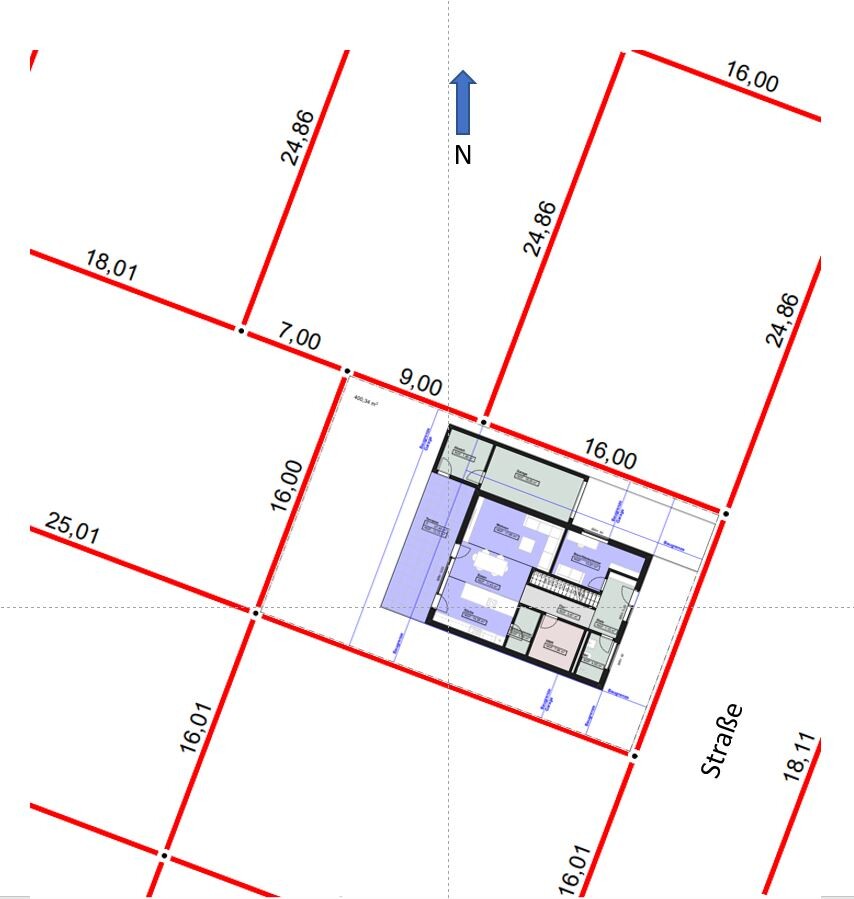
Plot size: 400 sqm (4300 sq ft)
Slope: No, and no means no!
Floor space index (FSI): 0.4
Floor area ratio (FAR): ?
Building envelope, building line and boundary: Yes, available.
Edge development: Possible with garage.
Number of parking spaces: at least 1, preferably 2
Number of storeys: 1-2
Roof type: Gable roof (pitch minimum 31°, maximum 45°)
Architectural style: ??
Orientation: Gable end facing
Maximum heights / limits: Roof ridge 6-7 m (20-23 ft), eaves 9-12 m (30-39 ft)
Other requirements: No brick facades allowed. Driveway or space in front of garage at least 6 m (20 ft). Red roof tiles mandatory, light facade.
Homeowners’ Requirements
Architectural style, roof type, building type: Gable roof, fixed
Basement, storeys: 2 full storeys without basement
Number of occupants, age: 4 people (2 toddlers)
Space requirements on ground floor and upper floor:
Office: Family use or home office? Office of approx. 12 sqm (130 sq ft) is a must.
Guest bedrooms per year: Few
Open or closed architecture: ? Whatever that means.
Conservative or modern construction style: rather modern construction.
Open kitchen, cooking island: Open kitchen, possibly with cooking island
Number of dining seats: 6
Fireplace: NO
Music / stereo wall: Not planned, TV location is quite important.
Balcony, roof terrace: NO
Garage, carport: Garage desired. Carport with storage box also conceivable.
Utility garden, greenhouse: NO
Further wishes / special features / daily routine, preferably with reasons for choices:
Laundry room on the upper floor. They want to do laundry where it is generated and where it must be returned clean. Anything else is a hassle, at least for us.
House Design
Who designed the plan: Architect
What do you particularly like? Why?
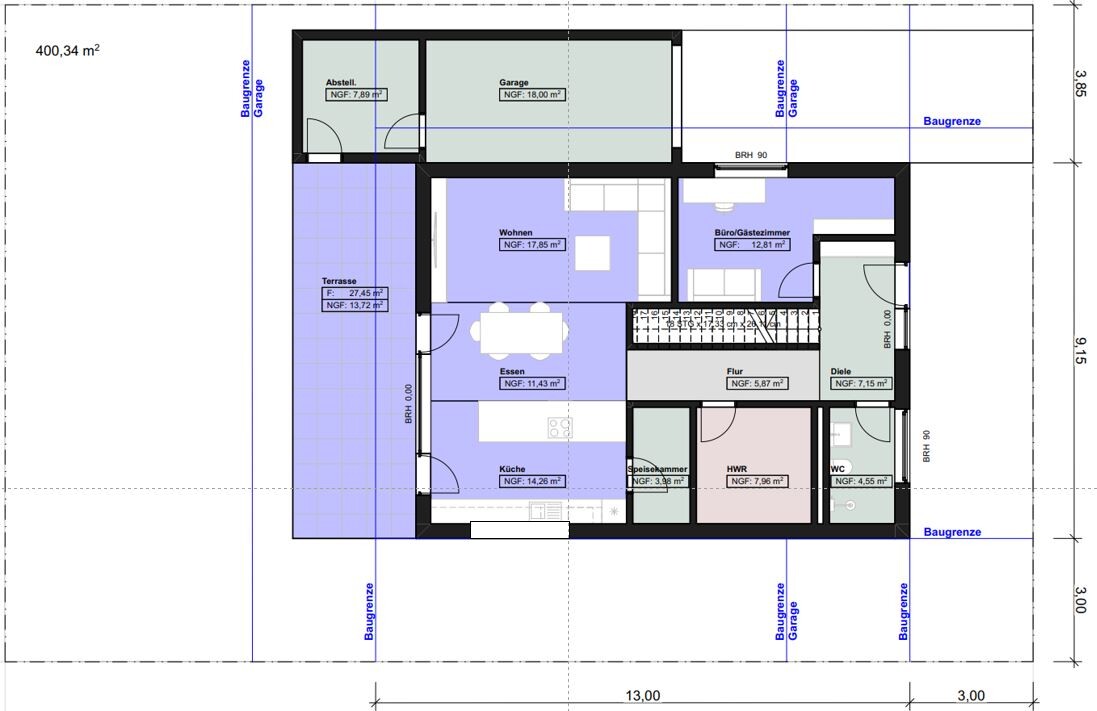
Everything we provided as basic information and what our daily life requires has been implemented.
We like the clear lines/structure.
The open space in the hallway.
The connection/proximity of all rooms on ground and upper floors that need water/sewage. So no funny business with the bathroom upstairs in one corner and the utility room diagonally opposite on the ground floor. Personally, I like that.
No bay windows or other awkward extensions.
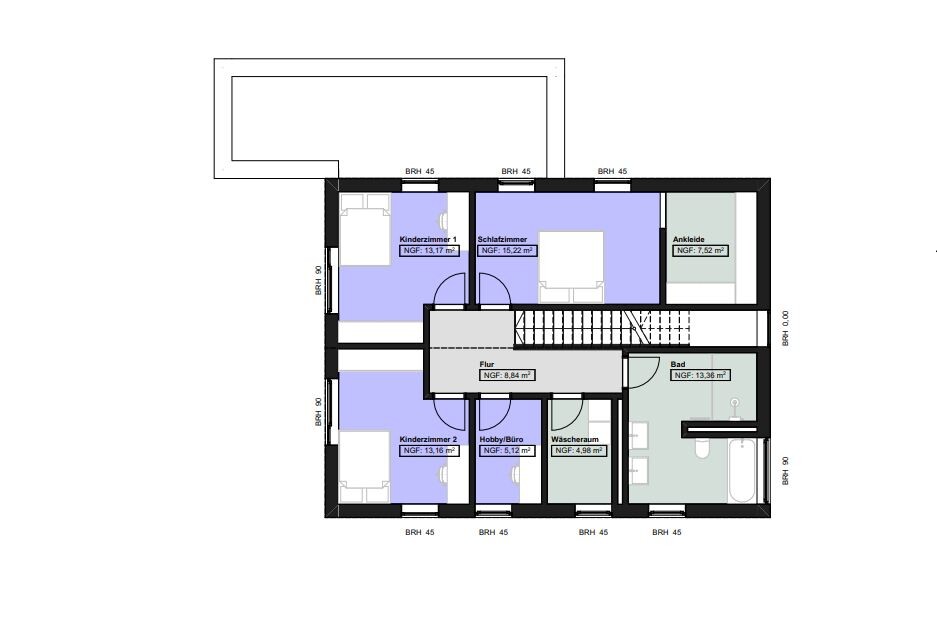
Laundry room upstairs where the washer and dryer are planned.
What don’t you like? Why?
The living room might be a bit too exposed for us. It could also be a cozy nook with TV without direct view of the kitchen. Cooking and eating together openly is liked; the living room could be a bit more separate. Currently, the floor plan shows it like a narrow, rather shadowy corner.
The somewhat narrow bedroom upstairs is not a dealbreaker but not 100% pleasing.
Price estimate according to architect/planner:
-
Personal price limit for the house, including fixtures and fittings:
500-575k
Preferred heating system:
Predefined, ground source heat pump with collector. Cold local heating network.
If you have to give up, which details/extras
-can you do without:
The small additional room for the father upstairs.
Garage, as mentioned carport also conceivable.
-can you not do without:
Office.
Storage box at garage or carport.
Children’s rooms.
Why is the design the way it is now? e.g.
The design turned out this way because the architect implemented our wishes and requirements almost 1:1. This preliminary layout resulted in this first version.
What do you consider particularly good or bad?
See what we like and what not. We don’t find anything particularly bad. Rather, not entirely optimal.
What is the most important/basic question about the floor plan in 130 characters?
Position garage flush with house or set back?
43.5 sqm (468 sq ft) + 4 sqm (43 sq ft) pantry sufficient as “all-purpose room”?
Same floor plan possibly mirrored? Then office on south side, sun all day, blinds always down. Same issue upstairs with bedroom in summer at least. Entrance farther from parking space.
The building method will be timber frame construction with a local timber builder.
This is a first sketch after clarifying needs/wishes with the architect.
Providing all information possible/available at this point in time.
Development Plan / Restrictions
Plot size: 400 sqm (4300 sq ft)
Slope: No, and no means no!
Floor space index (FSI): 0.4
Floor area ratio (FAR): ?
Building envelope, building line and boundary: Yes, available.
Edge development: Possible with garage.
Number of parking spaces: at least 1, preferably 2
Number of storeys: 1-2
Roof type: Gable roof (pitch minimum 31°, maximum 45°)
Architectural style: ??
Orientation: Gable end facing
Maximum heights / limits: Roof ridge 6-7 m (20-23 ft), eaves 9-12 m (30-39 ft)
Other requirements: No brick facades allowed. Driveway or space in front of garage at least 6 m (20 ft). Red roof tiles mandatory, light facade.
Homeowners’ Requirements
Architectural style, roof type, building type: Gable roof, fixed
Basement, storeys: 2 full storeys without basement
Number of occupants, age: 4 people (2 toddlers)
Space requirements on ground floor and upper floor:
Office: Family use or home office? Office of approx. 12 sqm (130 sq ft) is a must.
Guest bedrooms per year: Few
Open or closed architecture: ? Whatever that means.
Conservative or modern construction style: rather modern construction.
Open kitchen, cooking island: Open kitchen, possibly with cooking island
Number of dining seats: 6
Fireplace: NO
Music / stereo wall: Not planned, TV location is quite important.
Balcony, roof terrace: NO
Garage, carport: Garage desired. Carport with storage box also conceivable.
Utility garden, greenhouse: NO
Further wishes / special features / daily routine, preferably with reasons for choices:
Laundry room on the upper floor. They want to do laundry where it is generated and where it must be returned clean. Anything else is a hassle, at least for us.
House Design
Who designed the plan: Architect
What do you particularly like? Why?
Everything we provided as basic information and what our daily life requires has been implemented.
We like the clear lines/structure.
The open space in the hallway.
The connection/proximity of all rooms on ground and upper floors that need water/sewage. So no funny business with the bathroom upstairs in one corner and the utility room diagonally opposite on the ground floor. Personally, I like that.
No bay windows or other awkward extensions.
Laundry room upstairs where the washer and dryer are planned.
What don’t you like? Why?
The living room might be a bit too exposed for us. It could also be a cozy nook with TV without direct view of the kitchen. Cooking and eating together openly is liked; the living room could be a bit more separate. Currently, the floor plan shows it like a narrow, rather shadowy corner.
The somewhat narrow bedroom upstairs is not a dealbreaker but not 100% pleasing.
Price estimate according to architect/planner:
-
Personal price limit for the house, including fixtures and fittings:
500-575k
Preferred heating system:
Predefined, ground source heat pump with collector. Cold local heating network.
If you have to give up, which details/extras
-can you do without:
The small additional room for the father upstairs.
Garage, as mentioned carport also conceivable.
-can you not do without:
Office.
Storage box at garage or carport.
Children’s rooms.
Why is the design the way it is now? e.g.
The design turned out this way because the architect implemented our wishes and requirements almost 1:1. This preliminary layout resulted in this first version.
What do you consider particularly good or bad?
See what we like and what not. We don’t find anything particularly bad. Rather, not entirely optimal.
What is the most important/basic question about the floor plan in 130 characters?
Position garage flush with house or set back?
43.5 sqm (468 sq ft) + 4 sqm (43 sq ft) pantry sufficient as “all-purpose room”?
Same floor plan possibly mirrored? Then office on south side, sun all day, blinds always down. Same issue upstairs with bedroom in summer at least. Entrance farther from parking space.
The building method will be timber frame construction with a local timber builder.
This is a first sketch after clarifying needs/wishes with the architect.
ypg schrieb:
Here is another idea for the upper floor, with the disadvantage that the children’s rooms cannot have wardrobes placed behind the doors. Great visualization. Which software do you use?
Aspirant schrieb:
Great visualization. Which software are you using?This was done with Homebyme on their website. It’s quite intuitive – I can recommend it! Personally, I prefer pencil and paper, but the younger generation doesn’t seem to go for that anymore :p
Maulwurfbau schrieb:
What does “Bauchweh” mean? It was given as a note [...] Car directly in front of the platform or has to drive over it to access the garage. That's all.“Bauwich” comes from the fact that the building is set back from the boundary. No “Bauchweh,” with or without autocorrect ;-)Maulwurfbau schrieb:
Regarding the width. The house can be a maximum of 10 m (33 feet), the current plan is about 9.15 m (30 feet). So it can’t be much wider. Plus, it doesn’t hurt if the building volume has some proportionality. That’s why the plan is exactly as it is regarding length, width, and roof pitch. The staircase is not fixed for me. [...] And honestly, I can’t understand right now why it would be better to build in stone.Now don’t overdo it with the golden ratio or Fibonacci. The foundation slab seen from above will only be noticed briefly, and once the house is finished, you hardly see it anymore. Stone house = no problem with a sill plate = no need for the house to be higher because of that = platform in front of side entrance versus driveway would be solved. Otherwise, it’s equivalent, meaning no real advantage either way. With a “platform staircase,” the house either has to make full use of the possible width or the stair axis must align with the house axis, otherwise the floor plan becomes awkward and requires some fine-tuning.https://www.instagram.com/11antgmxde/
https://www.linkedin.com/company/bauen-jetzt/
M
Maulwurfbau13 Aug 2023 19:2111ant schrieb:
The term "building setback" comes from the fact that the building is set back from the property boundary. No stomach ache involved, with or without autocorrect ;-)
Now, don’t overdo it with the golden ratio or Fibonacci. You’ll only briefly appreciate the foundation slab in aerial views, and once the house is finished, it’s hardly noticeable. A masonry house = no rim joist issues = no need to raise the house height for that reason = the platform in front of the side entrance vs. the driveway would be resolved. Otherwise, it’s equivalent, meaning no particular advantage. With a "platform staircase," the house either has to make use of the available width, or the stair axis must align with the house axis, otherwise the floor plan risks looking awkward—it’s a bit of a puzzle. Yeah, you’re right, but it’s also fine as long as it looks good anyway...
M
Maulwurfbau14 Aug 2023 13:24So, here is a summary again.
The design is (bad).
Here is what I have gathered from the posts so far:
- Rethink the staircase; a landing staircase is a good alternative.
- The study should not have awkward corners or wasted space.
- The open living area could possibly be around the corner to create some privacy in the living space and to ease the cramped situation with the current 8.5m (28 feet) width.
- The children’s rooms could possibly be larger.
- Utility rooms could be located on the north side.
- Soften the narrow bedroom layout.
- Consider the entrance from the garage side.
- Make the house half a meter (about 20 inches) wider and possibly a bit shorter (width limit 10m (33 feet)).
- Obtain three quotes.
I also have additional points:
- The hobby room is not strictly necessary.
- The office can also be upstairs. There is no obligation to have it on the ground floor.
Furthermore, I recently liked the idea of keeping all the wet rooms together on the ground and upper floors to avoid plumbing running across the house. But based on your suggestions and assessments, I will probably have to abandon this and allow the supply and drainage lines to run across the house in favor of a better floor plan.
This is my summary of the last ~80 posts.
The design is (bad).
Here is what I have gathered from the posts so far:
- Rethink the staircase; a landing staircase is a good alternative.
- The study should not have awkward corners or wasted space.
- The open living area could possibly be around the corner to create some privacy in the living space and to ease the cramped situation with the current 8.5m (28 feet) width.
- The children’s rooms could possibly be larger.
- Utility rooms could be located on the north side.
- Soften the narrow bedroom layout.
- Consider the entrance from the garage side.
- Make the house half a meter (about 20 inches) wider and possibly a bit shorter (width limit 10m (33 feet)).
- Obtain three quotes.
I also have additional points:
- The hobby room is not strictly necessary.
- The office can also be upstairs. There is no obligation to have it on the ground floor.
Furthermore, I recently liked the idea of keeping all the wet rooms together on the ground and upper floors to avoid plumbing running across the house. But based on your suggestions and assessments, I will probably have to abandon this and allow the supply and drainage lines to run across the house in favor of a better floor plan.
This is my summary of the last ~80 posts.

First of all, I really appreciate that you’re carefully considering all ideas and staying open-minded. We’ve often experienced quite the opposite here, which usually leads to losing interest in contributing anything further.
Having water and wastewater aligned vertically is always better and simpler in my opinion, based on some self-taught knowledge and a bit of building experience 🙂
I find Hanghaus’s and Yvonne’s suggestions very good already. I would like to explore them further, but despite your explanations, I’m still missing some key conditions. Please tell me again the maximum dimensions, meaning width and length. Planning for 8x12 meters (26x39 feet) is quite different from 9x11 meters (30x36 feet). How is the development or layout to the south? Do you want as much distance as possible there, or is it not important? Your preferred orientation was west, based on your initial plan. Is that correct?
Is a landing staircase acceptable, or is a straight staircase still the better option for you? Regarding the straight staircase, I can only say that we love ours in our long, narrow house, but visiting children often felt uneasy and ALWAYS used the wall for support along with the handrail for safety when going down.
Placing the entrance on the north side next to the driveway leading to the garage rather than on the east side makes the floor plan much simpler, especially for a narrow house. However, this does require careful thought, for example, moving the garage door further north and creating an accessible open space. It wouldn’t make sense if you have to almost drive over the first step with your car.
If you’d like, feel free to share more information. I’m sure more ideas and suggestions will come up then.
Having water and wastewater aligned vertically is always better and simpler in my opinion, based on some self-taught knowledge and a bit of building experience 🙂
I find Hanghaus’s and Yvonne’s suggestions very good already. I would like to explore them further, but despite your explanations, I’m still missing some key conditions. Please tell me again the maximum dimensions, meaning width and length. Planning for 8x12 meters (26x39 feet) is quite different from 9x11 meters (30x36 feet). How is the development or layout to the south? Do you want as much distance as possible there, or is it not important? Your preferred orientation was west, based on your initial plan. Is that correct?
Is a landing staircase acceptable, or is a straight staircase still the better option for you? Regarding the straight staircase, I can only say that we love ours in our long, narrow house, but visiting children often felt uneasy and ALWAYS used the wall for support along with the handrail for safety when going down.
Placing the entrance on the north side next to the driveway leading to the garage rather than on the east side makes the floor plan much simpler, especially for a narrow house. However, this does require careful thought, for example, moving the garage door further north and creating an accessible open space. It wouldn’t make sense if you have to almost drive over the first step with your car.
If you’d like, feel free to share more information. I’m sure more ideas and suggestions will come up then.
Similar topics