
Hello,
I would like to introduce you to a project that has been developing in my mind for several years now. I look forward to your constructive feedback! First of all: the two views are not entirely up to date. Some windows have different sizes, for example, they are not all floor-to-ceiling. Also, the canopy does not extend to the bay window but ends at the “main facade.”
Zoning plan / restrictions
Plot size: approx. 1250m² (square)
Slope: no
Floor area ratio
Plot ratio
Building envelope, building line, and boundary
Boundary construction: the requirement is at least 3m (10 feet) distance from the neighbor’s property line, which we are complying with
Number of parking spaces: 2 mandatory parking spaces; planned are 2 either inside the garage or in front
Roof type: I’m not sure what it’s called, but it is definitely not a flat roof.
Orientation: the garage is on the north side, and the kitchen faces south. The street is a very quiet cul-de-sac running parallel to the house’s front.
Additional requirements: the distance from the property line at the street to the building must be 4m (13 feet); in the area of the office, it may be 3m (10 feet). Building is allowed up to 20m (66 feet) from the street into the property (minus the first 4m, so 16m). Sorry for the missing technical terms and the amateurish description!
Homeowner requirements
Basement, floors: two floors plus basement
Number of occupants, ages: 2 adults (40), two children aged 3 and 6
Office: the upstairs office should also serve as a PC workstation. The ground floor office is primarily planned as a storage room but possibly also as a PC workstation.
Guest stays per year: currently none, but probably later when the children are older. They would sleep on extra beds in the children’s rooms. We do not want a separate guest room or guest bathroom/WC.
Open or closed architecture: rather closed. Originally, we thought about an open connection between dining and living room but decided against it, even though the door will mostly remain open. The same applies to the dining room – hallway passage.
Traditional or modern construction: I would describe it as rather traditional. Function over form.
Open kitchen, cooking island: open kitchen facing the dining area, but intentionally no cooking island, rather a standing desk/bar with stools to allow for interaction.
Number of dining seats: at least 4, with the option to extend the table for family gatherings and similar occasions
Fireplace: yes, in the living room on the wall next to the stairs (plus another fireplace in the basement)
Music / stereo wall: no dedicated setup, only a TV in the living room with space for speakers on each side. In the bedroom, a place for a TV is planned in case we want to install one later. Each of the children’s rooms will have a TV.
Balcony, roof terrace: no
Garage, carport: garage yes; a carport possibly later.
Utility garden, greenhouse: regular garden with a pool adjacent to the living room/terrace
Further wishes / special features / daily routine, including reasons for choices or exclusions:
- Main terrace faces the garden and a small secondary terrace facing the street to enjoy the morning sun or to escape the hot afternoon sun in summer
- Second stairway leading to the basement (not to the upper floor!) to have quicker access from the garden to the workshop
- The WC behind the garage was an idea after removing the WC in the basement. It should also serve as a kind of mudroom after gardening or for the kids. The WC and stairway design are still a work in progress; this is just a snapshot.
- I couldn’t properly represent the wall thickness in my design program. The exterior walls are all 50cm (20 inches) brick; the interior walls are not yet defined individually.
House design
Who created the design: basically by us, now revised with an architect (and still in progress)
What do you like most? Why? The L-shape of the building, because it creates a nice, sheltered terrace and partially screens the garden from the street view.
What do you dislike? Why? The limited daylight in the hallway, especially on the ground floor. I plan to ease this by using glass panels in the doors. There is a window next to the elevator on the upper floor. I am also concerned about the relatively narrow children’s rooms and would appreciate your opinions about whether they are too “thin.”
If you have to give up certain details / add-ons
- can you give up: the WC behind the garage
- can you not give up: hmm…
Why is the design the way it is now?
As mentioned, I wanted an L-shape. The garage location on the north side was non-negotiable for me. The main entrance should also face north, sheltered from wind and rain. The WCs should be ventilated by windows, so not located in interior spaces. I had originally placed the kitchen near the living room to shorten the walk from the car to the kitchen but quickly abandoned that design. It is important for us to access both terraces quickly from the kitchen.
Regarding the upper floor: my wife wanted a small walk-in closet/dressing room, which resulted from the short corridor leading to the bedroom.
We wanted a parent and a children’s bathroom as well as separate toilets, but with the requirement that no toilet is directly inside a bathroom. I am personally not a fan of that due to odor reasons! Since both bathroom and WC should have windows, this was the compromise.
I would like the door from the hallway to the walk-in closet to open outward, but I fear this might cause conflicts with people and the stairs... Removing the door entirely is not an option since we do walk around naked here, and when friends of the children come over and pass by...
The door from the walk-in closet to the bedroom is not a must. It is more of a comfort factor, giving a sense that there is no dark corner in the room when sleeping, if you know what I mean.
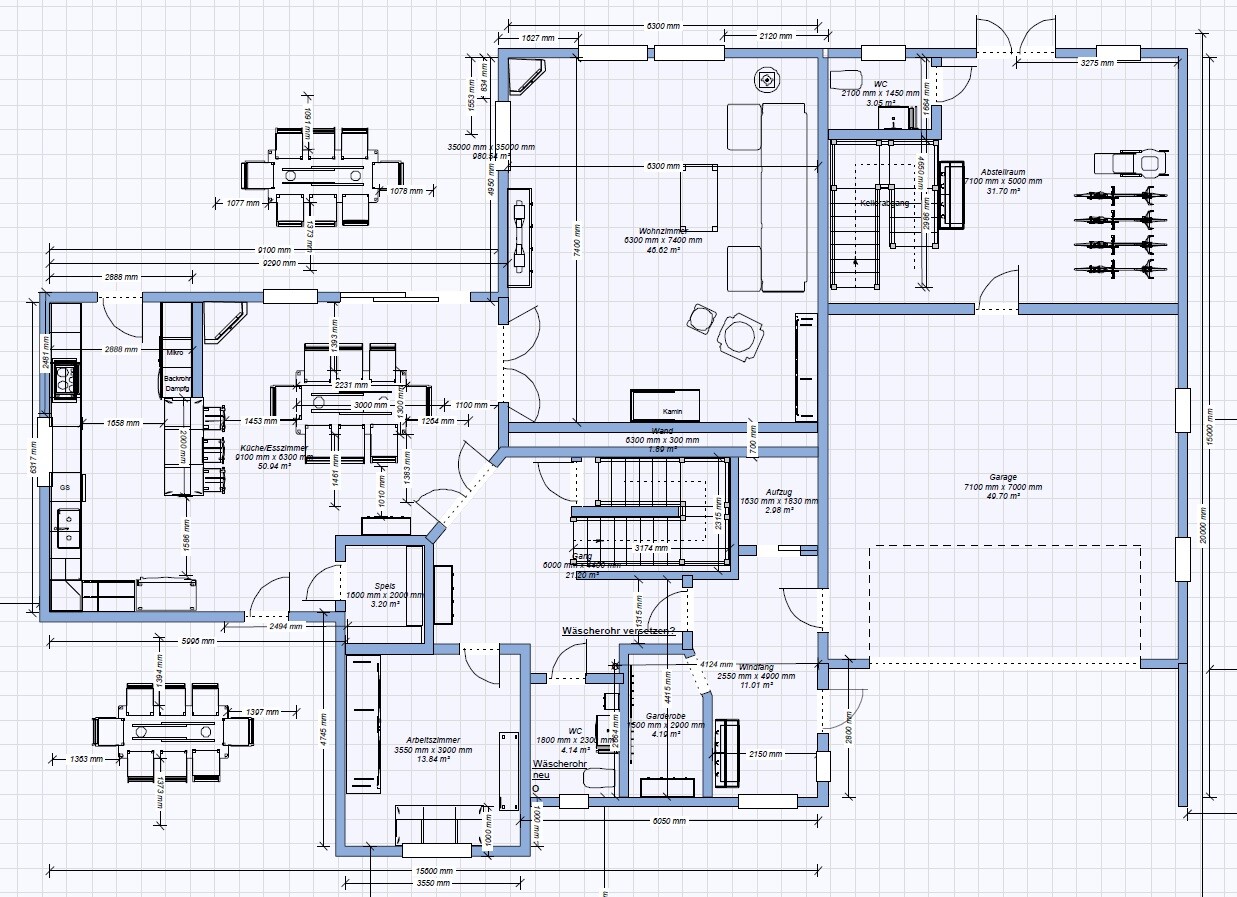
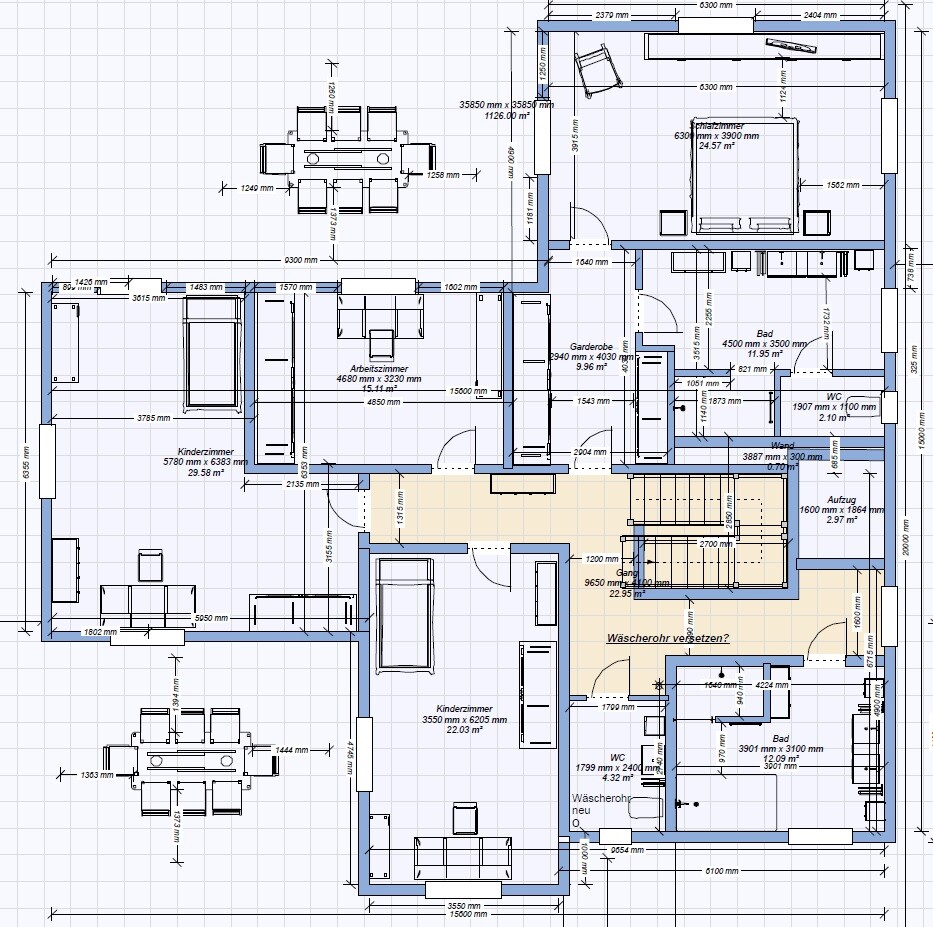
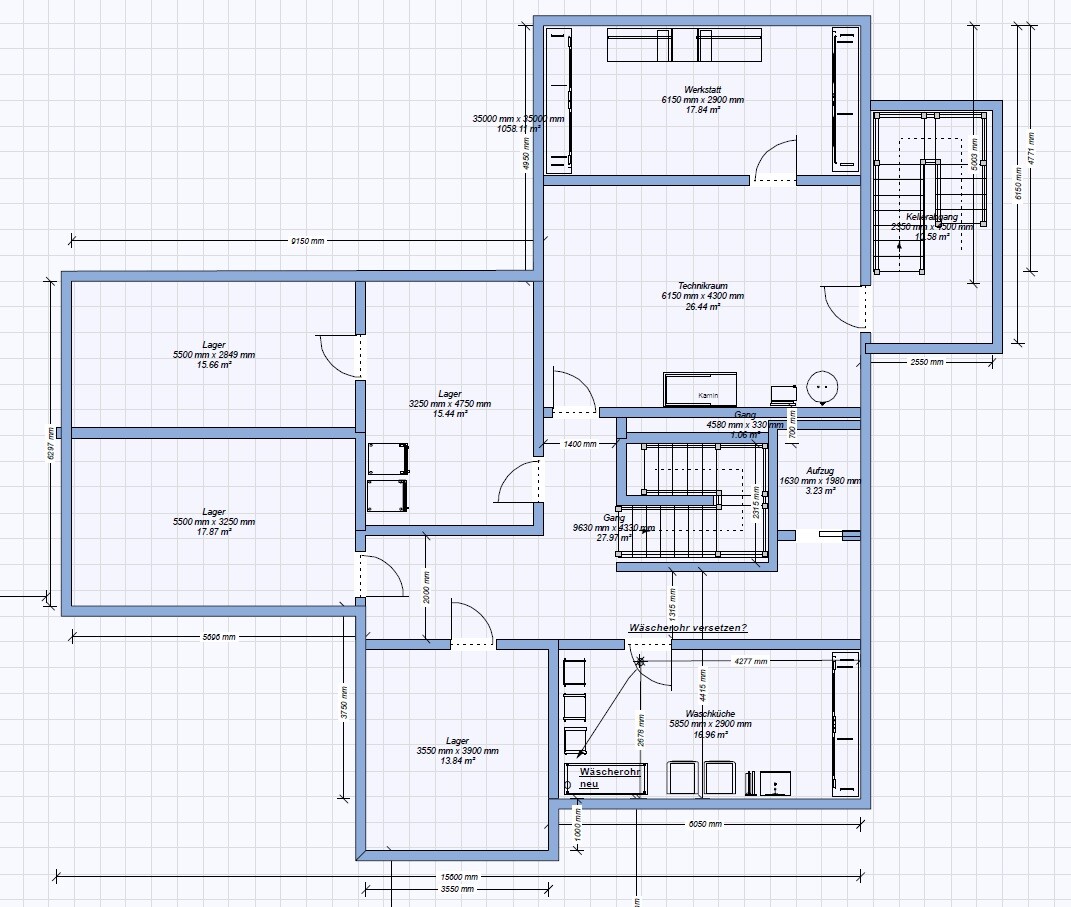
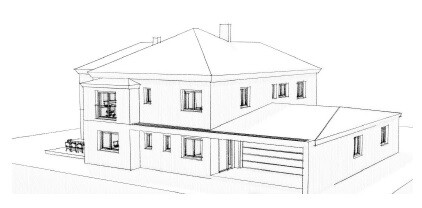
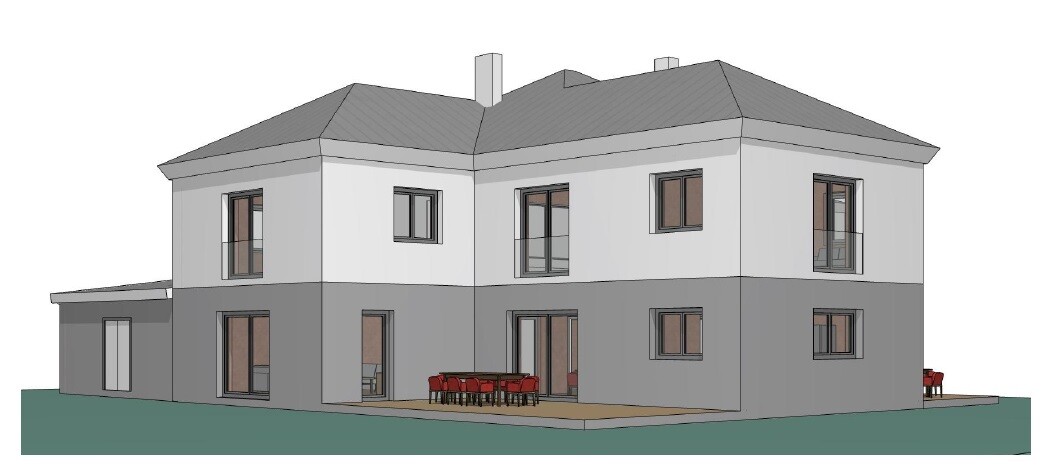
I would like to introduce you to a project that has been developing in my mind for several years now. I look forward to your constructive feedback! First of all: the two views are not entirely up to date. Some windows have different sizes, for example, they are not all floor-to-ceiling. Also, the canopy does not extend to the bay window but ends at the “main facade.”
Zoning plan / restrictions
Plot size: approx. 1250m² (square)
Slope: no
Floor area ratio
Plot ratio
Building envelope, building line, and boundary
Boundary construction: the requirement is at least 3m (10 feet) distance from the neighbor’s property line, which we are complying with
Number of parking spaces: 2 mandatory parking spaces; planned are 2 either inside the garage or in front
Roof type: I’m not sure what it’s called, but it is definitely not a flat roof.
Orientation: the garage is on the north side, and the kitchen faces south. The street is a very quiet cul-de-sac running parallel to the house’s front.
Additional requirements: the distance from the property line at the street to the building must be 4m (13 feet); in the area of the office, it may be 3m (10 feet). Building is allowed up to 20m (66 feet) from the street into the property (minus the first 4m, so 16m). Sorry for the missing technical terms and the amateurish description!
Homeowner requirements
Basement, floors: two floors plus basement
Number of occupants, ages: 2 adults (40), two children aged 3 and 6
Office: the upstairs office should also serve as a PC workstation. The ground floor office is primarily planned as a storage room but possibly also as a PC workstation.
Guest stays per year: currently none, but probably later when the children are older. They would sleep on extra beds in the children’s rooms. We do not want a separate guest room or guest bathroom/WC.
Open or closed architecture: rather closed. Originally, we thought about an open connection between dining and living room but decided against it, even though the door will mostly remain open. The same applies to the dining room – hallway passage.
Traditional or modern construction: I would describe it as rather traditional. Function over form.
Open kitchen, cooking island: open kitchen facing the dining area, but intentionally no cooking island, rather a standing desk/bar with stools to allow for interaction.
Number of dining seats: at least 4, with the option to extend the table for family gatherings and similar occasions
Fireplace: yes, in the living room on the wall next to the stairs (plus another fireplace in the basement)
Music / stereo wall: no dedicated setup, only a TV in the living room with space for speakers on each side. In the bedroom, a place for a TV is planned in case we want to install one later. Each of the children’s rooms will have a TV.
Balcony, roof terrace: no
Garage, carport: garage yes; a carport possibly later.
Utility garden, greenhouse: regular garden with a pool adjacent to the living room/terrace
Further wishes / special features / daily routine, including reasons for choices or exclusions:
- Main terrace faces the garden and a small secondary terrace facing the street to enjoy the morning sun or to escape the hot afternoon sun in summer
- Second stairway leading to the basement (not to the upper floor!) to have quicker access from the garden to the workshop
- The WC behind the garage was an idea after removing the WC in the basement. It should also serve as a kind of mudroom after gardening or for the kids. The WC and stairway design are still a work in progress; this is just a snapshot.
- I couldn’t properly represent the wall thickness in my design program. The exterior walls are all 50cm (20 inches) brick; the interior walls are not yet defined individually.
House design
Who created the design: basically by us, now revised with an architect (and still in progress)
What do you like most? Why? The L-shape of the building, because it creates a nice, sheltered terrace and partially screens the garden from the street view.
What do you dislike? Why? The limited daylight in the hallway, especially on the ground floor. I plan to ease this by using glass panels in the doors. There is a window next to the elevator on the upper floor. I am also concerned about the relatively narrow children’s rooms and would appreciate your opinions about whether they are too “thin.”
If you have to give up certain details / add-ons
- can you give up: the WC behind the garage
- can you not give up: hmm…
Why is the design the way it is now?
As mentioned, I wanted an L-shape. The garage location on the north side was non-negotiable for me. The main entrance should also face north, sheltered from wind and rain. The WCs should be ventilated by windows, so not located in interior spaces. I had originally placed the kitchen near the living room to shorten the walk from the car to the kitchen but quickly abandoned that design. It is important for us to access both terraces quickly from the kitchen.
Regarding the upper floor: my wife wanted a small walk-in closet/dressing room, which resulted from the short corridor leading to the bedroom.
We wanted a parent and a children’s bathroom as well as separate toilets, but with the requirement that no toilet is directly inside a bathroom. I am personally not a fan of that due to odor reasons! Since both bathroom and WC should have windows, this was the compromise.
I would like the door from the hallway to the walk-in closet to open outward, but I fear this might cause conflicts with people and the stairs... Removing the door entirely is not an option since we do walk around naked here, and when friends of the children come over and pass by...
The door from the walk-in closet to the bedroom is not a must. It is more of a comfort factor, giving a sense that there is no dark corner in the room when sleeping, if you know what I mean.
H
HeimatBauer9 Aug 2023 21:44The balcony is very deep, that's true. This only has advantages: when you sit on it, unlike a "normal" balcony, you really have an outdoor seating area—just elevated at about 2.5 meters (8 feet). You can set up a large banquet table with chairs all around; all of that works perfectly on the balcony. At first, our general contractor said, "That’s not possible. You can’t build a balcony deeper than 1.5 meters (5 feet)." We replied, "We’ve definitely seen balconies deeper than 1.5 meters (5 feet), and I thought you were a construction company?" The contractor said, "Well, you can build it, but you’ll need supports at the corners underneath." We said, "Then just build those supports—you are a construction company after all." And that’s what they did. So it worked out after all.
The sun angle was just an estimation on my part, based on how the sun sits in summer. I made a few mistakes in the calculation, which luckily canceled each other out—in summer, the sun now shines right up to 5 centimeters (2 inches) before the outer edge of the patio door, meaning no direct sunlight hits the glass. And thanks to the 4-meter (13 feet) width of the south-facing glass surface, it’s definitely anything but dark inside.
In summer, the seats under the balcony are always the most popular because they actually provide real sun protection. The outer seats (the terrace extends well beyond the balcony) are also shaded by the usual shade providers mentioned here — but the reality at parties shows that the spots under the balcony are far more popular than those under awnings or sun sails.
In winter, the sun shines all the way through the living room into the kitchen. During storms, the balcony offers excellent protection to everything on the terrace. The balcony railing fixtures are perfect for quickly mounting sun sails, string lights, rain covers, etc. So the balcony isn’t the end of sun protection but just the beginning.
Because the balcony area is significant, it collects a lot of rainwater into the cistern. It’s possible that photovoltaic panels will be added around the balcony railing on the upper floors; they can be quickly and securely screwed to the railing. In the optimally weather-protected corner between the house wall and the balcony underside, there is an electrical distribution box for power, network, cameras, speakers, and everything else needed for a party on the terrace.
One special feature of my house is that I designed it so it can be divided into two halves to some extent. Then the upper floor balcony becomes the terrace—just without direct garden access.
The sun angle was just an estimation on my part, based on how the sun sits in summer. I made a few mistakes in the calculation, which luckily canceled each other out—in summer, the sun now shines right up to 5 centimeters (2 inches) before the outer edge of the patio door, meaning no direct sunlight hits the glass. And thanks to the 4-meter (13 feet) width of the south-facing glass surface, it’s definitely anything but dark inside.
In summer, the seats under the balcony are always the most popular because they actually provide real sun protection. The outer seats (the terrace extends well beyond the balcony) are also shaded by the usual shade providers mentioned here — but the reality at parties shows that the spots under the balcony are far more popular than those under awnings or sun sails.
In winter, the sun shines all the way through the living room into the kitchen. During storms, the balcony offers excellent protection to everything on the terrace. The balcony railing fixtures are perfect for quickly mounting sun sails, string lights, rain covers, etc. So the balcony isn’t the end of sun protection but just the beginning.
Because the balcony area is significant, it collects a lot of rainwater into the cistern. It’s possible that photovoltaic panels will be added around the balcony railing on the upper floors; they can be quickly and securely screwed to the railing. In the optimally weather-protected corner between the house wall and the balcony underside, there is an electrical distribution box for power, network, cameras, speakers, and everything else needed for a party on the terrace.
One special feature of my house is that I designed it so it can be divided into two halves to some extent. Then the upper floor balcony becomes the terrace—just without direct garden access.
H
HeimatBauer9 Aug 2023 22:00Oh yes: Both the moving of bulky items and just recently the delivery of a large tabletop were only possible through the balconies. Using the staircase (which is bigger than the one shown in this floor plan proposal) was out of the question. So from the terrace to the upper floor balcony and then to the attic balcony. For me, the balcony is very often very practical, especially since I often sit on the terrace.
HeimatBauer schrieb:
The balcony is very deep, that’s true. This has only advantages: when you sit on it, compared to a “normal” balcony, you actually have a proper outdoor seating area—but just elevated at 2.5m (8 feet) height. You can set up a large banquet table with chairs all around, that’s all possible on the balcony. Our general contractor initially said, “No, you can’t build a balcony deeper than 1.5m (5 feet).” We replied, “Well, we’ve definitely seen balconies deeper than 1.5m (5 feet), and I thought you’re a construction company?” The contractor said, “Well, it’s possible, but then you need supports at the corners below.” We said, “Then just add the supports, you are a construction company after all.” And that’s what they built. So it was possible after all.
The sun angle was just an estimate from me, based on how the sun positions itself in summer. I made some mistakes in the calculation which fortunately balanced each other out—in summer, the sun now shines exactly up to 5cm (2 inches) before the outer edge of the terrace door, meaning there is no direct sunlight on the glass. And thanks to the 4m (13 feet) width of the glass surface facing south, it’s definitely anything but dark inside.
In summer, the seating under the balcony is always the most popular, because it really provides effective sun protection. The outer seats (the terrace extends well beyond the balcony) also have sun protection from the usual shade providers mentioned here—but the reality at parties shows that the seats under the balcony are clearly more popular than those under the awning or sunshade.
In winter, sunlight streams through the living room all the way into the kitchen. During storms, the balcony protects everything on the terrace very well. The balcony railing fixtures are perfect for quickly mounting sunshades, string lights, rain covers, etc. So the balcony is not the end of sun protection, only the beginning.
Since the balcony area is significant, it also channels a considerable amount of rainwater into the cistern. Possibly, photovoltaic panels will be installed all around the balcony railing on the upper and attic floors—they can be quickly and firmly screwed to the railing. In the optimally weather-protected corner between the house wall and the underside of the balcony, there’s an electrical distribution for power, network, cameras, speakers, basically everything needed for a party on the terrace.
One special feature of my house is that it is built so it can be divided roughly in half. Then the upper floor balcony becomes the terrace, just without garden access.Would you share some photos?H
HeimatBauer10 Aug 2023 15:17I am currently on the other side of the country, so here is a rough description:
Floor-to-ceiling glass doors without thresholds leading to the terrace, four units side by side, each 1m (3.3 ft) wide. Exactly facing south. Above, centered, there is a balcony about 6m (20 ft) wide and approximately 3m (10 ft) deep, meaning the balcony extends about 1m (3.3 ft) wider on each side than the doors. At the outer corners of the balcony, there is a steel column on each side. The balcony railing is screwed into the front edge of the balcony’s concrete slab. So, even when the sun slowly rises over the east, the sun is blocked by the lateral overhang.
The entire terrace is 8m (26 ft) wide and 4m (13 ft) deep, thus larger than the balcony.
Floor-to-ceiling glass doors without thresholds leading to the terrace, four units side by side, each 1m (3.3 ft) wide. Exactly facing south. Above, centered, there is a balcony about 6m (20 ft) wide and approximately 3m (10 ft) deep, meaning the balcony extends about 1m (3.3 ft) wider on each side than the doors. At the outer corners of the balcony, there is a steel column on each side. The balcony railing is screwed into the front edge of the balcony’s concrete slab. So, even when the sun slowly rises over the east, the sun is blocked by the lateral overhang.
The entire terrace is 8m (26 ft) wide and 4m (13 ft) deep, thus larger than the balcony.
H
HeimatBauer10 Aug 2023 15:38Oh yes: Because the balcony is so large, rain hardly reaches the glass panes. That’s why we also skipped the Aco channel and have only a few millimeters of water threshold due to the slight slope of the "window sills" under the doors and the few millimeters of the lower sealing threshold. Since we have been living here, we have experienced many storms but never had any water problems. We also always leave all shoes just beside the door, and they never get wet.
H
HeimatBauer10 Aug 2023 16:09HeimatBauer schrieb:
So we decided not to install the Aco channel after all.This is, of course, not a recommendation to do the same, and any competent professional would rightly ask why at least a slot drain wasn’t installed. Or, of course, an Aco channel specifically designed for this purpose. Sure, it’s all possible—and necessary if you don’t have this strong protection against rain. Considering the balcony, we chose to skip it, and the rain marks confirm that in this case it works without one. This also prevents plaster residue from window panes (rarely, as there is hardly any rain on them) or terrace surfaces (more so, since no rain washes it away) from entering the rainwater cistern.
Similar topics