
ᐅ Planning a Ground-Level Patio with Slope – Any Experiences?
Created on: 25 Jul 2023 13:19
J
jumbo125
Hello everyone,
We have a terrace that measures 3 x 5 meters (10 x 16 feet).
If we roof the entire area, it could be 7 meters (23 feet) long, but that is not currently planned.
My question is in which direction we should create the slope. I would make it slope to the left, with a 2% gradient.
This means the slope would lead away to the left when stepping out from the patio door.
So far, so good...
The precast company requires us to install a drainage grate at least 30 cm (12 inches) wide starting from the door. This grate should have a 2% slope toward the front.
Now the question is whether the grate should also have a slope to the left.
Thank you very much for your help!
We have a terrace that measures 3 x 5 meters (10 x 16 feet).
If we roof the entire area, it could be 7 meters (23 feet) long, but that is not currently planned.
My question is in which direction we should create the slope. I would make it slope to the left, with a 2% gradient.
This means the slope would lead away to the left when stepping out from the patio door.
So far, so good...
The precast company requires us to install a drainage grate at least 30 cm (12 inches) wide starting from the door. This grate should have a 2% slope toward the front.
Now the question is whether the grate should also have a slope to the left.
Thank you very much for your help!
K
KarstenausNRW25 Jul 2023 20:05Build a wooden deck. Then you can safely do without a gutter and slope.
KarstenausNRW schrieb:
Build a wooden deck. Then you can safely do without a channel drain and slope.2 pallets of porcelain stoneware are already purchased :-(WilderSueden schrieb:
Now it’s becoming a bit clearer. I hadn’t expected an angled floor plan. And when I read “comfort threshold,” I can understand the oversized channel. Basically, it would make sense to have a slope from the upper right side of the plan down to the lower left to direct water away from the house.
The larger part of the terrace is adjacent to the house at the top of the plan, so I would definitely create a slope downward from there. Whether it needs to be 2% or if 1% is sufficient is up to you. The main thing is that water from normal rain doesn’t flow against the facade. From the right side of the plan to the left, you could actually have no slope, but then you’d completely rely on the channel to manage heavy rain and on it not being clogged by leaves rotting since the fall before last. That’s why I would also suggest at least a 1% slope here. I thought the same, which is why I drew the slope from the top of the plan to the bottom.
The 2% slope from the left of the plan to the right refers ONLY to the grate. This MUST be installed with a slope from right to left according to the precast manufacturer (guarantee).
So back to my original question:
Should I install the grate with the same slope (top to bottom of the plan) as the slabs?
Or would that look odd?
Is that common practice—installing a grate with a longitudinal slope?
Oh, and there is no channel under the grate, but a “infiltration frame around the house.” By that I mean there is only gravel (16/32 size) about 30cm (12 inches) away from the base of the wall, all around the house, into which the water drains.
Oh yes, one more big question arises!
There is a strip footing under the paving slabs because something will be mounted on it. In addition, I need a curb stone at least 8cm (3 inches) thick to securely fasten the grid grate with angle brackets. (I have 20cm (8 inches) shuttering blocks).
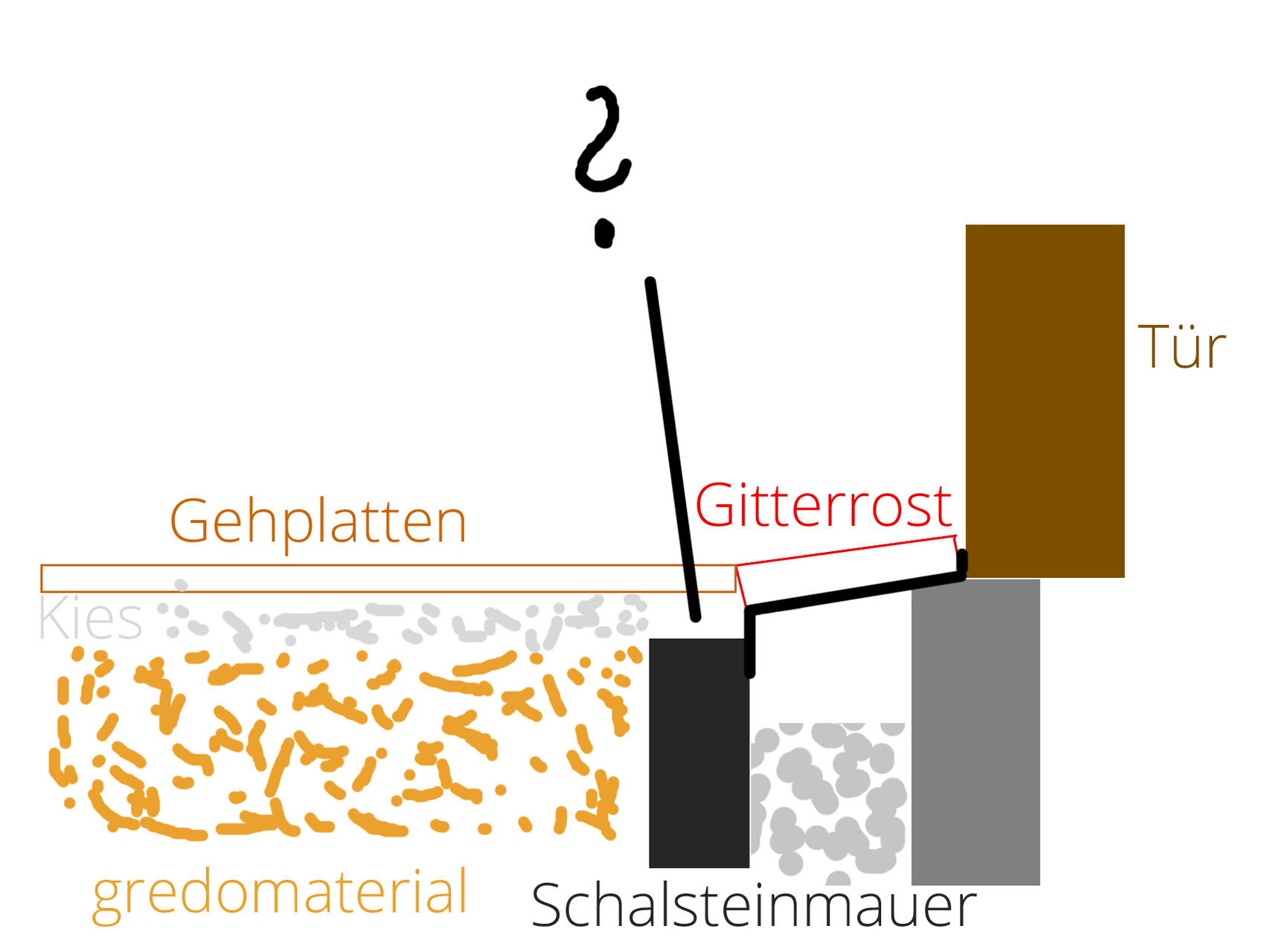
Now I wanted to ask how I should best lay the porcelain stoneware tiles on the shutter blocks?
Option 1:
I lower the shutter blocks by 4cm (1.5 inches) and apply 4cm (1.5 inches) of drainage mortar.
Option 2: (suggested to me by a tiler I know):
I set the shutter blocks 6-7mm (0.25 inches) below the bottom edge of the tiles and apply 6-7mm (0.25 inches) tile adhesive to bond the tiles to the shutter blocks.
Option 3:
I lay the tiles on gravel. Since I’m already placing the remaining tiles behind the shutter block wall in a gravel bed, this would be my preferred method. BUT since the shutter block’s upper edge on the right side protrudes into open space, the entire gravel would spill out.
There is a strip footing under the paving slabs because something will be mounted on it. In addition, I need a curb stone at least 8cm (3 inches) thick to securely fasten the grid grate with angle brackets. (I have 20cm (8 inches) shuttering blocks).
Now I wanted to ask how I should best lay the porcelain stoneware tiles on the shutter blocks?
Option 1:
I lower the shutter blocks by 4cm (1.5 inches) and apply 4cm (1.5 inches) of drainage mortar.
Option 2: (suggested to me by a tiler I know):
I set the shutter blocks 6-7mm (0.25 inches) below the bottom edge of the tiles and apply 6-7mm (0.25 inches) tile adhesive to bond the tiles to the shutter blocks.
Option 3:
I lay the tiles on gravel. Since I’m already placing the remaining tiles behind the shutter block wall in a gravel bed, this would be my preferred method. BUT since the shutter block’s upper edge on the right side protrudes into open space, the entire gravel would spill out.
W
WilderSueden25 Jul 2023 21:29Your sketch actually answers the question. If you install the grate with a slope and the terrace without (or vice versa), you'll get an awkward bend. That's why I would try to keep both surfaces as level as possible.
How large are your tiles and how thick? Thin and large tiles are usually either mortared down or laid on pedestals. If laid on crushed stone, they will eventually start to wobble.
How large are your tiles and how thick? Thin and large tiles are usually either mortared down or laid on pedestals. If laid on crushed stone, they will eventually start to wobble.
WilderSueden schrieb:
Your sketch actually answers the question. If you install the frame with a slope and the terrace without one (or vice versa), you’ll end up with an awkward kink. That’s why I would try to keep both on the same level.
How large and thick are your slabs? Thin and large slabs are usually either mortared in place or installed on pedestal supports. If laid on loose gravel, they’ll eventually start to wobble. Thanks.
45x90cm (18x36 inches).
We will also install a row of slabs all around the house.
We would like to lay these on gravel in case one needs to be replaced later.
Similar topics