
ᐅ What size and type of rainwater cistern should I choose?
Created on: 20 May 2014 12:56
D
Doc.SchnagglsD
Doc.Schnaggls20 May 2014 12:56Hello,
we are planning to have a rainwater cistern installed solely for garden irrigation. Using the water for toilet flushing or the washing machine is not an option for us due to the reasons mentioned in the other thread.
Our property is approximately 400 m² (4,300 sq ft) in size. After the garages and the house are built, about 260 m² (2,800 sq ft) of garden space will remain.
How large should our cistern be?
Rainwater will be collected from both roof slopes of the house and both garages.
Is it better to choose a concrete or a plastic cistern?
The tank will be buried under our driveway—does this affect the choice of material?
Regards,
Dirk
we are planning to have a rainwater cistern installed solely for garden irrigation. Using the water for toilet flushing or the washing machine is not an option for us due to the reasons mentioned in the other thread.
Our property is approximately 400 m² (4,300 sq ft) in size. After the garages and the house are built, about 260 m² (2,800 sq ft) of garden space will remain.
How large should our cistern be?
Rainwater will be collected from both roof slopes of the house and both garages.
Is it better to choose a concrete or a plastic cistern?
The tank will be buried under our driveway—does this affect the choice of material?
Regards,
Dirk

That depends on the local precipitation in your region. If it rarely rains but the rainfall is heavy, a larger system makes more sense.
Our architect had to include this information on the drainage application for the city.
According to the development plan, we are required to install a cistern. The calculated size (according to regulations) is about 2,200 liters (580 gallons). However, it will be built for (I don’t remember the exact number) slightly over 4,500 liters (1,190 gallons). The garden area is 430 square meters (4,630 square feet).
We are using concrete.
What you choose might depend on your groundwater level. If the groundwater is high and surrounds the cistern while it is nearly empty and therefore too light, it can happen that the tank floats up like a submarine.
Our architect had to include this information on the drainage application for the city.
According to the development plan, we are required to install a cistern. The calculated size (according to regulations) is about 2,200 liters (580 gallons). However, it will be built for (I don’t remember the exact number) slightly over 4,500 liters (1,190 gallons). The garden area is 430 square meters (4,630 square feet).
We are using concrete.
What you choose might depend on your groundwater level. If the groundwater is high and surrounds the cistern while it is nearly empty and therefore too light, it can happen that the tank floats up like a submarine.
D
Doc.Schnaggls20 May 2014 15:44emer schrieb:
Our architect had to include that on the drainage application for the city.Ok, interesting. I just checked our drainage application again, and there’s nothing like that on it. However, the approved building permit / planning permission does show the cistern. Maybe the rules in Baden-Württemberg are different from those in Hesse?
emer schrieb:
We’re building with concrete.
What you choose might depend on your groundwater level. If it’s high and surrounds the cistern, and the tank is almost empty and therefore too light, it could actually float like a submarine. Fascinating image...
Our plot is slightly on a slope; you could almost say on the “top of the hill.” The geologist didn’t find groundwater until he had to stop his planned five-meter (16 feet) borehole at just over three meters (10 feet) depth due to solid rock.
Personally, I also prefer concrete...
Regards,
Dirk
P
Polle 196720 May 2014 16:03Hello Dirk
You get the greatest benefit if all roof surfaces can be directed into the cistern (in the case of a sloped site, keep in mind that water does not flow uphill), so it should be located at a low point on the property.
You get the greatest benefit if all roof surfaces can be directed into the cistern (in the case of a sloped site, keep in mind that water does not flow uphill), so it should be located at a low point on the property.

Hello Doc,
I can’t give you exact information on this—just my own experience and what I’ve heard.
Material: My father has a plastic cistern that he installed himself and has been very satisfied with it even after more than 10 years. Sometimes he complains that the cistern is too small during hot and dry periods (as far as I know, it is 6 cubic meters (about 212 cubic feet) for a 650 sqm (7000 sq ft) plot including the house). Our general contractor only installs concrete cisterns. When I asked him about plastic cisterns, he said he never really dealt with them and seemed to prefer sticking to proven solutions.
I think it’s a matter of preference. However, I can imagine that a cistern in the driveway would be better made of concrete. We were told that if you want the concrete cistern (we have a 10 m³ (about 353 cubic feet), see the picture) to be drive-over capable, it needs a different lid. So I assume a drive-over cistern should be made from a more stable material.
We considered 5 m³ (about 177 cubic feet), 7.5 m³ (about 265 cubic feet), and 10 m³ options. When I asked about the price difference between the 5 and 10 m³ sizes, the answer was just under one thousand. So it was clear we’d go with the 10 m³.
If you have a soil that allows infiltration, make sure the cistern is placed in a gravel bed. That way, the overflow will seep away first until it reaches a certain level, then it will be directed into the sewer system. If the ground is not permeable, it probably doesn’t matter much, since the cistern overflow will go into the sewer anyway.
If the cistern is empty, it could float up when groundwater is high, whether it’s concrete or plastic. The heavier concrete might hold it down a bit longer.
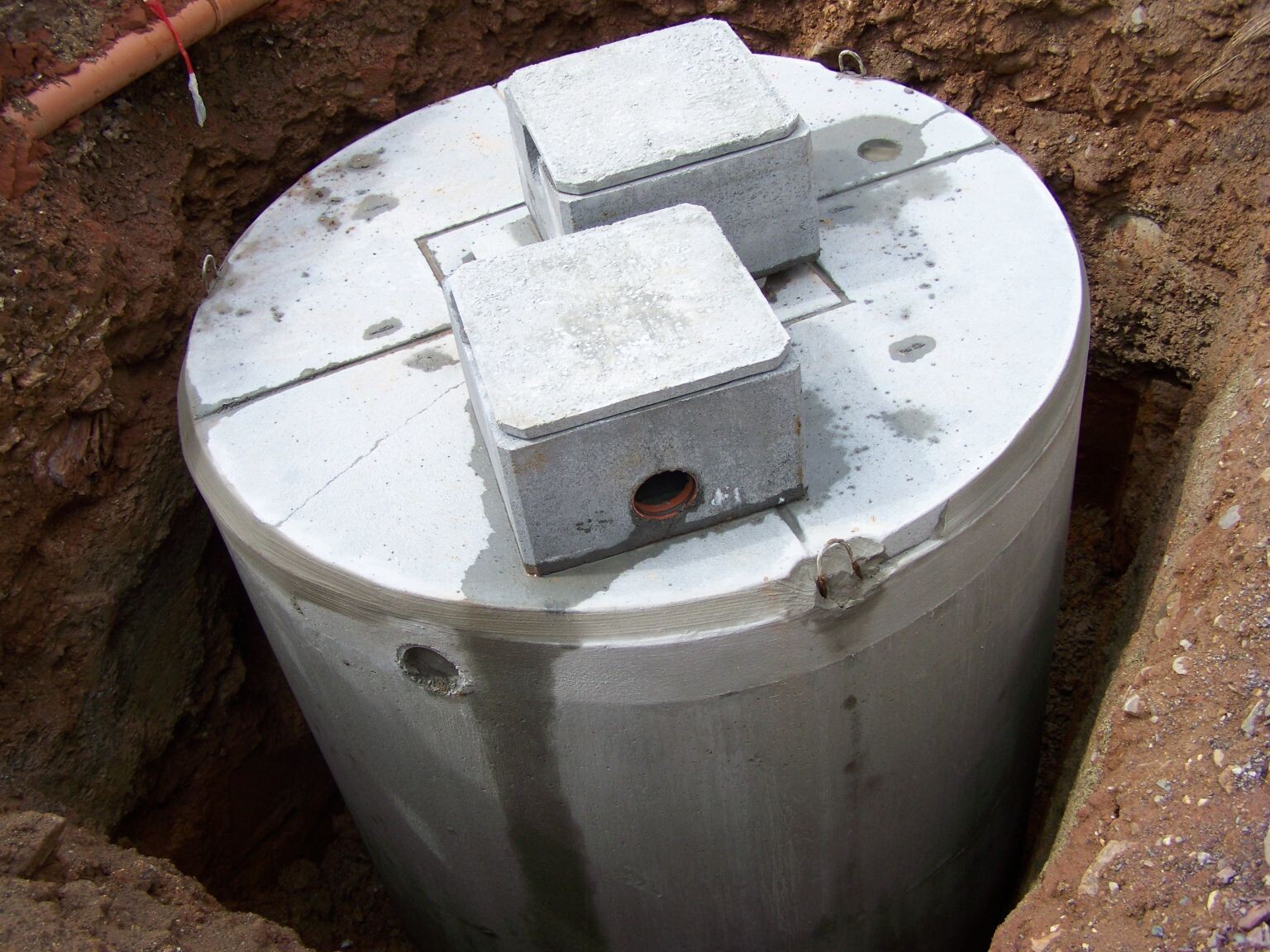
I can’t give you exact information on this—just my own experience and what I’ve heard.
Material: My father has a plastic cistern that he installed himself and has been very satisfied with it even after more than 10 years. Sometimes he complains that the cistern is too small during hot and dry periods (as far as I know, it is 6 cubic meters (about 212 cubic feet) for a 650 sqm (7000 sq ft) plot including the house). Our general contractor only installs concrete cisterns. When I asked him about plastic cisterns, he said he never really dealt with them and seemed to prefer sticking to proven solutions.
I think it’s a matter of preference. However, I can imagine that a cistern in the driveway would be better made of concrete. We were told that if you want the concrete cistern (we have a 10 m³ (about 353 cubic feet), see the picture) to be drive-over capable, it needs a different lid. So I assume a drive-over cistern should be made from a more stable material.
We considered 5 m³ (about 177 cubic feet), 7.5 m³ (about 265 cubic feet), and 10 m³ options. When I asked about the price difference between the 5 and 10 m³ sizes, the answer was just under one thousand. So it was clear we’d go with the 10 m³.
If you have a soil that allows infiltration, make sure the cistern is placed in a gravel bed. That way, the overflow will seep away first until it reaches a certain level, then it will be directed into the sewer system. If the ground is not permeable, it probably doesn’t matter much, since the cistern overflow will go into the sewer anyway.
If the cistern is empty, it could float up when groundwater is high, whether it’s concrete or plastic. The heavier concrete might hold it down a bit longer.
B
Bauexperte22 May 2014 10:24Hello Dirk,
Concrete cisterns have the advantage of being generally strong enough to support loads, meaning they are suitable for installation beneath yards and driveways. Another benefit is that the slightly acidic rainwater is partially neutralized by the concrete, which reduces its corrosive effect. A major downside of concrete cisterns is their heavier weight, which means higher effort for transportation and installation. A 6000-liter (1600-gallon) concrete cistern weighs around 5 metric tons (5.5 US tons).
Plastic tank
Plastic tanks for rainwater storage are made from polyethylene. Compared to concrete cisterns, they are much lighter, making transport and installation much easier. However, plastic tanks have significantly less structural strength, so their covers are not load-bearing and cannot be driven over.
In general, for both types of tanks, it is important to ensure that the tank cover is properly secured to prevent accidents, especially with young children. Due to the heavy weight of concrete covers, additional securing measures are usually not necessary. Plastic tanks, however, require an appropriate locking mechanism.
Source: my website
Best regards, Bauexperte
Doc.Schnaggls schrieb:That depends on the total roof area as well as how you plan to use the remaining 260 sqm (2800 sq ft). If you want to plant many flowers or establish a small vegetable garden, the cistern should be larger. If you only plan a lawn with occasional shrubs as borders, a smaller cistern sized to the roof area will be sufficient.
Our plot is roughly 400 sqm (4300 sq ft). Once the garage and house are built, about 260 sqm (2800 sq ft) of garden area will remain. How large should our rainwater cistern be?
Doc.Schnaggls schrieb:Concrete cistern
Is it better to choose a concrete or a plastic cistern?
The tank will be buried under our driveway – does this have any influence on the choice of material?
Concrete cisterns have the advantage of being generally strong enough to support loads, meaning they are suitable for installation beneath yards and driveways. Another benefit is that the slightly acidic rainwater is partially neutralized by the concrete, which reduces its corrosive effect. A major downside of concrete cisterns is their heavier weight, which means higher effort for transportation and installation. A 6000-liter (1600-gallon) concrete cistern weighs around 5 metric tons (5.5 US tons).
Plastic tank
Plastic tanks for rainwater storage are made from polyethylene. Compared to concrete cisterns, they are much lighter, making transport and installation much easier. However, plastic tanks have significantly less structural strength, so their covers are not load-bearing and cannot be driven over.
In general, for both types of tanks, it is important to ensure that the tank cover is properly secured to prevent accidents, especially with young children. Due to the heavy weight of concrete covers, additional securing measures are usually not necessary. Plastic tanks, however, require an appropriate locking mechanism.
Source: my website
Best regards, Bauexperte
Similar topics