
ᐅ Very Poor Parquet Flooring Installation – Is Rectification Impossible?
Created on: 19 Jan 2023 10:55
P
pim1985
Hello,
unfortunately, we are having problems again with our parquet installer (a small family business in NRW). The work on the transitions and the baseboards was done very poorly.
A brief summary of the situation: After a long wait due to residual moisture in the screed, the parquet was installed (oak, 18.5cm (7.3 inches) wide, fully glued).
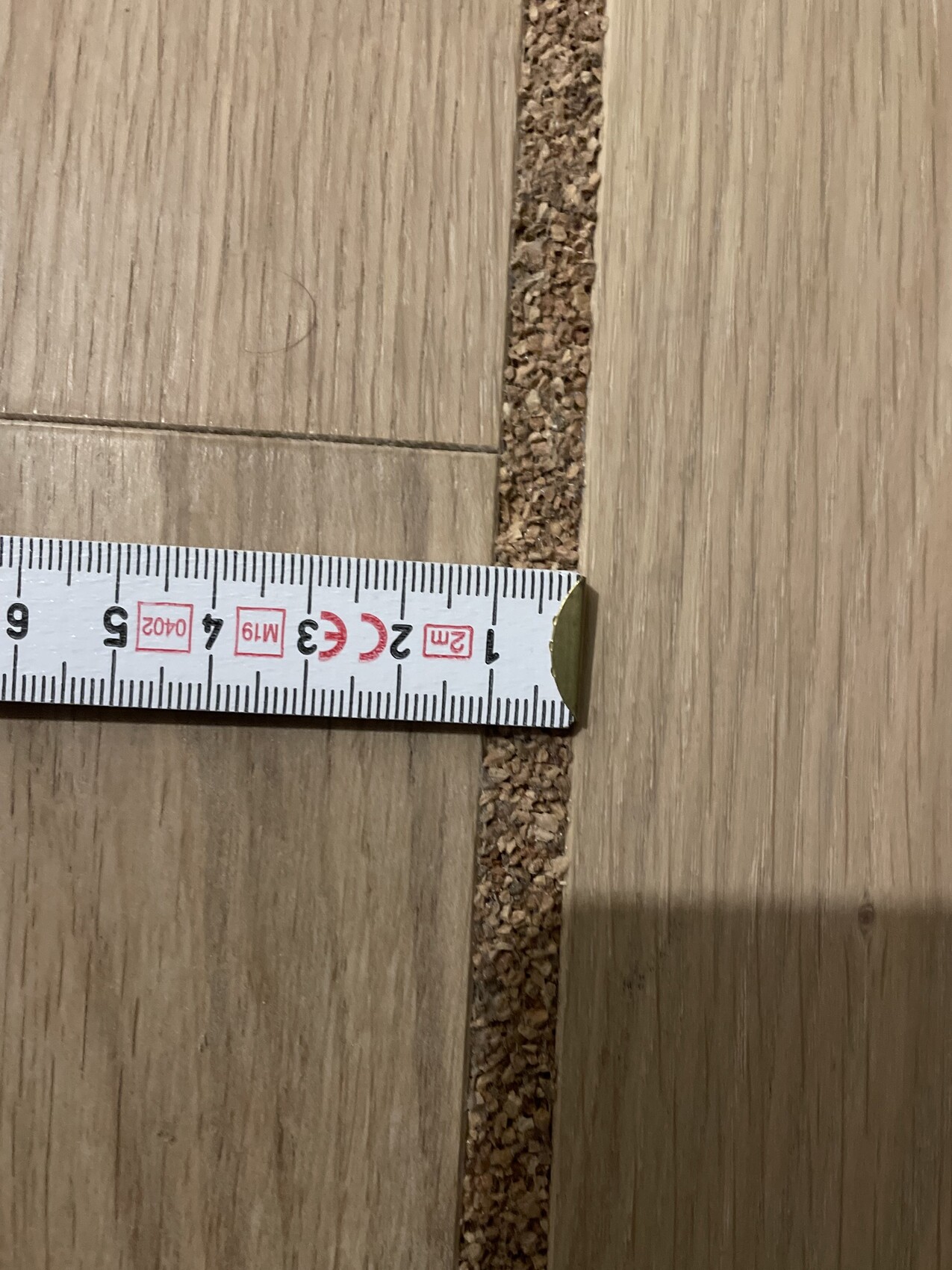
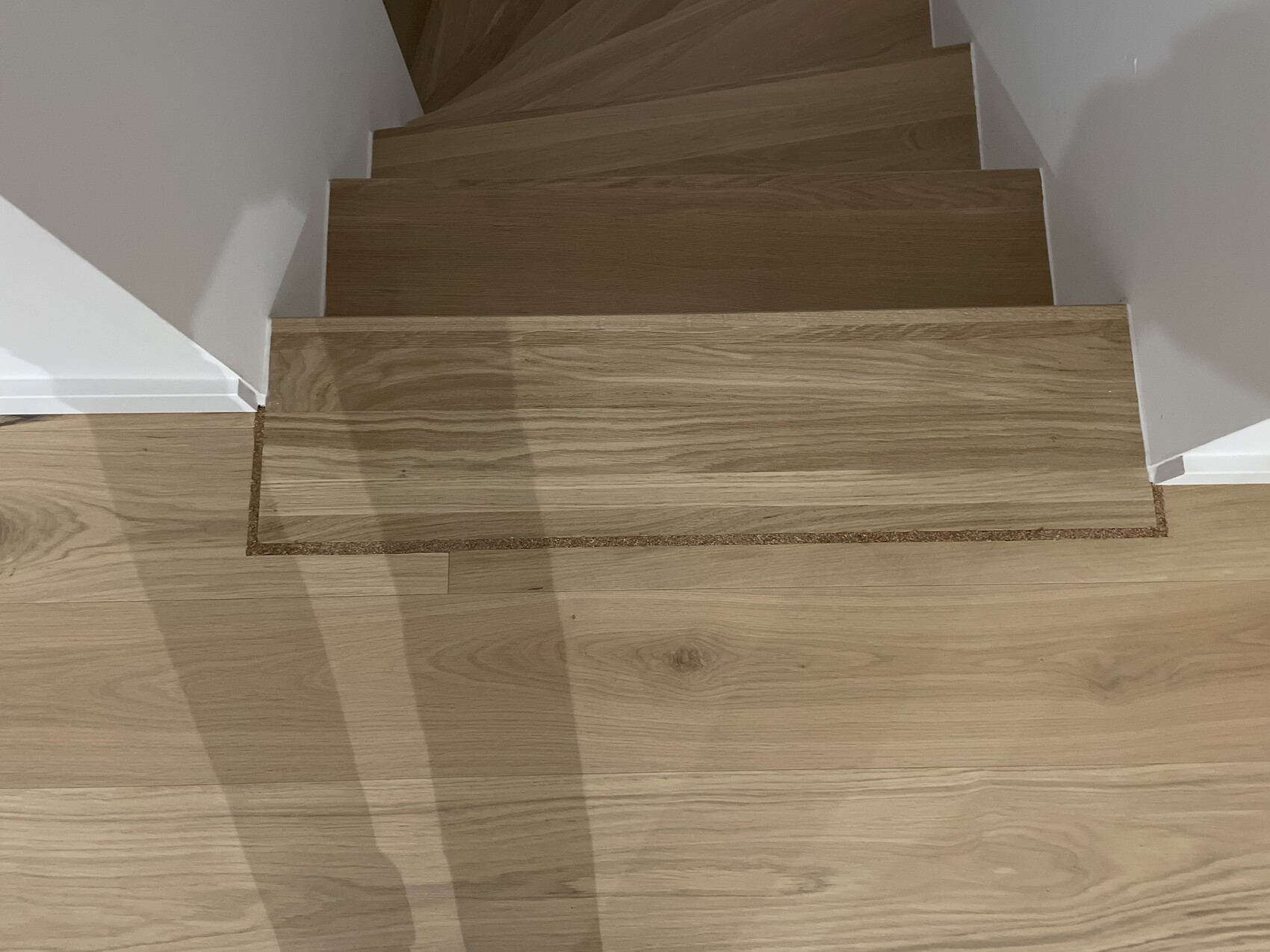
As you can see in the photos, the gaps at the transitions are about 1cm (0.4 inches) wide and filled with a cork material that does not match the color.
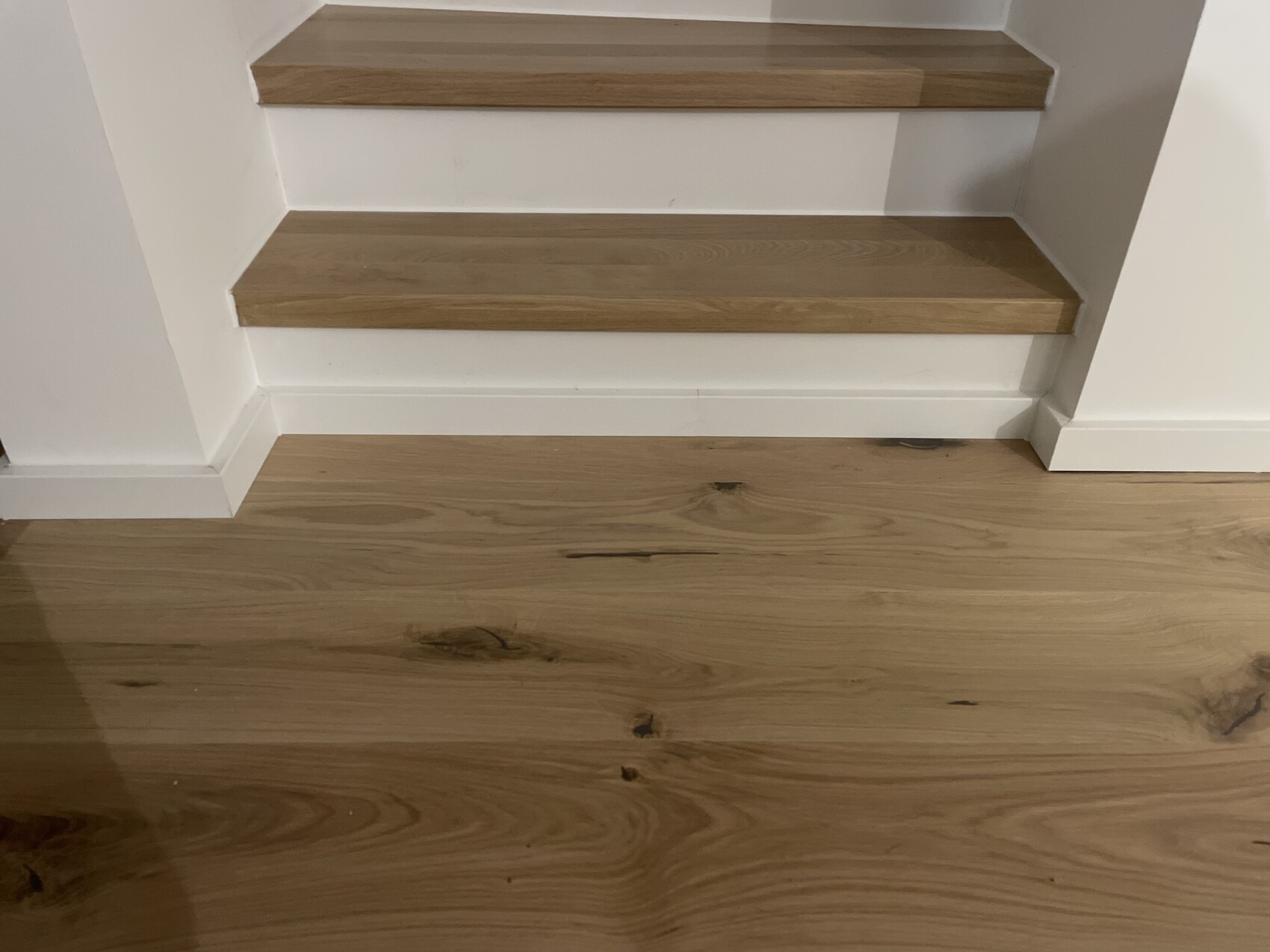
The baseboards (1.8cm (0.7 inches) wide, about 5.8cm (2.3 inches) high) at the floor-to-ceiling windows do not look good, the smaller baseboards/profiles are odd, and the work was very untidy. The reason for the unusual small baseboards/profiles: the window reveals are too narrow (1cm (0.4 inches) wide baseboards would fit; this is the case with our neighbors in an identical semi-detached house). There are nicer solutions for this, but there was no communication that the baseboards would not fit. The parquet installer is unable to accept criticism and is old-fashioned, just doing things as he learned 30 years ago. He refuses to make any corrections.
Regarding the cork filling, we probably have no legal chance for corrections, even though the boards at the transitions were cut unevenly. (I saw examples from other providers, unfortunately too late, and spoke with specialists from a large parquet company (Parkett Dietrich) who said that transitions without joints or with very small joints about 4mm (0.16 inches) are possible. These could be filled with parquet joint filler in a similar color and would look a thousand times better). Baseboards before the step in the staircase area???
The small baseboards in the window area are impossible, though. I am a member of the property owners’ protection association (legal insurance is also available) and I am considering taking legal action with a specialist lawyer and construction consultant, although I would prefer not to. But this job cost a lot of money, and now I will probably have to hire a second company to fix it.
I would appreciate any tips on how to salvage one or the other issue.
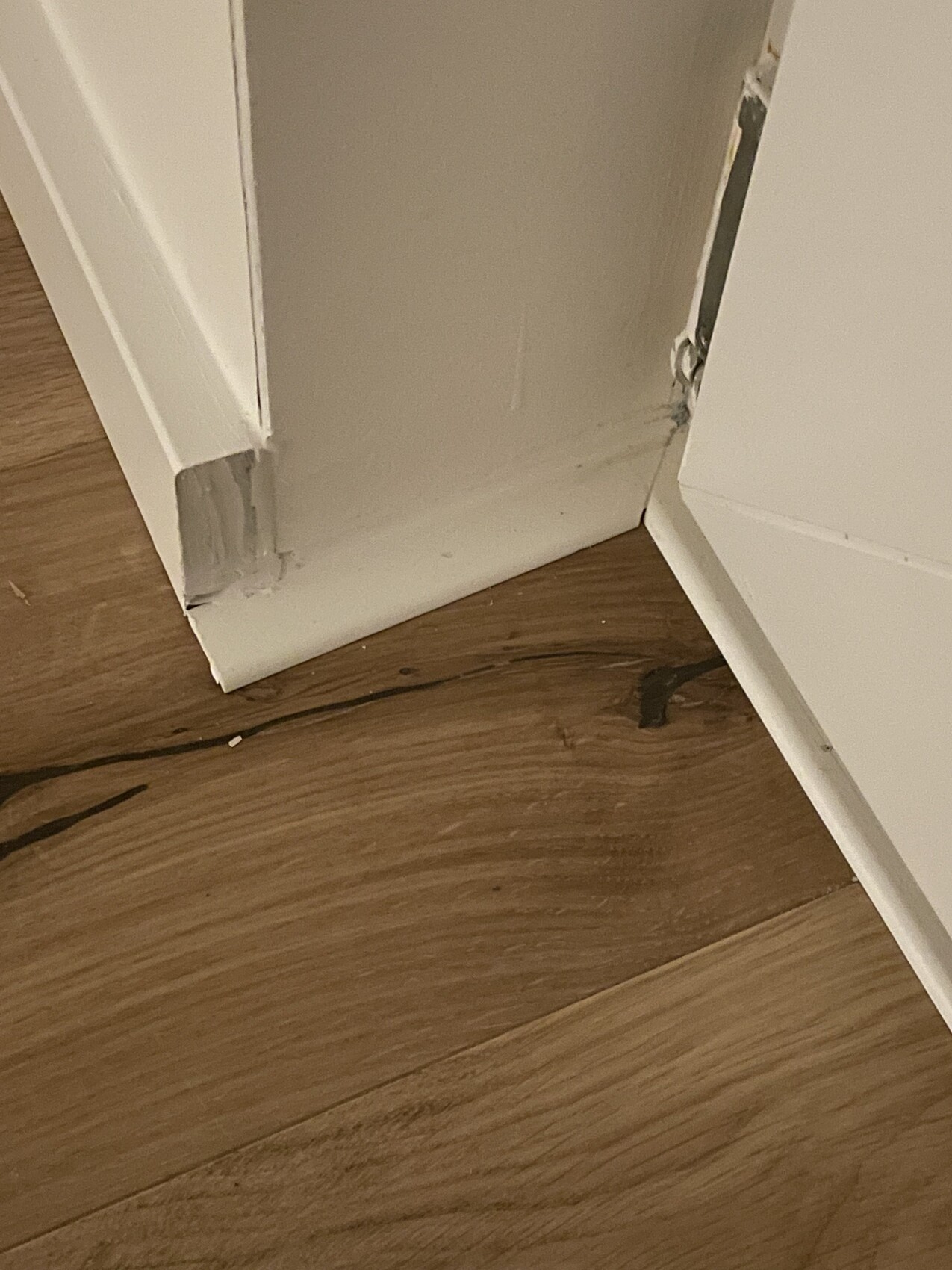
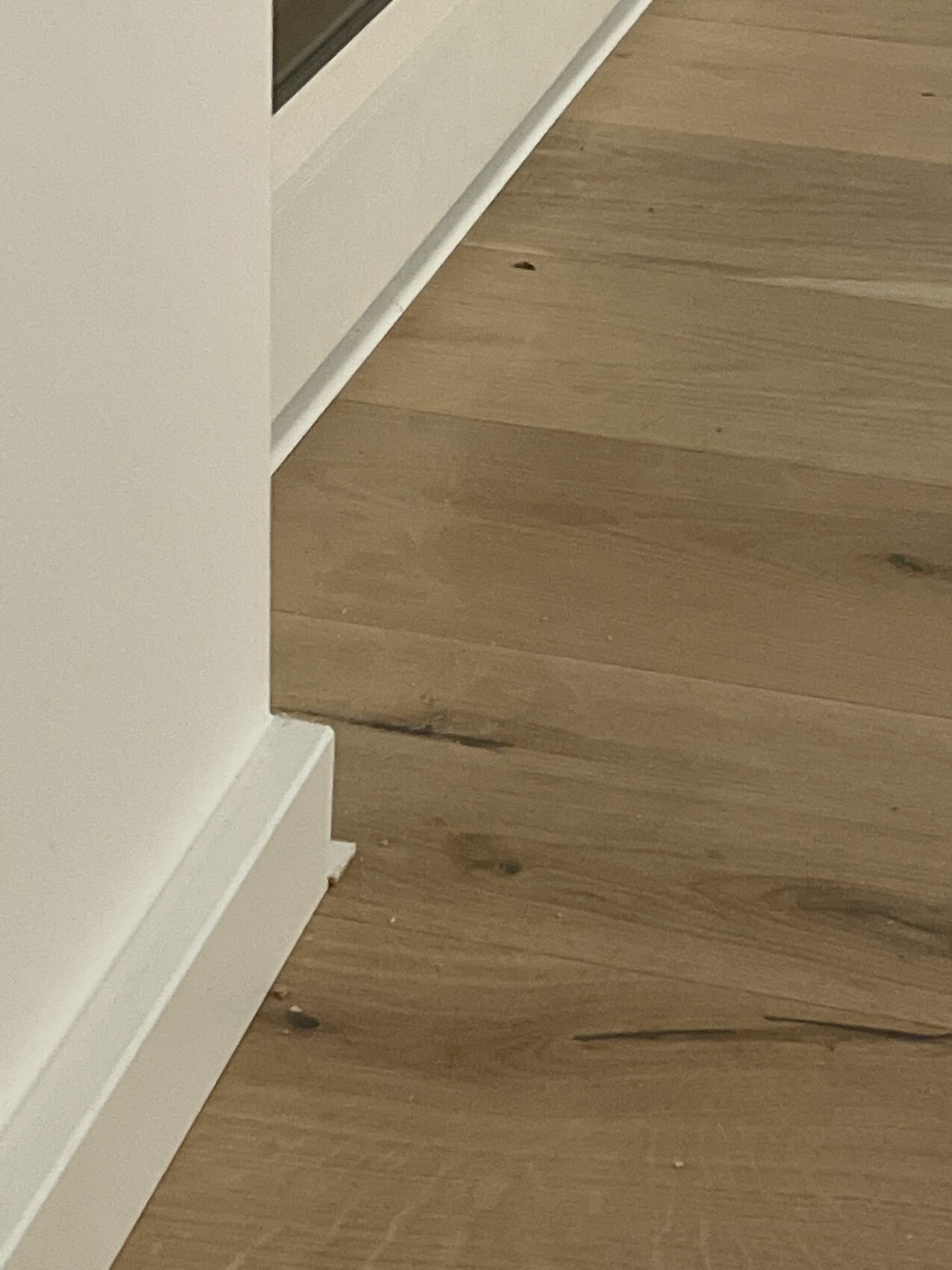
unfortunately, we are having problems again with our parquet installer (a small family business in NRW). The work on the transitions and the baseboards was done very poorly.
A brief summary of the situation: After a long wait due to residual moisture in the screed, the parquet was installed (oak, 18.5cm (7.3 inches) wide, fully glued).
As you can see in the photos, the gaps at the transitions are about 1cm (0.4 inches) wide and filled with a cork material that does not match the color.
The baseboards (1.8cm (0.7 inches) wide, about 5.8cm (2.3 inches) high) at the floor-to-ceiling windows do not look good, the smaller baseboards/profiles are odd, and the work was very untidy. The reason for the unusual small baseboards/profiles: the window reveals are too narrow (1cm (0.4 inches) wide baseboards would fit; this is the case with our neighbors in an identical semi-detached house). There are nicer solutions for this, but there was no communication that the baseboards would not fit. The parquet installer is unable to accept criticism and is old-fashioned, just doing things as he learned 30 years ago. He refuses to make any corrections.
Regarding the cork filling, we probably have no legal chance for corrections, even though the boards at the transitions were cut unevenly. (I saw examples from other providers, unfortunately too late, and spoke with specialists from a large parquet company (Parkett Dietrich) who said that transitions without joints or with very small joints about 4mm (0.16 inches) are possible. These could be filled with parquet joint filler in a similar color and would look a thousand times better). Baseboards before the step in the staircase area???
The small baseboards in the window area are impossible, though. I am a member of the property owners’ protection association (legal insurance is also available) and I am considering taking legal action with a specialist lawyer and construction consultant, although I would prefer not to. But this job cost a lot of money, and now I will probably have to hire a second company to fix it.
I would appreciate any tips on how to salvage one or the other issue.

I think filing a lawsuit probably isn’t worth the stress (and the amount in dispute is likely too low for the effort). A repair here most likely means "someone will just paint over it again," that’s my gut feeling as a layperson. Or do you expect them to replace everything completely? I rather suspect that what’s realistic and proportionate here is "the painter pays for the floor fitter" and not "the floor fitter rebuilds the staircase." And if the floor fitter absolutely refuses to do even the first, then I’m not sure it’s worth arguing endlessly over it.
This is purely a layperson’s opinion and not professional or legal advice.
This is purely a layperson’s opinion and not professional or legal advice.

pim1985 schrieb:
That is not related. The three of us built with this developer. Everything is excellent in all three houses. The houses were perfectly built brick by brick within 12 months (1 year), and three different building inspectors rated the work as excellent. No delays, no drama, no material shortages. If I had done it with the developer, I wouldn’t be stressed now. But that’s over. There is nothing about this in the contract. The flooring installer only had one option in white. He never once mentioned that the edges would be painted. These are prefabricated components. Who paints something like that? I will take this to court and expose all the botched work on this project. Have you already paid the full amount or held back enough money (as leverage)?
If you have withheld payment, set written deadlines for defect correction, then terminate the contract after those expire without results. Assign the work to a third party – done. Let the flooring installer sue for payment. Still, you will have to advance the legal fees (probably under $1,000 given the scope).
If you win, you’ll recover these costs; if there is a settlement, you might have to cover them; if you lose, you must also pay their attorney. This is not legal advice but reflects my current experience with litigation in the construction field.
If you have already paid everything, I would get an offer for defect correction and then decide if pursuing legal action is worthwhile. For defect corrections below $1,000, in my personal opinion, I wouldn’t waste my time and would just pay and enjoy the nice staircase. For your information, my lawsuit involves around $20,000, and I was sued for payment but was able to hold back $7,000 (1,800 GBP / 9,500 AUD / 5,600 CAD) as leverage.
i_b_n_a_n schrieb:
Have you already paid the full amount for the contract, or have you withheld enough money (as leverage)?
If you have withheld payment, set written deadlines for defect rectification, then terminate the contract after these deadlines pass without results. Assign the work to a third party – done. Let the flooring installer sue for payment. However, you will need to cover your lawyer’s fees upfront (estimated under $1,000 for this amount of work?). If you win, you get this back; if there is a settlement, you might have to bear the costs. If you lose, you also have to pay their lawyer. This is not intended as legal advice, just my current experience with a construction-related lawsuit.
If you have already paid everything, I would get a quote for defect correction and then consider whether a legal dispute is worthwhile. For defect costs under $1,000, in my personal opinion, it’s not worth wasting time on and better to just pay and then enjoy your nice staircase. For reference: my claim concerns about $20,000, and I was sued for payment because fortunately I had withheld enough ($7,000) as leverage.So, we have paid everything; the contract was from January 2023. We were unhappy with all the work, but didn’t want any further stress since the move was already delayed. In January, after the work was completed, we asked for a discount because the gaps around the doors and windows were cut unevenly and not sufficiently filled with cork. The flooring installer refused, arguing he could fix the gaps by widening them, essentially "reworking" them. Of course, we didn’t want that—who wants gaps over 1.5 cm (0.6 inches) thick around doors? The entire stairwell looked terrible, freshly painted walls were damaged, the stair nosings were extremely dirty, full of glue residue, the joints in the stairwell were uneven and very thick. In some places, the baseboards were not flush. The wooden steps were not cut precisely, although they measured the steps several times; in some areas there were excessive gaps and the joints were wider. We somehow accepted all of this plus the installer’s unfriendly and uncooperative attitude, repaired the problem spots ourselves, and even came to terms with it.
Around two weeks ago, thick stains from the glue suddenly appeared on the stair nosings. So, six months after the work was completed, we contacted the flooring installer again and requested a response. He admitted the glue caused the stains but claimed it was our fault because we hadn’t varnished the stair nosings?! That was not his problem. We responded by sending a letter with a deadline for correction (replacement of the stair nosings, not just varnishing). So far, he is ignoring us. Complete silence. We requested a quote from a third-party company. The damage control—just varnishing—would cost about €2,000 (31 stair nosings). According to the third party, the flooring installer did not "seal off" the stair nosings properly, which led to the stains. These stair nosings are finished, coated components in various decors that are not meant to be painted. This was also confirmed again by our building surveyor, site manager, and the third-party company. We will now seek legal advice and this time we will list all botched points, because enough is enough. We are talking about a contract value of €25,000 (approximately $27,000) with a “master craftsman company.”
X
xMisterDx30 Jun 2023 19:43Yes, a contract amount of 25,000 EUR. But that is not the damage, since you received the services and refused any rectification.
And, sorry, but painting 31 kick plates for 2,000 EUR? Our former landlord is currently having our old apartment painted, 98m² (1,055 sq ft) including ceilings, for 1,600 EUR.
Wish the painter a speedy recovery; he should apply the paint, not drink so much of it.
And, sorry, but painting 31 kick plates for 2,000 EUR? Our former landlord is currently having our old apartment painted, 98m² (1,055 sq ft) including ceilings, for 1,600 EUR.
Wish the painter a speedy recovery; he should apply the paint, not drink so much of it.
C
chand198630 Jun 2023 20:26xMisterDx schrieb:
And, sorry, but painting 31 damage spots, 2,000 EUR? Our former landlord is currently having our old apartment painted, 98m² (1055 ft²) including ceilings for 1,600 EUR.That’s extremely cheap then. Just one coat, cheapest paint, and a friend giving a discounted price but still charging an invoice. Even then, hard to believe.We had a friend who is a professional painter. 117m² (1260 ft²) including ceilings, walls painted twice, previously colored. 59 hours at 48 EUR per hour. 2,688 EUR without materials or travel costs. We bought the materials through him as part of our equity.
And now one room less for so much less?
Black? (I mean, not the walls)
X
xMisterDx30 Jun 2023 20:5020% more area means we’re no longer talking about 1,600 but 1,920 EUR.
And, of course, just one coat over white walls, not two over colored ones. So in that respect, your price is actually almost better than mine...
But are you seriously telling me that the painter wants to spend 40 hours on 31 stair treads? An entire working week? Over an hour per step?
I managed that myself in just two 8-hour days.
And, of course, just one coat over white walls, not two over colored ones. So in that respect, your price is actually almost better than mine...
But are you seriously telling me that the painter wants to spend 40 hours on 31 stair treads? An entire working week? Over an hour per step?
I managed that myself in just two 8-hour days.
Similar topics