
Our development plan requires permeable paving for the driveway and parking spaces. In principle, there's nothing wrong with that, but the problem is that the soil underneath is very clayey and hardly suitable for allowing water to simply drain away. Even days after the last rain, a layer of mud several centimeters thick sticks to boots, and the infrastructure work was probably delayed because every hole filled up during this wonderful summer. During heavy rain, a stream often runs through the neighbors’ gardens in the first construction phase as well.
I just reviewed the soil survey again; it states loess-bearing fluvial clay with a kf value of 9.5*10^-8 m/s (approximately ~10^-7). According to Wikipedia, soil with a permeability of 10^-6 or less is considered impermeable.
Now the question is how to deal with this situation. I see the following problems here:
- Originally, I planned to use the same paving for the path from the driveway to the front door, but now I worry that this could direct water underneath the foundation.
- An additional problem is that the road is located almost at the highest point of the property, and with a connected substructure, the water will likely follow the path of least resistance.
- Where should the water that seeps through the paving go? Probably less of an issue with light rain, but heavy rain could cause significant ponding.
- How to handle frost? The subsoil itself is classified as F3 and is already somewhat problematic, and having trapped water on top sounds like a recipe for problems. Our property is at 666 meters (The Number of the Beast... 😉 ), so we can expect significant frost.
- The neighbors to the east and northeast are at higher elevations, and depending on their construction, heavy rain could flow toward our front door. That’s exactly why permeable paving in front of the house was appealing.
Of course, I have already considered possible solutions:
- For the path to the house and the terrace, maybe avoid permeable paving so that rainwater flows away from the house on the surface and is directed by a slight slope into the lawn?
- Some sort of water barrier within the substructure using deep edge restraints between the driveway and the path so that each substructure is reasonably separated? The paths need much less sub-base than the driveway anyway.
- Or simply use permeable paving all the way up to the house but excavate extra deep under the driveway so that all water drains and infiltrates there? The driveway will be about 30cm (12 inches) higher than the ground floor level, so that would indeed mean excavating quite deep and probably extra cost.
- Or is diverting all this water unnecessary, and would a standard 30cm (12 inches) base layer plus 30cm (12 inches) frost protection under permeable paving be sufficient?
- Does it make a difference whether porous stones are used or if infiltration happens through the joints? I’m not really a fan of wide joints because they always seem to become completely covered with moss.
I just reviewed the soil survey again; it states loess-bearing fluvial clay with a kf value of 9.5*10^-8 m/s (approximately ~10^-7). According to Wikipedia, soil with a permeability of 10^-6 or less is considered impermeable.
Now the question is how to deal with this situation. I see the following problems here:
- Originally, I planned to use the same paving for the path from the driveway to the front door, but now I worry that this could direct water underneath the foundation.
- An additional problem is that the road is located almost at the highest point of the property, and with a connected substructure, the water will likely follow the path of least resistance.
- Where should the water that seeps through the paving go? Probably less of an issue with light rain, but heavy rain could cause significant ponding.
- How to handle frost? The subsoil itself is classified as F3 and is already somewhat problematic, and having trapped water on top sounds like a recipe for problems. Our property is at 666 meters (The Number of the Beast... 😉 ), so we can expect significant frost.
- The neighbors to the east and northeast are at higher elevations, and depending on their construction, heavy rain could flow toward our front door. That’s exactly why permeable paving in front of the house was appealing.
Of course, I have already considered possible solutions:
- For the path to the house and the terrace, maybe avoid permeable paving so that rainwater flows away from the house on the surface and is directed by a slight slope into the lawn?
- Some sort of water barrier within the substructure using deep edge restraints between the driveway and the path so that each substructure is reasonably separated? The paths need much less sub-base than the driveway anyway.
- Or simply use permeable paving all the way up to the house but excavate extra deep under the driveway so that all water drains and infiltrates there? The driveway will be about 30cm (12 inches) higher than the ground floor level, so that would indeed mean excavating quite deep and probably extra cost.
- Or is diverting all this water unnecessary, and would a standard 30cm (12 inches) base layer plus 30cm (12 inches) frost protection under permeable paving be sufficient?
- Does it make a difference whether porous stones are used or if infiltration happens through the joints? I’m not really a fan of wide joints because they always seem to become completely covered with moss.
W
WilderSueden26 Jun 2023 22:20Bumping this thread up. The scaffolding is coming down this week, and I’m currently planning the trench drain in front of the door. The drain is intended purely as an emergency measure in case of extreme heavy rain. The neighbor had two Wiltec drains left over. Now I could use some collective wisdom on the best way to connect it.
Option 1: Drain going downwards (the hole would be to the left of the slabs)
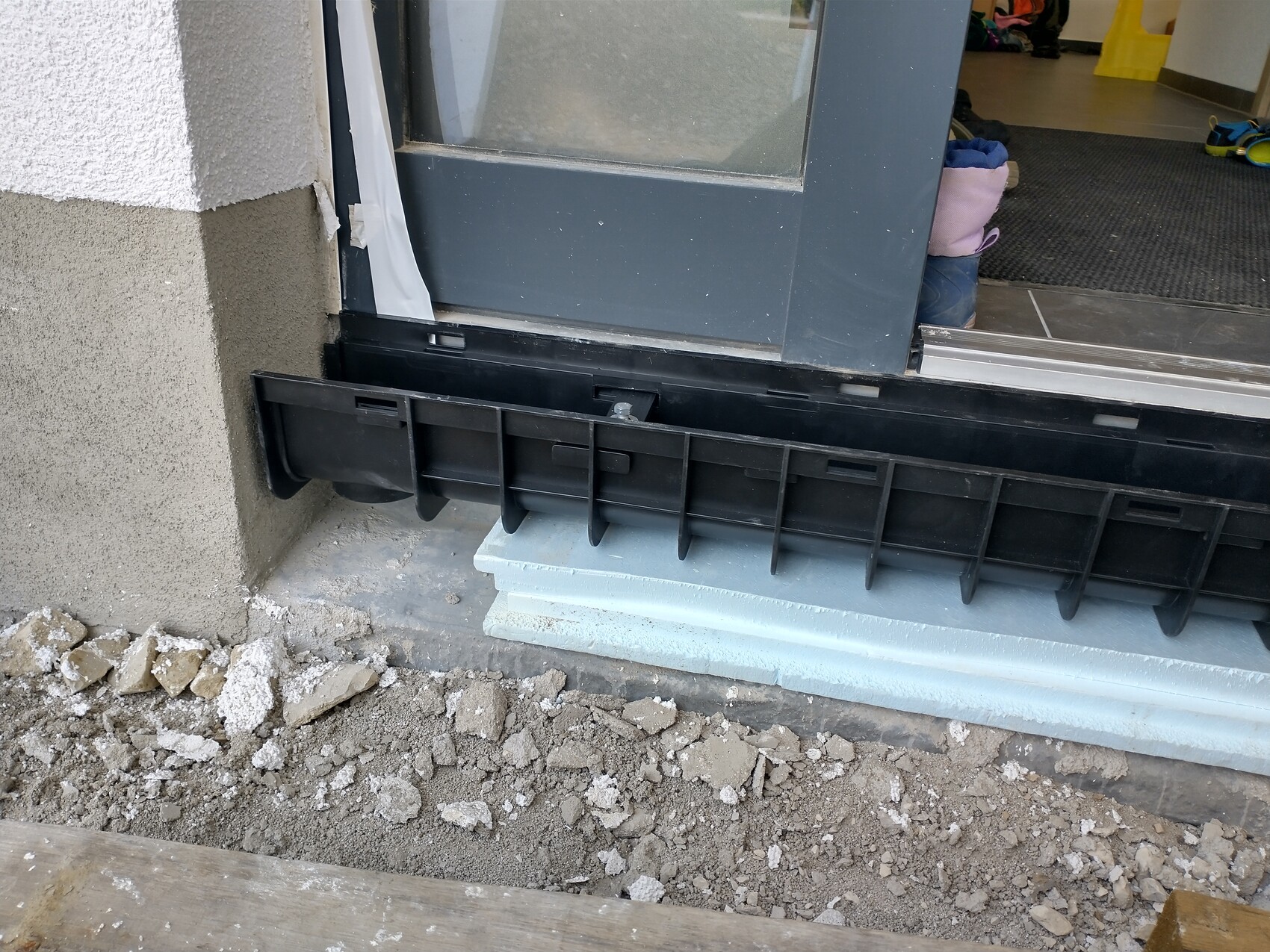
The problem here is that there’s only about 5.5cm (2 inches) of space underneath. So, a standard sewer pipe won’t fit. It’s a special size with an outer diameter of about 7.5cm (3 inches). Does anyone know of a 90-degree fitting or a suitable inlet for this?
Option 2: Side outlet
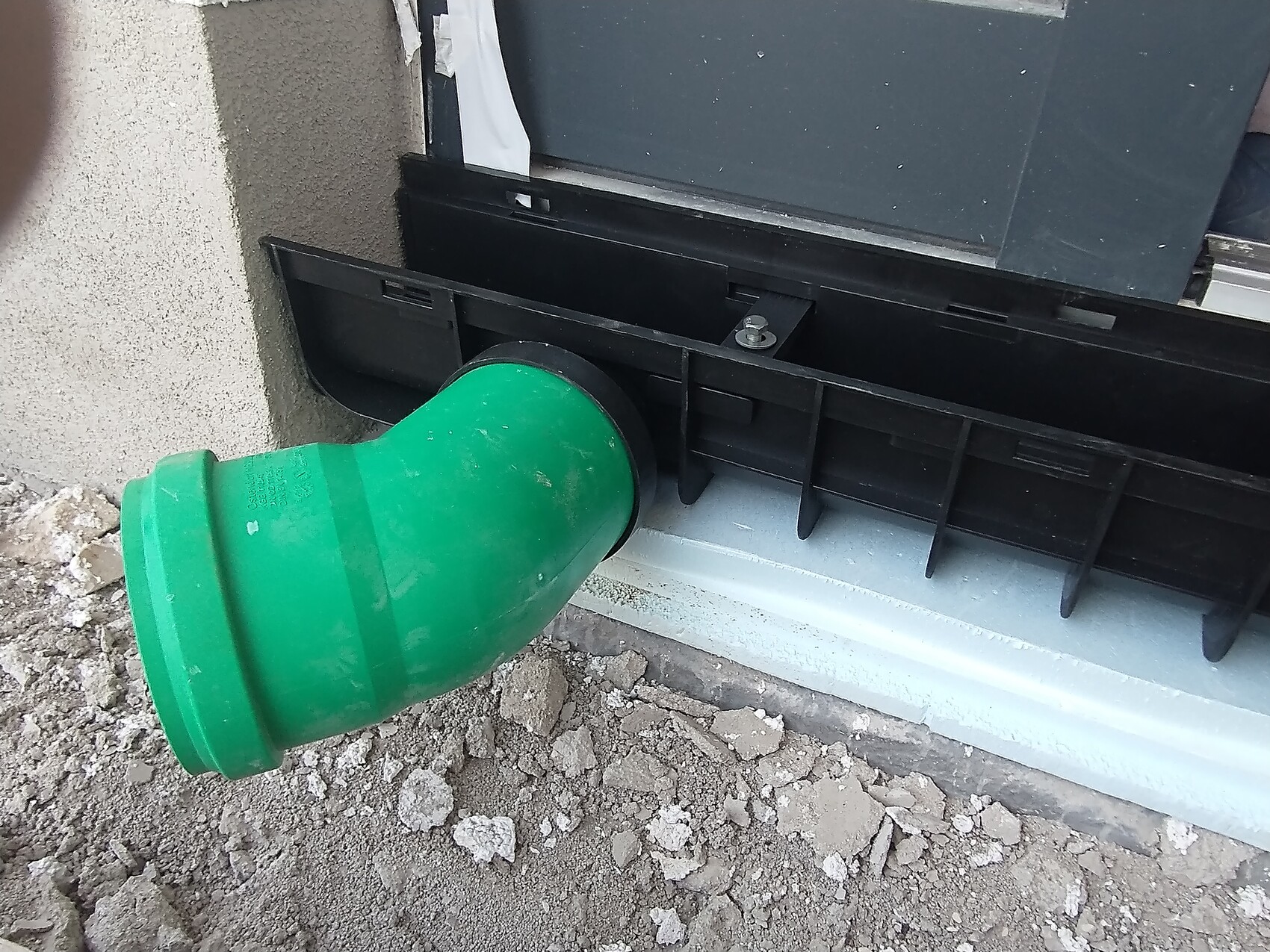
I would turn the pipe downwards from here and use an 87-degree elbow. The issue here is how to hide the pipe neatly. That’s why the other option is preferred, but if there’s nothing suitable for that, I would go with this one. The outlet here has an outer diameter of about 6cm (2.4 inches). Does anyone know of a smaller fitting that would fit properly here and could later be adapted to the sewer pipe?
Option 1: Drain going downwards (the hole would be to the left of the slabs)
The problem here is that there’s only about 5.5cm (2 inches) of space underneath. So, a standard sewer pipe won’t fit. It’s a special size with an outer diameter of about 7.5cm (3 inches). Does anyone know of a 90-degree fitting or a suitable inlet for this?
Option 2: Side outlet
I would turn the pipe downwards from here and use an 87-degree elbow. The issue here is how to hide the pipe neatly. That’s why the other option is preferred, but if there’s nothing suitable for that, I would go with this one. The outlet here has an outer diameter of about 6cm (2.4 inches). Does anyone know of a smaller fitting that would fit properly here and could later be adapted to the sewer pipe?
I would choose option 1 but place the gutter directly in line with the house wall. This way, you avoid the issue of limited space beneath the gutter and can easily connect a PVC drainage pipe. The paving stones between the gutter and the door can then be cut to fit.
However, I personally don’t find a gutter right in front of the front door (at least it looks like the main entrance) very attractive and would recommend using a door mat with a water tray instead. These are available from ACO. The tray also includes a connection for wastewater drainage. Just an idea.
However, I personally don’t find a gutter right in front of the front door (at least it looks like the main entrance) very attractive and would recommend using a door mat with a water tray instead. These are available from ACO. The tray also includes a connection for wastewater drainage. Just an idea.
W
WilderSueden27 Jun 2023 19:16We had already thought about placing the gutter at the front. My girlfriend is only moderately enthusiastic about that. I would need to check the idea with the push scraper accordingly. But of course, the gutter is already there 😉
In the meantime, another idea occurred to me. There is a rubber ring included that should fit the side opening to DN75. I could hide that more easily than a 110mm (4.3 inches) PVC pipe.
In the meantime, another idea occurred to me. There is a rubber ring included that should fit the side opening to DN75. I could hide that more easily than a 110mm (4.3 inches) PVC pipe.
X
xMisterDx28 Jun 2023 15:05I would buy a shallower channel where you can still get a proper bend at the bottom. And don’t just cobble something together because the neighbor still had leftovers.
We’re talking about less than 100 EUR. That should still be manageable, right?
We’re talking about less than 100 EUR. That should still be manageable, right?
W
WilderSueden28 Jun 2023 15:46The problem is that I only have 15–16cm (6–6.3 inches) of space. Channel drains are specified as 5.5cm (2.2 inches) high, so that leaves just 10cm (4 inches) for a possible adapter and a 90-degree bend. That’s very little. For the DN75 bend, I found an installation height of 130mm (5.1 inches). I don’t want to use a smaller diameter, but if the drain requires proper water flow, this becomes really challenging.
Similar topics