
Hello,
we are planning to build soon, and I am currently looking into the heating system.
I have tried to estimate how much electricity our air-to-water heat pump might consume.
Am I correct in understanding that the final energy demand is the amount of energy I need to put into the house for heating and hot water?
And this can be provided by oil, gas, or a heat pump?
If so, how does the COP work in this context?
I am trying to explain it with a very simple, hypothetical example:
A house with 200 sqm (2153 sq ft) and a calculated final energy demand of 10 kWh/sqm/year.
I understand this to mean that 2000 kWh of heating energy is needed annually.
An air-to-water heat pump with a theoretical COP of 2 converts 1 kW of electricity to 2 kW of heat.
Does that mean that with such a heat pump, only 1000 kWh of electricity is needed for heating and hot water?
I hope I am not making too many mistakes, but primary energy, final energy, COP, efficiency, and performance are all new and quite confusing to me.
Thanks in advance
Anja
we are planning to build soon, and I am currently looking into the heating system.
I have tried to estimate how much electricity our air-to-water heat pump might consume.
Am I correct in understanding that the final energy demand is the amount of energy I need to put into the house for heating and hot water?
And this can be provided by oil, gas, or a heat pump?
If so, how does the COP work in this context?
I am trying to explain it with a very simple, hypothetical example:
A house with 200 sqm (2153 sq ft) and a calculated final energy demand of 10 kWh/sqm/year.
I understand this to mean that 2000 kWh of heating energy is needed annually.
An air-to-water heat pump with a theoretical COP of 2 converts 1 kW of electricity to 2 kW of heat.
Does that mean that with such a heat pump, only 1000 kWh of electricity is needed for heating and hot water?
I hope I am not making too many mistakes, but primary energy, final energy, COP, efficiency, and performance are all new and quite confusing to me.
Thanks in advance
Anja

By stating my total grid-related electricity consumption in kWh, I am being clear—right? I have no intention of misleading anyone. Why would I? Besides, I’m not part of the "photovoltaic faction"; I simply know how to do the math ;-) and, back then, I received a lot of subsidies. I don’t need to manipulate the numbers to make them fit my case. Unfortunately, the conditions have changed recently. If I were to invest new today, the situation would look very different, and I might even make different decisions. Anyone who believes that such a small photovoltaic system makes you self-sufficient in winter also believes that CEOs actually run businesses well (uhmmm, like butterflies folding lemons).
Since I even provided the price per kWh, everyone can calculate for themselves (with their current figures) what it would look like over the course of a year. I’m happy to share my entire dataset (Excel) with anyone interested. I record monthly data—for myself, for billing with Westnetz (feed-in tariff), and for accounting with my company (charging company cars).
By the way, anyone who struggles for longer than 15 minutes with the (sales) tax declaration is probably doing something wrong ;-) Every subsequent one is just copy/paste.
Since I even provided the price per kWh, everyone can calculate for themselves (with their current figures) what it would look like over the course of a year. I’m happy to share my entire dataset (Excel) with anyone interested. I record monthly data—for myself, for billing with Westnetz (feed-in tariff), and for accounting with my company (charging company cars).
By the way, anyone who struggles for longer than 15 minutes with the (sales) tax declaration is probably doing something wrong ;-) Every subsequent one is just copy/paste.
K
KarstenausNRW19 May 2023 13:47xMisterDx schrieb:
I did say down to 0%... and that will definitely happen on rainy days in autumn or winter, when the photovoltaic output is close to zero.
You're deceiving yourself I don’t understand. A 50% self-sufficiency rate is actually a great achievement. On average, you consume half of your annual electricity at 6 cents per kWh from photovoltaic power instead of the current 25.8 cents (which you can currently contract) or whatever price applies.
I’m also happy about every year with 2,500 kWh of self-consumption at production costs of 6 cents. That means saving at least €500 annually on electricity costs. On top of that, there are 7,500 kWh fed into the grid at 8 cents, which equals €600.
So how exactly is that self-deception?
W
WilderSueden19 May 2023 14:46i_b_n_a_n schrieb:
By the way, anyone who gets frustrated with the (sales) tax return for longer than a one-time 15 minutes is doing something wrong ;-) Every following one is just copy/paste. For new systems, it doesn’t apply anyway. So that argument is not really valid.

i_b_n_a_n schrieb:
Anyone who thinks that such a small photovoltaic system makes you fully self-sufficient in winter also believes that CEOs run businesses. Exactly. Very few photovoltaic systems make anyone fully self-sufficient, and that’s probably not the goal. But they do contribute. And you can easily calculate the annual yield of a photovoltaic system—there are good experience-based values available nowadays—and how much that saves you in grid electricity and earns from feed-in tariffs. You just need to compare that to the investment cost of the photovoltaic system. It’s actually not that complicated.
If you want to be exact, you should also factor in maintenance costs, like a faulty inverter here and there.
a-stern.1 schrieb:
As I said, the exact value isn’t really important to me, and whether it ends up being called a Passive House or KfW40 doesn’t matter either.
I just received an energy certificate for a standard house from them.
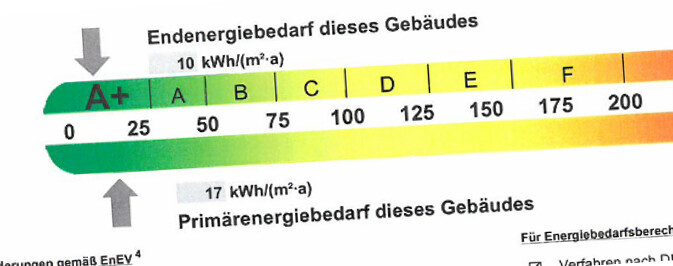
Considering that this forum mainly consists of homeowners, these are relatively surprising responses for the person asking the question.
The final energy consumption shown in the energy performance certificate refers to the amount of energy carrier actually consumed in the house, not to the amount of heat delivered to the building!
The primary energy demand takes into account the resource use and emissions of the energy carrier used, including effects along the supply chain (transport, production, etc.—for example, wood has a factor of 0.2, natural gas 1.1, and electricity 1.8).
The energy carrier used is always specified in both the energy performance certificate and the thermal insulation report. In this case, it is electricity, since the primary energy demand is 17 kWh/m²a—electricity is rated with a factor of 1.8 (the slight difference here is probably due to rounding).
The KfW rating for a KfW40 house also refers to the primary energy demand, not the final energy consumption.
Furthermore, the final energy consumption (and the primary energy demand) does not relate to the net living area of the building but, in energy certificates, to a non-directly measurable usable floor area. This is usually calculated as one-third of the heated volume Ve. This area is always larger than the living area (except in cases of very low ceiling heights), so for example, a 150 m² (1,615 sq ft) living area corresponds to about 200 m² (2,153 sq ft) usable floor area—the absolute final energy consumption is therefore greater than 10 × 150 kWh/m²a!
In this example, 10 kWh/m²a of electricity per year is required. For 200 m² (2,153 sq ft) living area, this corresponds to about 250 m² (2,691 sq ft) usable floor area, which this figure refers to. According to the energy certificate, you would thus need approximately 2,500 kWh of ELECTRICITY to heat the building. Actual consumption may deviate up or down due to different usage patterns (hot water) or suboptimal operation of the heat pump.
W
WilderSueden24 May 2023 08:46I have read this three times now and have to admit that it confuses me more than it helps. Does this mean that the same building envelope is classified very differently in terms of final energy demand, depending on whether I generate heat with gas (~1:1) or a heat pump (1:3.6)? The factors for primary energy demand adjust this somewhat, but in the example, gas would still be around 1.1 and the heat pump about 0.5 kWh of primary energy per kWh of heat?
Similar topics