
Hello,
we are planning to build soon, and I am currently looking into the heating system.
I have tried to estimate how much electricity our air-to-water heat pump might consume.
Am I correct in understanding that the final energy demand is the amount of energy I need to put into the house for heating and hot water?
And this can be provided by oil, gas, or a heat pump?
If so, how does the COP work in this context?
I am trying to explain it with a very simple, hypothetical example:
A house with 200 sqm (2153 sq ft) and a calculated final energy demand of 10 kWh/sqm/year.
I understand this to mean that 2000 kWh of heating energy is needed annually.
An air-to-water heat pump with a theoretical COP of 2 converts 1 kW of electricity to 2 kW of heat.
Does that mean that with such a heat pump, only 1000 kWh of electricity is needed for heating and hot water?
I hope I am not making too many mistakes, but primary energy, final energy, COP, efficiency, and performance are all new and quite confusing to me.
Thanks in advance
Anja
we are planning to build soon, and I am currently looking into the heating system.
I have tried to estimate how much electricity our air-to-water heat pump might consume.
Am I correct in understanding that the final energy demand is the amount of energy I need to put into the house for heating and hot water?
And this can be provided by oil, gas, or a heat pump?
If so, how does the COP work in this context?
I am trying to explain it with a very simple, hypothetical example:
A house with 200 sqm (2153 sq ft) and a calculated final energy demand of 10 kWh/sqm/year.
I understand this to mean that 2000 kWh of heating energy is needed annually.
An air-to-water heat pump with a theoretical COP of 2 converts 1 kW of electricity to 2 kW of heat.
Does that mean that with such a heat pump, only 1000 kWh of electricity is needed for heating and hot water?
I hope I am not making too many mistakes, but primary energy, final energy, COP, efficiency, and performance are all new and quite confusing to me.
Thanks in advance
Anja
A
a-stern.116 May 2023 16:32As I said, the exact value isn’t really important to me, and I don’t mind whether it ends up being called Passive House or KfW40.
I just received an energy certificate for a standard house from them.
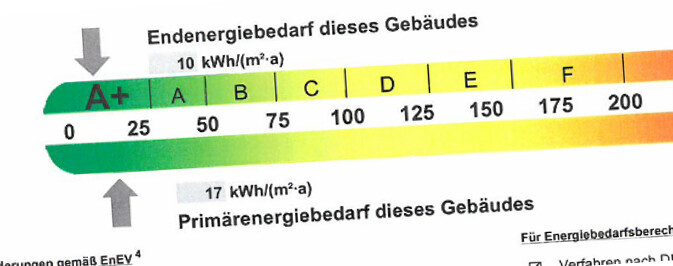
I just received an energy certificate for a standard house from them.

Hi, I have a KfW40+ and passive house myself with a heating energy demand of only 14.8 kWh/m² per year. It’s really very well insulated. Don’t be misled by exaggerated values. 10 kWh/m² is clearly unrealistic.
My total energy demand (heating, cooling, household electricity for 2–3 people, BEV with approximately 1200 km (745 miles) per month) still only requires about 8800 kWh for the whole year. ;-)
My total energy demand (heating, cooling, household electricity for 2–3 people, BEV with approximately 1200 km (745 miles) per month) still only requires about 8800 kWh for the whole year. ;-)
Perhaps a useful addition: With my small 6.5KWp photovoltaic system (including a 4KWh battery), I achieve a self-sufficiency rate of about 50% on an annual average. I purchase approximately 430KWh of electricity from the grid (annual average) at a monthly rate of 31 cents until March 2023, and from April unfortunately already 41 cents.
X
xMisterDx19 May 2023 12:07I don’t want to be difficult, but when it comes to self-sufficiency, the average isn’t what matters—it’s the distribution.
From May to September, you will almost certainly reach 100%, and from June to August very likely 100%. But that also means that in winter, it can drop down to 0%.
I’m mentioning this because you talk about misinformation. The solar power community tends to do the same.
In summer, they feed a lot of energy into the grid at a feed-in tariff of 8.2 cents/kWh, minus taxes, plus the hassle of tax returns... and then they buy it back in winter at 41 cents.
From May to September, you will almost certainly reach 100%, and from June to August very likely 100%. But that also means that in winter, it can drop down to 0%.
I’m mentioning this because you talk about misinformation. The solar power community tends to do the same.
In summer, they feed a lot of energy into the grid at a feed-in tariff of 8.2 cents/kWh, minus taxes, plus the hassle of tax returns... and then they buy it back in winter at 41 cents.
W
WilderSueden19 May 2023 12:56I don’t want to sound like a know-it-all. But the distribution is already taken into account on an annual average. And when you consider the distribution, 100% + 20% equals 50%.
X
xMisterDx19 May 2023 13:23I said down to 0%... and that can definitely happen on rainy days in autumn or winter, when solar power output is close to 0. People are deceiving themselves, and others are making good money from it. But go ahead, it’s your money after all.
Similar topics