
Hello,
I have owned a house for about three years now (built around 1970) and would like to make a small change in the attic. Here is the situation: The large living room in the attic (which spans the full width of the house) has knee walls (is that the correct term?) set inward so much that there is a large unused space behind them. Presumably, this was done to minimize the sloping ceiling in the room.
I would like to install a 70cm (28 inch) wide door in this side wall, which is about 160cm (63 inch) high, to at least be able to use the space behind it for storage. After a test drill, I found out that the wall is 16cm (6 inch) thick and built with standard hollow concrete blocks. Now I am wondering if this wall might have a load-bearing function and if creating an opening for the door could cause major problems.
Or could it be said that regardless of whether it is load-bearing or not, a 70cm (28 inch) opening would not cause any issues anyway?
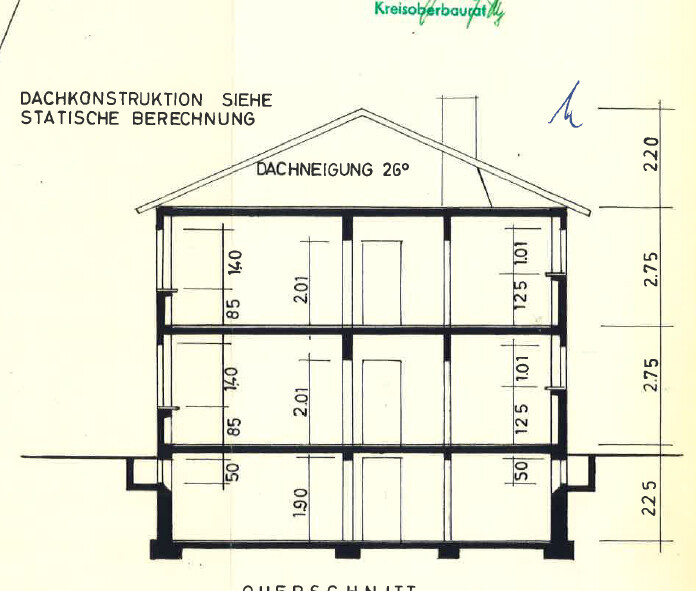
The original building plans from the 1960s do not include a floor plan for the attic, only a side elevation, which I am attaching. I have no idea if this helps at all.
What do you think?
Best regards,
N
I have owned a house for about three years now (built around 1970) and would like to make a small change in the attic. Here is the situation: The large living room in the attic (which spans the full width of the house) has knee walls (is that the correct term?) set inward so much that there is a large unused space behind them. Presumably, this was done to minimize the sloping ceiling in the room.
I would like to install a 70cm (28 inch) wide door in this side wall, which is about 160cm (63 inch) high, to at least be able to use the space behind it for storage. After a test drill, I found out that the wall is 16cm (6 inch) thick and built with standard hollow concrete blocks. Now I am wondering if this wall might have a load-bearing function and if creating an opening for the door could cause major problems.
Or could it be said that regardless of whether it is load-bearing or not, a 70cm (28 inch) opening would not cause any issues anyway?
The original building plans from the 1960s do not include a floor plan for the attic, only a side elevation, which I am attaching. I have no idea if this helps at all.
What do you think?
Best regards,
N
N
Nanopixel28 Mar 2023 13:35Do you mean whether the rafters rest on this wall? It’s hard to tell because either the wall was built up to the rafters or the rafters were laid on top of the masonry wall. I don’t know how to distinguish between these two options.
However, it would be unusual if this wall supports the rafters, since it is not continuous across the entire attic floor. In fact, it only exists in the large living room and is roughly half the length of the attic floor.
In the adjacent rooms, the knee wall is set much further back or is not present at all, allowing the space to be used almost up to the very corner.
However, it would be unusual if this wall supports the rafters, since it is not continuous across the entire attic floor. In fact, it only exists in the large living room and is roughly half the length of the attic floor.
In the adjacent rooms, the knee wall is set much further back or is not present at all, allowing the space to be used almost up to the very corner.
Nanopixel schrieb:
There is no structural calculation or other documentation available, apart from the construction drawings. Structural engineers also work on assessing existing buildings for their structural integrity, for example, to determine whether the masonry knee wall serves a bracing function.
Nanopixel schrieb:
What is your opinion on this? Opinions on the structural aspects of your house are truly out of place here, no matter how much is written.

Nanopixel schrieb:
In the house I've owned for about three years (built around 1970), I would like to make a small modification in the attic. Here's the situation: In the large living room on the top floor (which spans the entire width of the house), the knee walls are set so far inward that there is a huge unused space behind them. Probably to minimize the sloped ceiling effect in this room.
I would like to install a 70cm (27.5 inch) wide door in this side wall, which is just under 160cm (63 inch) high, so the space behind it can at least be used for storage.Of course, without guarantee, I have no concerns about this. A masonry knee wall certainly wouldn’t serve as a principal purlin. It could provide bracing, but I don’t see your desired small door "affecting" that potential function significantly.https://www.instagram.com/11antgmxde/
https://www.linkedin.com/company/bauen-jetzt/
P.S.: but always keep in mind with such cavity openings, finding a corpse is legally reportable *ROTFL* *SCNR*
https://www.instagram.com/11antgmxde/
https://www.linkedin.com/company/bauen-jetzt/
https://www.instagram.com/11antgmxde/
https://www.linkedin.com/company/bauen-jetzt/
N
Nanopixel31 Mar 2023 20:5611ant schrieb:
P.S.: but always keep in mind with such cavity openings, discovering dead bodies must be reported *ROTFL* *SCNR*LOL 😉
Nothing can happen there, I’ve already been inside that cavity. In the adjacent room (kitchen), there is a tiny door that also gives access. However, not for long—once the new kitchen is installed, that small door will be gone.
Nanopixel schrieb:
I have already checked inside the cavity. In the adjacent room (kitchen), there is a tiny door that also provides access there. Oh, and did you not find any insight there that would answer your question?
https://www.instagram.com/11antgmxde/
https://www.linkedin.com/company/bauen-jetzt/
Similar topics