
N
Nanopixel16 Feb 2023 23:59Hello,
I have owned a house for about three years now (built around 1970) and would like to make a small change in the attic. Here is the situation: The large living room in the attic (which spans the full width of the house) has knee walls (is that the correct term?) set inward so much that there is a large unused space behind them. Presumably, this was done to minimize the sloping ceiling in the room.
I would like to install a 70cm (28 inch) wide door in this side wall, which is about 160cm (63 inch) high, to at least be able to use the space behind it for storage. After a test drill, I found out that the wall is 16cm (6 inch) thick and built with standard hollow concrete blocks. Now I am wondering if this wall might have a load-bearing function and if creating an opening for the door could cause major problems.
Or could it be said that regardless of whether it is load-bearing or not, a 70cm (28 inch) opening would not cause any issues anyway?
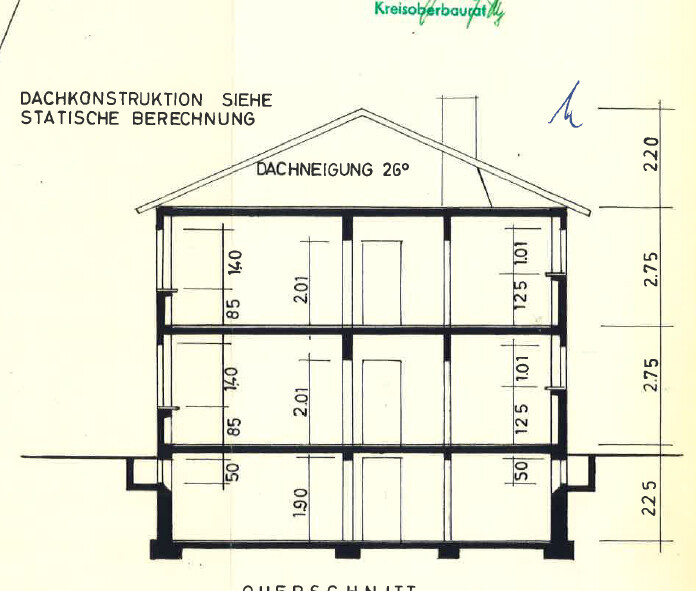
The original building plans from the 1960s do not include a floor plan for the attic, only a side elevation, which I am attaching. I have no idea if this helps at all.
What do you think?
Best regards,
N
I have owned a house for about three years now (built around 1970) and would like to make a small change in the attic. Here is the situation: The large living room in the attic (which spans the full width of the house) has knee walls (is that the correct term?) set inward so much that there is a large unused space behind them. Presumably, this was done to minimize the sloping ceiling in the room.
I would like to install a 70cm (28 inch) wide door in this side wall, which is about 160cm (63 inch) high, to at least be able to use the space behind it for storage. After a test drill, I found out that the wall is 16cm (6 inch) thick and built with standard hollow concrete blocks. Now I am wondering if this wall might have a load-bearing function and if creating an opening for the door could cause major problems.
Or could it be said that regardless of whether it is load-bearing or not, a 70cm (28 inch) opening would not cause any issues anyway?
The original building plans from the 1960s do not include a floor plan for the attic, only a side elevation, which I am attaching. I have no idea if this helps at all.
What do you think?
Best regards,
N
W
WilderSueden17 Feb 2023 08:20A knee wall is the extension of the exterior wall up to the roof. I don’t see that on your sketch; the roof structure is placed directly on the last floor slab. What you are referring to is a dwarf wall. It partitions off a section to avoid knee-high corners under the slope. Usually, these are non-load-bearing and built as drywall. So I’m also surprised that it is masonry.
In principle, creating an opening with a properly sized lintel should not be a problem. Do you have the structural calculation? A structural engineer should be able to confirm this for you.
In principle, creating an opening with a properly sized lintel should not be a problem. Do you have the structural calculation? A structural engineer should be able to confirm this for you.

One indication against a load-bearing function could be whether there is another wall beneath the respective knee wall (i.e., on the floor below). If there isn’t, the knee wall cannot be load-bearing, as it would not be able to transfer the load downwards. However, it could still act as a bracing element. That's why it is always better to consult a structural engineer, although in this case, I believe a 70cm (28 inches) opening should not be problematic...
H
hanghaus202318 Feb 2023 13:34Make a larger opening (a few bricks) where the door is supposed to go. This way, you can see what’s behind it. Some photos would also be helpful.
N
Nanopixel27 Mar 2023 00:44Thanks for your answers.
There are no structural calculations or other documents available—apart from the construction drawings. As mentioned, it’s from the late 1960s.
In the floors below, there is no wall at this spot. That would have created unusually narrow rooms along the building’s exterior wall.
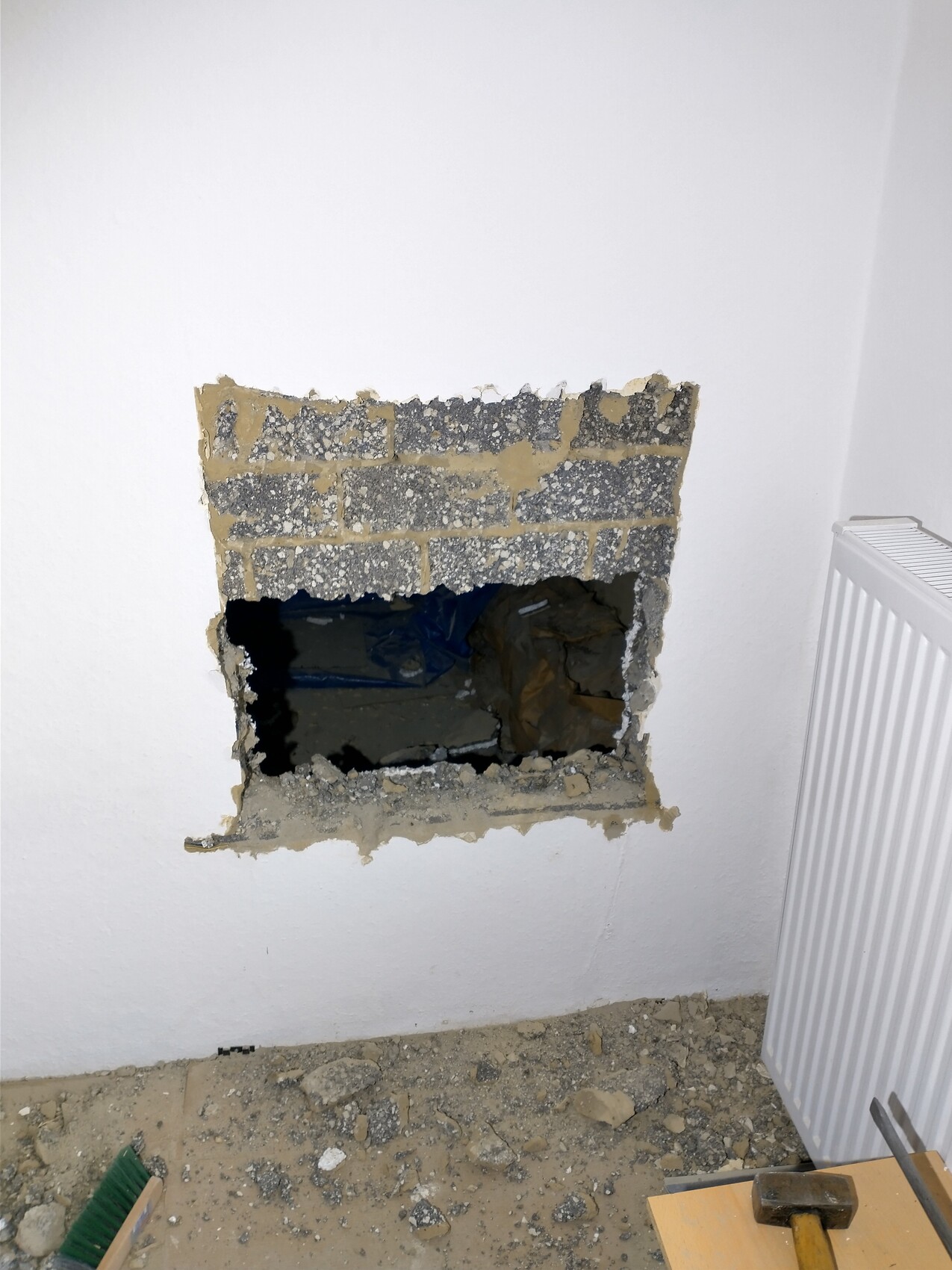
I took a photo. The opening is already 70 cm (28 inches) wide. The height still needs to be measured.
Interestingly, the wall is made of 12 cm (5 inches) thick solid pumice blocks.
There are no structural calculations or other documents available—apart from the construction drawings. As mentioned, it’s from the late 1960s.
In the floors below, there is no wall at this spot. That would have created unusually narrow rooms along the building’s exterior wall.
I took a photo. The opening is already 70 cm (28 inches) wide. The height still needs to be measured.
Interestingly, the wall is made of 12 cm (5 inches) thick solid pumice blocks.
Similar topics