
ᐅ Lowering the Supply Temperature in Underfloor Heating Systems More Complex Than Expected?
Created on: 9 Mar 2023 22:07
J
JohnnyEHHello everyone!
We are currently discussing the supply temperature for the underfloor heating system with our prefab house provider.
The house is a timber frame panel construction and meets the KFW40 standard.
According to the construction description, the provider sets the supply temperature of the underfloor heating to 35°C (95°F). We mentioned that we consider this outdated for a new build and would prefer a supply temperature of around 30°C (86°F). We were then told that with a supply temperature of 30°C (86°F), a larger heat pump and a completely different heating system design would be required, and the additional costs could quickly reach five figures. Such extra costs obviously would not make financial sense.
Until now, I thought the supply temperature was primarily determined by the pipe spacing and would be lower if the pipe spacing was reduced.
Why could a lower supply temperature lead to a larger heat pump? What am I missing?
I should add that the heating load calculation and the exact determination of the heat pump have yet to be done. In any case, a Vaillant Arotherm Plus will be used.
Additionally, a question about the floor covering.
We know that tiles are optimal for underfloor heating but vinyl is almost equivalent. We will also have an active underfloor cooling system installed (via the air-to-water heat pump). Does either floor covering—tiles or vinyl—have advantages for cooling? Or would laminate flooring actually be the best option for cooling?
We are currently discussing the supply temperature for the underfloor heating system with our prefab house provider.
The house is a timber frame panel construction and meets the KFW40 standard.
According to the construction description, the provider sets the supply temperature of the underfloor heating to 35°C (95°F). We mentioned that we consider this outdated for a new build and would prefer a supply temperature of around 30°C (86°F). We were then told that with a supply temperature of 30°C (86°F), a larger heat pump and a completely different heating system design would be required, and the additional costs could quickly reach five figures. Such extra costs obviously would not make financial sense.
Until now, I thought the supply temperature was primarily determined by the pipe spacing and would be lower if the pipe spacing was reduced.
Why could a lower supply temperature lead to a larger heat pump? What am I missing?
I should add that the heating load calculation and the exact determination of the heat pump have yet to be done. In any case, a Vaillant Arotherm Plus will be used.
Additionally, a question about the floor covering.
We know that tiles are optimal for underfloor heating but vinyl is almost equivalent. We will also have an active underfloor cooling system installed (via the air-to-water heat pump). Does either floor covering—tiles or vinyl—have advantages for cooling? Or would laminate flooring actually be the best option for cooling?

I had the problem with this requirement that a low supply temperature would require a small temperature difference. This temperature difference could not be achieved by the Vaillant Arotherm Plus 55/6 in my case. Only the 75 model could deliver the required pumping capacity (pumping water through the heating coils – not the compressor) according to the datasheet (1x00 liters per hour).
Basically, it applies that a lower supply temperature = SMALLER heat pump, provided it can deliver the necessary pumping capacity for the heated water.
How does the supplier calculate this, and what is their reasoning?
Edit: This value
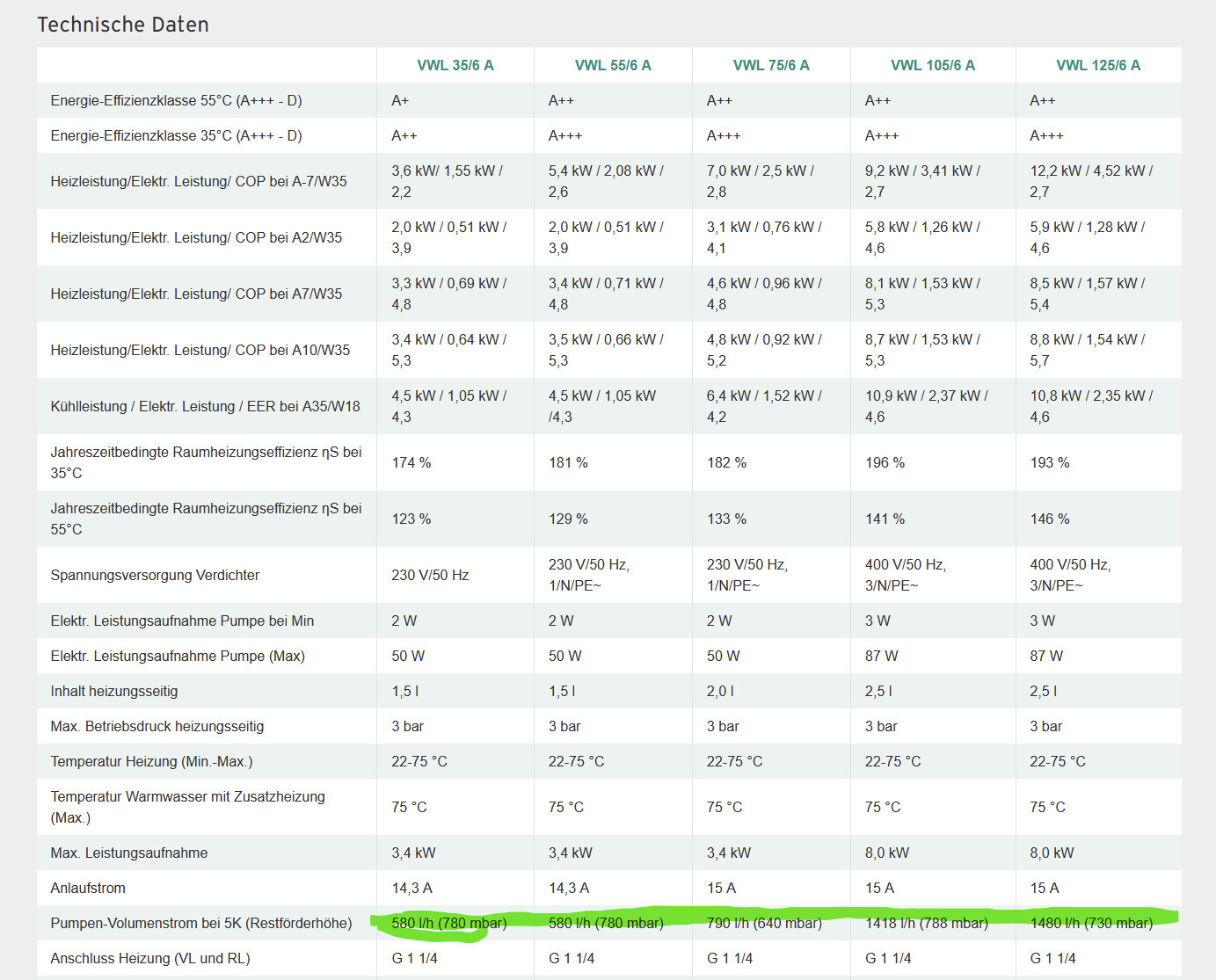
Basically, it applies that a lower supply temperature = SMALLER heat pump, provided it can deliver the necessary pumping capacity for the heated water.
How does the supplier calculate this, and what is their reasoning?
Edit: This value
R
RotorMotor10 Mar 2023 08:03In my opinion, the biggest challenge is always getting the bathroom properly warm.
This almost always requires very close pipe spacing and circuits or loops along the wall to make it comfortable at a supply temperature of 30°C (86°F) without an electric radiator.
This almost always requires very close pipe spacing and circuits or loops along the wall to make it comfortable at a supply temperature of 30°C (86°F) without an electric radiator.
JohnnyEH schrieb:
… Tiles … Vinyl … equivalent … laminate …Find the mistake! One word doesn’t fit. There are two possible solutions 😉S
Stefan00110 Mar 2023 11:52JohnnyEH schrieb:
Also, one more question about flooring. We know that tiles are optimal for underfloor heating, but vinyl is almost equally good. We will also be installing underfloor cooling (active via an air-to-water heat pump). Does one of these floorings—tiles or vinyl—have advantages when it comes to cooling? Or would laminate actually be the best for cooling?Regarding the flooring, it really depends on the construction method. Glue-down vinyl works very well; vinyl installed as a floating floor with cork insulation and impact sound insulation does not.It doesn’t matter if it is for heating or cooling—the key factor is thermal conductivity.
I am equally satisfied with glued vinyl and tiles in my home. However, I can’t really tell the difference myself, as I don’t have a consumption comparison to “tiles only.”
K
KarstenausNRW10 Mar 2023 12:05JohnnyEH schrieb:
Until now, I thought the supply temperature is mainly determined by the pipe spacing and would be correspondingly lower if the pipe spacing is reduced. That’s correct.
JohnnyEH schrieb:
We were told that with a supply temperature of 30°C (86°F), a larger heat pump and a completely different heating system design would be required, and the additional costs could quickly reach five figures. Yes, it needs to be designed differently. Different pipe spacing, possibly more loops, more manifold circuits.
A larger heat pump? I don’t see that right away. Ultimately, it depends on your house – in 99% of cases, no different heat pump is needed. Many heat pump manufacturers use, for example, the same pump in every unit, so the devices are basically identical except for heating capacity.
Five-figure costs might happen – the home builder wants to make a good profit on special requests. However, the additional material and installation effort will most likely be in the low four-figure range.
Aside from that, I fully agree with you that 35°C (95°F) is outdated. But it allows for a simpler and more economical design, and the house ends up being cheaper…
Similar topics