
We have a mold problem on one wall in our temporary accommodation.
The issue has been ongoing for some time. Last autumn, we tried treating it with a mold removal kit that I had good experience with before, but unfortunately, it didn’t achieve the desired result. The likely cause is that the wall keeps getting wet at that spot.
The stains are limited to about 1m² (11 sq ft) of wall surface. Within this area, the problem is steadily getting worse, but it is not spreading beyond that. On the opposite side of the wall is the shower in the bathroom. We suspect that something is leaking there, which causes the wall to become damp and mold to develop. For context, the wall was freshly wallpapered in July 2022. When we moved in, there was no visible issue. However, we are the first ones to really use this shower, since my uncle who previously lived here rarely used it. 🙄
To my great frustration, the affected wall is in our son’s nursery. So far, we had controlled the problem by placing a changing table in front of the wall. The changing pad on top ensured he couldn’t reach behind it, and the table was always kept about 20cm (8 inches) away from the wall.
Now we have to move the changing pad because baby number two is on the way. We’re wondering what to do with the wall. We have to stay here for about another 3 to 4 months until we can move out.
If I remove the changing pad, the table would be close to the moldy wall. That wouldn’t be too bad; I would probably just get rid of the table anyway rather than risk bringing mold into the new house over a $100 piece of furniture. That thought makes me shudder. :/
Still, I’m worried that the mold might get worse if a piece of furniture is placed directly against the wall. It would be especially bad if the mold started spreading sideways.
In the bathroom, we temporarily fixed black mold spots on the plasterboard ceiling by covering them with vinyl foil. It’s not pretty, but it at least provides a barrier between us and whatever is living in the ceiling. The advantage there is that we have shut off that bathroom (which was causing the ceiling to get wet). So while the ceiling is stained, it is now dry.
We can’t do the same for the children’s room wall. The shower next door is the only one in the house still in use.
Would taping plastic foil over the affected area work if the wall keeps getting wet? Or would it be better to push the table close to the wall without any foil?
Does anyone have a completely different, clever idea on how to solve this?
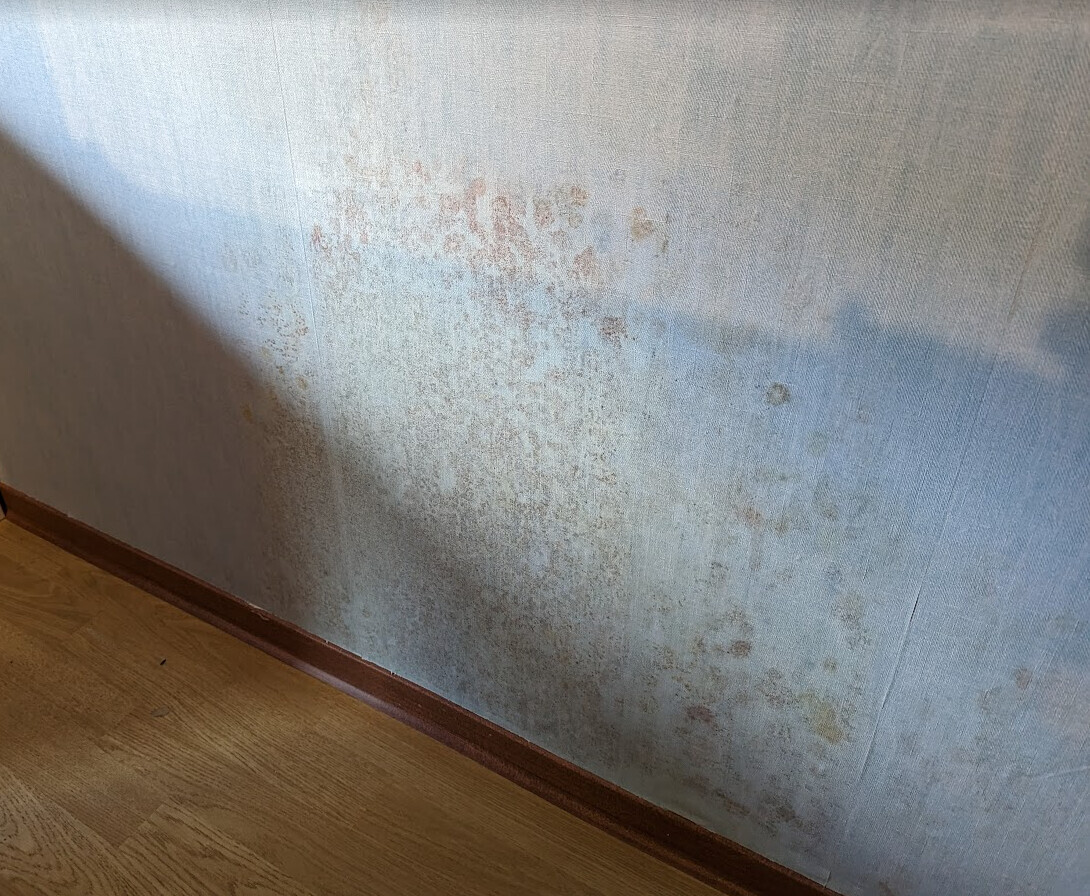
The issue has been ongoing for some time. Last autumn, we tried treating it with a mold removal kit that I had good experience with before, but unfortunately, it didn’t achieve the desired result. The likely cause is that the wall keeps getting wet at that spot.
The stains are limited to about 1m² (11 sq ft) of wall surface. Within this area, the problem is steadily getting worse, but it is not spreading beyond that. On the opposite side of the wall is the shower in the bathroom. We suspect that something is leaking there, which causes the wall to become damp and mold to develop. For context, the wall was freshly wallpapered in July 2022. When we moved in, there was no visible issue. However, we are the first ones to really use this shower, since my uncle who previously lived here rarely used it. 🙄
To my great frustration, the affected wall is in our son’s nursery. So far, we had controlled the problem by placing a changing table in front of the wall. The changing pad on top ensured he couldn’t reach behind it, and the table was always kept about 20cm (8 inches) away from the wall.
Now we have to move the changing pad because baby number two is on the way. We’re wondering what to do with the wall. We have to stay here for about another 3 to 4 months until we can move out.
If I remove the changing pad, the table would be close to the moldy wall. That wouldn’t be too bad; I would probably just get rid of the table anyway rather than risk bringing mold into the new house over a $100 piece of furniture. That thought makes me shudder. :/
Still, I’m worried that the mold might get worse if a piece of furniture is placed directly against the wall. It would be especially bad if the mold started spreading sideways.
In the bathroom, we temporarily fixed black mold spots on the plasterboard ceiling by covering them with vinyl foil. It’s not pretty, but it at least provides a barrier between us and whatever is living in the ceiling. The advantage there is that we have shut off that bathroom (which was causing the ceiling to get wet). So while the ceiling is stained, it is now dry.
We can’t do the same for the children’s room wall. The shower next door is the only one in the house still in use.
Would taping plastic foil over the affected area work if the wall keeps getting wet? Or would it be better to push the table close to the wall without any foil?
Does anyone have a completely different, clever idea on how to solve this?
S
Schorsch_baut28 Feb 2023 18:59kati1337 schrieb:
Actually, he doesn’t go near it, but I want to block it off just to be safe, so he can’t get to it. We just thought that we could simply order a second changing unit, so we can keep his room as it is, preventing him from reaching that wall, while also not having anything directly against it. This also helps avoid jealousy (“why is the baby getting my stuff”) and solves two issues at once.
Thanks anyway for your advice. The option to remove the wallpaper and paint with lime paint, as suggested here, is something we could also consider after the baby is born.I strongly advise against that. My nephew is seven now and developed asthma and a severe allergy to mold spores as a baby after his parents overlooked water damage and mold behind the bedroom wardrobe. Mold spores are not only toxic but also potent allergens. I wouldn’t let any child sleep or play in a room with mold. It can even lead to fungal infections of the respiratory tract. Remove the wallpaper and paint with lime paint—real lime paint!—because mold can’t grow on that. And don’t put anything against the wall! I don’t understand how parents can take such risks with their child. It’s well known that this is not harmless.
Also, mold removers are not exactly healthy if they are effective.

kati1337 schrieb:
official ETA is less than 48 hours. 😉then I technically wish you a good start into the new year 🙄C
Costruttrice28 Feb 2023 20:15kati1337 schrieb:
We will find out soon, official ETA is less than 48 hours.Oh, I wish you all the best!!!Regarding mold: I would also be concerned about spores and wouldn’t let a child sleep there. I would first remove everything, ventilate thoroughly, and avoid placing anything in front. Of course, this comes at a really bad time now…

Costruttrice schrieb:
Oh, I wish you all the best!!!
Regarding mold: I would also be concerned about the spores and wouldn’t let a child sleep there. I would first remove everything, ventilate thoroughly, and avoid placing anything there. Of course, this comes at a really bad time now… Thank you.
Yes, that’s exactly it—I can’t tear down wallpaper so close to the delivery date. 🙂
I really don’t like the idea of the spores either. Ideally, I’d move out yesterday, but some things you just can’t know beforehand. No one was aware of these conditions with the leaks. Our house will be ready to move into in about 3–4 months. Moving again for 3 months in the meantime, with a newborn, is simply not feasible logistically.
But I do like the tip about lime paint. We can do that as soon as I’m feeling well enough again.
S
Schorsch_baut28 Feb 2023 20:31kati1337 schrieb:
Thank you.
Yes, that’s exactly the problem—I can’t remove wallpaper so close to my due date. 🙂
I really don’t like those mold spots at all. I’d love to move out yesterday, but sometimes you just don’t know these things in advance. Nobody was aware of the leaks until now. Our house will be ready to move into in 3 to 4 months. Moving again for another 3 months with a newborn is simply not feasible.
I do like the tip about using lime paint. We can do that once I’m feeling better. Why can’t your husband do it? It won’t take half a day. Wear a mask, disinfect the wallpaper thoroughly with a chlorine solution, soak it, and then remove it. Let the wall dry and apply two coats of whitewash. After that, clean the room thoroughly and wash everything machine washable. (I hope there is no baby clothes in the dresser?)
I wouldn’t wait, especially now that the weather is getting warmer and humidity is rising again. This isn’t just a small corner by a window—it’s a whole square meter!
My nephew’s symptoms were first mistaken for a bad cold and pseudocroup. They went to the hospital multiple times with the baby. Children are very sensitive to mold; asthma often develops as a result. No one should have to go through that.
(Wishing you all the best for the coming time!)
J
Jurassic13528 Feb 2023 20:34First of all, best wishes for the birth and the baby period!
A friend of mine had mold in her room as a teenager, which only became visible later. At that time, she also suffered from very frequent respiratory illnesses. Before moving in and after moving out, she no longer had these issues. So this really shouldn’t be taken lightly. I would immediately "close off" the nursery and move the little one to another room or into the parents’ bedroom to minimize or avoid exposure. With a baby, I wouldn’t go into that room at all.
It’s obviously inconvenient, but it’s better for all family members to spend time in fewer rooms and stay healthy than to risk health problems in the last 3-4 months. In the new house, you can have the desired layout again.
A friend of mine had mold in her room as a teenager, which only became visible later. At that time, she also suffered from very frequent respiratory illnesses. Before moving in and after moving out, she no longer had these issues. So this really shouldn’t be taken lightly. I would immediately "close off" the nursery and move the little one to another room or into the parents’ bedroom to minimize or avoid exposure. With a baby, I wouldn’t go into that room at all.
It’s obviously inconvenient, but it’s better for all family members to spend time in fewer rooms and stay healthy than to risk health problems in the last 3-4 months. In the new house, you can have the desired layout again.
Similar topics