
ᐅ Floor plan of a detached single-family house approximately 200 m² with two separate living units
Created on: 23 Feb 2023 23:30
T
ThomasMagmar
Preliminary note: This is not a specific building project, but it is something that may happen in the future if possible. Many of my friends have recently built houses and are currently in the process, but for myself it will still take some time. However, since I am quite interested in the subject and have skills in 3D design, I have started to think about how my "dream house" should look. I am fully aware that the floor plan may still change due to the location.
Therefore, I don’t need comments about how planning like this in advance doesn’t make sense. My goal is to see what is roughly possible and reasonable or not, and to gain more experience.
Development plan / restrictions Not available
Client requirements
Style, roof shape, building type: Modern, gable roof, future-oriented
Basement, floors: No basement, 2 floors + attic area for storage
Number of occupants, age: 2 adults + 2 children
Space requirement on ground floor and upper floor: Approximately 90m² (970 sq ft) each
Office: Family use or home office? Yes
Occasional guests per year: Possible but not planned
Open or closed architecture: Rather closed
Conservative or modern construction: Mixed
Open kitchen, kitchen island: Partly, no
Number of dining seats: 2 with couch ^^
Fireplace: No
Music / stereo wall: Probably
Balcony, roof terrace: Yes, yes
Garage, carport: Garage
Utility garden, greenhouse: Possibly garden shed
If possible, the garden should face south, among other reasons because photovoltaics will be used.
House design
Who planned it: Do-it-yourself with Inventor!
What do you especially like: The use of the house for several life phases
What do you dislike? Why? More difficult / expensive utility connections, presumed costs ^^
Price estimate according to architect / planner: Own estimate 600k without land
Personal price limit for the house including equipment: Currently unclear
Preferred heating technology: Air-to-water heat pump
If you have to give up certain details / expansions
- Can give up: Large utility room, changing room
- Cannot give up: Terrace
Why did the design turn out the way it is? For example:
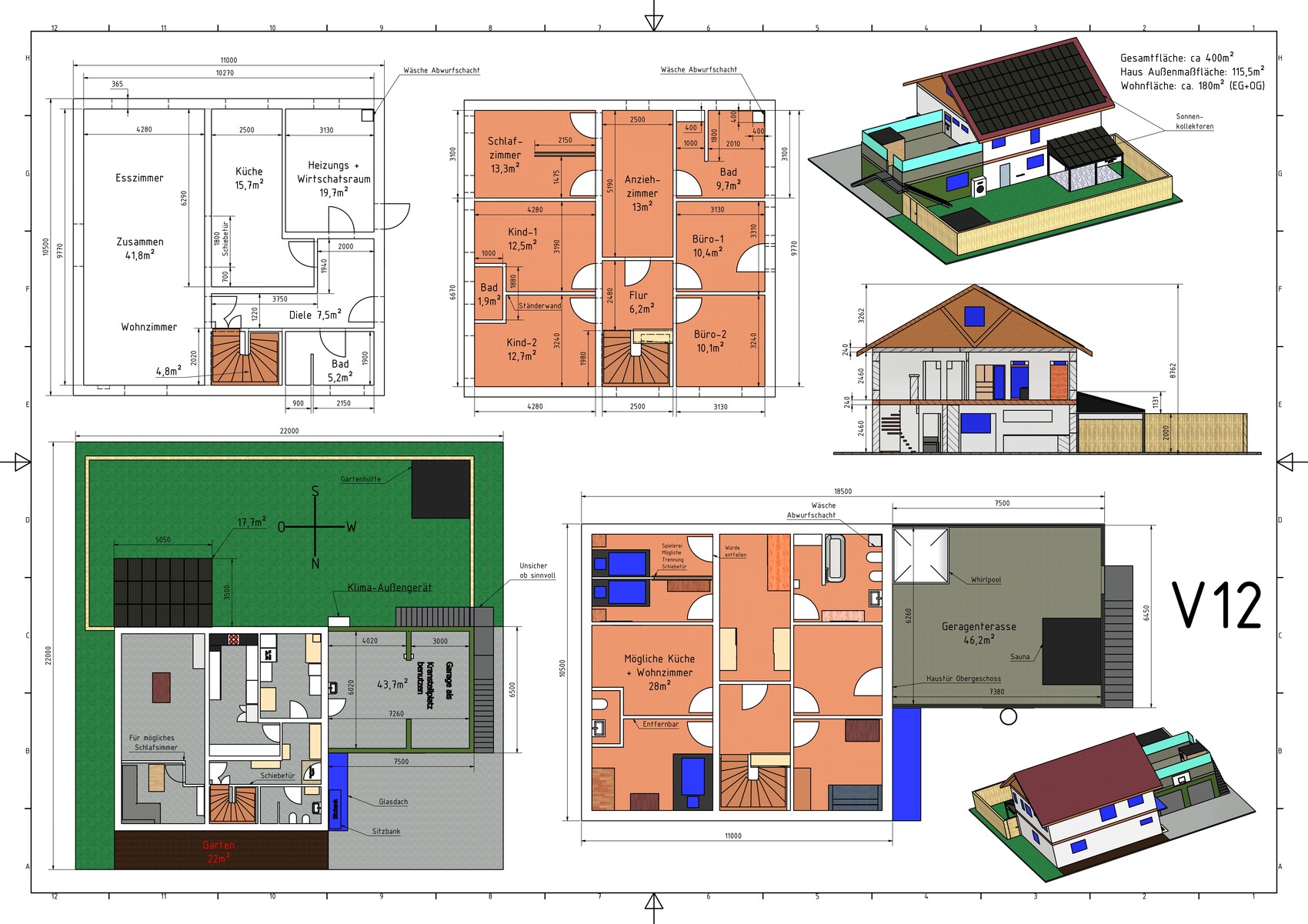
I tried to create a floor plan that keeps the house practical for different stages of life. Both the ground floor and the upper floor can be used as independent apartments with minor modifications, for example when the children are not yet there, when they move out, or if the marriage should break down. Depending on the situation, either one floor or both can be rented out. The garage and utility room remain accessible to both floors. In addition, features such as photovoltaics, KNX (home automation system), empty conduits etc. should prepare the house for the future.
Therefore, I don’t need comments about how planning like this in advance doesn’t make sense. My goal is to see what is roughly possible and reasonable or not, and to gain more experience.
Development plan / restrictions Not available
Client requirements
Style, roof shape, building type: Modern, gable roof, future-oriented
Basement, floors: No basement, 2 floors + attic area for storage
Number of occupants, age: 2 adults + 2 children
Space requirement on ground floor and upper floor: Approximately 90m² (970 sq ft) each
Office: Family use or home office? Yes
Occasional guests per year: Possible but not planned
Open or closed architecture: Rather closed
Conservative or modern construction: Mixed
Open kitchen, kitchen island: Partly, no
Number of dining seats: 2 with couch ^^
Fireplace: No
Music / stereo wall: Probably
Balcony, roof terrace: Yes, yes
Garage, carport: Garage
Utility garden, greenhouse: Possibly garden shed
If possible, the garden should face south, among other reasons because photovoltaics will be used.
House design
Who planned it: Do-it-yourself with Inventor!
What do you especially like: The use of the house for several life phases
What do you dislike? Why? More difficult / expensive utility connections, presumed costs ^^
Price estimate according to architect / planner: Own estimate 600k without land
Personal price limit for the house including equipment: Currently unclear
Preferred heating technology: Air-to-water heat pump
If you have to give up certain details / expansions
- Can give up: Large utility room, changing room
- Cannot give up: Terrace
Why did the design turn out the way it is? For example:
I tried to create a floor plan that keeps the house practical for different stages of life. Both the ground floor and the upper floor can be used as independent apartments with minor modifications, for example when the children are not yet there, when they move out, or if the marriage should break down. Depending on the situation, either one floor or both can be rented out. The garage and utility room remain accessible to both floors. In addition, features such as photovoltaics, KNX (home automation system), empty conduits etc. should prepare the house for the future.

ThomasMagmar schrieb:
So far, I haven’t heard any convincing arguments that seem more reasonable to me regarding the other points.The thing is, no one has really made any alternative suggestions yet. The problem seems to be that it doesn’t feel like you are open to something completely different, while at the same time, the current floor plan is not seen as salvageable 🙂 It’s also a question of how much fun the hobbyists here have in designing a house that probably will never be built anyway, since you are mainly gathering ideas for the future.Roughly speaking: We can’t link here, but you can google for example “Haas sustainable adaptation options,” where you’ll find a sample of converting a single-family house into two apartments, which is clearly much better thought out. Yes, the kitchen is open, and yes, there is only one office, but overall it still comes across as a much more solid foundation. That’s why the suggestion here was to basically “start from scratch, create a room program” such as “2 children’s bedrooms, 2 offices (the question being how large they really need to be), closed kitchen, and so on,” or alternatively “take a look at existing floor plans.”

Tolentino schrieb:
I would recommend the original poster to plan only with drywall on wooden studs over a raised floor. That way, the walls can be moved relatively easily if they realize later that the layout doesn’t work.
It’s best not to use screed but instead a raised floor on joists, similar to office construction, so that the wiring can be routed or rerouted under the floor as desired.
This allows almost everything to be changed afterward, except for a few details. Indulging in dreams of complete modularity to avoid a clear concept has its limits. I would suggest switching gears decisively: enjoy a freeform “Villa Kunterbunt” approach—with a touch of Schrödinger and/or M. C. Escher—while still in dream mode. But after that paradigm shift back to reality, proceed in a structured, planned way with an architect. In reality, few family life paths are so volatile that a house with fixed walls wouldn’t be suitable for a reasonable long term.
ThomasMagmar schrieb:
It’s not about what criticism is offered, but how it is delivered. For example, something can be described as “unsuitable/inappropriate” or as “sh***.” While I appreciate and am grateful for the criticism, I feel that some comments were aimed only at belittling. Notably, this is said by the author of the remark
ThomasMagmar schrieb:
Your last sentence is completely unnecessary, https://www.instagram.com/11antgmxde/
https://www.linkedin.com/company/bauen-jetzt/

11ant schrieb:
I would rather recommend a hard switch thereAnd you still think the OP is capable of that?11ant schrieb:
I would rather recommend a decisive switch:Tolentino schrieb:
And you still think the original poster can manage that?Yes, I already mentioned a11ant schrieb:
Mrs. Right, who sets Thomas straightWith that said: when a woman comes, advice comes. Then even Thomas Magnum grows up enough to surprise Higgins ;-)https://www.instagram.com/11antgmxde/
https://www.linkedin.com/company/bauen-jetzt/
You are simply a hopeless romantic.
From my experience, it usually goes like this: making plans (the gods laugh), confronting reality, tears, starting over.
My approach would be to keep the tears phase as short as possible and make starting over as easy as possible.
But hope dies last.
From my experience, it usually goes like this: making plans (the gods laugh), confronting reality, tears, starting over.
My approach would be to keep the tears phase as short as possible and make starting over as easy as possible.
But hope dies last.
T
ThomasMagmar24 Feb 2023 14:39mayglow schrieb:
Try furnishing the dressing room, which, if I understand correctly, is also supposed to include the wardrobe. Consider where you would stand to get dressed and how the walkways would work, for example, if someone wants to get to the bathroom. Even though the room is spacious, it doesn’t work for me. I would rather prioritize a bathroom that is easily accessible for everyone.
Regarding the bedroom setup: a mattress gives way, so sliding a wardrobe door over it won’t be a satisfactory solution. Either there will be a gap when you lie on the bed, or the mechanism will jam when you’re not on it, or it will rattle when you turn over. Eventually, the bed will need replacing, and then the height won’t match anymore. My conclusion is that it might have sounded like a fun idea at first but is impractical. Getting and assembling a double bed in there will be challenging, if possible at all. I also find the short wall unattractive because it creates a cramped feeling. Since you planned a dressing room for changing with minimal disturbance, having completely separate bedrooms would definitely be more comfortable if someone wants to sleep separately.
About the kitchen and windows: keep in mind that it’s pointless if the window is blocked by cabinets. A kitchen can be arranged on a 2.50m (8 ft) wide wall—this is common in townhouses. But you’re talking about a 200sqm (2,150 sq ft) dream house with all possibilities open, right? Having that narrow hallway alongside the kitchen passage seems odd.
Please, please don’t get too attached to the current floor plan. I don’t believe all the described issues would be resolved by moving a wall just 10cm (4 inches); structurally, it’s probably not feasible. Neither the upper floor nor the ground floor feels coherent, neither as two separate apartments nor as one.
Regarding “what happens after 10 years”:
A) One or both children might stay in the house longer than expected.
B) Parents might find new hobbies and appreciate the extra space.
C) You might find a solution then and better understand the actual space needs.
D) You might move to a smaller place later.
E) You could plan a few areas for flexibility (like a separable stairwell) but shouldn’t design everything around uncertain future needs. You can also choose to plan smaller now if you focus on what you need presently rather than always thinking “if we separate here, a kitchen could go there.” If the second door in the bedroom is removed, an additional wardrobe can be placed in that area. If I arrange two wardrobes facing each other, there would still be 1.3m (4 ft 3 in) of space between them, which should be enough for two people to pass by comfortably. I also considered using a hinged door with a mirror to allow viewing from a greater distance. I don’t think the room would necessarily always be used as a dressing room, but rather more as storage for clothes. Then, clothes would be taken out and dressing would be done in the bathroom, possibly after showering there first.
In principle, the bathroom could also be located in the middle, but that would require moving the entrance door upward, which I don’t like. Guests would then always have to walk through the dressing room. If necessary, the bathroom could be placed in the lower corner, but then the route from the bedroom would be the same as the current one for the children. The laundry chute would no longer be usable, and you would have to walk through the hallway to reach the dressing room. The children’s bathroom could also be removed altogether; in my opinion, it’s not a big deal if the children have to walk 5m (16 ft 5 in) instead of 2m (6 ft 7 in) to the bathroom.
As your predecessor mentioned, sound insulation would probably be insufficient to be effective. As I said, it was a bit of a gimmick, but it likely won’t work as hoped. (Regarding the previous idea: the drywall partition would only be installed after the bed is in place; fabric tubes like those used under door gaps could be placed between the door and bed, but replacing the bed later would be very problematic.)
Regarding the kitchen and windows, I’m not entirely sure what you mean. With 2.5m (8 ft) width and two kitchen units, there would still be 1.3m (4 ft 3 in) left in the middle. Installing a window measuring 1.5 x 1.0m (5 ft x 3 ft 3 in) centered there should be sufficient in my opinion. Also, quite a bit of light comes from the dining room. I think it makes sense if groceries can be stored either in the utility room or directly in the kitchen after shopping. Likewise, you can enter the kitchen directly from the front door if you don’t use a car, for example.
This is my 12th version/arrangement, so I have already discarded many ideas. Therefore, I am open to changes. Still, I like this draft best so far, as I would have to compromise the least. A completely perfect plan will probably never exist.
A) This is exactly why it could make sense to use both floors independently.
B) What hobby would require 90sqm (970 sq ft)? And if so, you’d likely need to knock down all the walls anyway.
C) Once the house is built, making changes (if not planned beforehand) is difficult. You also have to consider cables, pipes inside the walls, etc.
D) If you move later, you could rent out two separate apartments. I assume it wouldn’t be easy to rent 200sqm (2,150 sq ft) to just one person or family.
E) There aren’t that many changes now: on the ground floor, a partition wall would be added for a bedroom, and upstairs the partition wall between the children’s rooms would be removed, creating a living room with an open kitchen. The partition wall could theoretically stay, but then the living room would be too small.
Similar topics