
ᐅ Floor plan of a detached single-family house approximately 200 m² with two separate living units
Created on: 23 Feb 2023 23:30
T
ThomasMagmar
Preliminary note: This is not a specific building project, but it is something that may happen in the future if possible. Many of my friends have recently built houses and are currently in the process, but for myself it will still take some time. However, since I am quite interested in the subject and have skills in 3D design, I have started to think about how my "dream house" should look. I am fully aware that the floor plan may still change due to the location.
Therefore, I don’t need comments about how planning like this in advance doesn’t make sense. My goal is to see what is roughly possible and reasonable or not, and to gain more experience.
Development plan / restrictions Not available
Client requirements
Style, roof shape, building type: Modern, gable roof, future-oriented
Basement, floors: No basement, 2 floors + attic area for storage
Number of occupants, age: 2 adults + 2 children
Space requirement on ground floor and upper floor: Approximately 90m² (970 sq ft) each
Office: Family use or home office? Yes
Occasional guests per year: Possible but not planned
Open or closed architecture: Rather closed
Conservative or modern construction: Mixed
Open kitchen, kitchen island: Partly, no
Number of dining seats: 2 with couch ^^
Fireplace: No
Music / stereo wall: Probably
Balcony, roof terrace: Yes, yes
Garage, carport: Garage
Utility garden, greenhouse: Possibly garden shed
If possible, the garden should face south, among other reasons because photovoltaics will be used.
House design
Who planned it: Do-it-yourself with Inventor!
What do you especially like: The use of the house for several life phases
What do you dislike? Why? More difficult / expensive utility connections, presumed costs ^^
Price estimate according to architect / planner: Own estimate 600k without land
Personal price limit for the house including equipment: Currently unclear
Preferred heating technology: Air-to-water heat pump
If you have to give up certain details / expansions
- Can give up: Large utility room, changing room
- Cannot give up: Terrace
Why did the design turn out the way it is? For example:
I tried to create a floor plan that keeps the house practical for different stages of life. Both the ground floor and the upper floor can be used as independent apartments with minor modifications, for example when the children are not yet there, when they move out, or if the marriage should break down. Depending on the situation, either one floor or both can be rented out. The garage and utility room remain accessible to both floors. In addition, features such as photovoltaics, KNX (home automation system), empty conduits etc. should prepare the house for the future.
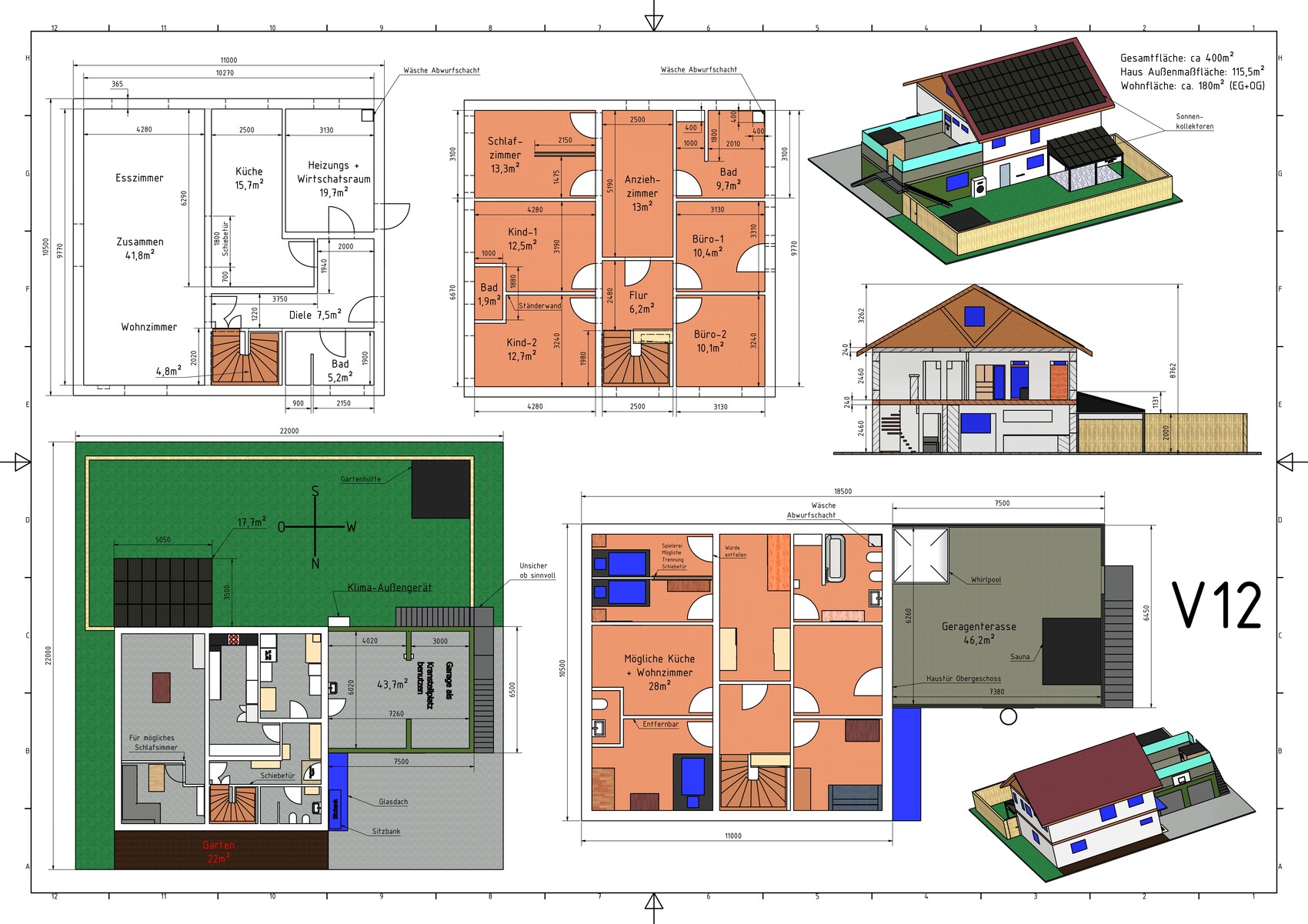
Therefore, I don’t need comments about how planning like this in advance doesn’t make sense. My goal is to see what is roughly possible and reasonable or not, and to gain more experience.
Development plan / restrictions Not available
Client requirements
Style, roof shape, building type: Modern, gable roof, future-oriented
Basement, floors: No basement, 2 floors + attic area for storage
Number of occupants, age: 2 adults + 2 children
Space requirement on ground floor and upper floor: Approximately 90m² (970 sq ft) each
Office: Family use or home office? Yes
Occasional guests per year: Possible but not planned
Open or closed architecture: Rather closed
Conservative or modern construction: Mixed
Open kitchen, kitchen island: Partly, no
Number of dining seats: 2 with couch ^^
Fireplace: No
Music / stereo wall: Probably
Balcony, roof terrace: Yes, yes
Garage, carport: Garage
Utility garden, greenhouse: Possibly garden shed
If possible, the garden should face south, among other reasons because photovoltaics will be used.
House design
Who planned it: Do-it-yourself with Inventor!
What do you especially like: The use of the house for several life phases
What do you dislike? Why? More difficult / expensive utility connections, presumed costs ^^
Price estimate according to architect / planner: Own estimate 600k without land
Personal price limit for the house including equipment: Currently unclear
Preferred heating technology: Air-to-water heat pump
If you have to give up certain details / expansions
- Can give up: Large utility room, changing room
- Cannot give up: Terrace
Why did the design turn out the way it is? For example:
I tried to create a floor plan that keeps the house practical for different stages of life. Both the ground floor and the upper floor can be used as independent apartments with minor modifications, for example when the children are not yet there, when they move out, or if the marriage should break down. Depending on the situation, either one floor or both can be rented out. The garage and utility room remain accessible to both floors. In addition, features such as photovoltaics, KNX (home automation system), empty conduits etc. should prepare the house for the future.

ThomasMagmar schrieb:
Since I actually enjoy the topic myself and am skilled in the 3D area, You probably meant “in the 3 square meter area,” because your drawing is so huge – and therefore practically impossible to view for mobile device users. I took the liberty to shrink it.
@admin, could this please be set so that such gigapixel uploads are prevented here?
https://www.instagram.com/11antgmxde/
https://www.linkedin.com/company/bauen-jetzt/

Personal opinion: Even though I’m not really able to create practical floor plans myself, I immediately see too many corners and edges here that just don’t fit well together. On top of that, so-called "clever features" were added that simply don’t work in this form. For example, the children’s bathroom seems like an afterthought; it wasn’t originally there, and then it sounded like a great idea. But putting two doors into a bathroom smaller than 2m² (22 sq ft), and having the drain pipes run right through the living room, is quite far from a functional layout.
You should rather rethink your room program (what is essential, what is optional) and how you want to live in the space, and then consult with an architect and/or look at existing plans to see if they suit your needs. I myself also don’t have the ability to create a sensible floor plan from scratch, but the good thing is, I don’t have to 😉
You should rather rethink your room program (what is essential, what is optional) and how you want to live in the space, and then consult with an architect and/or look at existing plans to see if they suit your needs. I myself also don’t have the ability to create a sensible floor plan from scratch, but the good thing is, I don’t have to 😉
T
ThomasMagmar24 Feb 2023 11:29Thanks in advance for the reply, the first one that didn’t just seem aimed at “putting me down” 🙂
Regarding the more precise positioning of the walls, I am still flexible in some areas. If more than 50 mm (2 inches) extra space is needed, that would be possible. The 1m (3 ft 3 in) width is measured from the inside of the wall, and the toilet room is meant only for the bare essentials. However, it wouldn’t be a problem to make the room a bit longer or wider if needed. But as I mentioned before, I’m also unsure whether that would really make sense or not.
There is a large window on the kitchen’s exterior wall (size is flexible), and there is also a large opening of 1.8 x 2m (6 ft x 6 ft 6 in) leading to the dining room. If the door is ever closed, frosted glass is planned so light can still pass through. We do cook quite often, but usually just by myself. It’s not planned to cook with friends or anything like that. From what I’ve seen in apartments with an island in the middle, the aisle space generally only measures about 1.4m (4 ft 7 in).
Yes, I have looked at sliding doors, including those from Knauf with the pocket kit. In that case, the sliding door disappears inside the wall and therefore doesn’t take up any extra space.
No, it’s actually one single wide bed. The door (with an opening) runs into the wall and is basically an L-shaped horizontal layout, so the bottom edge of the door would just barely be above the mattress. Using the guest couch in the office would be possible as well, but that would always involve more effort handling bedding, stuff, etc., rather than just closing the door.
And what happens after those 10 years? Building a house, especially with current prices, is so expensive that I would like to get more than 10 years’ use out of it. I know many people whose children have moved out, and the parents then live in a house that’s too big, much of which they no longer use. But they still have to clean it now and then.
With the partition, you would have three options:
1. One of the children stays in the house but then lives there with his/her “own” family. Especially as a young couple, you want more privacy, which this setup would provide.
2. Rent out a floor to a stranger and thereby afford things like a nice vacation each year.
3. If the marriage eventually breaks down, you wouldn’t necessarily have to rush a move. If that does happen, you could rent out one floor, or if both move out (because maintenance is too expensive), you could rent out both floors.
mayglow schrieb:
Keep in mind that you usually plan with rough structural dimensions. A 1m (3 ft 3 in) wide toilet room can get quite tight once you factor in necessary clearances.
Regarding the more precise positioning of the walls, I am still flexible in some areas. If more than 50 mm (2 inches) extra space is needed, that would be possible. The 1m (3 ft 3 in) width is measured from the inside of the wall, and the toilet room is meant only for the bare essentials. However, it wouldn’t be a problem to make the room a bit longer or wider if needed. But as I mentioned before, I’m also unsure whether that would really make sense or not.
mayglow schrieb:
About the kitchen: check where natural light currently enters the room. I also feel our townhouse kitchen could be brighter and less cramped. Don’t you cook a lot?
There is a large window on the kitchen’s exterior wall (size is flexible), and there is also a large opening of 1.8 x 2m (6 ft x 6 ft 6 in) leading to the dining room. If the door is ever closed, frosted glass is planned so light can still pass through. We do cook quite often, but usually just by myself. It’s not planned to cook with friends or anything like that. From what I’ve seen in apartments with an island in the middle, the aisle space generally only measures about 1.4m (4 ft 7 in).
mayglow schrieb:
Have you looked into sliding doors anywhere? Proper sliding doors usually need about the same amount of space on the side where the door slides into. Alternatively, there are folding doors. The question is whether that really works well and is practical where you currently plan everything. It seems like the sliding door is your universal solution for flexibility and also to solve “tight corners.” I’d put a question mark on that.
Yes, I have looked at sliding doors, including those from Knauf with the pocket kit. In that case, the sliding door disappears inside the wall and therefore doesn’t take up any extra space.
mayglow schrieb:
I don’t quite understand how you imagine the bedroom situation. Sliding door between two single beds and when you want to cuddle, you leave it open and push the beds together? Or am I misunderstanding? I think practically there’s usually a standard: either you always keep it open or always closed if you prefer separate sleeping arrangements. Personally, I would plan a plain regular shared bedroom and put a pull-out sofa or similar in one of the offices as a backup option.
No, it’s actually one single wide bed. The door (with an opening) runs into the wall and is basically an L-shaped horizontal layout, so the bottom edge of the door would just barely be above the mattress. Using the guest couch in the office would be possible as well, but that would always involve more effort handling bedding, stuff, etc., rather than just closing the door.
mayglow schrieb:
Instead of trying to create the perfect plan for all life stages, it might be more sensible to create a good plan for the next 10 years.
And what happens after those 10 years? Building a house, especially with current prices, is so expensive that I would like to get more than 10 years’ use out of it. I know many people whose children have moved out, and the parents then live in a house that’s too big, much of which they no longer use. But they still have to clean it now and then.
With the partition, you would have three options:
1. One of the children stays in the house but then lives there with his/her “own” family. Especially as a young couple, you want more privacy, which this setup would provide.
2. Rent out a floor to a stranger and thereby afford things like a nice vacation each year.
3. If the marriage eventually breaks down, you wouldn’t necessarily have to rush a move. If that does happen, you could rent out one floor, or if both move out (because maintenance is too expensive), you could rent out both floors.
A single-family house that is supposed to simultaneously become a two-family house usually doesn’t work well. It either doesn’t result in a practical layout for a single family, or the second living unit ends up being inadequate. It’s something like trying to square the circle.
Before you start drawing in 3D—by the way, you might think you have the perfect floor plan now, but if you already have a plot of land, it often ends up just being stored away—first create a room program. Include the dimensions for all desired or existing furniture. Gather information by exploring model homes and catalogs. Pay attention everywhere—even at friends’ and acquaintances’ homes—to what you like about the spatial feel and what you don’t like. This way you develop a sense for spaces. As you slowly learn what to look for, you’ll notice many details. For example, planning a bathroom where you bump your elbows, or a seating area where Aunt Erna can never get past Grandpa Helmut. Use this time to absorb all these little details like a sponge. Nothing is more frustrating later than realizing you have to stand sideways to open the oven because there isn’t enough space between the stove and the kitchen island.
It’s normal for a house to become too large for a family over time. Who do you want to have living in the house later? A stranger, your own children, or would you rather sell it and enjoy retirement in a warmer climate?
A two-family house intended for renting to strangers has different requirements: separate meters, parking spaces, and so on. If it becomes a multi-generational house with your own children and grandchildren, everything is usually more open with fewer strict separations.
Before you start drawing in 3D—by the way, you might think you have the perfect floor plan now, but if you already have a plot of land, it often ends up just being stored away—first create a room program. Include the dimensions for all desired or existing furniture. Gather information by exploring model homes and catalogs. Pay attention everywhere—even at friends’ and acquaintances’ homes—to what you like about the spatial feel and what you don’t like. This way you develop a sense for spaces. As you slowly learn what to look for, you’ll notice many details. For example, planning a bathroom where you bump your elbows, or a seating area where Aunt Erna can never get past Grandpa Helmut. Use this time to absorb all these little details like a sponge. Nothing is more frustrating later than realizing you have to stand sideways to open the oven because there isn’t enough space between the stove and the kitchen island.
It’s normal for a house to become too large for a family over time. Who do you want to have living in the house later? A stranger, your own children, or would you rather sell it and enjoy retirement in a warmer climate?
A two-family house intended for renting to strangers has different requirements: separate meters, parking spaces, and so on. If it becomes a multi-generational house with your own children and grandchildren, everything is usually more open with fewer strict separations.

SoL schrieb:
This "design" most reminds me of a teenager playing The Sims. No way, back when I was a teenager (around 2000), this kind of nonsense wouldn’t have worked in The Sims either.
(If anything, it was the opposite—the Sims always needed an incredible amount of walking space to pass each other.)
H
hanghaus202324 Feb 2023 11:42ThomasMagmar schrieb:
I have no idea what you mean by your orientation. I chose the cardinal directions so that the terrace is on the south side, just like the solar panels. The street could theoretically be located either to the north (running west to east) or to the east (running north to south). As I mentioned before, I am fully aware that certain regulations must be followed when dealing with a plot of land.
I just meant that north should be at the top of the plan. Unfortunately, in your case, south is at the top.
Similar topics