
ᐅ Floor plan, post-and-beam construction, accessory dwelling unit, and existing building
Created on: 21 Feb 2023 20:48
B
BucheOnBoardB
BucheOnBoard21 Feb 2023 20:48Hello everyone,
Currently, my father, my wife, and my child (under 1 year old) live in a small residential house from the 1950s with 61m² (655 sq ft) of living space. The property is owned 50/50 by my father and me but is still partly being paid off by my grandmother (my outstanding payments are held in a separate account and are therefore just a “pass-through” item, while my father pays his monthly installments from his income). The plot is in Hamburg Iserbrook and measures 681m² (7,333 sq ft) with a standard land value of €985.
Unsurprisingly, the space is becoming somewhat tight, even though we get along well. Furthermore, the health of the older housemate is declining, and the narrow staircase to the upper floor is already becoming difficult to manage.
The basic idea is this: I would receive the second half of the plot as a gift, debt-free. My father will continue paying off his installments until he inherits the remainder. In return, we will build him a nice accessory apartment with the corresponding right of residence (or usufruct right, which still needs to be clarified)—barrier-free and compact so he can live independently there for as long as possible. The rest of the ground floor would then only contain a multipurpose room, guest toilet, and hallway; upstairs four rooms and a bathroom. We would like a (simple) converted attic as a retreat area. To relieve the ground floor space and avoid fully using the building envelope (sealing of surfaces, etc.), we plan a basement, as there are also two space-intensive hobbies and a workshop desired for DIY projects. I will also build some of the furniture myself.
Now to the questionnaire:
Building Plan / Restrictions
Plot size: 681m² (7,333 sq ft) with existing house
Slope: No, but the area from the street level up to the terrace is filled +90cm (35 inches), the garage is at about +40cm (16 inches), the neighboring plot to the north also about +40cm (16 inches), and to the south approximately at street level
Floor area ratio (FAR): 0.4
Plot ratio (building coverage ratio): 0.4
Building envelope, building line, and boundaries: 5m (16.4 ft) setback to the street, then 15m (49.2 ft) deep, 2.5m (8.2 ft) setback on each side (more for taller buildings)
Edge development: Allowed (garages etc., max. wall height 3m (10 ft), max. length 9m (30 ft))
Number of parking spaces: We believe none are legally required; we plan to provide one for future use, for electric vehicle charging (currently not needed)
Number of floors: One full story; ALKIS shows some buildings apparently with two floors (see attachment)
Roof type: Not specified
Architectural style: Not specified
Orientation: Not specified
Maximum heights/limits: Not specified
Other requirements: No illuminated advertising signs 😉
The 1965 building plan mainly mandates “residential zoning only” and “one full story,” but even these rules seem flexible. There is a very large copper beech tree in the southeast corner of the plot, with an estimated crown diameter of 10m (33 ft) and at least 12-14m (39-46 ft) tall. The tree is to be preserved (it is unclear if it must officially be preserved with a new build). I expect that the new building must not come closer to the tree than the current building—about 2.5m (8.2 ft) from the trunk. The trunk itself is roughly 1.5m (5 ft) in diameter. A pruning plan is under discussion (also due to shading of the roof, planned for solar panels).
Owners' Requirements
Architectural style, roof shape, building type: Detached single-family home, gable roof with pitch >45°, rather long and narrow
Basement, number of floors: Yes to basement, 1.5 floors plus a converted attic
Number of occupants, ages: 4 (64 (gruff and private), 34, 31, under 1) Another child should be possible
Ground floor space needs: Open-plan area preferably with a small pantry, guest toilet
Accessory apartment with barrier-free design (walk-in shower, open living kitchen with sleeping niche). Can be small.
Shared hallway important (for potential care needs without going outside, access to joint basement with laundry facilities, etc.)
Upper floor space needs: 1 bedroom with a large bed and built-in closets but no extras, 3 rooms (1 child’s room, 1 office/child’s room, 1 guest/office (can be small)), 1 bathroom with a larger vanity, bathtub, and shower
Attic space needs: 2 “retreat” areas for the adults; if necessary, just a rocking chair with reading lamp and sewing machine on one side, and a gaming PC on the other. The current attic is an equilateral triangle with 2.1m (83 inches) side length; it doesn’t need to be much larger/wider/higher than that.
Basement space needs (access via shared hallway + additional exterior entrance): Technical room with heat pump, ventilation, electrical distribution, inverter, server; woodwork workshop; laundry room; 2 hobby cellars for large-format collections—Lego and beer cans, no kink-shaming please 😉 ; 1 storage room for decorations, suitcases, camping gear, etc. Must be heated (and ventilated), but simple tile flooring and surface-mounted installations are sufficient.
Office: Family use or home office? Home office about three times a week, plus one self-employed side business
Guest stays per year: 6–10, usually just one night, sometimes 2–3 nights
Open or closed design: Open on the ground floor but staircase not located in the living room/open space
Conservative or modern construction? I’m never quite sure of the difference, but I feel fully modern
Open kitchen, kitchen island: Yes, cooking often and joyfully, also with guests
Number of dining seats: 6; existing table extends to 14 seats for Christmas and birthdays
Fireplace: No, no chimney planned
Music/stereo wall: No
Balcony, roof terrace: No
Garage, carport: Carport/roof overhang directly at the building would be good, mainly for bikes and potentially for an electric vehicle in the (near) future. To my knowledge, Hamburg does not require parking spaces.
Vegetable garden, greenhouse: Maybe a small bed later, but not important at the moment
Other wishes/particularities/daily routine, including reasons for certain choices: Currently, leisure activities happen at the dining table, which is between sofa and TV (used about once a week), so large lounge furniture is not really needed. The tree is a critical factor, as it likely narrows the building envelope in the front area to about 6.5m (21 ft). We don’t want to move the house further back because of the garden.
House Design
Planner: Still in the very early idea phase. Overall, we think about 180m² (1,937 sq ft) of living space plus basement. We currently live as four on 61m² (655 sq ft) and can manage. We don’t need huge increases in room size, rather a spatial separation with the accessory apartment and space for hobbies and home office. Dressing rooms or a children’s bathroom are not planned.
Personal budget limit for house including fittings: €750,000–800,000 (USD amount varies), with much furniture available from the existing house. Demolition cost would be extra, but I see plenty of grants and rental expenses during construction period. €450,000 (about $480,000) equity is available; the plot described above would be fully paid off (worth almost €700,000 or approximately $750,000).
Preferred heating technology: Ground-source heat pump with deep borehole and 12–15kWp photovoltaic system plus centralized controlled residential ventilation with enthalpy heat exchanger
If you have to compromise, on which features/extensions
- What can you do without: Either attic conversion or guest-office room
- What you cannot do without: Basement
Why is the design like this? No design yet; we are still considering the orientation on the plot.
It will be a timber frame construction, a gable roof to fit well, knee wall about 1.3m (4.3 ft), roof pitch >45°. The current roof is 60° and gives it a rustic fairy-tale look. On the south side, we want nearly full photovoltaic coverage except for a few roof windows; on the north side, we can imagine a dormer also to integrate the staircase to the attic—maybe a cross-gable?
The rough idea is close to the volume of a Danwood Point 138.1, but a bit wider and longer, and “narrower at the front” (the east side facing the street) due to the tree. Plus an attic conversion with a steeper roof. Access via staircase on the north side.
Alternatively, separate accessory apartment in the south and main residence in the north, but that would split the already narrow house into even narrower parts.
We would like a local timber frame general contractor (any recommendations in the greater Hamburg area?).
Am I completely off track? Have I forgotten anything? Made any major mistakes besides not building three years ago? Are important details missing? Will it all turn out too cramped? Is the budget roughly realistic? Aside from a garden shed, I have no building experience but some electrical knowledge. Photovoltaics and networking could be done by me, full electrical installation I am allowed but would not be practical with a general contractor.
Or is the program so complex that an architect is absolutely necessary because a draftsman would be overwhelmed? From my research it seems that architects for single-family homes that are not villas are quite rare.
Thanks to everyone who made it this far! And even more thanks to those who share their opinions or ideas.
Attached are current ALKIS excerpt, aerial photo, and building plan excerpt, all oriented north and approximately the same section. I hope they are legible… Red borders and points mark the plot.
Currently, my father, my wife, and my child (under 1 year old) live in a small residential house from the 1950s with 61m² (655 sq ft) of living space. The property is owned 50/50 by my father and me but is still partly being paid off by my grandmother (my outstanding payments are held in a separate account and are therefore just a “pass-through” item, while my father pays his monthly installments from his income). The plot is in Hamburg Iserbrook and measures 681m² (7,333 sq ft) with a standard land value of €985.
Unsurprisingly, the space is becoming somewhat tight, even though we get along well. Furthermore, the health of the older housemate is declining, and the narrow staircase to the upper floor is already becoming difficult to manage.
The basic idea is this: I would receive the second half of the plot as a gift, debt-free. My father will continue paying off his installments until he inherits the remainder. In return, we will build him a nice accessory apartment with the corresponding right of residence (or usufruct right, which still needs to be clarified)—barrier-free and compact so he can live independently there for as long as possible. The rest of the ground floor would then only contain a multipurpose room, guest toilet, and hallway; upstairs four rooms and a bathroom. We would like a (simple) converted attic as a retreat area. To relieve the ground floor space and avoid fully using the building envelope (sealing of surfaces, etc.), we plan a basement, as there are also two space-intensive hobbies and a workshop desired for DIY projects. I will also build some of the furniture myself.
Now to the questionnaire:
Building Plan / Restrictions
Plot size: 681m² (7,333 sq ft) with existing house
Slope: No, but the area from the street level up to the terrace is filled +90cm (35 inches), the garage is at about +40cm (16 inches), the neighboring plot to the north also about +40cm (16 inches), and to the south approximately at street level
Floor area ratio (FAR): 0.4
Plot ratio (building coverage ratio): 0.4
Building envelope, building line, and boundaries: 5m (16.4 ft) setback to the street, then 15m (49.2 ft) deep, 2.5m (8.2 ft) setback on each side (more for taller buildings)
Edge development: Allowed (garages etc., max. wall height 3m (10 ft), max. length 9m (30 ft))
Number of parking spaces: We believe none are legally required; we plan to provide one for future use, for electric vehicle charging (currently not needed)
Number of floors: One full story; ALKIS shows some buildings apparently with two floors (see attachment)
Roof type: Not specified
Architectural style: Not specified
Orientation: Not specified
Maximum heights/limits: Not specified
Other requirements: No illuminated advertising signs 😉
The 1965 building plan mainly mandates “residential zoning only” and “one full story,” but even these rules seem flexible. There is a very large copper beech tree in the southeast corner of the plot, with an estimated crown diameter of 10m (33 ft) and at least 12-14m (39-46 ft) tall. The tree is to be preserved (it is unclear if it must officially be preserved with a new build). I expect that the new building must not come closer to the tree than the current building—about 2.5m (8.2 ft) from the trunk. The trunk itself is roughly 1.5m (5 ft) in diameter. A pruning plan is under discussion (also due to shading of the roof, planned for solar panels).
Owners' Requirements
Architectural style, roof shape, building type: Detached single-family home, gable roof with pitch >45°, rather long and narrow
Basement, number of floors: Yes to basement, 1.5 floors plus a converted attic
Number of occupants, ages: 4 (64 (gruff and private), 34, 31, under 1) Another child should be possible
Ground floor space needs: Open-plan area preferably with a small pantry, guest toilet
Accessory apartment with barrier-free design (walk-in shower, open living kitchen with sleeping niche). Can be small.
Shared hallway important (for potential care needs without going outside, access to joint basement with laundry facilities, etc.)
Upper floor space needs: 1 bedroom with a large bed and built-in closets but no extras, 3 rooms (1 child’s room, 1 office/child’s room, 1 guest/office (can be small)), 1 bathroom with a larger vanity, bathtub, and shower
Attic space needs: 2 “retreat” areas for the adults; if necessary, just a rocking chair with reading lamp and sewing machine on one side, and a gaming PC on the other. The current attic is an equilateral triangle with 2.1m (83 inches) side length; it doesn’t need to be much larger/wider/higher than that.
Basement space needs (access via shared hallway + additional exterior entrance): Technical room with heat pump, ventilation, electrical distribution, inverter, server; woodwork workshop; laundry room; 2 hobby cellars for large-format collections—Lego and beer cans, no kink-shaming please 😉 ; 1 storage room for decorations, suitcases, camping gear, etc. Must be heated (and ventilated), but simple tile flooring and surface-mounted installations are sufficient.
Office: Family use or home office? Home office about three times a week, plus one self-employed side business
Guest stays per year: 6–10, usually just one night, sometimes 2–3 nights
Open or closed design: Open on the ground floor but staircase not located in the living room/open space
Conservative or modern construction? I’m never quite sure of the difference, but I feel fully modern
Open kitchen, kitchen island: Yes, cooking often and joyfully, also with guests
Number of dining seats: 6; existing table extends to 14 seats for Christmas and birthdays
Fireplace: No, no chimney planned
Music/stereo wall: No
Balcony, roof terrace: No
Garage, carport: Carport/roof overhang directly at the building would be good, mainly for bikes and potentially for an electric vehicle in the (near) future. To my knowledge, Hamburg does not require parking spaces.
Vegetable garden, greenhouse: Maybe a small bed later, but not important at the moment
Other wishes/particularities/daily routine, including reasons for certain choices: Currently, leisure activities happen at the dining table, which is between sofa and TV (used about once a week), so large lounge furniture is not really needed. The tree is a critical factor, as it likely narrows the building envelope in the front area to about 6.5m (21 ft). We don’t want to move the house further back because of the garden.
House Design
Planner: Still in the very early idea phase. Overall, we think about 180m² (1,937 sq ft) of living space plus basement. We currently live as four on 61m² (655 sq ft) and can manage. We don’t need huge increases in room size, rather a spatial separation with the accessory apartment and space for hobbies and home office. Dressing rooms or a children’s bathroom are not planned.
Personal budget limit for house including fittings: €750,000–800,000 (USD amount varies), with much furniture available from the existing house. Demolition cost would be extra, but I see plenty of grants and rental expenses during construction period. €450,000 (about $480,000) equity is available; the plot described above would be fully paid off (worth almost €700,000 or approximately $750,000).
Preferred heating technology: Ground-source heat pump with deep borehole and 12–15kWp photovoltaic system plus centralized controlled residential ventilation with enthalpy heat exchanger
If you have to compromise, on which features/extensions
- What can you do without: Either attic conversion or guest-office room
- What you cannot do without: Basement
Why is the design like this? No design yet; we are still considering the orientation on the plot.
It will be a timber frame construction, a gable roof to fit well, knee wall about 1.3m (4.3 ft), roof pitch >45°. The current roof is 60° and gives it a rustic fairy-tale look. On the south side, we want nearly full photovoltaic coverage except for a few roof windows; on the north side, we can imagine a dormer also to integrate the staircase to the attic—maybe a cross-gable?
The rough idea is close to the volume of a Danwood Point 138.1, but a bit wider and longer, and “narrower at the front” (the east side facing the street) due to the tree. Plus an attic conversion with a steeper roof. Access via staircase on the north side.
Alternatively, separate accessory apartment in the south and main residence in the north, but that would split the already narrow house into even narrower parts.
We would like a local timber frame general contractor (any recommendations in the greater Hamburg area?).
Am I completely off track? Have I forgotten anything? Made any major mistakes besides not building three years ago? Are important details missing? Will it all turn out too cramped? Is the budget roughly realistic? Aside from a garden shed, I have no building experience but some electrical knowledge. Photovoltaics and networking could be done by me, full electrical installation I am allowed but would not be practical with a general contractor.
Or is the program so complex that an architect is absolutely necessary because a draftsman would be overwhelmed? From my research it seems that architects for single-family homes that are not villas are quite rare.
Thanks to everyone who made it this far! And even more thanks to those who share their opinions or ideas.
Attached are current ALKIS excerpt, aerial photo, and building plan excerpt, all oriented north and approximately the same section. I hope they are legible… Red borders and points mark the plot.
Very nice opening, just one value is missing 😉 .. width and length of the plot.
I can’t reconcile the granny flat with the Danwood 138.1 you mentioned... how do you envision the granny flat, and what size should the kitchen-living area with sleeping nook be? What if your father's partner moves in later?
Terrace location for the granny flat and the main family living area?
I can’t reconcile the granny flat with the Danwood 138.1 you mentioned... how do you envision the granny flat, and what size should the kitchen-living area with sleeping nook be? What if your father's partner moves in later?
Terrace location for the granny flat and the main family living area?
B
BucheOnBoard22 Feb 2023 10:32Darn, I forgot something. The plot is 15.8m (52 feet) wide and on average 43m (141 feet) long – the southern side is about 1.5m (5 feet) longer than the northern side, so the back edge is not parallel to the street.
We were thinking of a combined living, kitchen, and sleeping niche of about 20m² (215 square feet), plus a bathroom and hallway. I consider having a partner very unlikely, but in case it happens, moving in together in the granny flat wouldn’t really be possible. That is already known...
The terrace location would be on the east side, meaning the front garden and the front part of the southern side; for the main living area, mainly the west side.
The 138.1 was mostly considered because of the volume, but I roughly sketched something out. Drawing it nicely on the computer will take a bit more time... Presumably, a bay window could be built in the northeast corner (top left), but there’s a tree in the top right corner...
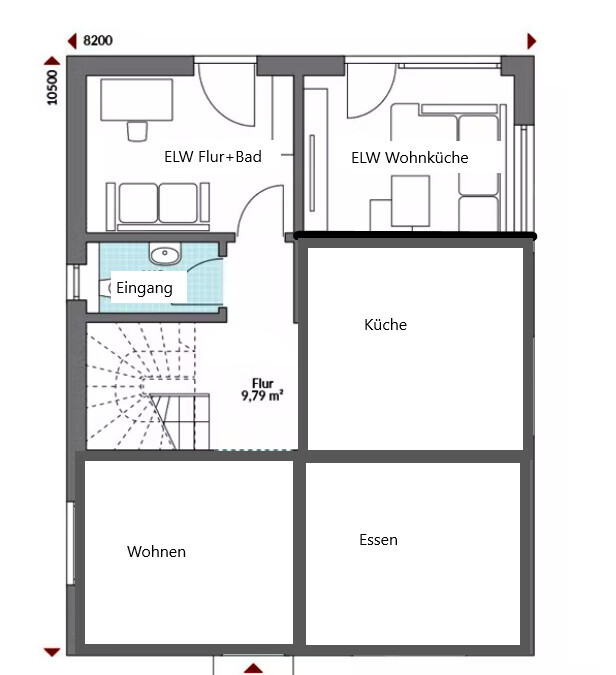
We were thinking of a combined living, kitchen, and sleeping niche of about 20m² (215 square feet), plus a bathroom and hallway. I consider having a partner very unlikely, but in case it happens, moving in together in the granny flat wouldn’t really be possible. That is already known...
The terrace location would be on the east side, meaning the front garden and the front part of the southern side; for the main living area, mainly the west side.
The 138.1 was mostly considered because of the volume, but I roughly sketched something out. Drawing it nicely on the computer will take a bit more time... Presumably, a bay window could be built in the northeast corner (top left), but there’s a tree in the top right corner...
The idea of a barrier-free secondary apartment suitable for care needs won’t fit into just two rooms.
Try searching for “zero-barrier tiny house.” The house has 16 sqm (172 sq ft); I don’t think having neither a proper bed nor bathroom works as a long-term solution. Although I have to admit, it’s impressive that it fits into such a small space. You might be able to implement some of the features or use them as inspiration.
A walker doesn’t require much less space than a wheelchair. Based on your requirement for “a hallway because of care,” I assume you’re planning for nursing services and significant physical impairments. You’ll need a bathroom where a second person can assist, space next to the bed, and so on.
Allkauf houses offer some solutions for single-family homes with an “older generation” section. You might find some ideas there.
It’s important that for every floor plan you consider, you draw in your existing and desired furniture to scale. The large dining table, in particular, takes up a lot of space. I wouldn’t plan a pantry on the ground floor. You have a basement.
Try searching for “zero-barrier tiny house.” The house has 16 sqm (172 sq ft); I don’t think having neither a proper bed nor bathroom works as a long-term solution. Although I have to admit, it’s impressive that it fits into such a small space. You might be able to implement some of the features or use them as inspiration.
A walker doesn’t require much less space than a wheelchair. Based on your requirement for “a hallway because of care,” I assume you’re planning for nursing services and significant physical impairments. You’ll need a bathroom where a second person can assist, space next to the bed, and so on.
Allkauf houses offer some solutions for single-family homes with an “older generation” section. You might find some ideas there.
It’s important that for every floor plan you consider, you draw in your existing and desired furniture to scale. The large dining table, in particular, takes up a lot of space. I wouldn’t plan a pantry on the ground floor. You have a basement.

Something seems off to me with the size specifications. A house with 61 sqm (660 sq ft) – does that even exist? That doesn’t seem right. Is there a missing 1 in front?
I actually think the budget is reasonable, but Hamburg is naturally a bit of a different story. I’m afraid you’ll probably have to add about 500 on top of the usual 3000 per sqm (278 per sq ft) just as a Hamburg premium. Then there’s the basement at living height and the roof peak – 800K (800,000) will definitely be tight. Demolition on top of that – I’d personally pull the emergency brake and say I don’t think that’s enough. But of course, we can’t know for sure. Everything is still in flux.
Not wanting to hire an architect when you’re so close to a million seems almost reckless to me. I also think you confuse more people than you clarify when you say you want to build 180 sqm (1,938 sq ft) but then mention a 138 sqm (1,485 sq ft) floor plan. But that’s just a side note.
Preserving the tree is very commendable. To take it a step further, I would try to increase the distance to the trunk drastically. They say the size of the canopy you see above corresponds roughly to the same size of the roots underground. A 2.5 m (8 ft) distance would probably kill the tree. So keep your distance! Honestly, a tree like that is worth gold, and if you have to choose between moving the house back and saving the tree or killing the tree, definitely choose the tree! We’re struggling to turn a former field into a garden. We lack big trees for shade. Wind and sun ruthlessly burn everything that tries to grow. Every new leaf is celebrated as a success. We would love to have your beech tree!
Otherwise, I would recommend having an architect create a design. You could then maybe hand the rest over to a general contractor. Common prefab house companies would probably be happy to offer something based on a design as well. But materials and personal rapport also play a role.
By the way: Just make sure you are allowed to share the sketches here, then we’ll gladly help you dissect them. 😉
I actually think the budget is reasonable, but Hamburg is naturally a bit of a different story. I’m afraid you’ll probably have to add about 500 on top of the usual 3000 per sqm (278 per sq ft) just as a Hamburg premium. Then there’s the basement at living height and the roof peak – 800K (800,000) will definitely be tight. Demolition on top of that – I’d personally pull the emergency brake and say I don’t think that’s enough. But of course, we can’t know for sure. Everything is still in flux.
Not wanting to hire an architect when you’re so close to a million seems almost reckless to me. I also think you confuse more people than you clarify when you say you want to build 180 sqm (1,938 sq ft) but then mention a 138 sqm (1,485 sq ft) floor plan. But that’s just a side note.
Preserving the tree is very commendable. To take it a step further, I would try to increase the distance to the trunk drastically. They say the size of the canopy you see above corresponds roughly to the same size of the roots underground. A 2.5 m (8 ft) distance would probably kill the tree. So keep your distance! Honestly, a tree like that is worth gold, and if you have to choose between moving the house back and saving the tree or killing the tree, definitely choose the tree! We’re struggling to turn a former field into a garden. We lack big trees for shade. Wind and sun ruthlessly burn everything that tries to grow. Every new leaf is celebrated as a success. We would love to have your beech tree!
Otherwise, I would recommend having an architect create a design. You could then maybe hand the rest over to a general contractor. Common prefab house companies would probably be happy to offer something based on a design as well. But materials and personal rapport also play a role.
By the way: Just make sure you are allowed to share the sketches here, then we’ll gladly help you dissect them. 😉
H
hanghaus202322 Feb 2023 19:22A prefabricated house comes to mind for this, for example: Junto 190 by FINGERHUT-HAUS
Similar topics