
ᐅ Adding an Additional Floor to a Bungalow-Style House – Increase the Roof Pitch?!
Created on: 9 Feb 2023 10:15
M
monty99Hello,
In 2016, we built a single-story L-shaped house in bungalow style (KFW70 standard). The house has about 170sqm (1830 sq ft) of living space living area, features a reinforced concrete ceiling, and the roof is a hipped roof structure with an extension made of engineered solid timber with a 30-degree pitch. The attic was originally intended only as a storage area, which was sufficient for that purpose.
Now we want to convert the attic into a living area, which was not planned initially. Unfortunately, the ceiling height is insufficient for this. We have considered solutions like a hydraulic roof lift (which is not an option for us) or a knee wall increase (currently there is no knee wall at all). However, both options seem unfeasible for practical reasons (structural concerns and probably cost issues).
Currently, there is a foldable attic ladder, but we already created a larger opening in the reinforced concrete ceiling for a proper staircase, which is now covered.
I asked about the possible knee wall increase in another thread, but it seems unlikely because the structural integrity and substructure are considered too risky.
We want to use the attic as additional living space within the next 1-2 years (for a child), but in the current state, the space is too small and too low. The usable area is now about 65sqm (700 sq ft) and should ideally be around 90-120sqm (970-1300 sq ft). (The total ground floor living space in the L-shaped house is about 170sqm (1830 sq ft).)
The question is whether it would be generally feasible to remodel the roof by increasing the pitch from the current 30 degrees to 45-55 degrees. This would allow us to add multiple windows (currently there is only one) and possibly install a photovoltaic system at the same time. One idea would be to use the longer "L-section" as living space and keep the shorter section mainly for storage. Although it might look odd to alter only the longer section and leave the shorter one unchanged.
The current brine heat pump has sufficient capacity to cover the needs. The neighboring houses all have roof pitches up to 55 degrees.
General opinions without detailed floor plans or calculations would be appreciated.
Thank you very much!
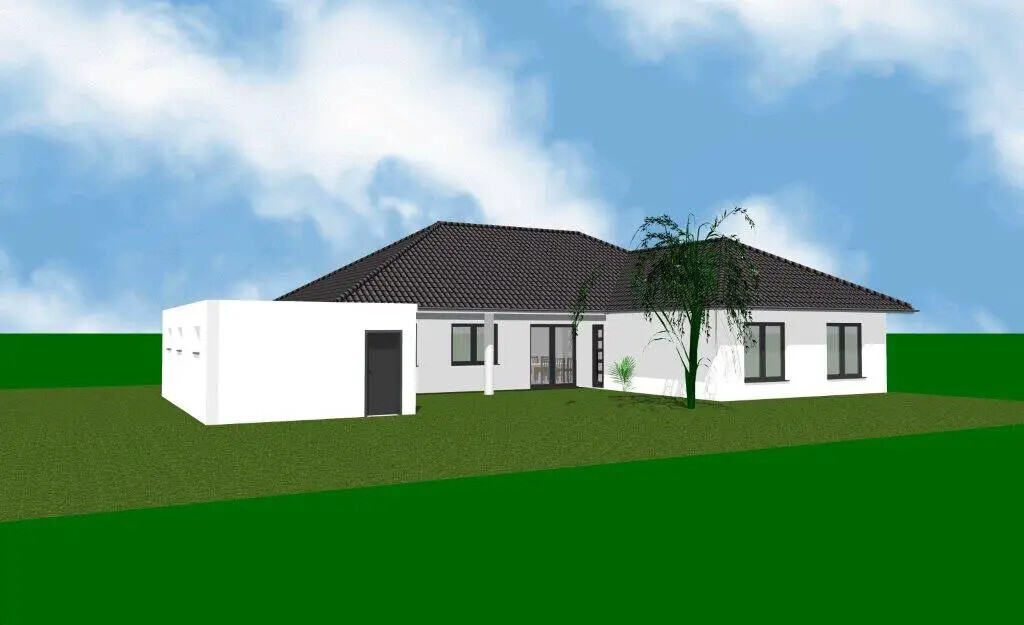
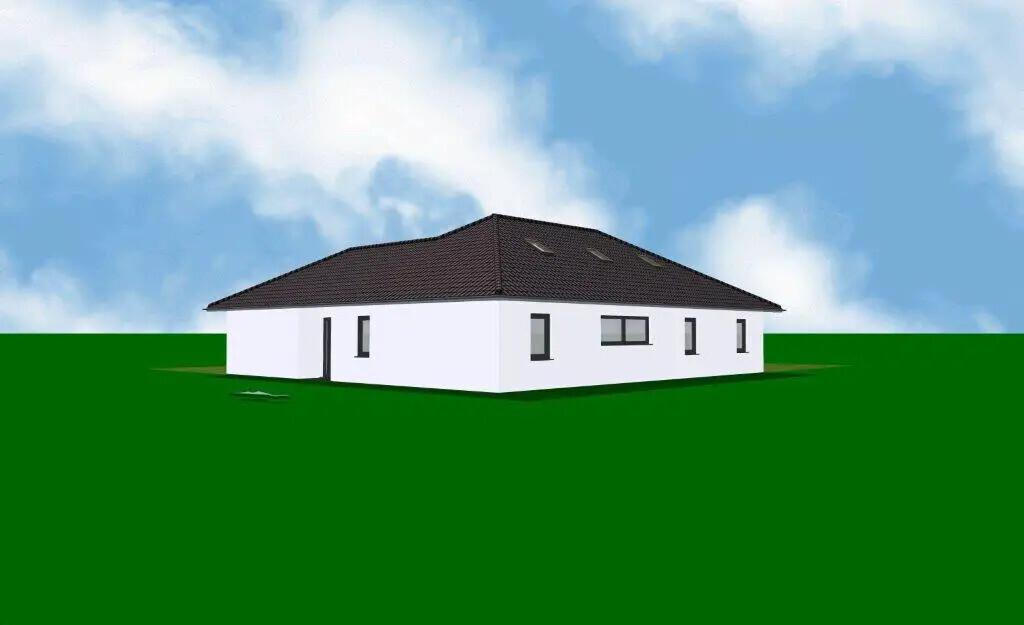
In 2016, we built a single-story L-shaped house in bungalow style (KFW70 standard). The house has about 170sqm (1830 sq ft) of living space living area, features a reinforced concrete ceiling, and the roof is a hipped roof structure with an extension made of engineered solid timber with a 30-degree pitch. The attic was originally intended only as a storage area, which was sufficient for that purpose.
Now we want to convert the attic into a living area, which was not planned initially. Unfortunately, the ceiling height is insufficient for this. We have considered solutions like a hydraulic roof lift (which is not an option for us) or a knee wall increase (currently there is no knee wall at all). However, both options seem unfeasible for practical reasons (structural concerns and probably cost issues).
Currently, there is a foldable attic ladder, but we already created a larger opening in the reinforced concrete ceiling for a proper staircase, which is now covered.
I asked about the possible knee wall increase in another thread, but it seems unlikely because the structural integrity and substructure are considered too risky.
We want to use the attic as additional living space within the next 1-2 years (for a child), but in the current state, the space is too small and too low. The usable area is now about 65sqm (700 sq ft) and should ideally be around 90-120sqm (970-1300 sq ft). (The total ground floor living space in the L-shaped house is about 170sqm (1830 sq ft).)
The question is whether it would be generally feasible to remodel the roof by increasing the pitch from the current 30 degrees to 45-55 degrees. This would allow us to add multiple windows (currently there is only one) and possibly install a photovoltaic system at the same time. One idea would be to use the longer "L-section" as living space and keep the shorter section mainly for storage. Although it might look odd to alter only the longer section and leave the shorter one unchanged.
The current brine heat pump has sufficient capacity to cover the needs. The neighboring houses all have roof pitches up to 55 degrees.
General opinions without detailed floor plans or calculations would be appreciated.
Thank you very much!
W
WilderSueden9 Feb 2023 10:48What is your current interior height up to the ridge beam? We also have a 30-degree pitch and decent ceiling heights in the middle of the attic. I can well imagine mostly keeping the existing roof, adding dormers, and closing off the lowest areas as knee walls.

I would
1. Have a structural engineer review the building documents, the strength of the foundations, and the load-bearing capacity of the bricks for the additional loads.
2. Consult a local carpenter or roofer, simply telling them that I want two rooms and a bathroom upstairs, and let the professional take the lead.
1. Have a structural engineer review the building documents, the strength of the foundations, and the load-bearing capacity of the bricks for the additional loads.
2. Consult a local carpenter or roofer, simply telling them that I want two rooms and a bathroom upstairs, and let the professional take the lead.
WilderSueden schrieb:
What is your current interior height up to the ridge beam? We also have a 30-degree roof pitch and decent headroom in the middle of the attic. I can well imagine largely keeping the roof as it is, adding dormers, and enclosing the lowest parts as knee walls. In the middle of the long L-shaped section, the height is currently about 2.2m (7 ft 3 in). At the moment, there is only insulation laid on the reinforced concrete slab, with OSB boards on top.
If we build a proper floor structure with underfloor heating there, we will lose height again.
Overall, the usable space will remain quite limited.
Nida35a schrieb:
PS:
3. Check the zoning plan or building permit / planning permission to see if you are allowed to add height.
Small rooms don’t necessarily have to result from this, since it’s timber framing and there is enough space.
Be open to solutions; the house will look different.Yes, that’s correct. Of course, we need to sort out all the official matters, including the structural engineer, etc.We are aware that the appearance of the house will change. You can’t have one thing without accepting the other.
Similar topics