
ᐅ Suggestions for Floor Plan Improvements for a Single-Family House on a South-Facing Slope
Created on: 5 Feb 2023 20:02
I
Indahaus
Hello everyone,
after purchasing the plot in February last year, which was fully serviced by the end of last year, we have been gathering inspiration and planning ever since. Despite rising costs and interest rates, we are excited about building our house, including some DIY work.
Development Plan / Restrictions
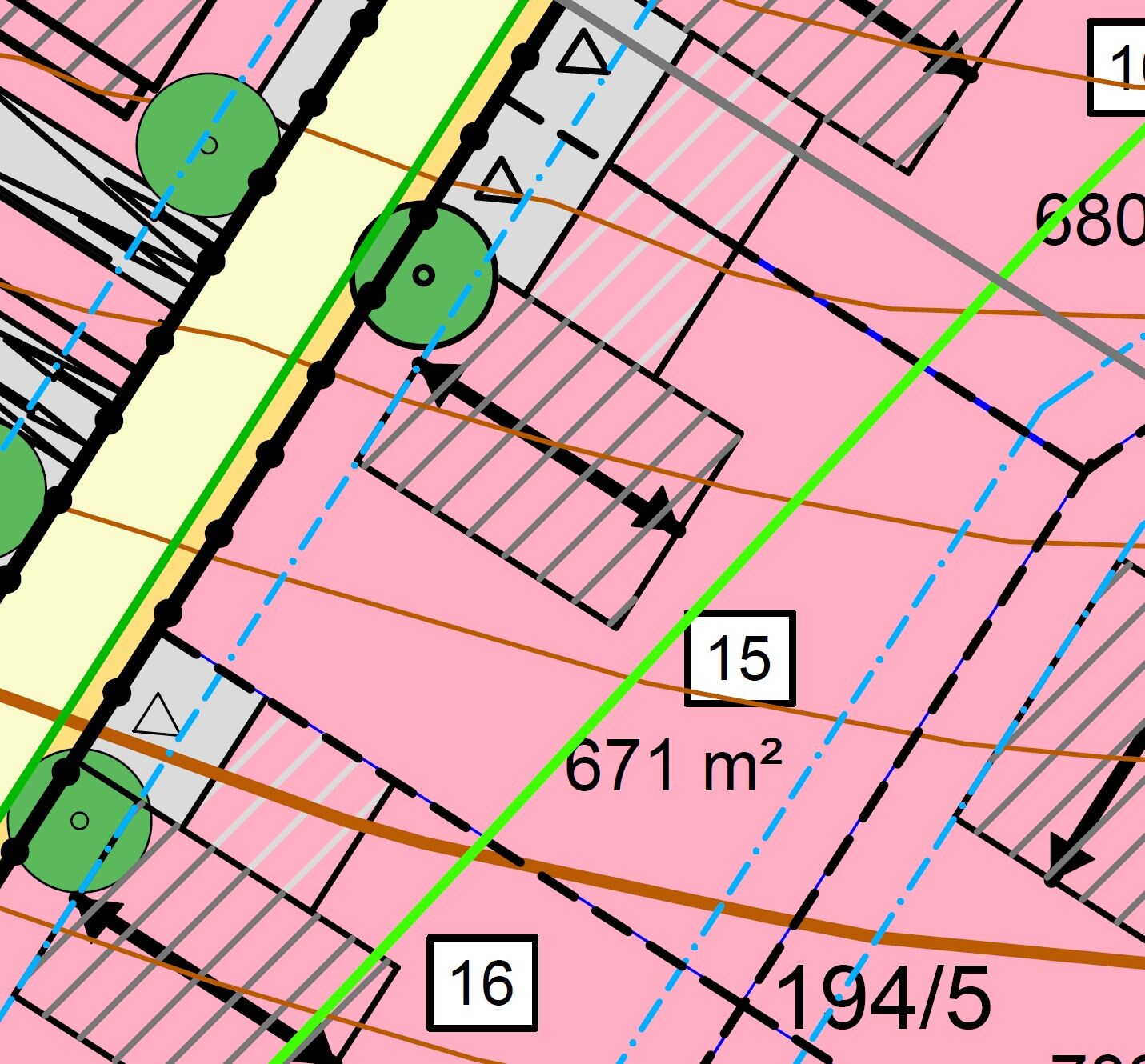
Plot size: 669 m² (7200 sq ft approx.)
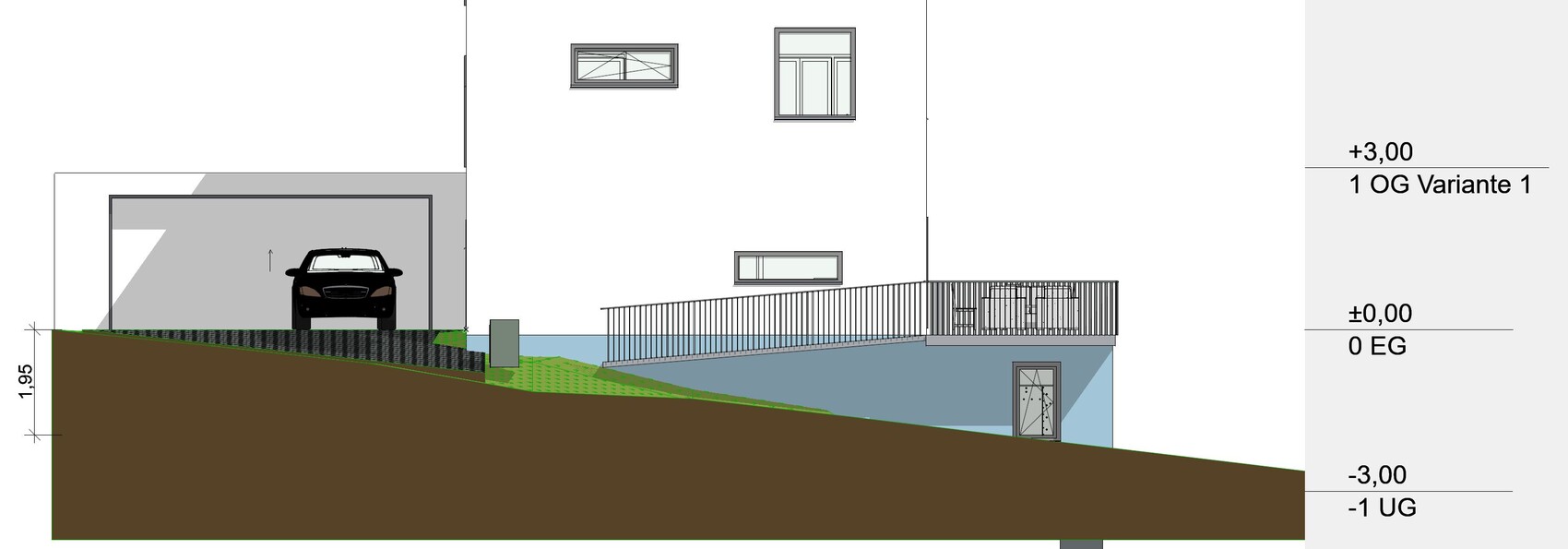
Slope: South-facing slope, 3.90 m (12.8 ft) diagonal (approx. 7.3° incline at the street side)
Site occupancy index: 0.4
Floor area ratio: 0.7
Building window, building line and boundary: 3 meters (10 ft) or setback areas
Edge development: garage
Number of parking spaces: two per dwelling unit in front of garages, minimum 5 meters (16 ft)
Number of stories: 3 full stories (basement, ground floor, upper floor)
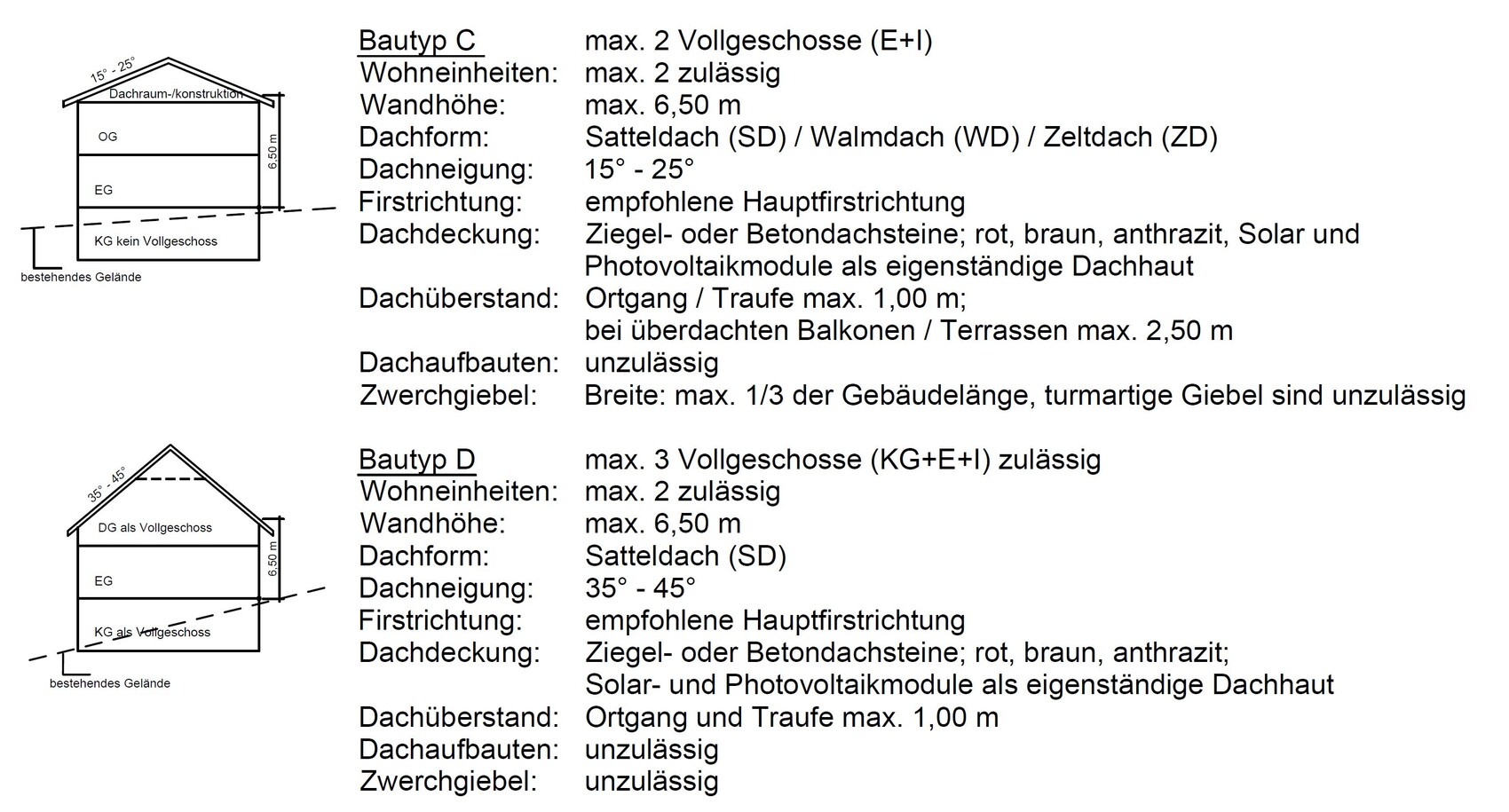
Roof style: gable roof with 35° to 45° pitch (if basement is not a full floor, then 15° to 25°)
Architectural style
Orientation: see draft sketch
Maximum heights / limits: wall height 6.50 m (21.3 ft) measured from finished floor level of the ground floor to the junction of wall and exterior roof surface
Additional requirements: garage roof as flat roof with green roofing, at least 40% photovoltaic panels
Homeowners’ Requirements
Style, roof type, building type: no decision yet on wood or masonry (affordable ecological)
Basement, floors: 2 plus basement suitable as living space
Number of occupants, age: 2 persons, both 26 years old
Space requirements on ground and upper floors: see draft sketch
Office: family use or home office? home office
Overnight guests per year: few
Open or closed architecture: rather open
Conservative or modern design: rather modern
Open kitchen, kitchen island: both desired
Number of dining seats: 8, preferably extendable
Fireplace: would be nice but too expensive
Music/Stereo wall: no
Balcony, roof terrace: roof terrace on garage for drying laundry, terrace, balcony-like at living/dining/kitchen area but with garden access
Garage, carport: double garage (possibly added later)
Utility garden, greenhouse: yes (greenhouse not planned at least for now)
Further wishes / special features / daily routine, please also reasons for inclusion or exclusion
House Design
Source of planning: do-it-yourself
What do you particularly like? Why? no bay windows, no spiral stairs, enough space in entrance area, access garage-house in entrance area, access garage roof/laundry room on the upper floor, level access to ground floor on north side and basement on south side, sight lines
What don’t you like? Why? staircase not located near living area, small main bathroom
Cost estimate according to architect/planner: not obtained yet
Personal price limit for house including fittings:
Preferred heating system: heat pump (underfloor heating possibly combined with cooled ceiling)
If you had to give up something, on which details/extensions
-you can give up: efficient sqm (unused areas), basement under garage or terrace
-you cannot give up: basement with large hobby workshop
Why is the design as it is now? For example:
Standard design from planner? No
Which wishes from the architect were implemented? No architect, we tried to implement our wishes ourselves on a compact footprint without feeling cramped
What makes it, in your view, particularly good or bad?
What is the most important/fundamental question about the floor plan in 130 characters?
Do you have any suggestions for improvement? What would bother you? Any tips on doing things similarly but more cost-effectively?
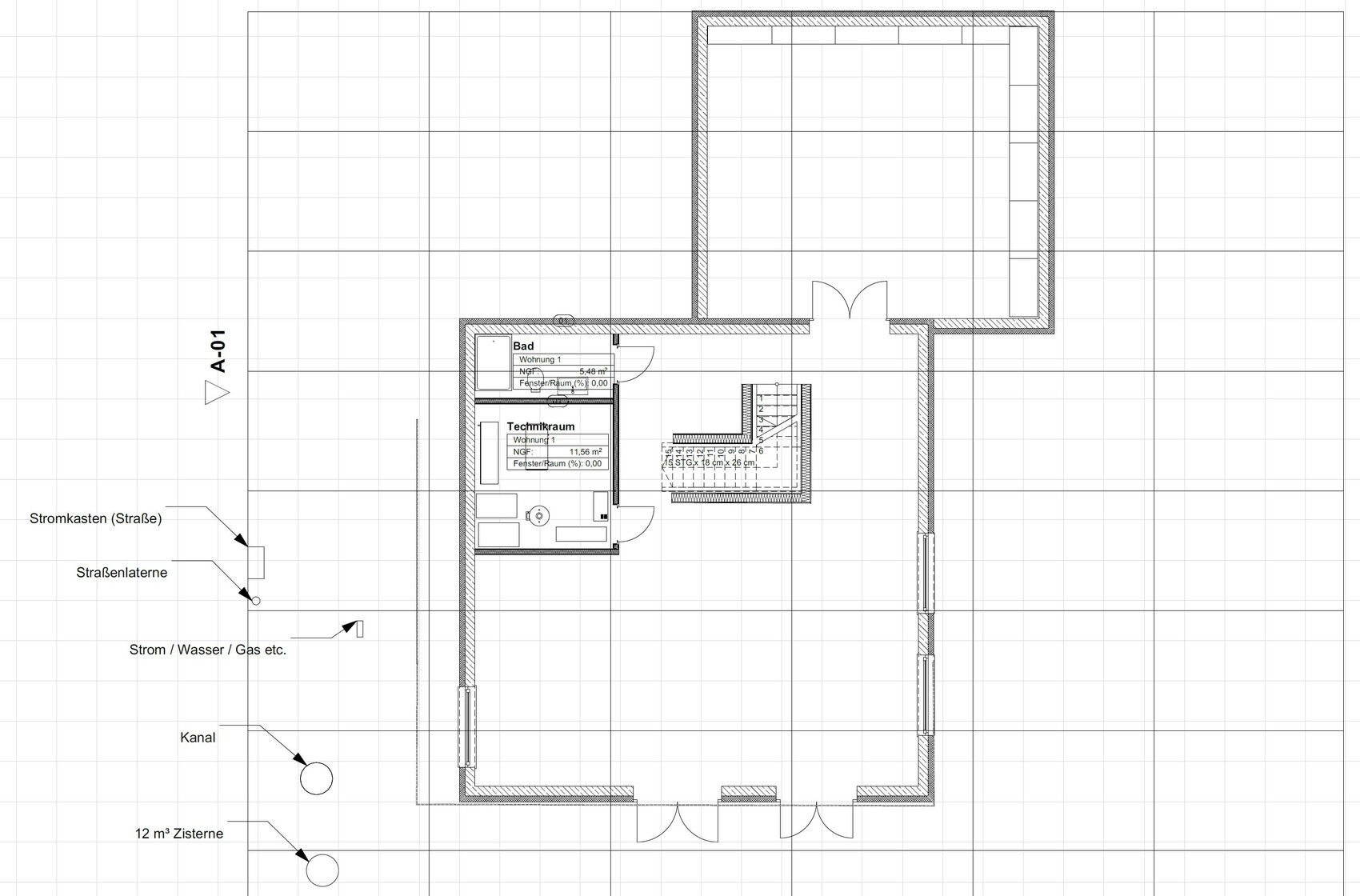
The basement plan is not finalized yet. In addition to utility rooms, storage, possibly a bathroom (for quick cleaning and a potential future granny flat), a space-intensive hobby needs to be accommodated here. We are considering adding a basement under the garage or terrace or both. If you have any preliminary tips or rough cost estimates, please share.
If you need further information, just ask.
Thank you all!
Indahaus

after purchasing the plot in February last year, which was fully serviced by the end of last year, we have been gathering inspiration and planning ever since. Despite rising costs and interest rates, we are excited about building our house, including some DIY work.
Development Plan / Restrictions
Plot size: 669 m² (7200 sq ft approx.)
Slope: South-facing slope, 3.90 m (12.8 ft) diagonal (approx. 7.3° incline at the street side)
Site occupancy index: 0.4
Floor area ratio: 0.7
Building window, building line and boundary: 3 meters (10 ft) or setback areas
Edge development: garage
Number of parking spaces: two per dwelling unit in front of garages, minimum 5 meters (16 ft)
Number of stories: 3 full stories (basement, ground floor, upper floor)
Roof style: gable roof with 35° to 45° pitch (if basement is not a full floor, then 15° to 25°)
Architectural style
Orientation: see draft sketch
Maximum heights / limits: wall height 6.50 m (21.3 ft) measured from finished floor level of the ground floor to the junction of wall and exterior roof surface
Additional requirements: garage roof as flat roof with green roofing, at least 40% photovoltaic panels
Homeowners’ Requirements
Style, roof type, building type: no decision yet on wood or masonry (affordable ecological)
Basement, floors: 2 plus basement suitable as living space
Number of occupants, age: 2 persons, both 26 years old
Space requirements on ground and upper floors: see draft sketch
Office: family use or home office? home office
Overnight guests per year: few
Open or closed architecture: rather open
Conservative or modern design: rather modern
Open kitchen, kitchen island: both desired
Number of dining seats: 8, preferably extendable
Fireplace: would be nice but too expensive
Music/Stereo wall: no
Balcony, roof terrace: roof terrace on garage for drying laundry, terrace, balcony-like at living/dining/kitchen area but with garden access
Garage, carport: double garage (possibly added later)
Utility garden, greenhouse: yes (greenhouse not planned at least for now)
Further wishes / special features / daily routine, please also reasons for inclusion or exclusion
House Design
Source of planning: do-it-yourself
What do you particularly like? Why? no bay windows, no spiral stairs, enough space in entrance area, access garage-house in entrance area, access garage roof/laundry room on the upper floor, level access to ground floor on north side and basement on south side, sight lines
What don’t you like? Why? staircase not located near living area, small main bathroom
Cost estimate according to architect/planner: not obtained yet
Personal price limit for house including fittings:
Preferred heating system: heat pump (underfloor heating possibly combined with cooled ceiling)
If you had to give up something, on which details/extensions
-you can give up: efficient sqm (unused areas), basement under garage or terrace
-you cannot give up: basement with large hobby workshop
Why is the design as it is now? For example:
Standard design from planner? No
Which wishes from the architect were implemented? No architect, we tried to implement our wishes ourselves on a compact footprint without feeling cramped
What makes it, in your view, particularly good or bad?
What is the most important/fundamental question about the floor plan in 130 characters?
Do you have any suggestions for improvement? What would bother you? Any tips on doing things similarly but more cost-effectively?
The basement plan is not finalized yet. In addition to utility rooms, storage, possibly a bathroom (for quick cleaning and a potential future granny flat), a space-intensive hobby needs to be accommodated here. We are considering adding a basement under the garage or terrace or both. If you have any preliminary tips or rough cost estimates, please share.
If you need further information, just ask.
Thank you all!
Indahaus
H
hanghaus20236 Feb 2023 13:17This is how I imagined it. Cross-section west finished floor approximately 60 cm (24 inches) lower
Ground floor gravel with at least 3 steps towards the east

Ground floor gravel with at least 3 steps towards the east
Indahaus schrieb:
The planning software suggests a total length of 2.4 m (7 ft 10.5 in) for 8 seats (see image). Planning software is a tool you should master like a craftsman. If the software plays a trick on you, you need to notice it.
Indahaus schrieb:
Also, the entrance area is not so cramped because of its shape, The problem with the staircase is its location: it splits the house area into two narrow parts, making it difficult to create pleasant room layouts…
Indahaus schrieb:
Basically, we tried to plan as barrier-reduced as possible given the space conditions. … which means I actually did not apply the term “barrier-reduced” properly in this design. I’m not even starting with _barrier-free_ 1-meter (3 ft 3 in) wide doors, but with all your narrow spots: if a piece of furniture is placed anywhere, you won’t be able to pass through with a sporty wheelchair or other walking aid (cane) without getting stuck. Ground floor bathroom: not accessible, office requires backing out, which leads to collisions with others coming from either the garage or upstairs. Sofa: inaccessible when someone is sitting at the dining table. Kitchen island: impossible to walk around, pantry also requires backing out.
For barrier-reduced living, a staircase with a lift can be used. That can also be a normally rotated staircase. What matters is space… area… which should be available everywhere to move freely without bumping into corners or having to avoid another resident.
Indahaus schrieb:
Besides the doors, the staircase is one of the biggest barriers in the house for us and therefore should have a straight walking surface whenever possible. Indahaus schrieb:
The question is, what would be the alternative for the required space in the basement? Repeated: larger floor area and then basement/tool storage room.
Required space is relative! If the budget does not allow it, you have to consider what is really needed.

Indahaus schrieb:
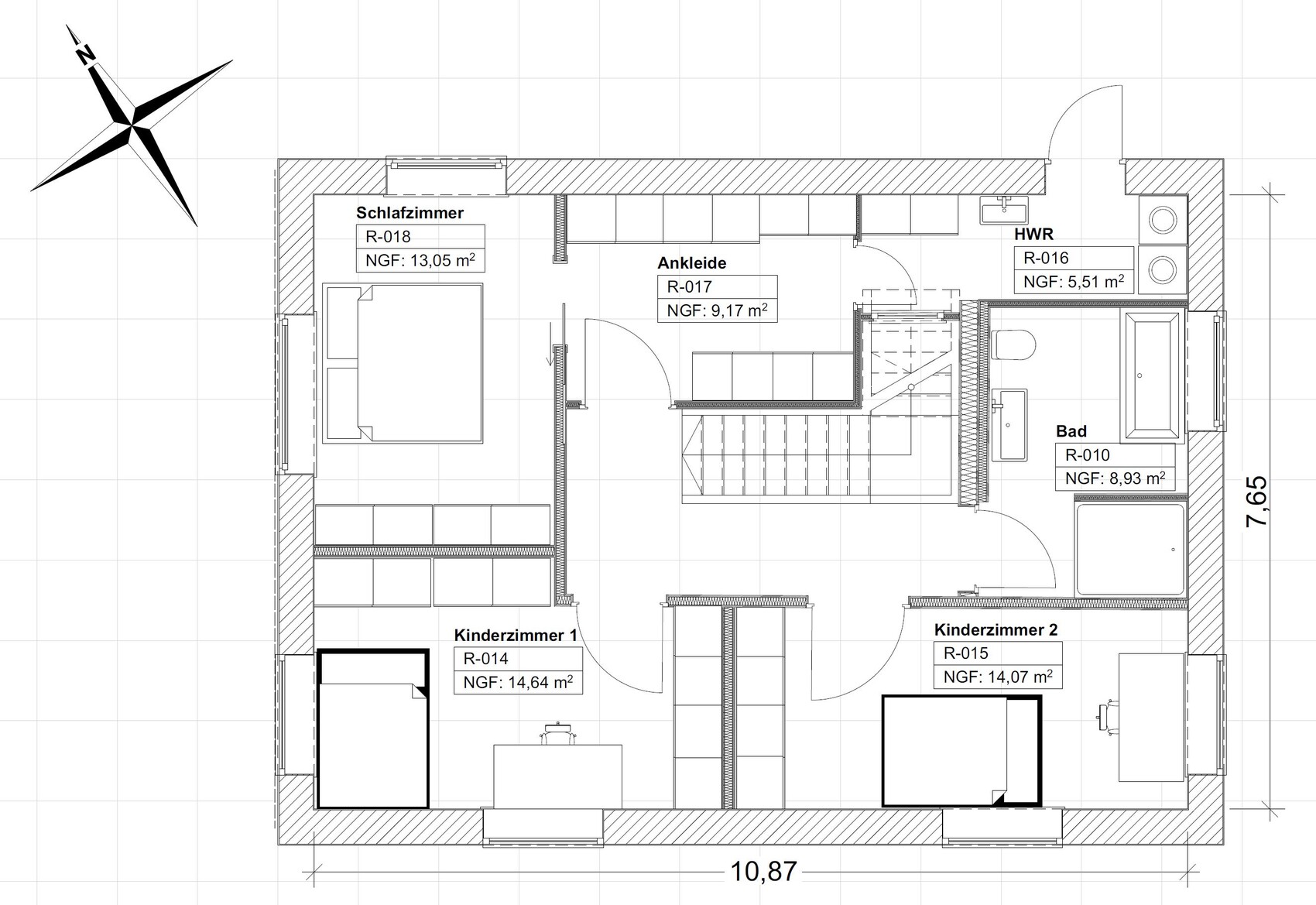
If you think the children's rooms are too narrow and elongated, what room proportions would you recommend? What is the minimum depth?
Unfortunately, there are no dimensions provided, so it’s difficult to assess. Here are some standard sizes I usually use as common "new build" measurements:
- Living room 4 m x 4 m (13 ft x 13 ft)
- Children's rooms at least 3 m (10 ft) deep on each side and a minimum of 12 sqm (130 sq ft)
- Dining area at least 3.5 m (11.5 ft) deep and depending on seating capacity, also 4 m (13 ft) long
I don’t think the design is that bad. With some adjustments, it could probably be worked out. What I don’t see at all, though, is the huge basement reaching all the way to the garage on this budget. That’s why, in my opinion, the discussion about the floor plan is irrelevant.

The excerpt from the development plan mostly shows only your plot, which is not sufficient as a basis for meaningful advice. First, clarify your budget, and then consult an architect. By the way, the classification as a full storey has nothing to do with whether you finish the basement as living space – it solely depends on how much it protrudes from the original terrain.
In my opinion, there is nothing to improve here, as your planning skills prevent you from creating a sufficiently suitable foundation. Architectural fees (for full support through service phases 1 to 8) will cost you less than one-third of the additional expenses you would incur with self-planning, despite compromises involving narrow spaces, oversized elements, terrain modeling costs, and similar factors. Being young does not mean you can consistently put in full effort for your own work. Also, forget the idea that a friend will operate all the excavation equipment for a few Saturdays in exchange for a case of beer. Expect to spend painfully hard cash, as nothing comes free—even on a moderate slope. It is better to approach the architect with a wish list rather than detailed drawings, as there is absolutely no discount for such supposed "preparatory work."
A reading recommendation from someone who has gone through similar planning challenges (including a terrace above a protruding basement) would be https://www.hausbau-forum.de/threads/entwurf-grundriss-efh-als-zfh-im-alter-moeglich-in-hanglage.38691/
https://www.instagram.com/11antgmxde/
https://www.linkedin.com/company/bauen-jetzt/
In my opinion, there is nothing to improve here, as your planning skills prevent you from creating a sufficiently suitable foundation. Architectural fees (for full support through service phases 1 to 8) will cost you less than one-third of the additional expenses you would incur with self-planning, despite compromises involving narrow spaces, oversized elements, terrain modeling costs, and similar factors. Being young does not mean you can consistently put in full effort for your own work. Also, forget the idea that a friend will operate all the excavation equipment for a few Saturdays in exchange for a case of beer. Expect to spend painfully hard cash, as nothing comes free—even on a moderate slope. It is better to approach the architect with a wish list rather than detailed drawings, as there is absolutely no discount for such supposed "preparatory work."
A reading recommendation from someone who has gone through similar planning challenges (including a terrace above a protruding basement) would be https://www.hausbau-forum.de/threads/entwurf-grundriss-efh-als-zfh-im-alter-moeglich-in-hanglage.38691/
https://www.instagram.com/11antgmxde/
https://www.linkedin.com/company/bauen-jetzt/
ypg schrieb:
If the software plays a trick on you, you should notice it. First, I want to clarify that we are not professionals regarding the software; we planned everything ourselves, so please forgive any such mistakes. We do appreciate such feedback.
However, I don’t find the size that unreasonable. Of course, the software uses average values, meaning a person weighing 150 kg (330 lbs) might feel a bit cramped, but that is acceptable to us. In everyday use, likely only 4–6 chairs will be needed. It is still possible to set up all 8 chairs if desired.
ypg schrieb:
The problem with the staircase is its location: it divides the floor area into two narrow parts, making attractive room layouts difficult… Where would be a better location for one of the mentioned staircase options given the current layout with a basement, ground floor, and upper floor?
ypg schrieb:
You have to exit the office by walking backwards, which creates conflicts with another resident coming either from the garage or upstairs. I think such situations are quite common even in supposedly accessible buildings, as the likelihood of such occurrences is generally considered low.
I have indeed looked into maneuvering space requirements for accessible design, but it should be clear that with the current floor area, you cannot apply the same clearances as those found in public buildings. Basically, I consider the rules for public buildings sensible and, in some cases, useful to apply to private homes as well. However, in this respect, the available space in public buildings is, of course, significantly larger. Doors, unlike furniture, can only be altered with considerable effort. Therefore, adapting to changed needs can be done much more easily by rearranging furniture. That is at least our view.
If someone uses a wheelchair, they will not manage with the current kitchen layout anyway, because the work surfaces are far too high. Therefore, we have marked a distance that fits us but is still not very small:
97.5 cm (38.4 inches) at the northern passage, 72 cm (28.3 inches) at the southern passage.
1.22 meters (48 inches) clearance between the kitchen island and the kitchen wall on the west side.
K a t j a schrieb:
Unfortunately, no measurements are provided, so it’s hard to assess. Here are some standard dimensions I use as typical "new build" sizes:
- Living room 4m x 4m
- Children’s rooms at least 3m (10 feet) deep on each side and a minimum of 12 sqm (129 sq ft)
- Dining area at least 3.5m (11.5 feet) deep and depending on seating also 4m (13 feet) long Dining area: 3.5m (11.5 feet) depth given, length 2.6m (8.5 feet)
Living room: about 3.5m x 3.5m (11.5 feet x 11.5 feet) is also not too far off from that.
I have attached a picture with the children’s room measurements; the depth is about 2.5m (8 feet).
K a t j a schrieb:
I don’t think the design is that bad at all. At least that much.
K a t j a schrieb:
Huge basement space up to the garage with this budget. Cutbacks can definitely still be planned there, but as mentioned before, having no basement at all is definitely not our goal.
A room depth of 2.50 m (8.2 feet) is too shallow for a living space like a children’s room. You can clearly notice that the closet doors next to the bed no longer open properly, let alone having space to stand in front of them.
Also, keep in mind that you’re building a house for 650K, which doesn’t even meet common standards. That’s quite frustrating.
As I mentioned before, here’s my advice: build larger with a basement and a ground floor. In my opinion, that’s much nicer anyway. Along with the garage, this provides a lot more useful living space.
Also, keep in mind that you’re building a house for 650K, which doesn’t even meet common standards. That’s quite frustrating.
As I mentioned before, here’s my advice: build larger with a basement and a ground floor. In my opinion, that’s much nicer anyway. Along with the garage, this provides a lot more useful living space.
Similar topics