
W
Waldbewohner31 Jan 2023 20:09Hello everyone,
Here is the shown basement floor plan. White tank waterproofing.
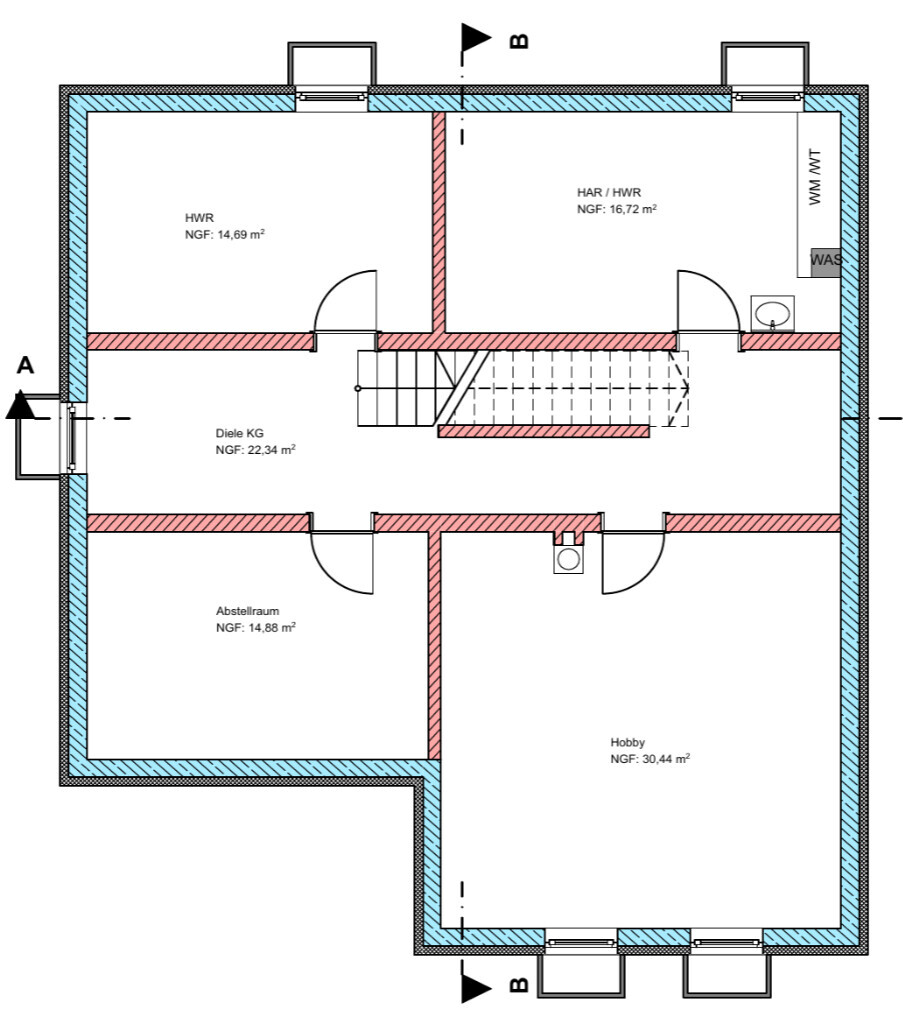
We are currently gathering offers for the shell construction (not a general contractor) and are still in the early planning phase, so nothing is set in stone yet. A specific KfW energy efficiency class is not planned due to lack of funding.
Heating will probably be done with an air-to-water heat pump. Only the hobby room in the basement will have underfloor heating.
One of the shell builders plans no insulation under the basement floor, while another proposes 12 cm (5 inches) of perimeter insulation.
A screed installer we contacted also prefers no insulation (for whatever reason).
It’s not really a big deal; the insulation shouldn’t blow the budget now.
I’m just a bit surprised that in 2023 some basements are still being built without insulation. Of course, heat rises and the ground maintains a more or less constant temperature. But still, does insulation really make so little difference?
Well, especially because of the underfloor heating in the hobby room, insulation should be mandatory anyway—I don’t want to be heating the ground.
What do you think?
Here is the shown basement floor plan. White tank waterproofing.
We are currently gathering offers for the shell construction (not a general contractor) and are still in the early planning phase, so nothing is set in stone yet. A specific KfW energy efficiency class is not planned due to lack of funding.
Heating will probably be done with an air-to-water heat pump. Only the hobby room in the basement will have underfloor heating.
One of the shell builders plans no insulation under the basement floor, while another proposes 12 cm (5 inches) of perimeter insulation.
A screed installer we contacted also prefers no insulation (for whatever reason).
It’s not really a big deal; the insulation shouldn’t blow the budget now.
I’m just a bit surprised that in 2023 some basements are still being built without insulation. Of course, heat rises and the ground maintains a more or less constant temperature. But still, does insulation really make so little difference?
Well, especially because of the underfloor heating in the hobby room, insulation should be mandatory anyway—I don’t want to be heating the ground.
What do you think?
A
Allthewayup31 Jan 2023 21:23Opinions differ widely on this topic. If you are planning the basement purely as a utility space and are not applying for any subsidies, I would suggest calculating the actual extra costs involved. It’s not just the insulation boards but also the additional excavation material and possible disposal fees. We have a guest room with a correspondingly large window and underfloor heating, which is why we decided to insulate. I also recall that the prices for XPS boards noticeably increased when we installed them.
As a side note, if I were you, I would focus more on the technical details of a waterproof concrete shell (known as a “white tank”) and what you absolutely need to watch out for, especially regarding your tender and obtaining quotes. Browsing this forum, you’ll find some truly concerning reports. I certainly have my own experience to share when it comes to our basement…
As a side note, if I were you, I would focus more on the technical details of a waterproof concrete shell (known as a “white tank”) and what you absolutely need to watch out for, especially regarding your tender and obtaining quotes. Browsing this forum, you’ll find some truly concerning reports. I certainly have my own experience to share when it comes to our basement…
There are few areas where you can have a significantly greater impact on the overall energy balance with comparatively little money. At the same time, there are few areas where retrofitting later would be more difficult. In other words: do it. As thick as possible / affordable.
Also consider using the floor slab itself as a heat or cold storage (BKA or thermal slab). With relatively little effort, you can make your heat pump even more efficient and only need to forgo underfloor heating in certain areas. It is also conceivable to completely omit screed in the basement.
Of course, this only makes sense if the perimeter insulation is installed without any gaps and properly connected to the exterior insulation.
Also consider using the floor slab itself as a heat or cold storage (BKA or thermal slab). With relatively little effort, you can make your heat pump even more efficient and only need to forgo underfloor heating in certain areas. It is also conceivable to completely omit screed in the basement.
Of course, this only makes sense if the perimeter insulation is installed without any gaps and properly connected to the exterior insulation.
W
Waldbewohner1 Feb 2023 10:11Harakiri schrieb:
There are few areas where you can still achieve a significant impact on the overall energy balance with relatively little money. At the same time, there are few areas where retrofitting later would be more difficult. That is a valid argument.
A decision here is more or less final, of course.
It’s about approximately €4,500 for the insulation. That should be feasible.
Allthewayup schrieb:
But just as a side note, if I were you, I would focus on the technical details of a waterproof concrete basement (white tank) and what you absolutely need to pay attention to, especially regarding your tender and obtaining quotes. If you browse the forum, you will find some really concerning reports. I can already tell you my own story about our basement… Oh dear, please do share ;-).
What went wrong for you? Have you written anything about it here on the forum?
A
Allthewayup1 Feb 2023 12:45I deliberately avoided discussing the details in the forum because negotiations on options are still ongoing. You never know who might be reading. ;-)
Regarding the cellar construction with a waterproof concrete shell, I like to point out the challenges of this method as a precaution, to prevent anyone from unknowingly running into serious problems. Unfortunately, this happens far too often in practice.
Based on your question, I simply assumed there is no in-depth knowledge about waterproof concrete shells. Please feel free to correct me if that’s not the case :-)
I fully agree with what the colleague said, that this is an “upgrade” you can’t retrofit later. The question is whether it is necessary for the overall energy balance of the house and the energy targets you aim to achieve. In our primary energy demand calculation, we did not need floor slab insulation to meet the goal thanks to the very good performance of the bricks, windows, front door, and insulated cellar walls. We chose it mainly for future-oriented reasons (who knows what will be standard in 30 years) and as a potential selling point. I believe the total cost, including additional excavation, transportation, landfill, and XPS insulation boards plus installation, was around 6,500 (units). I don’t think we will recover that through energy savings over 30 years, but that was never our main criterion. If cost is also a secondary consideration for you, I wouldn’t hesitate and would go for it.
Regarding the cellar construction with a waterproof concrete shell, I like to point out the challenges of this method as a precaution, to prevent anyone from unknowingly running into serious problems. Unfortunately, this happens far too often in practice.
Based on your question, I simply assumed there is no in-depth knowledge about waterproof concrete shells. Please feel free to correct me if that’s not the case :-)
I fully agree with what the colleague said, that this is an “upgrade” you can’t retrofit later. The question is whether it is necessary for the overall energy balance of the house and the energy targets you aim to achieve. In our primary energy demand calculation, we did not need floor slab insulation to meet the goal thanks to the very good performance of the bricks, windows, front door, and insulated cellar walls. We chose it mainly for future-oriented reasons (who knows what will be standard in 30 years) and as a potential selling point. I believe the total cost, including additional excavation, transportation, landfill, and XPS insulation boards plus installation, was around 6,500 (units). I don’t think we will recover that through energy savings over 30 years, but that was never our main criterion. If cost is also a secondary consideration for you, I wouldn’t hesitate and would go for it.
W
Waldbewohner1 Feb 2023 17:09The costs wouldn’t bankrupt us, but I wouldn’t want to do it just for fun either. The resale value was basically the argument from the structural shell contractor, and from an energy efficiency perspective, he also doesn’t consider it that important.
I’m just not sure about the heated floor in the hobby room. After all, you don’t necessarily have to actively heat the ground. ;-)
Regarding the watertight concrete basement:
Well, of course I’ve done some research and understand why it’s needed and how it’s done, but that doesn’t make me an expert. So if you want, feel free to educate me.
I do believe the structural shell contractors we asked have experience and won’t cut corners deliberately.
Most people build here with watertight concrete basements, and these are established family businesses—you know each other.
I’m just not sure about the heated floor in the hobby room. After all, you don’t necessarily have to actively heat the ground. ;-)
Regarding the watertight concrete basement:
Well, of course I’ve done some research and understand why it’s needed and how it’s done, but that doesn’t make me an expert. So if you want, feel free to educate me.
I do believe the structural shell contractors we asked have experience and won’t cut corners deliberately.
Most people build here with watertight concrete basements, and these are established family businesses—you know each other.
Similar topics