
ᐅ Insufficient concrete cover in basement "white tank" construction
Created on: 27 Jan 2023 19:51
D
domino55Hello everyone,
The structural shell contractor agreed to build a basement using cast-in-place concrete. According to the reinforcement plan from the structural engineer, it concerns a “white tank” (watertight concrete structure). The reinforcement plan specifies the following concrete cover:
Reinforced concrete walls at the base area:
On the east side, a minimum cover of 16 mm (0.63 inches), on the west side 14 mm (0.55 inches), and on the south side 7 mm (0.28 inches) was found.
The basement walls will be insulated with 12 cm (4.7 inches) XPS insulation.
The contractor offers the following remedial measures:
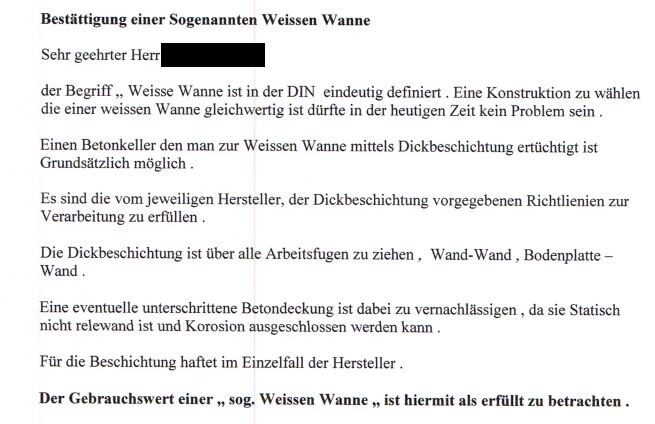
The structural contractor obtained the following letter from their own structural engineer, recommending reactive waterproofing:
Is what the structural engineer states correct?
Best regards
The structural shell contractor agreed to build a basement using cast-in-place concrete. According to the reinforcement plan from the structural engineer, it concerns a “white tank” (watertight concrete structure). The reinforcement plan specifies the following concrete cover:
- Base slab: 4.0 cm (1.6 inches)
- Basement walls: 3.5 cm (1.4 inches)
Reinforced concrete walls at the base area:
On the east side, a minimum cover of 16 mm (0.63 inches), on the west side 14 mm (0.55 inches), and on the south side 7 mm (0.28 inches) was found.
The basement walls will be insulated with 12 cm (4.7 inches) XPS insulation.
The contractor offers the following remedial measures:
- Reactive waterproofing
- Epoxy resin
- Shotcrete
The structural contractor obtained the following letter from their own structural engineer, recommending reactive waterproofing:
| Confirmation of a So-Called White Tank Dear Mr. XXXXX, The term “white tank” is clearly defined in the DIN standard. Choosing a construction equivalent to a white tank should not pose a problem nowadays. In principle, it is possible to waterproof a concrete basement as a white tank by means of a thick coating. The processing guidelines specified by the respective manufacturer of the thick coating must be followed. The thick coating must be applied over all construction joints: wall-to-wall and base slab-to-wall. Any insufficient concrete cover can be disregarded since it is not structurally relevant and corrosion can be excluded. The manufacturer is solely responsible for the coating’s performance in each individual case. The serviceability of a “so-called white tank” can hereby be considered fulfilled. |
Is what the structural engineer states correct?
Best regards
A
Allthewayup27 Jan 2023 20:24One thing upfront: a plastic-modified thick coating (black tank) is not equivalent to a white tank. There are already relevant court rulings on this matter. In my opinion, this statement is an attempt to refute.
What exactly was contractually agreed upon regarding the basement? Specifically, which concrete was ultimately used? Is there a geotechnical report? What load scenario is present in the ground?
What exactly was contractually agreed upon regarding the basement? Specifically, which concrete was ultimately used? Is there a geotechnical report? What load scenario is present in the ground?
According to the execution plan and reinforcement plan, it concerns a "white tank" waterproofing method without further specification.
Concrete
Exposure classes: XC4, XF1, XA1
Moisture class: WA
Strength classes: C 25/30
According to the geotechnical report, the groundwater is only found 19 m (62 feet) below the surface. However, this is not correct :-(
The soil is clayey and has very poor water permeability. In the excavation pit, layered water or seepage water accumulates.
Concrete
Exposure classes: XC4, XF1, XA1
Moisture class: WA
Strength classes: C 25/30
According to the geotechnical report, the groundwater is only found 19 m (62 feet) below the surface. However, this is not correct :-(
The soil is clayey and has very poor water permeability. In the excavation pit, layered water or seepage water accumulates.
A
Allthewayup27 Jan 2023 20:59A proper waterproof concrete structure involves a lot more details, which I won’t list here. Let’s go back to your geotechnical report. I’m quite surprised that groundwater was found at 19m (62 feet). I remember the dynamic cone penetration test going down to a maximum of 7m (23 feet). What were they looking for at that depth, oil? Never mind.
What does the geotechnical report say about waterproofing of below-ground elements, such as the basement? There must be something like: “cohesive soil, therefore periodically standing/pressurized groundwater, load case 1, recommendation for watertight construction” or something similar.
In our report, it was very clear what was required.
Did your contractor have the report before signing the contract, or is it included as part of the contract documentation for execution?
I’m not an expert when it comes to concrete cover, but I consider 7mm (0.28 inches) extremely low (how was that even measured?), and as SoL already mentioned, that is “maximally suboptimal.”
What does the geotechnical report say about waterproofing of below-ground elements, such as the basement? There must be something like: “cohesive soil, therefore periodically standing/pressurized groundwater, load case 1, recommendation for watertight construction” or something similar.
In our report, it was very clear what was required.
Did your contractor have the report before signing the contract, or is it included as part of the contract documentation for execution?
I’m not an expert when it comes to concrete cover, but I consider 7mm (0.28 inches) extremely low (how was that even measured?), and as SoL already mentioned, that is “maximally suboptimal.”
W
WilderSueden27 Jan 2023 21:52domino55 schrieb:
According to the soil survey, the groundwater is only found 19 meters (62 feet) below the surface. But that's not correct :-(
The soil is clayey and has very poor permeability. In the excavation pit, perched water or seepage water accumulates. This is not groundwater but trapped seepage water. However, it is equally problematic.
Do you have an expert consultant? If not, now is the time to get one as soon as possible. They can then explain to the contractor how the work should be properly done and also oversee all further work.
Similar topics