
ᐅ Floor Plan Design for a Single-Family House, Solid Wood Construction, 140 sqm in Lower Saxony
Created on: 2 Jan 2023 15:30
-
-LotteS-
Hello dear house building forum!
Here are some details—based on our best knowledge and judgment—about our house construction project...
Development Plan/Restrictions
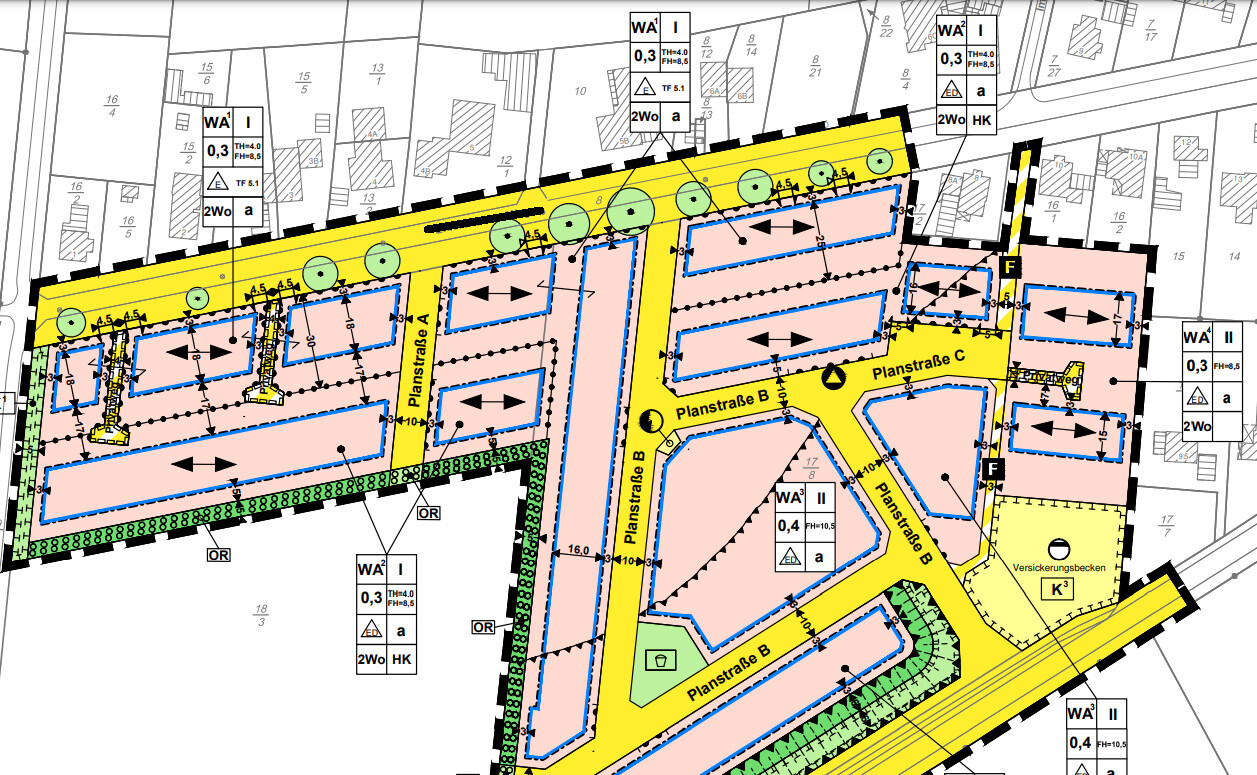
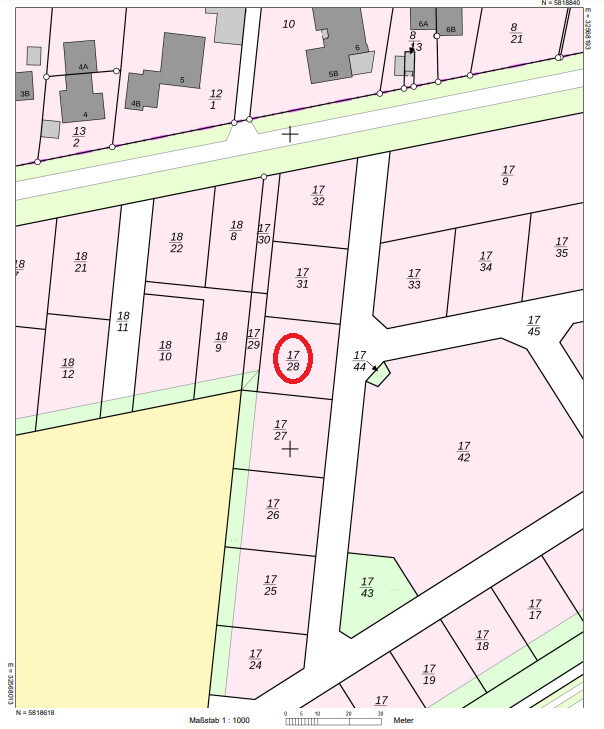
Plot size 576 sqm (approx. 6195 sq ft) - parcel 17/28 (see cadastral map)
Slope no – the plot has only a few centimeters (inches) of elevation difference
Floor area ratio (FAR) 0.3 = 172.8 sqm (1861 sq ft)
Plot ratio not defined
Building envelope, building line and boundary 24x24 meter (79x79 feet) plot = N-E-S-W 16x18x16x18 meter (52x59x52x59 feet) building envelope
Edge development no, exceptions possibly according to Lower Saxony Building Regulations
Required number of parking spaces not specified
Number of floors single storey
Roof shape gable/hip/half-hip with 35-50 degree pitch
Architectural style classic detached house
Ridge direction specified = ridge line running west-east
Max height limits ridge height 4.0 m (13 ft), eaves height 8.5 m (28 ft)
Additional rules no oil heating, 50% of the south-facing roof must have solar panels, no building allowed between house and street (e.g., no parking or similar in front yard)
The plot has been purchased and the utility infrastructure in the new development area is already completed (our plot is even located on a pre-asphalted road).
Homeowner Requirements
Style, roof shape, building type solid wooden house made of massive log beams inside, blown insulation, and exterior cladding
Basement, floors no basement – only ground floor + upper floor
Number of occupants, ages three, aged 36, 29, and five and a half
Space requirements on ground and upper floors standard single-family home with 3 bedrooms plus bathroom upstairs, open-plan living area downstairs, guest WC, and large utility/housekeeping room
Office: family use or home office? One room currently usable as office/guest room (backup for future child needs), currently neither of us have jobs with home office option
Open or closed layout living/dining/kitchen preferably open
Conservative or modern construction style conservative
Open kitchen, kitchen island open kitchen yes, kitchen island currently not planned
Number of dining seats daily use for 3, but dining nook should be sufficient for more people
Fireplace planned is a masonry stove
Music/stereo wall no
Balcony, roof terrace no
Garage, carport carport with workshop
Utility garden, greenhouse no
Other wishes/special features/daily routine, including reasons why some things are included or excluded
House Design
Who designed the plan: plan based on our principles, then optimized with the manufacturer’s in-house architect
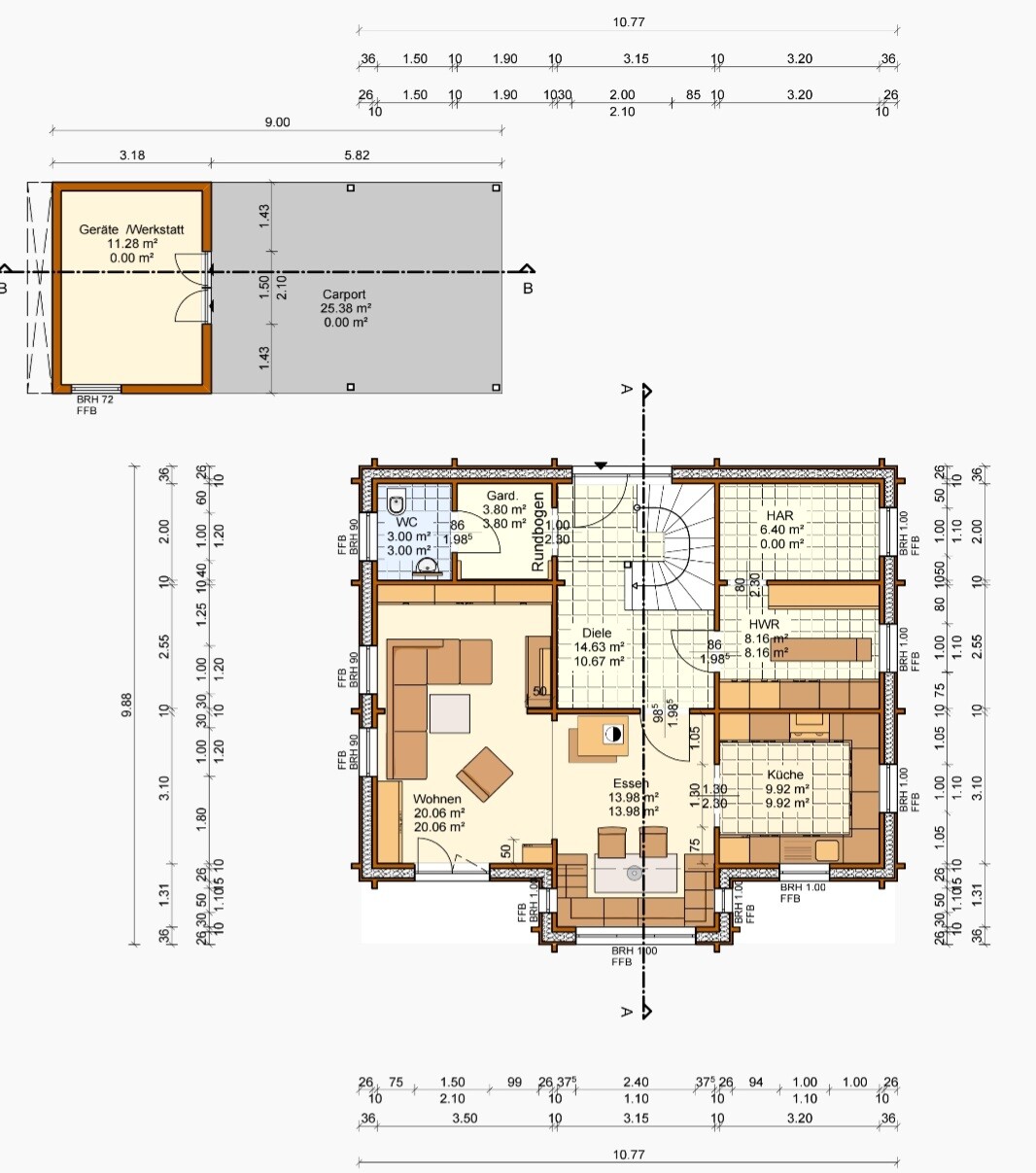
What do you particularly like? Why? We really like the extended dining nook with the surrounding bench; overall, our ideas about room sizes have been well implemented – whether everything will really work as we imagine, we would like to ask here.
What do you dislike? Why? The chimney’s position might be bothersome in the children's room? Or is that negligible in daily life? We are still not satisfied with the kitchen and bathroom upstairs and are currently looking for a good furnishing/decorating solution.
Price estimate according to architect/planner: Since we are not working with a general contractor but will handle contracts ourselves after the shell is built and do a lot of work ourselves, we don’t have all numbers yet. The following trades are currently being costed.
Personal price limit for the house including fittings: 400,000 up to move-in ready, excluding everything outside the building itself, plot is paid
Preferred heating technology: heat pump with underfloor heating plus photovoltaics with possible storage
If you have to give up something, which details/extensions
- can you do without: We have tried to adapt our demands to the budget as much as possible – does anyone see further savings potential?
- can you not do without: As an absolute last resort, we would remove the dining nook and redesign the ground floor – also, the masonry stove is fixed for us (we just love this cozy atmosphere).
Why is the design the way it is now?
Standard plan from planner? The manufacturer does not offer standard houses; everything is individually designed
Which of your wishes were implemented by the architect? The current plan reflects our wishes quite well. Now we just need fine-tuning, and we hope for your assessments, ideas, and experiences.
A mix of many examples from various magazines... Of course, our inspirations come from many different sources (good and bad…) 😀
What makes it particularly good or bad in your opinion? It feels good to us so far – all our furniture fits, and the things that bother us in our current rented house have been eliminated in the design.
What is the most important/basic question about the layout, summarized in 130 characters?
- Does the layout work as it is, or are there specific arrangements that don’t work?
- Is the position and number of windows sufficient?
- Do the children's rooms upstairs need two roof windows or is one enough each?
- Have we missed or overlooked anything important?
- Can a U-shaped kitchen be sensibly planned in the existing space, or do we need to adjust walls downstairs first?
- Are the door positions appropriate regarding width, wall distance, and opening direction?
- Is the utility room (unfurnished room behind the laundry on the north/east side of the ground floor) dimensionally adequate?
- What knee wall height is recommended upstairs? Currently at 40 cm (16 in), we plan to raise it because otherwise, especially the upstairs bathroom will be problematic (though we don’t want a large bathroom, just “as big as necessary” – we would probably place the bathtub in the northeast corner of the room – would that fit?
- We’d like to add a laundry chute from the upstairs bathroom to the utility room – does anyone have a good idea for the best location?
One final note on our general concept:
We intend to buy the house from the manufacturer including insulation, cladding, and roof structure. Assembly will follow the “master carpenter assembly” principle (the company provides two experienced workers, plus 4-5 helpers from us – full warranty and savings of around 15,000-20,000 euros, about three to four weeks of hard work). The manufacturer’s “basic package” also includes windows and the front door, as they must be specially installed due to the house settling.
We plan to contract the foundation slab, roofing, and plumbing work separately. Electrical work (in consultation with the local master electrician), interior finishing (room doors, screed, underfloor heating, floor covering), and small tasks can be done by my partner (trained electrician, highly interested in almost everything, skilled and experienced with wood). I work professionally in an office of a building materials supplier, so I have access to good conditions, storage capacity, and established contacts in the industry. We also have great friends and a large family who are all enthusiastic about our project and willing to support us. We know this will require a lot of work, strain our time, nerves, and budget—but we want to give it a try.
We are now looking forward to suggestions, critical comments, and anything that can help us avoid as many mistakes as possible during the process.
Thank you very much in advance!

Here are some details—based on our best knowledge and judgment—about our house construction project...
Development Plan/Restrictions
Plot size 576 sqm (approx. 6195 sq ft) - parcel 17/28 (see cadastral map)
Slope no – the plot has only a few centimeters (inches) of elevation difference
Floor area ratio (FAR) 0.3 = 172.8 sqm (1861 sq ft)
Plot ratio not defined
Building envelope, building line and boundary 24x24 meter (79x79 feet) plot = N-E-S-W 16x18x16x18 meter (52x59x52x59 feet) building envelope
Edge development no, exceptions possibly according to Lower Saxony Building Regulations
Required number of parking spaces not specified
Number of floors single storey
Roof shape gable/hip/half-hip with 35-50 degree pitch
Architectural style classic detached house
Ridge direction specified = ridge line running west-east
Max height limits ridge height 4.0 m (13 ft), eaves height 8.5 m (28 ft)
Additional rules no oil heating, 50% of the south-facing roof must have solar panels, no building allowed between house and street (e.g., no parking or similar in front yard)
The plot has been purchased and the utility infrastructure in the new development area is already completed (our plot is even located on a pre-asphalted road).
Homeowner Requirements
Style, roof shape, building type solid wooden house made of massive log beams inside, blown insulation, and exterior cladding
Basement, floors no basement – only ground floor + upper floor
Number of occupants, ages three, aged 36, 29, and five and a half
Space requirements on ground and upper floors standard single-family home with 3 bedrooms plus bathroom upstairs, open-plan living area downstairs, guest WC, and large utility/housekeeping room
Office: family use or home office? One room currently usable as office/guest room (backup for future child needs), currently neither of us have jobs with home office option
Open or closed layout living/dining/kitchen preferably open
Conservative or modern construction style conservative
Open kitchen, kitchen island open kitchen yes, kitchen island currently not planned
Number of dining seats daily use for 3, but dining nook should be sufficient for more people
Fireplace planned is a masonry stove
Music/stereo wall no
Balcony, roof terrace no
Garage, carport carport with workshop
Utility garden, greenhouse no
Other wishes/special features/daily routine, including reasons why some things are included or excluded
House Design
Who designed the plan: plan based on our principles, then optimized with the manufacturer’s in-house architect
What do you particularly like? Why? We really like the extended dining nook with the surrounding bench; overall, our ideas about room sizes have been well implemented – whether everything will really work as we imagine, we would like to ask here.
What do you dislike? Why? The chimney’s position might be bothersome in the children's room? Or is that negligible in daily life? We are still not satisfied with the kitchen and bathroom upstairs and are currently looking for a good furnishing/decorating solution.
Price estimate according to architect/planner: Since we are not working with a general contractor but will handle contracts ourselves after the shell is built and do a lot of work ourselves, we don’t have all numbers yet. The following trades are currently being costed.
Personal price limit for the house including fittings: 400,000 up to move-in ready, excluding everything outside the building itself, plot is paid
Preferred heating technology: heat pump with underfloor heating plus photovoltaics with possible storage
If you have to give up something, which details/extensions
- can you do without: We have tried to adapt our demands to the budget as much as possible – does anyone see further savings potential?
- can you not do without: As an absolute last resort, we would remove the dining nook and redesign the ground floor – also, the masonry stove is fixed for us (we just love this cozy atmosphere).
Why is the design the way it is now?
Standard plan from planner? The manufacturer does not offer standard houses; everything is individually designed
Which of your wishes were implemented by the architect? The current plan reflects our wishes quite well. Now we just need fine-tuning, and we hope for your assessments, ideas, and experiences.
A mix of many examples from various magazines... Of course, our inspirations come from many different sources (good and bad…) 😀
What makes it particularly good or bad in your opinion? It feels good to us so far – all our furniture fits, and the things that bother us in our current rented house have been eliminated in the design.
What is the most important/basic question about the layout, summarized in 130 characters?
- Does the layout work as it is, or are there specific arrangements that don’t work?
- Is the position and number of windows sufficient?
- Do the children's rooms upstairs need two roof windows or is one enough each?
- Have we missed or overlooked anything important?
- Can a U-shaped kitchen be sensibly planned in the existing space, or do we need to adjust walls downstairs first?
- Are the door positions appropriate regarding width, wall distance, and opening direction?
- Is the utility room (unfurnished room behind the laundry on the north/east side of the ground floor) dimensionally adequate?
- What knee wall height is recommended upstairs? Currently at 40 cm (16 in), we plan to raise it because otherwise, especially the upstairs bathroom will be problematic (though we don’t want a large bathroom, just “as big as necessary” – we would probably place the bathtub in the northeast corner of the room – would that fit?
- We’d like to add a laundry chute from the upstairs bathroom to the utility room – does anyone have a good idea for the best location?
One final note on our general concept:
We intend to buy the house from the manufacturer including insulation, cladding, and roof structure. Assembly will follow the “master carpenter assembly” principle (the company provides two experienced workers, plus 4-5 helpers from us – full warranty and savings of around 15,000-20,000 euros, about three to four weeks of hard work). The manufacturer’s “basic package” also includes windows and the front door, as they must be specially installed due to the house settling.
We plan to contract the foundation slab, roofing, and plumbing work separately. Electrical work (in consultation with the local master electrician), interior finishing (room doors, screed, underfloor heating, floor covering), and small tasks can be done by my partner (trained electrician, highly interested in almost everything, skilled and experienced with wood). I work professionally in an office of a building materials supplier, so I have access to good conditions, storage capacity, and established contacts in the industry. We also have great friends and a large family who are all enthusiastic about our project and willing to support us. We know this will require a lot of work, strain our time, nerves, and budget—but we want to give it a try.
We are now looking forward to suggestions, critical comments, and anything that can help us avoid as many mistakes as possible during the process.
Thank you very much in advance!
W
WilderSueden25 Jan 2023 13:49-LotteS- schrieb:
Then the floor-to-ceiling windows in the small bedrooms would become very narrow. Four dormers—one for each room—are actually beyond the budget (the development plan allows 50% of the eaves sides)—but maybe the manufacturer could be flexible here... How about two large dormers? The complex part of a dormer isn’t the area of the dormer roof, but all the transitions.

If a small handheld vacuum cleaner seems too insignificant to you, I would consider "saving" on the thick (about 70cm (28 inches) thick?) roof structure instead ;-)
By the way, I don’t see any dormers in the design shown in post #66.
Maybe you should reconsider the supplier. I’m bringing @neo-sciliar into the thread, along with the question of whether Stommel also offers shell homes 🙂
https://www.instagram.com/11antgmxde/
https://www.linkedin.com/company/bauen-jetzt/
By the way, I don’t see any dormers in the design shown in post #66.
Maybe you should reconsider the supplier. I’m bringing @neo-sciliar into the thread, along with the question of whether Stommel also offers shell homes 🙂
https://www.instagram.com/11antgmxde/
https://www.linkedin.com/company/bauen-jetzt/

WilderSueden schrieb:
How about two large dormers? The complex part of a dormer isn’t the area of the dormer roof itself, but all the transitions around it.On the south side, this is currently one of our considerations – on the north side, it would probably be two separate ones, since the stairwell doesn’t necessarily require a dormer, and in the end there wouldn’t be enough usable space in the bedroom and bathroom – right?
W
WilderSueden25 Jan 2023 15:07I wouldn’t think in isolation here. Currently, the staircase starts on the upper floor right at the front door, where all the dirt is brought in. With an extended dormer, you could change the direction of the stairs and position the staircase at the lower floor, and for example, place a shoe rack under the stairs. It is also likely that one large dormer would be more cost-effective than two smaller ones. The real question is whether gaining 50% of the length in the two other rooms provides enough space.
11ant schrieb:
If a vacuum cleaner attic knee wall seems too small for you, I would try to save on the thick (about 70cm (28 inches) thick ?) roof construction ;-)
By the way, I don’t see any dormers in the design shown in post #66. If we added it correctly, the roof construction is about 66cm (26 inches) thick. Since our preferred manufacturer (Nordic Haus) can only use external roof insulation with the log walls and cannot insulate between the rafters, reducing the thickness is unfortunately not an option.
Currently, we have no dormers in the plan, because we are still completely unsure about how...
But at this point, a question for you experts: Is the thermal heat loss calculated based on the roof tiles, or do I possibly need to add photovoltaic panels on top of that?
11ant schrieb:
Maybe you should reconsider the provider. I’ll bring @neo-sciliar into the thread, along with the question of whether Stommel also offers shell homes 🙂 In the meantime, we have also spoken with other providers. But then problems arise in different areas... So far, none have convinced us—either because they use membranes (then I don’t need a wooden house) or because the entire upper floor is built with drywall. We would rather not give up on the preferred manufacturer yet. Without a satisfactory solution for the upper floor—so even if you don’t have any more ideas—we probably have no other choice as a last resort... Unfortunately, you are right about that.
WilderSueden schrieb:
I wouldn’t think about this in isolation. Right now, your stairway starts at the top floor directly by the front door, where all the dirt gets tracked in. With a dormer that spans across, you could change the stair direction and place the stairway start at the lower floor, for example, installing a shoe rack under the stairs. Also, a larger dormer would probably be more cost-effective than two smaller ones. The question is whether gaining 50% of the length in the other two rooms will provide enough space. I’m trying to picture this... So the staircase would start basically at the corner of the wall where the utility room door begins, keeping the stair shape and position but reversing the walking direction? Did I understand you correctly?
With the 50%, we would have 5.48 meters (18 feet) of usable length given the current building dimensions. The hallway is 3.15 meters (10 feet 4 inches) wide plus two times 10cm (4 inches) wall thickness, leaving just over 1 meter (3 feet 3 inches) each for the bathroom and bedroom. Although, there will likely be less usable space since the dormers will also require room for the supporting structure, to call it this in layman’s terms.
Similar topics