
ᐅ Very Poor Parquet Flooring Installation – Is Rectification Impossible?
Created on: 19 Jan 2023 10:55
P
pim1985
Hello,
unfortunately, we are having problems again with our parquet installer (a small family business in NRW). The work on the transitions and the baseboards was done very poorly.
A brief summary of the situation: After a long wait due to residual moisture in the screed, the parquet was installed (oak, 18.5cm (7.3 inches) wide, fully glued).
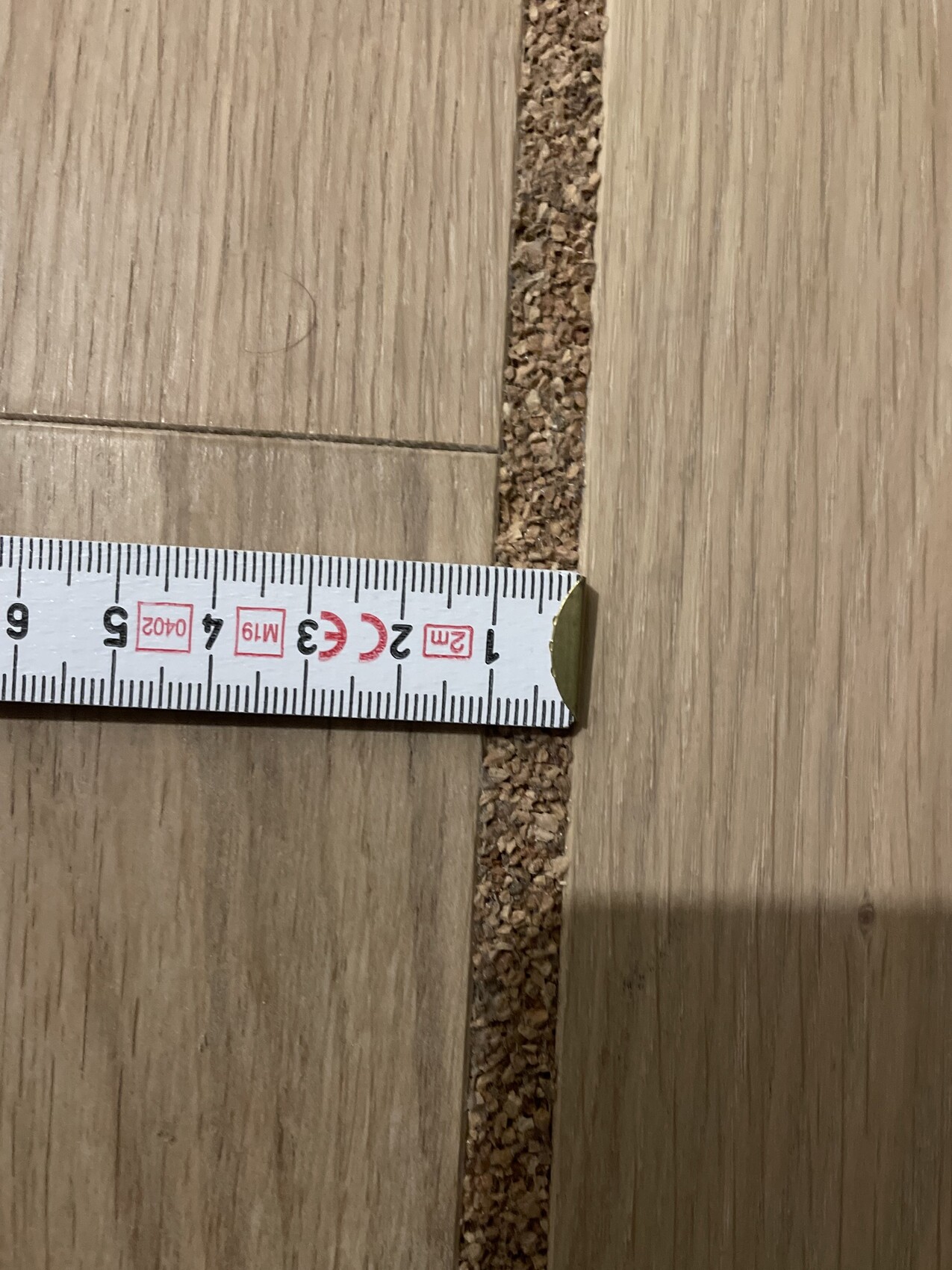
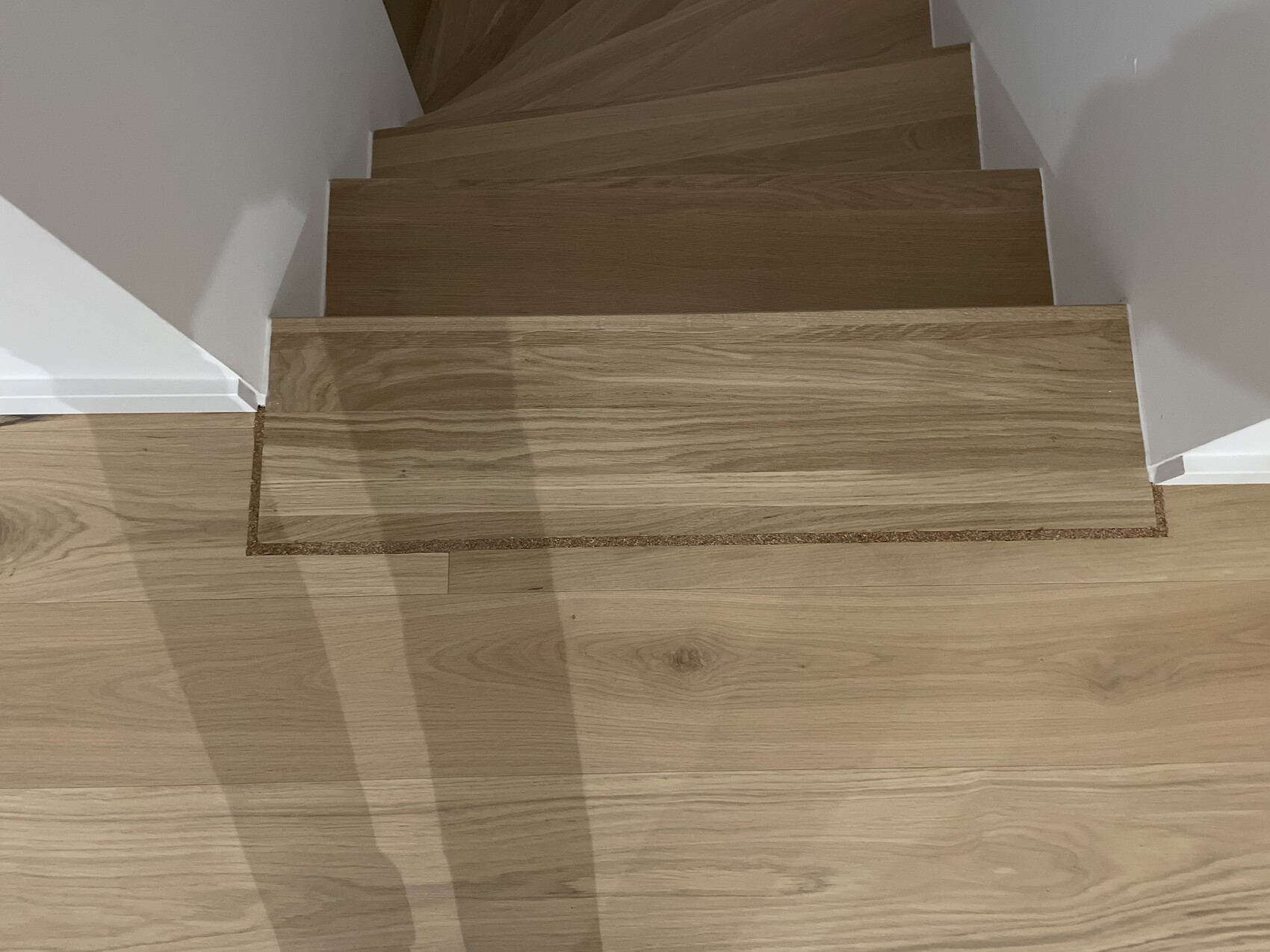
As you can see in the photos, the gaps at the transitions are about 1cm (0.4 inches) wide and filled with a cork material that does not match the color.
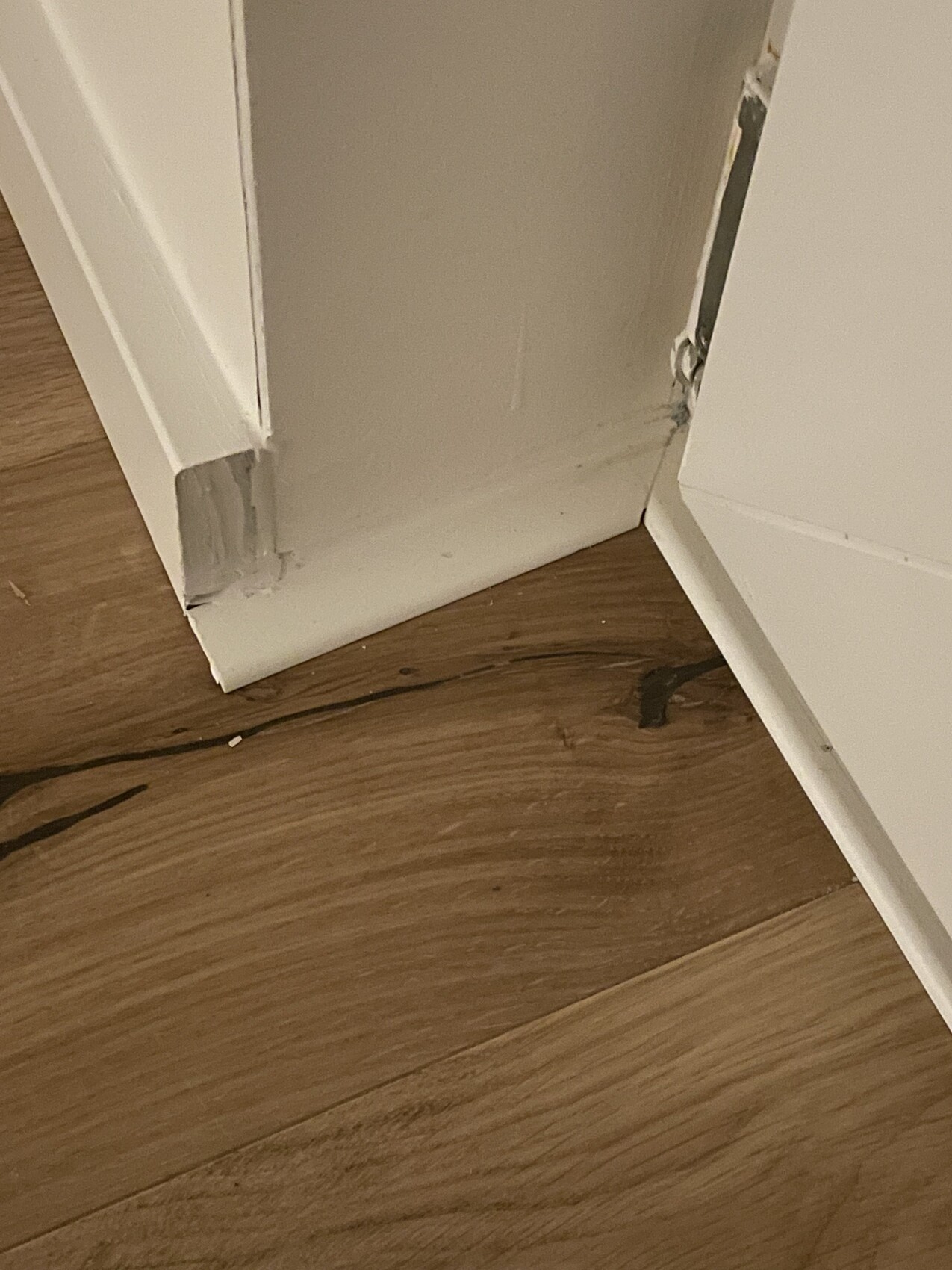
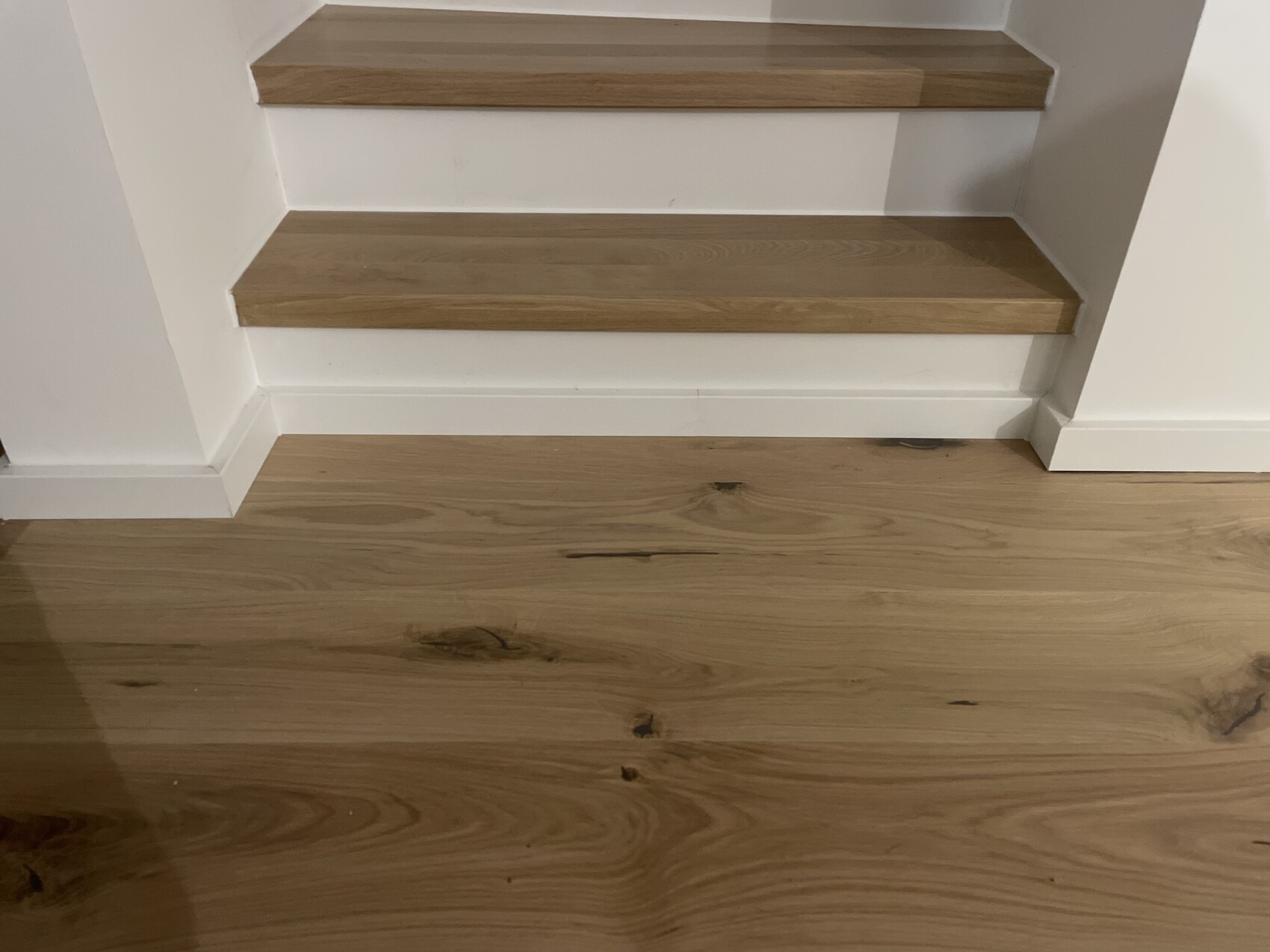
The baseboards (1.8cm (0.7 inches) wide, about 5.8cm (2.3 inches) high) at the floor-to-ceiling windows do not look good, the smaller baseboards/profiles are odd, and the work was very untidy. The reason for the unusual small baseboards/profiles: the window reveals are too narrow (1cm (0.4 inches) wide baseboards would fit; this is the case with our neighbors in an identical semi-detached house). There are nicer solutions for this, but there was no communication that the baseboards would not fit. The parquet installer is unable to accept criticism and is old-fashioned, just doing things as he learned 30 years ago. He refuses to make any corrections.
Regarding the cork filling, we probably have no legal chance for corrections, even though the boards at the transitions were cut unevenly. (I saw examples from other providers, unfortunately too late, and spoke with specialists from a large parquet company (Parkett Dietrich) who said that transitions without joints or with very small joints about 4mm (0.16 inches) are possible. These could be filled with parquet joint filler in a similar color and would look a thousand times better). Baseboards before the step in the staircase area???
The small baseboards in the window area are impossible, though. I am a member of the property owners’ protection association (legal insurance is also available) and I am considering taking legal action with a specialist lawyer and construction consultant, although I would prefer not to. But this job cost a lot of money, and now I will probably have to hire a second company to fix it.
I would appreciate any tips on how to salvage one or the other issue.
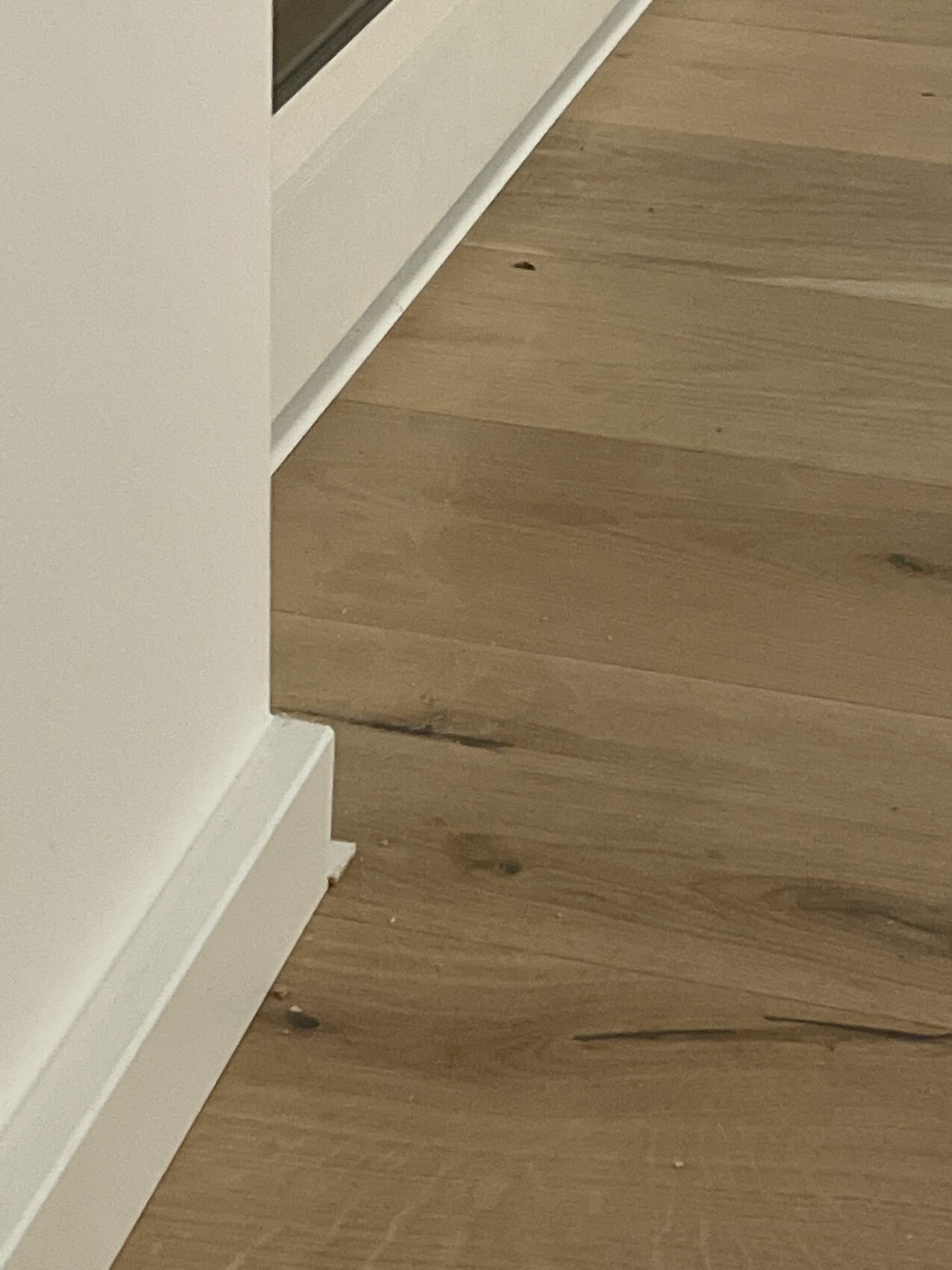
unfortunately, we are having problems again with our parquet installer (a small family business in NRW). The work on the transitions and the baseboards was done very poorly.
A brief summary of the situation: After a long wait due to residual moisture in the screed, the parquet was installed (oak, 18.5cm (7.3 inches) wide, fully glued).
As you can see in the photos, the gaps at the transitions are about 1cm (0.4 inches) wide and filled with a cork material that does not match the color.
The baseboards (1.8cm (0.7 inches) wide, about 5.8cm (2.3 inches) high) at the floor-to-ceiling windows do not look good, the smaller baseboards/profiles are odd, and the work was very untidy. The reason for the unusual small baseboards/profiles: the window reveals are too narrow (1cm (0.4 inches) wide baseboards would fit; this is the case with our neighbors in an identical semi-detached house). There are nicer solutions for this, but there was no communication that the baseboards would not fit. The parquet installer is unable to accept criticism and is old-fashioned, just doing things as he learned 30 years ago. He refuses to make any corrections.
Regarding the cork filling, we probably have no legal chance for corrections, even though the boards at the transitions were cut unevenly. (I saw examples from other providers, unfortunately too late, and spoke with specialists from a large parquet company (Parkett Dietrich) who said that transitions without joints or with very small joints about 4mm (0.16 inches) are possible. These could be filled with parquet joint filler in a similar color and would look a thousand times better). Baseboards before the step in the staircase area???
The small baseboards in the window area are impossible, though. I am a member of the property owners’ protection association (legal insurance is also available) and I am considering taking legal action with a specialist lawyer and construction consultant, although I would prefer not to. But this job cost a lot of money, and now I will probably have to hire a second company to fix it.
I would appreciate any tips on how to salvage one or the other issue.

Actually, these are tricky areas (cork) but definitely easier to execute properly. The baseboards are, in my opinion, completely out of standard (paint bucket tipped against the baseboard?).
However, I really spent more than 2 hours cutting and sanding a single transition piece until the narrow parquet strip fit precisely to the millimeter. Pressed it in, checked the fit, made adjustments until it was perfect. Then glued and screwed it in (pre-drilled holes, countersunk, shortened special screws with very small heads, etc.). You see the transition every day, and it’s especially noticeable when you know to look for it or can’t overlook it. The same goes for the transition between the parquet and the bathroom tiles. That was very tedious because I had to repair the subfloor multiple times to match the screed height exactly to the millimeter (I had to raise it slightly). That took me half a day. Afterwards, the painter filled the narrow, perfectly parallel joint with sealant – I think it’s perfect ;-)
Maybe he simply didn’t want to or have time for that? Either way, you would have paid if he had said the transitions were a bit complicated and he needed more money to make them look really good – right?
Now, here’s how you could possibly fix it...
Remove the cork completely, clean the joint, and straighten the edges of the adjacent parquet (Japanese saw, sandpaper, and lots of patience). Then cut a parquet piece exactly matching the shape of the joint (craftsmanship) and fit it in one piece. Visually, this is definitely better since it fits properly. In my opinion, it will look as intended and, if you do it precisely to the millimeter, certainly better than the current condition.
However, I really spent more than 2 hours cutting and sanding a single transition piece until the narrow parquet strip fit precisely to the millimeter. Pressed it in, checked the fit, made adjustments until it was perfect. Then glued and screwed it in (pre-drilled holes, countersunk, shortened special screws with very small heads, etc.). You see the transition every day, and it’s especially noticeable when you know to look for it or can’t overlook it. The same goes for the transition between the parquet and the bathroom tiles. That was very tedious because I had to repair the subfloor multiple times to match the screed height exactly to the millimeter (I had to raise it slightly). That took me half a day. Afterwards, the painter filled the narrow, perfectly parallel joint with sealant – I think it’s perfect ;-)
Maybe he simply didn’t want to or have time for that? Either way, you would have paid if he had said the transitions were a bit complicated and he needed more money to make them look really good – right?
Now, here’s how you could possibly fix it...
Remove the cork completely, clean the joint, and straighten the edges of the adjacent parquet (Japanese saw, sandpaper, and lots of patience). Then cut a parquet piece exactly matching the shape of the joint (craftsmanship) and fit it in one piece. Visually, this is definitely better since it fits properly. In my opinion, it will look as intended and, if you do it precisely to the millimeter, certainly better than the current condition.
M
Myrna_Loy20 Jan 2023 11:41The cork joint could be a bit narrower, but in my experience, it is within the usual craftsmanship standards. I also find the quality of the workmanship acceptable, as I have seen quite different work from professional companies that was also considered standard.
For such large areas, a sufficiently large expansion gap is necessary; a few millimeters are definitely not enough for solid wood. The required size depends on the material, the subfloor, and the installation method. "An expansion gap of 2 mm per meter of flooring should be observed. For a room measuring 4 x 4 meters (13 x 13 feet), the edges of the parquet should therefore have an 8 mm (0.3 inch) clearance from the wall."
Regarding the baseboard, the question is what was contractually agreed upon. As mentioned before, quality costs extra. As a correction, I would request that the baseboards in the window area be revised. The short piece could be easily reduced in thickness and adjusted. Below the window, a cork joint might also be more appealing than the flat baseboards.
For such large areas, a sufficiently large expansion gap is necessary; a few millimeters are definitely not enough for solid wood. The required size depends on the material, the subfloor, and the installation method. "An expansion gap of 2 mm per meter of flooring should be observed. For a room measuring 4 x 4 meters (13 x 13 feet), the edges of the parquet should therefore have an 8 mm (0.3 inch) clearance from the wall."
Regarding the baseboard, the question is what was contractually agreed upon. As mentioned before, quality costs extra. As a correction, I would request that the baseboards in the window area be revised. The short piece could be easily reduced in thickness and adjusted. Below the window, a cork joint might also be more appealing than the flat baseboards.
i_b_n_a_n schrieb:
These are actually tricky spots (cork) but definitely possible to do better. The baseboards are, in my opinion, completely out of any standard (paint can tipped against the board?)
I really spent more than 2 hours on a single transition, sawing and sanding until the narrow parquet piece for the transition fit exactly to the millimeter. Pressed it in, checked the fit, adjusted until it was perfect. Then glued and screwed it in (pre-drilled hole, countersunk, cut special screws with a very small head, etc.). You see the transition every day and it is especially bothersome when you know about it or can’t overlook it. The same applies to the transition between parquet and tiles in the bathroom. That was very tedious because I had to correct the subfloor multiple times to adjust it exactly to the screed height to the millimeter (I had to slightly raise it). That took me half a day. Afterwards, the painter applied sealant into the narrow, exactly parallel joint – I find it perfect ;-)
Maybe he simply had no desire/time for this? Anyway, you would have paid if he had said the transitions are a bit complicated and he needed more money to make them look really good – right?
Now about how you might fix it...
Remove the cork completely, clean the joint and straighten the edges of the adjacent parquet (Japanese saw, sandpaper + lots of patience). Then precisely cut a parquet piece (a craft job) shaped exactly to the joint and fit it in one piece. Visually definitely better because it fits properly. In my opinion, it will then look intentional and if you do it perfectly to the millimeter, certainly better than the current state.Cork: I have thought about exactly that. Unfortunately, he didn’t leave any planks, but I know the exact product name and would order the minimum quantity elsewhere (2.44 m² (26.3 sq ft) / 6 planks) if the parquet fitter refuses or claims no planks are left. That would definitely be the most cost-effective option. The somewhat more expensive option would be to replace the entire planks at the transitions.
I found slimmer baseboards in the same color and height. I would install these in the window area. Visually, no one will notice if they are 1.8 cm (0.7 inches) or 1 cm (0.4 inches) wide. It will definitely look better.
Would it be worthwhile to ask my building inspector, who has supervised the entire construction of the house (unfortunately, I did not hire him for this trade), for an expert opinion and then consult with a specialist construction lawyer? I doubt the parquet installer can or will correct this work. I’m happy to pay for jobs done well, but not for this. The invoice amounts to over 24,000.
Myrna_Loy schrieb:
The cork joint might be a little narrower, but in my experience it is within the professional standard. I also find the quality of the workmanship acceptable; I have seen much worse work from professional companies that was still within standards. With such large areas, an adequately sized expansion joint is necessary; a few millimeters are definitely required for solid wood. The exact size depends on the material, substrate, and installation. "2 mm expansion gap per meter of flooring should be observed. In a room 4 x 4 meters (13 x 13 feet), the edges of the parquet should have an 8 mm (0.3 inches) gap from the wall." Regarding the baseboards, the question is what was contractually agreed upon. And as mentioned before, good work costs extra. For corrections, I would request the baseboards in the window area be redone. The short piece could be reduced in thickness and adjusted easily. Below the window, a cork joint might be more attractive than flat baseboards.He cannot do better, constant claim it is impossible. The method with cork is outdated. You have to keep up with the times. I’m paying enough for perfect execution. I would have preferred to hire the large, modern parquet company instead of this small firm stuck in 1980. The quotes were similar.
M
Myrna_Loy20 Jan 2023 12:57pim1985 schrieb:
It can’t be done better, that’s the constant claim. The cork method is outdated. You have to keep up with the times. I’m paying enough for a perfect job. I would have preferred to hire a large, modern parquet company instead of this small place stuck in 1980. The price was the same. But then that is your problem. If you didn’t specify the execution in the contract, you can’t later say you wanted it done differently. What does the order say about the treatment of the joints? The trim?
Even in 2023, there are recommendations and standards for the width of expansion joints in parquet flooring. No modern company can reduce those to 2 mm (0.08 inches) or just leave them out.
The method is hardly outdated. We recently supervised the renovation of a project where an absolutely premium floor was newly installed in a prestigious building. And yes, all expansion joints of the approximately 200 sqm (2,150 sq ft) were done with cork.
pim1985 schrieb:
He can’t do better, constant claim that it’s not possible. The cork method is outdated.I agree, and it can definitely be done better. Since you are in NRW, could you please specify the exact location? Within about 50 km (30 miles) of Wuppertal, for example, I could recommend a true professional who knows what they’re doing with the proper quality standards. Also, you don’t have to spend a fortune on it.
So before you start tinkering, have the entire parquet skirting replaced at the transitions, and you’ll be happy.
Myrna_Loy schrieb:
Then that is your problem. If you didn’t specify the execution in the contract, you can’t later claim it was supposed to be different. What does the contract say about the installation of the joints? The moldings?
Even in 2023, there are still recommendations and standards for the width of movement joints in parquet flooring. A modern company can’t just reduce them to 2 mm (0.08 inches) or omit them.
The method is hardly outdated. We recently oversaw the renovation of a property where an absolute premium floor was installed in a prestigious project. And yes, all movement joints over approximately 200 sq m (2,150 sq ft) were filled with cork. Is my problem that I want it to look nice? The contract doesn’t say anything about that. I wasn’t informed about the joints or the moldings before installation. I wasn’t told that it wouldn’t fit properly at the windows. They just did it. It’s 100 sq m (1,075 sq ft). If you go to a place like Parkett Dietrich or similar, you’ll see how they install the floor continuously. It’s a new build, not an old house!
Similar topics