
Hi everyone,
you probably all know this classic challenge of renovating an old building—there's always another surprise around every corner 🙂 I’m a bit puzzled right now and hope you can help.
As mentioned, we are currently renovating a house from 1935. Today, we examined the construction of the wooden beam ceiling on the first floor. The structure itself is fairly typical. On the underside, there is a plastered layer of reed matting attached to the wood joists with cross battens; above that is the subfloor, and on top of the wooden beams are the wooden floorboards (see picture). Inside and above the subfloor, there is a filling made of construction debris. The subfloor timbers are not nailed to the edges of the wooden beams but are just loosely resting. The wooden floorboards will not be our final flooring, but for energy efficiency reasons, we would like to insulate the floor. We are currently discussing how to proceed and I have the following questions and would be very grateful for your help.
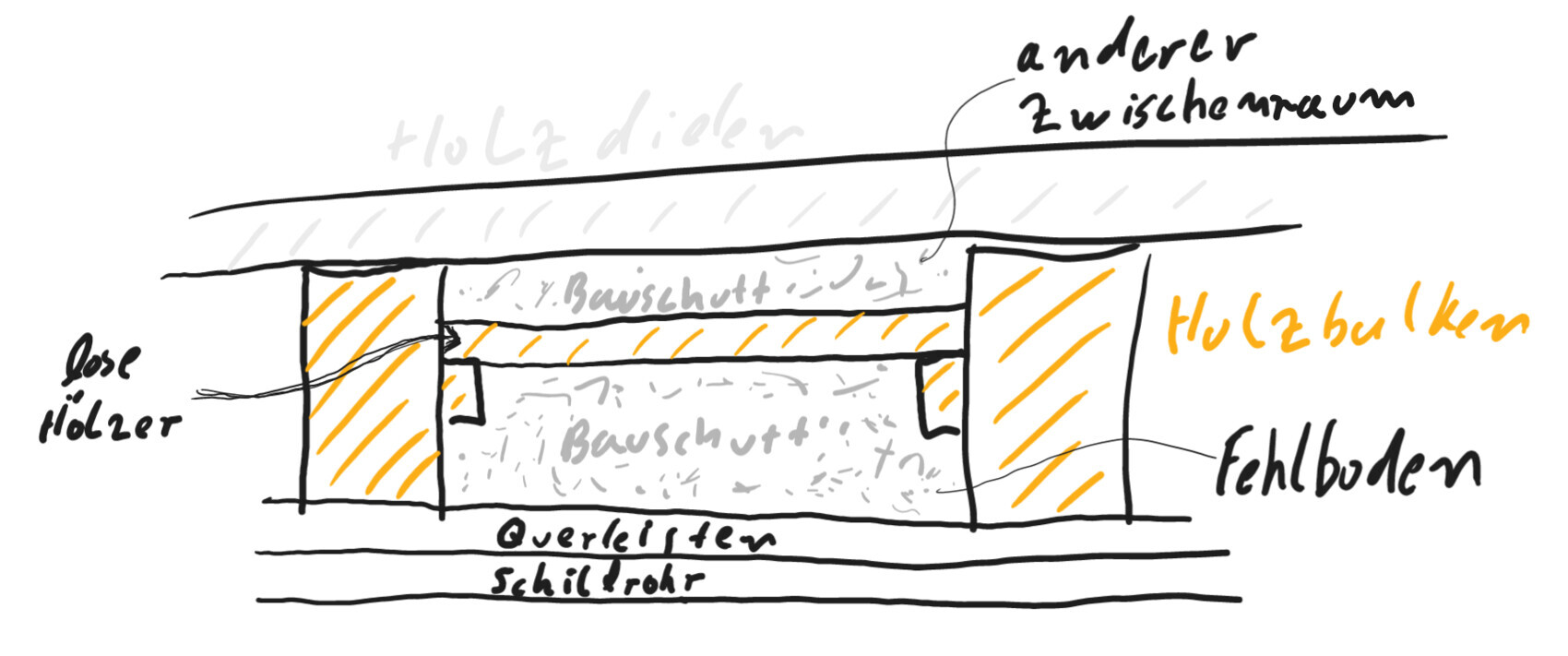
1. Should both the space above the subfloor and the subfloor itself be insulated for optimal thermal performance, for example with mineral wool/Rockwool/etc., or is something heavier like rubble necessary to achieve adequate impact sound insulation? Should a different type of fill be used in the subfloor cavity compared to the space above? If so, which materials would you recommend for the subfloor and the other cavity?
2. If everything should be insulated, we would remove the rubble by pulling out the reed matting from below. I’m afraid this will make an enormous mess. Since new windows have already been installed on the lower floor, I’d like to avoid that if possible. If a subfloor with rubble is acceptable, would it be sufficient to remove the floorboards, take out the rubble resting on the loose timbers (and empty it into the subfloor, which is not completely filled), and then insulate the space under the current floorboards with mineral wool?
3. If it is sufficient to only fill the "other" cavity under the current floorboards with mineral wool, we would remove the floorboards and insulate “from above.” What should we replace the floorboards with? OSB panels and dry screed? Or would OSB panels alone be sufficient (structure: joist spacing approx. 70cm (27.5 inches)) to support the impact sound insulation and the flooring?
Sorry for the long post, many thanks in advance!
Best regards
you probably all know this classic challenge of renovating an old building—there's always another surprise around every corner 🙂 I’m a bit puzzled right now and hope you can help.
As mentioned, we are currently renovating a house from 1935. Today, we examined the construction of the wooden beam ceiling on the first floor. The structure itself is fairly typical. On the underside, there is a plastered layer of reed matting attached to the wood joists with cross battens; above that is the subfloor, and on top of the wooden beams are the wooden floorboards (see picture). Inside and above the subfloor, there is a filling made of construction debris. The subfloor timbers are not nailed to the edges of the wooden beams but are just loosely resting. The wooden floorboards will not be our final flooring, but for energy efficiency reasons, we would like to insulate the floor. We are currently discussing how to proceed and I have the following questions and would be very grateful for your help.
1. Should both the space above the subfloor and the subfloor itself be insulated for optimal thermal performance, for example with mineral wool/Rockwool/etc., or is something heavier like rubble necessary to achieve adequate impact sound insulation? Should a different type of fill be used in the subfloor cavity compared to the space above? If so, which materials would you recommend for the subfloor and the other cavity?
2. If everything should be insulated, we would remove the rubble by pulling out the reed matting from below. I’m afraid this will make an enormous mess. Since new windows have already been installed on the lower floor, I’d like to avoid that if possible. If a subfloor with rubble is acceptable, would it be sufficient to remove the floorboards, take out the rubble resting on the loose timbers (and empty it into the subfloor, which is not completely filled), and then insulate the space under the current floorboards with mineral wool?
3. If it is sufficient to only fill the "other" cavity under the current floorboards with mineral wool, we would remove the floorboards and insulate “from above.” What should we replace the floorboards with? OSB panels and dry screed? Or would OSB panels alone be sufficient (structure: joist spacing approx. 70cm (27.5 inches)) to support the impact sound insulation and the flooring?
Sorry for the long post, many thanks in advance!
Best regards
Winniefred schrieb:
Oh, let me tell you what we are planning. We will remove the slag on the ground floor until the vault underneath is exposed, and then in the There is a clear difference between the ground floor and the basement, and between the ground floor and the first floor.
Since quite a few answers were incorrect, here is my opinion.
Thermal insulation between heated living spaces is not necessary. Any kind of foil is also not required. For dust protection, paper is sufficient. Sound insulation, both structure-borne and airborne noise, can only be reduced by mass, not by light materials like glass wool or polystyrene. Depending on the composition and condition of the construction debris, it can either be left in place or removed from above. If the upper floorboards are to be replaced, they can be substituted with new floorboards or OSB (structurally better). Removing the reed matting involves a lot of work and dirt but does not affect the new windows on the ground floor.
Thermal insulation between heated living spaces is not necessary. Any kind of foil is also not required. For dust protection, paper is sufficient. Sound insulation, both structure-borne and airborne noise, can only be reduced by mass, not by light materials like glass wool or polystyrene. Depending on the composition and condition of the construction debris, it can either be left in place or removed from above. If the upper floorboards are to be replaced, they can be substituted with new floorboards or OSB (structurally better). Removing the reed matting involves a lot of work and dirt but does not affect the new windows on the ground floor.
 Winniefred11 Jan 2023 09:48
Grundaus schrieb:
there is a clear difference between the ground floor and basement and between the ground floor and first floor Yes, and so what?^^ I specifically wrote that this is what WE plan to do. Not that I recommend it in this case.
I'm currently dealing with exactly the same situation. The plan was originally to remove the old loose fill, add new fill, and put OSB panels on top.
When I explained this at the hardware store and showed photos, I was immediately advised to leave the old fill in place (construction debris, etc., relatively heavy material) and fill it up flush with heavy loose fill from the store. First, remove the old fill, install a filtering layer, then add old plus new fill on top. Finally, install 20mm (3/4 inch) floating dry screed panels (glued and screwed together). Optionally, you can add an 8mm (5/16 inch) wood fiber mat under the panels or at least insulation strips on the wooden joists.
The main reasons against OSB and in favor of dry screed: better sound insulation due to greater mass, no screwing into the wooden joists, which results in decoupling of the floor. I’m willing to pay the extra three euros per square meter for that.
When I explained this at the hardware store and showed photos, I was immediately advised to leave the old fill in place (construction debris, etc., relatively heavy material) and fill it up flush with heavy loose fill from the store. First, remove the old fill, install a filtering layer, then add old plus new fill on top. Finally, install 20mm (3/4 inch) floating dry screed panels (glued and screwed together). Optionally, you can add an 8mm (5/16 inch) wood fiber mat under the panels or at least insulation strips on the wooden joists.
The main reasons against OSB and in favor of dry screed: better sound insulation due to greater mass, no screwing into the wooden joists, which results in decoupling of the floor. I’m willing to pay the extra three euros per square meter for that.
Winniefred12 Jan 2023 21:37Dry screed is definitely very easy to work with. Although the boards are quite heavy, they are easy to cut and install.
Similar topics