
ᐅ Indoor heat pump in the basement not possible due to groundwater?
Created on: 10 Jan 2023 19:40
B
BaskervileB
Baskervile10 Jan 2023 19:40Hello,
I am currently planning the construction of a detached single-family house. When signing the contract, the general contractor promised an indoor heat pump in the basement, which is also specified in the contract. After receiving the soil survey report, which states a design groundwater level of -1.75m (-5.7 feet), I was told that an indoor heat pump is not possible because the air ducts cannot be sealed according to the relevant standards (DIN).
Is this really impossible or just too risky?
Furthermore, I received an offer for an outdoor installation along with a discount of just under €1000. During the planning discussions, I was told there would be an additional cost of about €5000 for the indoor heat pump. Overall, this feels a bit strange to me.
I would appreciate your experiences and any information on this topic.
A second question about civil engineering work: My general contractor insists on having the excavation supervised by an unexploded ordnance clearance service due to a note in the soil report, without any prior survey. He claims this is now a regulation by the BG-Bau (German Social Accident Insurance for the construction industry). Is this correct?
I am happy to provide further information or pictures if helpful. I hope I have posted this in the appropriate subforum.
Thank you very much for your responses!
I am currently planning the construction of a detached single-family house. When signing the contract, the general contractor promised an indoor heat pump in the basement, which is also specified in the contract. After receiving the soil survey report, which states a design groundwater level of -1.75m (-5.7 feet), I was told that an indoor heat pump is not possible because the air ducts cannot be sealed according to the relevant standards (DIN).
Is this really impossible or just too risky?
Furthermore, I received an offer for an outdoor installation along with a discount of just under €1000. During the planning discussions, I was told there would be an additional cost of about €5000 for the indoor heat pump. Overall, this feels a bit strange to me.
I would appreciate your experiences and any information on this topic.
A second question about civil engineering work: My general contractor insists on having the excavation supervised by an unexploded ordnance clearance service due to a note in the soil report, without any prior survey. He claims this is now a regulation by the BG-Bau (German Social Accident Insurance for the construction industry). Is this correct?
I am happy to provide further information or pictures if helpful. I hope I have posted this in the appropriate subforum.
Thank you very much for your responses!
A
Allthewayup10 Jan 2023 20:06I am familiar with this topic somewhere :-D
A cross-section of the house would be helpful to see how deep the foundation is. The design water level here is practically at the turf, so at zero. I assume you have planned a system like Tecalor, where the ventilation unit is also integrated into the basement?
We routed the indoor unit of the ventilation system, including supply and exhaust air, through a wall penetration. For waterproof concrete basements (white tanks), there are approved wall penetrations that are either placed during concreting or already built into the element in prefabricated construction. These are pressure-tight up to a certain water level. I can understand if a general contractor is reluctant to do this due to a possible weak point – we ourselves are currently experiencing some issues with our basement – but I don’t think it is entirely correct to say that this is not compliant with the relevant standards (e.g., DIN). Simply try to position the penetration as high as possible above the basement floor; this significantly reduces the risk of water ingress. Additionally, a gravel packing can be installed on the outside around the penetration to allow quick drainage of surface water.
*Edit:
Did I understand correctly that the soil report was only available after signing the contract? If so, how much time elapsed between signing the contract and receiving the soil report?
A cross-section of the house would be helpful to see how deep the foundation is. The design water level here is practically at the turf, so at zero. I assume you have planned a system like Tecalor, where the ventilation unit is also integrated into the basement?
We routed the indoor unit of the ventilation system, including supply and exhaust air, through a wall penetration. For waterproof concrete basements (white tanks), there are approved wall penetrations that are either placed during concreting or already built into the element in prefabricated construction. These are pressure-tight up to a certain water level. I can understand if a general contractor is reluctant to do this due to a possible weak point – we ourselves are currently experiencing some issues with our basement – but I don’t think it is entirely correct to say that this is not compliant with the relevant standards (e.g., DIN). Simply try to position the penetration as high as possible above the basement floor; this significantly reduces the risk of water ingress. Additionally, a gravel packing can be installed on the outside around the penetration to allow quick drainage of surface water.
*Edit:
Did I understand correctly that the soil report was only available after signing the contract? If so, how much time elapsed between signing the contract and receiving the soil report?

Baskervile schrieb:
an interior heat pump is not possible because the air shafts cannot be sealed according to DIN standards I would consider the ventilation of the air shafts (=light well) as not compliant with DIN standards.
Allthewayup schrieb:
There are also approved wall penetrations for waterproof concrete tanks ("white tanks") that are either installed during the concrete pour or are pre-installed in precast elements. These can be pressure-tight up to a certain water level. I understand why a general contractor might be reluctant to use them due to potential weak points – we are currently having some issues with our basement ourselves – but I don't think it’s entirely correct to say that this is not possible according to DIN standards. Or something like a DOYMA sealing system. There are always solutions.
A
Allthewayup10 Jan 2023 20:33OWLer schrieb:
I would have considered the ventilation of the air shafts (= light well) as not compliant with DIN standards.
Or something like a DOYMA seal. There are always escape routes. I believe by air shaft he meant the supply and exhaust air ducts that lead to the stainless steel vents outside; at least my explanations were based on that. I also consider it questionable to make a light well that channels supply/exhaust air watertight against groundwater pressure.
Exactly, there is “Doyma,” meaning ring space seals and penetrations with a masonry collar.
B
Baskervile10 Jan 2023 21:36Thanks for the replies! Here are the views for the planned air ducts. The cutouts are from the input plan.
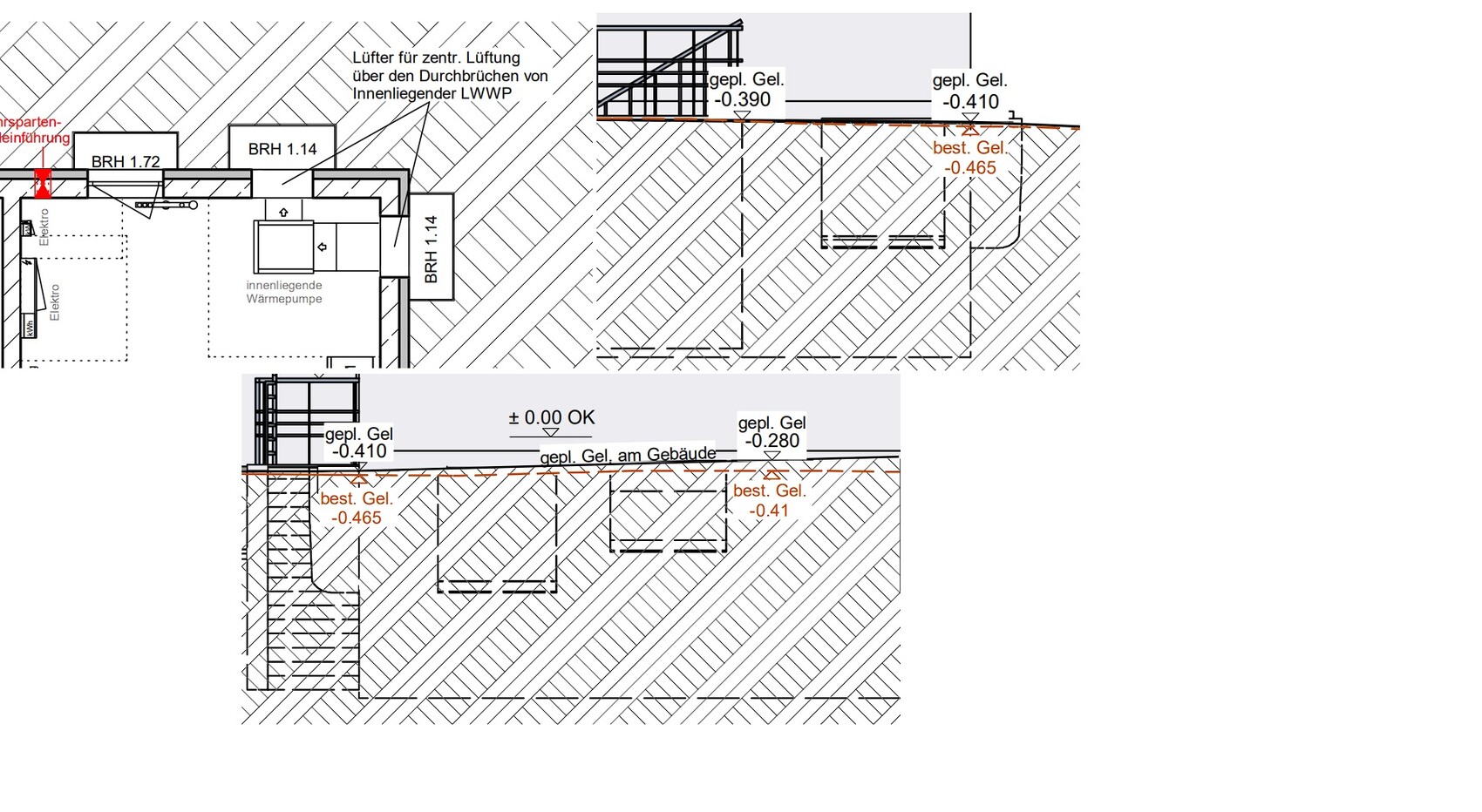
I have looked at the products from Doyma, but I believe they are not designed for the required size. The heat pump will be from Novelan, but I don’t know the exact model designation.
I have looked at the products from Doyma, but I believe they are not designed for the required size. The heat pump will be from Novelan, but I don’t know the exact model designation.
A
Allthewayup10 Jan 2023 22:02Now I understand it a bit better. The heat pump doesn’t have an outdoor unit and is therefore supplied through very large duct cross-sections for supply and exhaust air. That explains the air ducts on the outside – things are becoming clearer to me now. This is a completely different issue than I initially assumed. I looked up pictures of the installed unit online and can now understand the general contractor’s perspective a little more.
Try calling the manufacturer and ask if there is a waterproof building penetration available for this. A second option would be a waterproof external air duct (there are also waterproof light wells) with forced drainage, including a backflow preventer.
What does the soil report say about the groundwater level and which load case applies? Is the design water level of -1.75 m (about -5.7 ft) already increased with a risk surcharge (usually 0.3 m (1 ft))? What does the soil report recommend for basement waterproofing? Probably waterproof concrete construction and watertight light wells and windows?
Overall, I see it positive that your general contractor immediately raises concerns here instead of just blindly proceeding.
Try calling the manufacturer and ask if there is a waterproof building penetration available for this. A second option would be a waterproof external air duct (there are also waterproof light wells) with forced drainage, including a backflow preventer.
What does the soil report say about the groundwater level and which load case applies? Is the design water level of -1.75 m (about -5.7 ft) already increased with a risk surcharge (usually 0.3 m (1 ft))? What does the soil report recommend for basement waterproofing? Probably waterproof concrete construction and watertight light wells and windows?
Overall, I see it positive that your general contractor immediately raises concerns here instead of just blindly proceeding.
Similar topics