
ᐅ Floor Plan Design / Initial Draft for Preliminary Feedback
Created on: 30 Mar 2014 01:03
L
LiquidSky
Hello,
I would appreciate any feedback on these ideas. Much of it is not yet finalized because I am primarily looking for initial input.
The planned house will be built on a plot that slopes approximately 1 meter (3.3 feet) from north to south. However, the ground floor can only be 30 cm (12 inches) above street level. The house must have a 40° pitched roof. Two full stories are possible, but we are planning for 1.5 stories with a knee wall height of 1.50 meters (5 feet). Eventually, two adults and two children will live in the house. I have not yet planned the upper floor because, in my view, the ground floor is more complex; once that is finalized, I will work on the upper floor.
The current design is based on a 10 x 10 meter (33 x 33 feet) slab foundation. Wall thicknesses may add to this, or the rooms might be slightly smaller. The wall between the guest room and living room could possibly be moved along the yellow line. Likewise, the closet in the hallway might be relocated under the stairs. The red/gray areas in the images are placeholders for the fireplace.
I created everything on the computer since it allows me to try different variations more quickly.
I look forward to your feedback and plan to post the next steps here as well.
Good luck,
LiquidSky
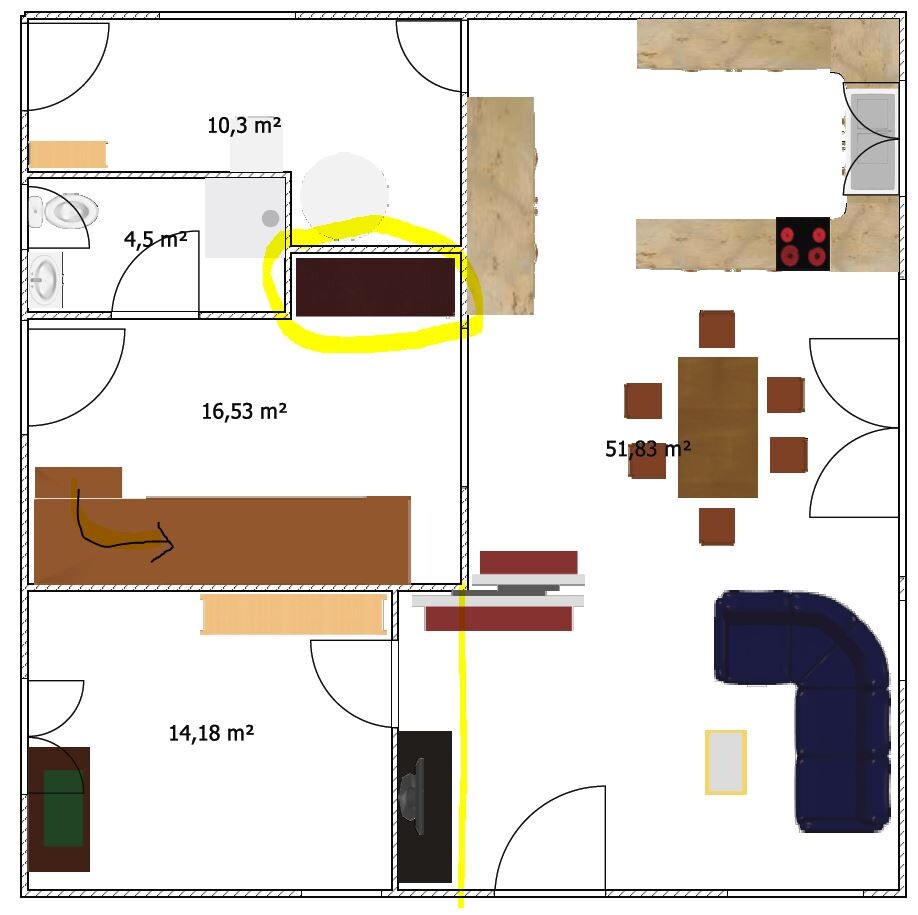
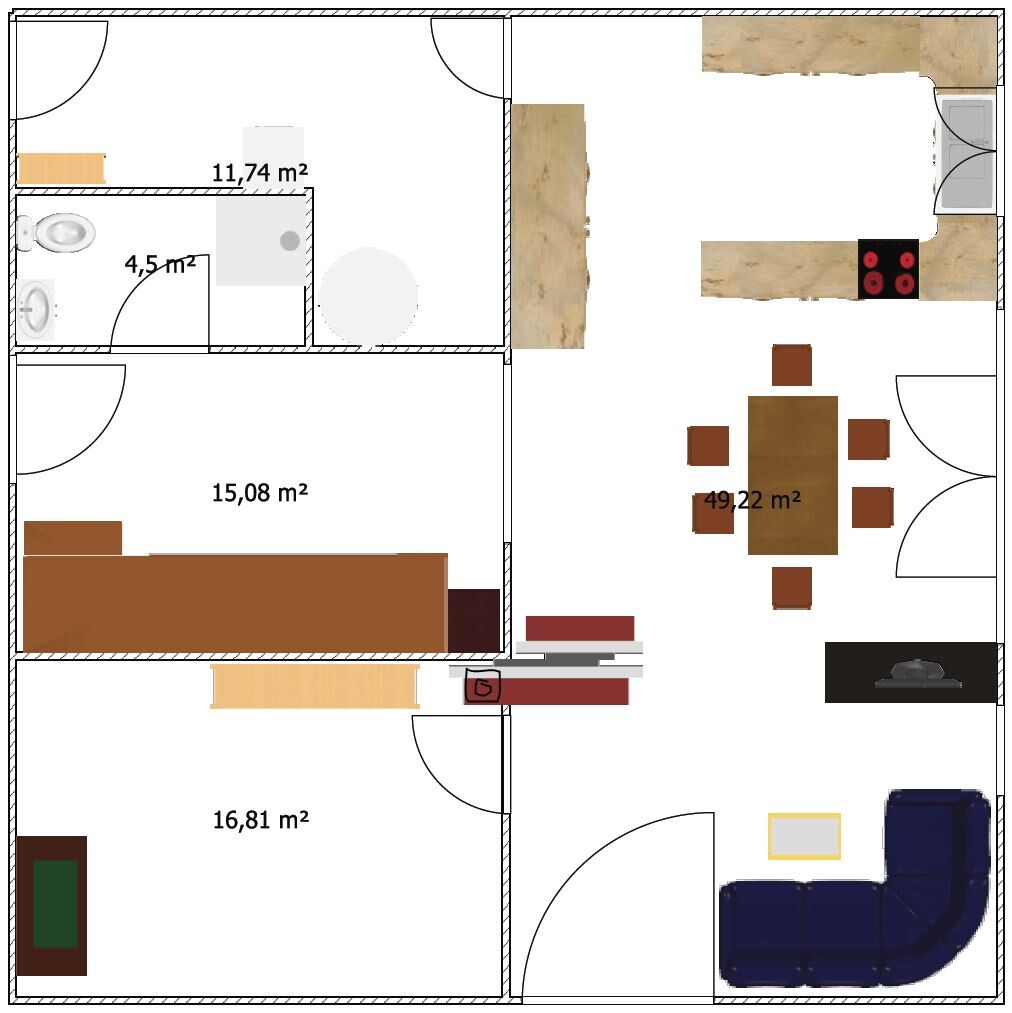
I would appreciate any feedback on these ideas. Much of it is not yet finalized because I am primarily looking for initial input.
The planned house will be built on a plot that slopes approximately 1 meter (3.3 feet) from north to south. However, the ground floor can only be 30 cm (12 inches) above street level. The house must have a 40° pitched roof. Two full stories are possible, but we are planning for 1.5 stories with a knee wall height of 1.50 meters (5 feet). Eventually, two adults and two children will live in the house. I have not yet planned the upper floor because, in my view, the ground floor is more complex; once that is finalized, I will work on the upper floor.
The current design is based on a 10 x 10 meter (33 x 33 feet) slab foundation. Wall thicknesses may add to this, or the rooms might be slightly smaller. The wall between the guest room and living room could possibly be moved along the yellow line. Likewise, the closet in the hallway might be relocated under the stairs. The red/gray areas in the images are placeholders for the fireplace.
I created everything on the computer since it allows me to try different variations more quickly.
I look forward to your feedback and plan to post the next steps here as well.
Good luck,
LiquidSky
L
LiquidSky2 Apr 2014 23:55May I ask what makes a 1.5-story house more expensive than a 2-story one? As a layperson, the only thing that comes to mind is the additional ring beam, but many other components are actually omitted.
My experience with various construction companies clearly indicated that 2-story houses tend to be more expensive.
Yes, I’m still pondering the utility room as well.
We have already consulted the architect, but unfortunately, the issue hasn’t been resolved for us yet. The biggest challenge with the building plot is the slope and how it affects the buildable area. We kept the floor plan simple, mainly to control costs, and for example, didn’t choose an L-shape.
I think it’s time to schedule another meeting with the architect soon.
My experience with various construction companies clearly indicated that 2-story houses tend to be more expensive.
Yes, I’m still pondering the utility room as well.
We have already consulted the architect, but unfortunately, the issue hasn’t been resolved for us yet. The biggest challenge with the building plot is the slope and how it affects the buildable area. We kept the floor plan simple, mainly to control costs, and for example, didn’t choose an L-shape.
I think it’s time to schedule another meeting with the architect soon.
W
Wanderdüne3 Apr 2014 00:53LiquidSky schrieb:
The building envelope has the biggest challenge regarding the slope present on the site. You can approach a slope creatively and, within certain limits, modify it. This doesn’t make planning easier, but the outcome can be more appealing.
LiquidSky schrieb:
We kept the floor plan simple, mainly because of cost considerations, and for example didn’t choose an L-shape. However, you also need to consider the total costs. Landscaping planning and execution cost money, as does your bike shed, and while the storage solution under the stairs is attractive, it also adds significant expense. An L-shape will be more expensive, but it can achieve the planning goals that are very difficult to meet with a standard floor plan.
Originally, you had a square floor plan. To question this, try a perspective change: if you only looked at the floor plan and then tried to infer the shape of the lot from it, would the imagined lot match the actual one? Probably not. That means something doesn’t fit.
LiquidSky schrieb:
I think it’s time to meet with the architect again. Please share the previous plans— I still don’t see where a 40% savings can come from. Did you have a large wellness or spa area? An underground garage? A ballroom? In the latest plan, the north arrow doesn’t match the sketch, the guest toilet wastes space and money, the living room offers almost no space for wardrobes, the bathroom is not worthy of a new build, and the overall room orientation needs to be reconsidered. The plot is challenging— you won’t get far without a professional. However, it might be that you could save money overall by choosing a different lot suitable for building the very low-cost, basic catalog house 124, but that would require very inexpensive building land in my opinion.
L
LiquidSky3 Apr 2014 11:10I have to agree with you about the L-shape and the costs. I’ve taken a look at what a floor plan with a garage on the ground floor might look like.
At first glance, it seems quite complex because we need to have a gable roof with a 40-degree pitch. If the current floor plan becomes narrower, there will quickly be only sloped ceilings on the upper floor. I’ll see what ideas I come up with for that. But basically, a house in an L-shape with two full floors would certainly be nice. Still, I can see the costs adding up. We’ll see.
My wife wants a living room without many cabinets, just a display cabinet at most. I have already been thinking about storage space, but then the study will simply have to provide enough room for that.
I’ve attached the old plan. Above the dining area, there was supposed to be a gallery and a window spanning two floors. In the cost estimate, only the floor of the attic is included. The rest is just a placeholder.
But the more I thought about it, there is more than just the cost that bothers me about it.
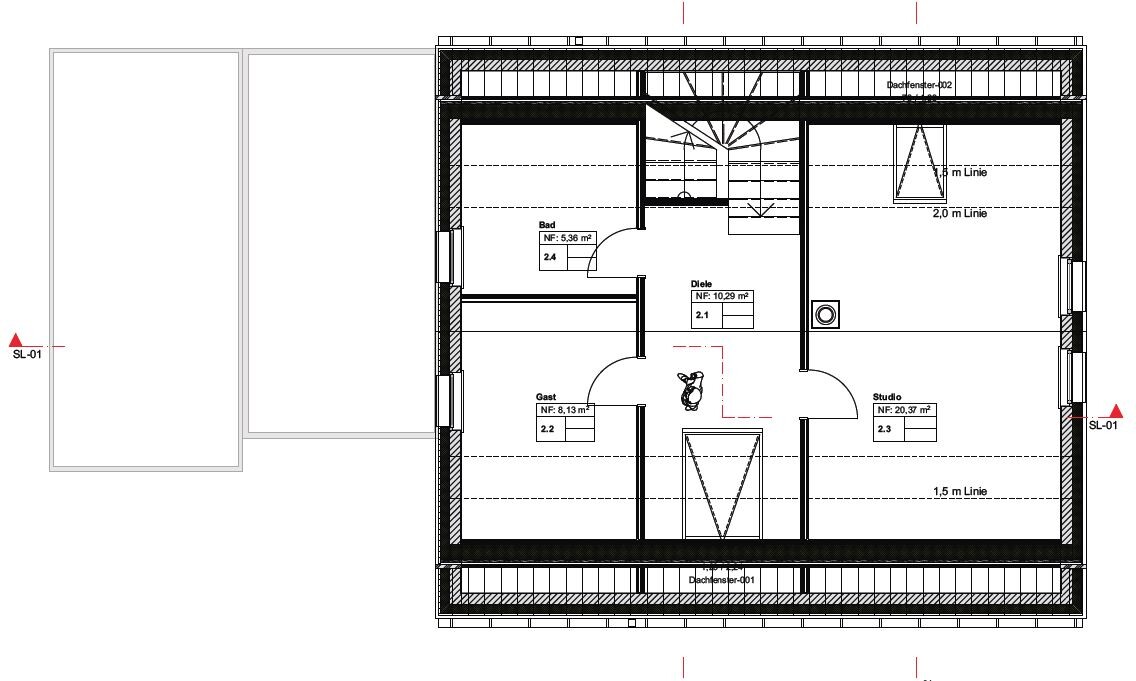
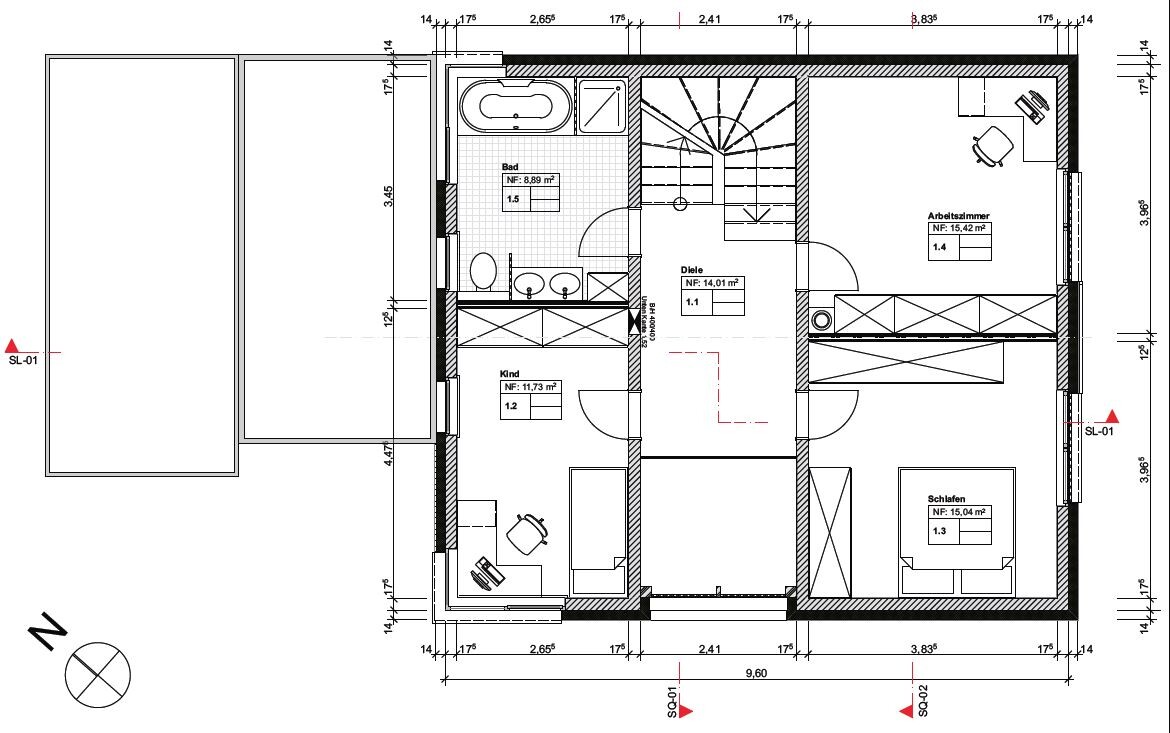
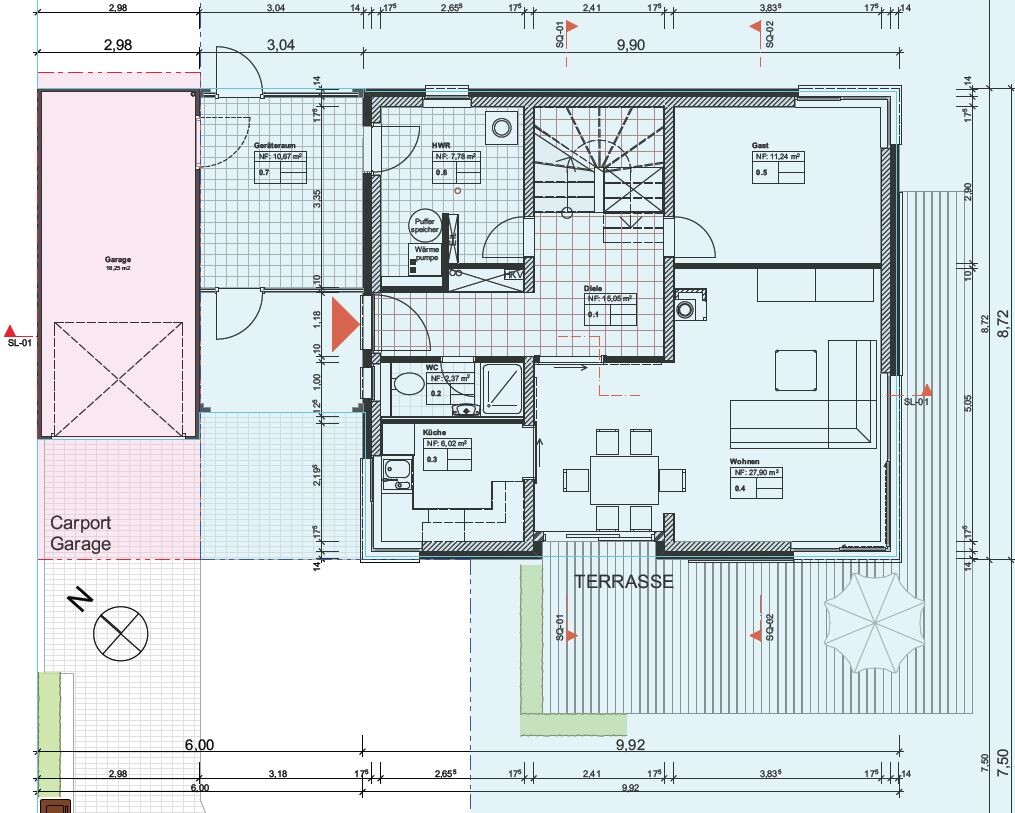
At first glance, it seems quite complex because we need to have a gable roof with a 40-degree pitch. If the current floor plan becomes narrower, there will quickly be only sloped ceilings on the upper floor. I’ll see what ideas I come up with for that. But basically, a house in an L-shape with two full floors would certainly be nice. Still, I can see the costs adding up. We’ll see.
My wife wants a living room without many cabinets, just a display cabinet at most. I have already been thinking about storage space, but then the study will simply have to provide enough room for that.
I’ve attached the old plan. Above the dining area, there was supposed to be a gallery and a window spanning two floors. In the cost estimate, only the floor of the attic is included. The rest is just a placeholder.
But the more I thought about it, there is more than just the cost that bothers me about it.
L
LiquidSky3 Apr 2014 21:58I really like the L-shaped design idea, but in my opinion, the building boundary limits the possibilities here.
In the northwest, the building boundary is quite narrow, so an L-shape would make the building very elongated. That would cause difficulties with the gable roof and the roof slopes.
If I leave the house as it is, there is hardly any space within the building boundary for the cross wing, or the house has to be set far back on the lot, which would make the garden behind the house very small.
As the simplest option, I considered placing the garage as a wing in front of the house and possibly adding a small gable roof to increase privacy. But that does not fit within the building boundary. I have attached a picture showing it (house - pink / garage - yellow).
I need a break for today.
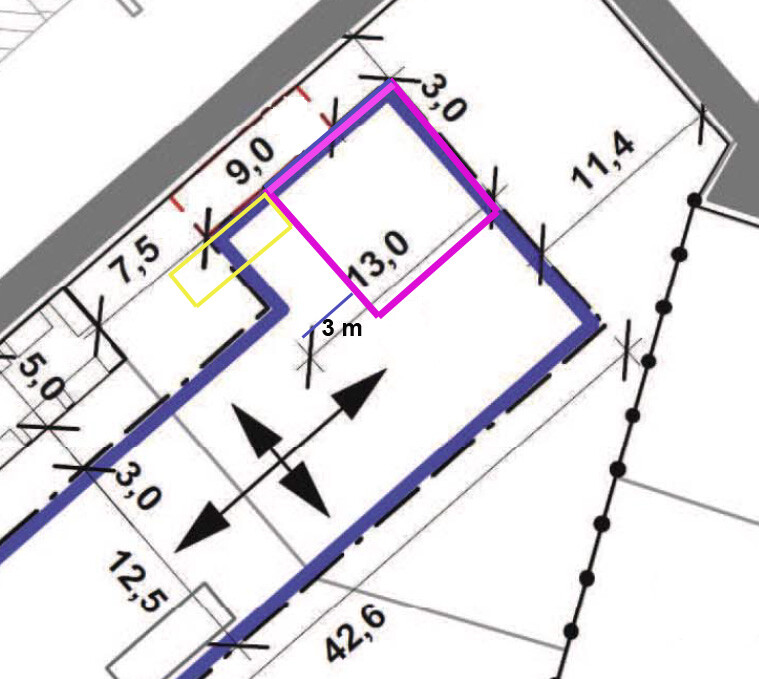
In the northwest, the building boundary is quite narrow, so an L-shape would make the building very elongated. That would cause difficulties with the gable roof and the roof slopes.
If I leave the house as it is, there is hardly any space within the building boundary for the cross wing, or the house has to be set far back on the lot, which would make the garden behind the house very small.
As the simplest option, I considered placing the garage as a wing in front of the house and possibly adding a small gable roof to increase privacy. But that does not fit within the building boundary. I have attached a picture showing it (house - pink / garage - yellow).
I need a break for today.
W
Wanderdüne4 Apr 2014 09:17Before you start planning on your own:
Wall heights and windows affect setback requirements.
If the neighboring property owner is cooperative, setbacks can sometimes be reduced through building encumbrances or easements. However, this must be checked in each case in advance with the applicable building regulations, the authority (e.g., by preliminary inquiry—only by a professional!), and the neighbor.
With these requirements, the planner can then work creatively. (For example, a flatter building section closer to the boundary, roof pitch, handling of building storeys.)
Wall heights and windows affect setback requirements.
If the neighboring property owner is cooperative, setbacks can sometimes be reduced through building encumbrances or easements. However, this must be checked in each case in advance with the applicable building regulations, the authority (e.g., by preliminary inquiry—only by a professional!), and the neighbor.
With these requirements, the planner can then work creatively. (For example, a flatter building section closer to the boundary, roof pitch, handling of building storeys.)
Similar topics