
ᐅ Floor plan: New construction on an existing bungalow basement, one-and-a-half stories
Created on: 19 Dec 2022 01:12
M
Mal Bauen
Hello to all forum members,
We are still relatively early in our building project and have many fundamental questions to clarify. Nevertheless, I would like to introduce the project here.
We recently became owners of a prefabricated bungalow from Streif Haus, built in 1987. It has a full concrete basement (by Betonkemmler).
Our plan is to demolish the bungalow down to the top edge of the basement and build a new house for our family (currently four, eventually five) on top. The existing basement (very solid construction) is to be integrated as a utility basement including a technical room. At the same time, the heating system will be modernized from oil heating to a heat pump.
Currently, we are in contact with both prefabricated house suppliers (Weberhaus, Danwood) and solid construction companies (Denkinger). The property is located in Baden-Württemberg (southern Baden).
Even though the floor plan is only a first draft, I would like to present it here for feedback (summary below).
In particular, I hope to get some thoughts on the following basic questions:
Here is the summary sheet (key points).
Many thanks in advance for your input, comments, and critiques. I will gladly report further developments here in the thread.
Development Plan / Restrictions
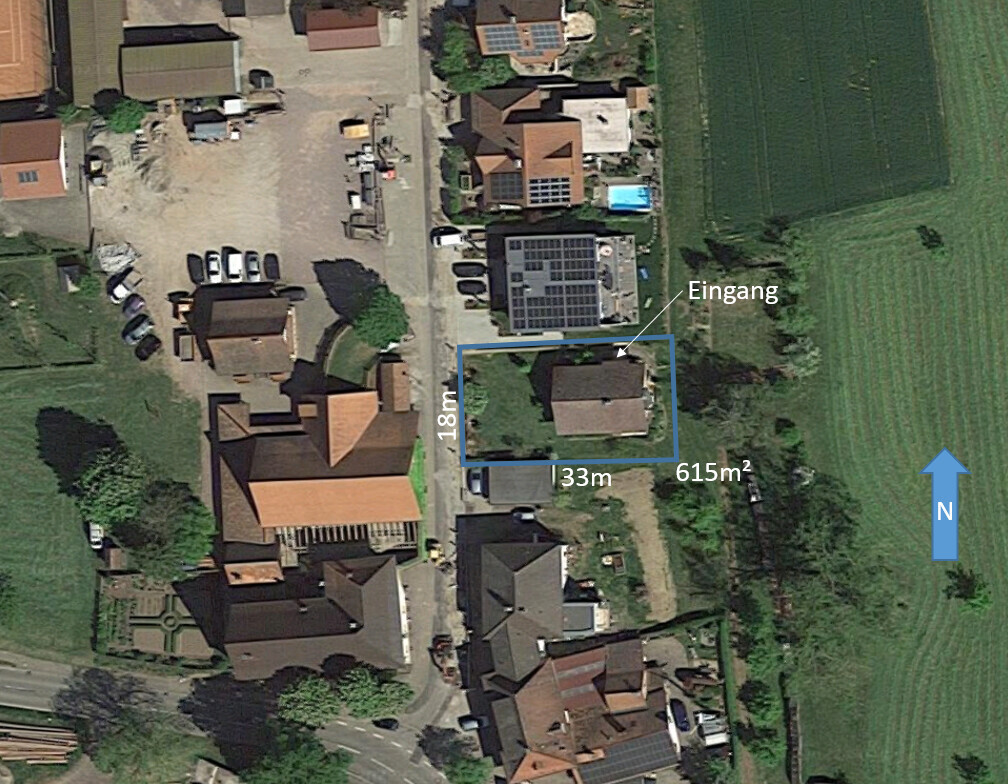
Size of the plot: 615m² (6620 sq ft)
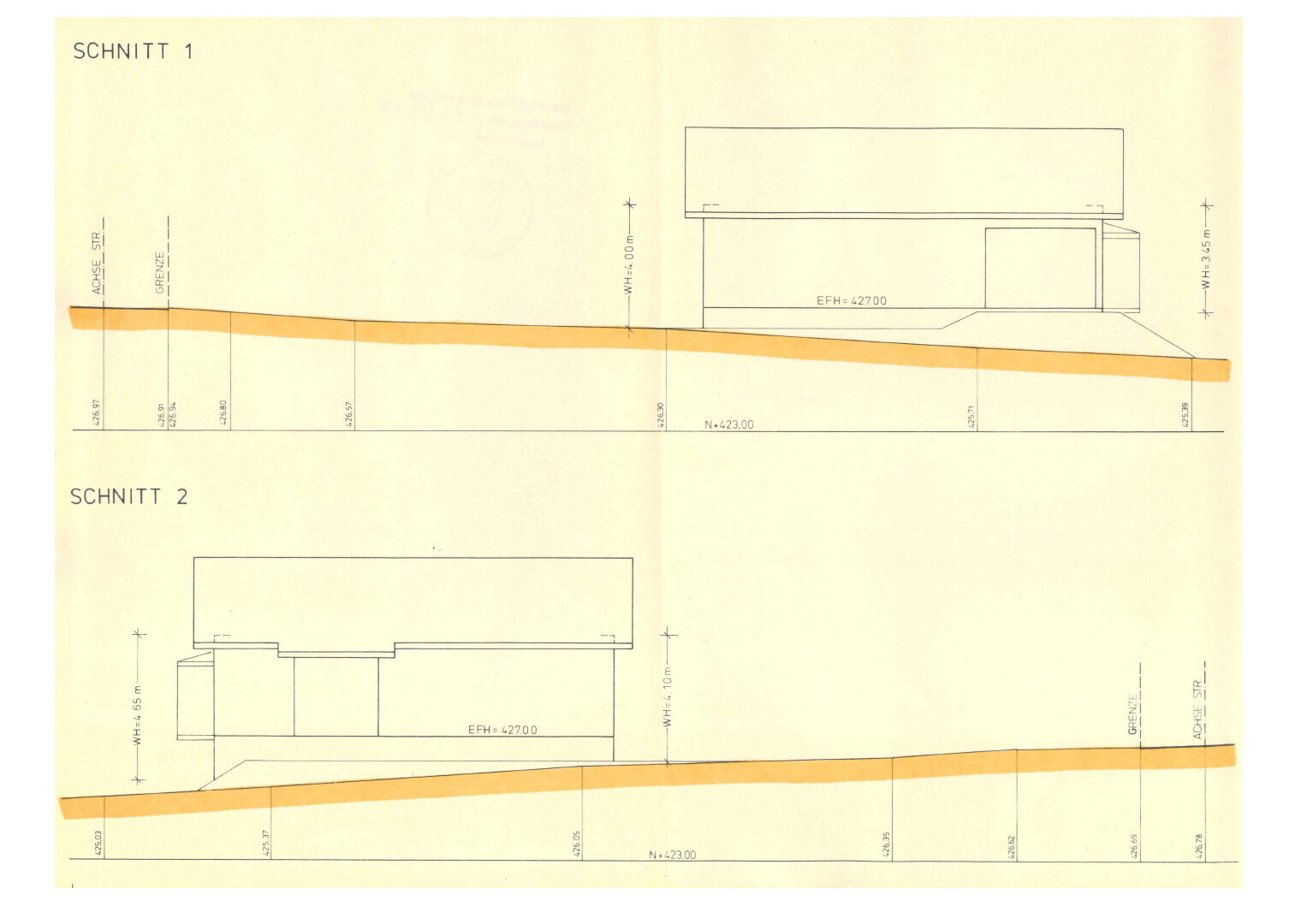
Slope: North/South: <0.5m (1.6 ft) over 18m (59 ft), West-East: approx. 2m (6.6 ft) over 33m (108 ft) (see elevation profile)
Site coverage ratio: No development plan (Section 34 of German Building Code). The immediate neighborhood contains some generously built plots. We do not want to change the building footprint of the existing house but want to add a double garage (not currently present).
Floor area ratio: No development plan (Section 34 of German Building Code)
Building envelope, building line and boundary: No development plan (Section 34 of German Building Code). Property boundaries and existing building shown in aerial photo attached
Edge development: None
Number of parking spaces: None
Number of floors: 1.5 stories
Roof type: Gable roof
Architectural style: Modern detached family house
Orientation: see aerial photo. Entrance (currently): north
Maximum height/limits: No development plan
Immediate neighbors: Northern neighbor: 2 stories with flat roof. Southern: 1.5 stories with hipped roof. Western: 1.5 stories with gable roof.
Client Requirements
Style, roof form, building type: We want to transform the existing bungalow into a classic 1.5-story detached house with a gable roof and possibly shed dormers.
Basement, floors: Utility basement (existing, concrete basement), ground floor (living), upper floor (sleeping)
Number of persons, ages: Our family currently has four members (ages: 32, 30, 2, 0), with another child planned
Space requirements on ground and upper floor:
Ground floor: living room, kitchen (possibly with pantry), room for home office or guest room, guest WC with shower, cloakroom
Upper floor: master bedroom, 3 children’s bedrooms, bathroom
Office: family use or home office: Home office (100% for me)
Overnight guests per year: Few, less than 5 guests/nights
Open or closed architecture: Rather closed. Ability to separate kitchen and living room would be desirable.
Conservative or modern design: Modern
Open kitchen, kitchen island: Kitchen island not mandatory. Partly open kitchen: separation from living room would be good.
Number of dining seats: 5-8
Fireplace: Only if budget allows, not mandatory
Music/ stereo wall: No
Balcony, roof terrace: No
Garage, carport: Double garage
Utility garden, greenhouse: No
Further wishes/special features/daily routine, including reasons for preferences or exclusions: The technical room should be located in the existing basement (e.g., in the former oil heating room). A sensible circulation concept is very important: front door/upper floor stairs/basement stairs. Ideally, short distances between garage and house as well as good accessibility of rooms within the house.
House Design
Designed by: Initial draft from the prefab house supplier after first meeting
What do you especially like? Why?: (Almost) all room requests fulfilled. Good accessibility of upper floor rooms via centrally located landing. Short distances from garage to house thanks to new front door position (west instead of north). Spacious cloakroom area. Living room oriented south/east with a nice view.
What do you not like? Why?: The draft was created after an initial discussion of the project. Some ideas and preferences developed or changed later on by us:
- Existing concrete stairs in the basement will not be used, causing extra costs for upgrading the basement (new stairs, new room layout).
- (Small) pantry for food/storage on the ground floor would be great
- Better separation of kitchen and living room is desirable
Price estimate according to architect/planner: 520,000 € (approx. $560,000), turnkey (including 10kWp photovoltaic system with 10kW storage, fresh air heating with air-to-air heat pump), excluding demolition of existing bungalow, double garage, incidental building costs
Personal price limit for house including fittings: 700,000 € (rough estimate: demolition down to top of basement: 30,000 €, house: 530,000 €, incidental costs including basement statics: 50,000 €, double garage: 30,000 €, kitchen/furniture: 40,000 €, landscaping: 20,000 €)
Preferred heating technology: Heat pump with underfloor heating. If budget allows: ground-source heat pump with deep geothermal drilling. The prefab house supplier prefers fresh air heating.
If you had to give up something, which details or add-ons could you do without: Fireplace, new basement stairs
What can you absolutely not do without: Home office
Why is the design like it is now?
Individualized draft by the prefab supplier adapted to the existing basement footprint after discussing our rough (space) requirements.
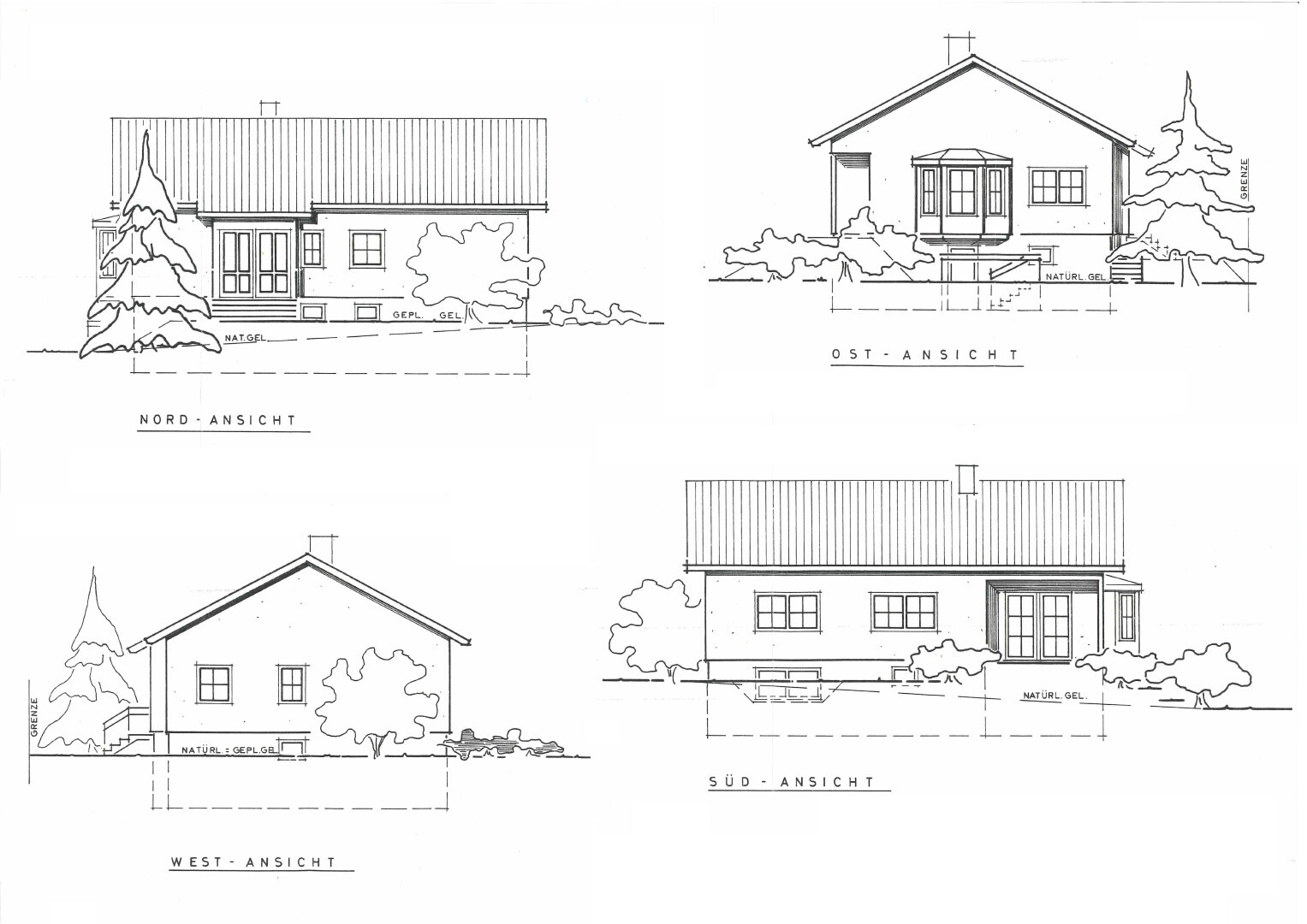
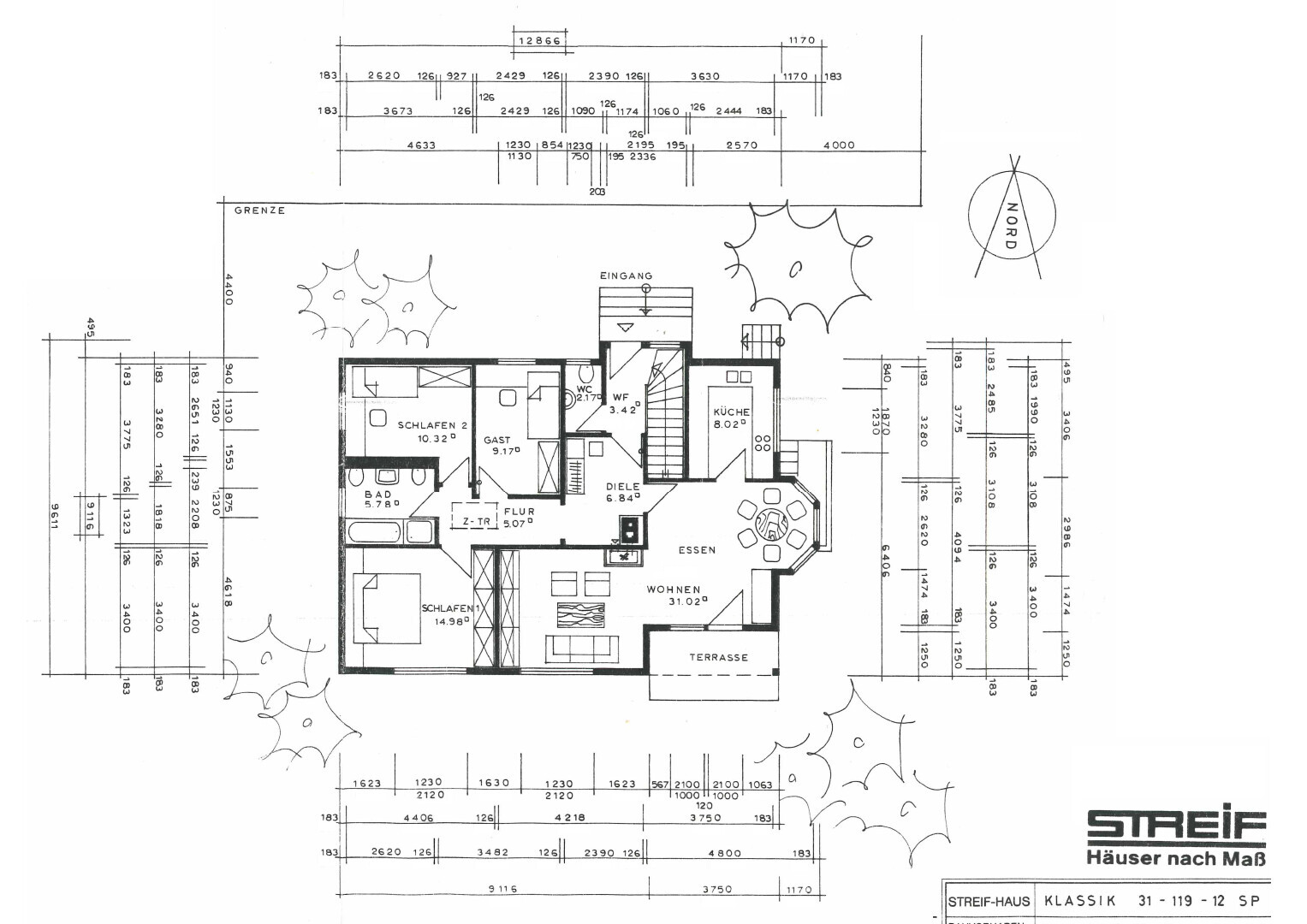
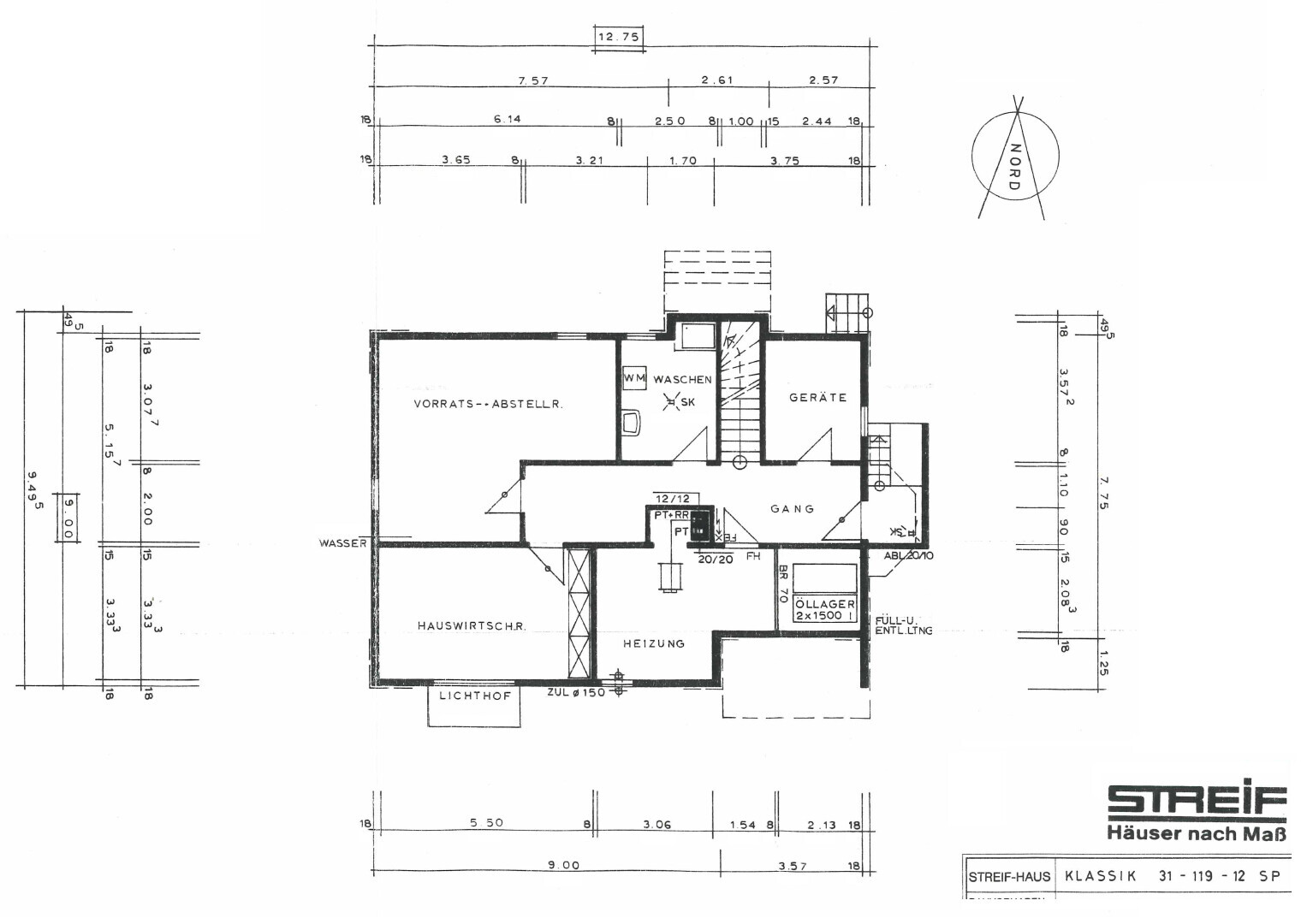
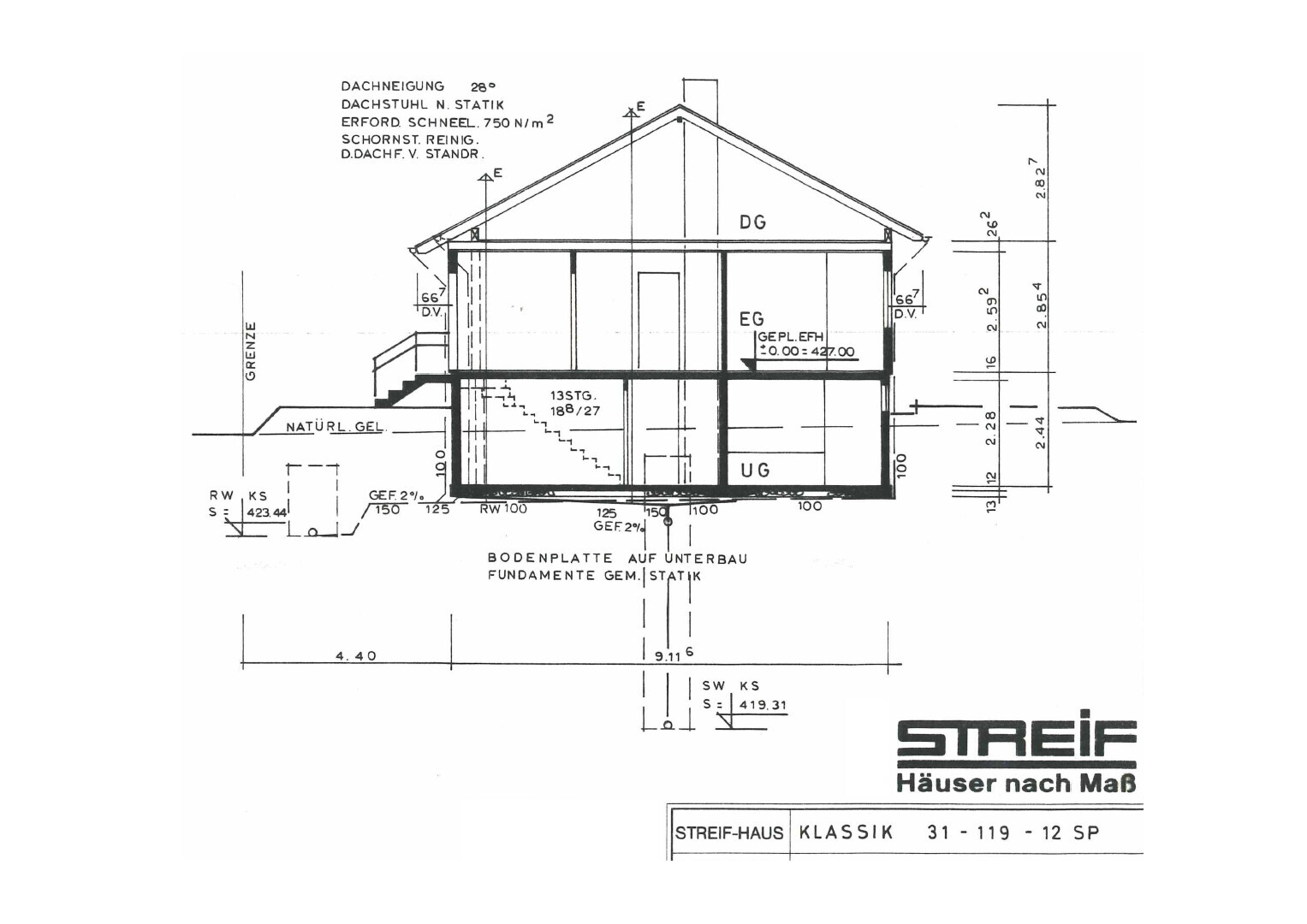
We are still relatively early in our building project and have many fundamental questions to clarify. Nevertheless, I would like to introduce the project here.
We recently became owners of a prefabricated bungalow from Streif Haus, built in 1987. It has a full concrete basement (by Betonkemmler).
Our plan is to demolish the bungalow down to the top edge of the basement and build a new house for our family (currently four, eventually five) on top. The existing basement (very solid construction) is to be integrated as a utility basement including a technical room. At the same time, the heating system will be modernized from oil heating to a heat pump.
Currently, we are in contact with both prefabricated house suppliers (Weberhaus, Danwood) and solid construction companies (Denkinger). The property is located in Baden-Württemberg (southern Baden).
Even though the floor plan is only a first draft, I would like to present it here for feedback (summary below).
In particular, I hope to get some thoughts on the following basic questions:
- Has any forum member gained experience with building on an existing basement?
- Is there generally a preferred construction method for our project? We are still undecided whether to go for a prefab timber frame house or a masonry (brick or block) solid construction.
- So far, we have not discussed a double garage with the builders, but it will be needed. Where does it make more sense: northwest or southwest (directly next to the neighbor’s garage)?
- To what extent can the project be treated as a renovation with partial demolition in terms of building regulations? Background: Are there any possibilities for funding (still) available?
- What we want to achieve with the floor plan is short walking distances inside and around the house. Therefore, the main entrance was moved from the north side to the west side. However, since it is on the short side of the house, this results in more corridor space and longer routes inside (e.g., from the front door to the stairs to the upper floor). But as the saying goes, you have to accept some drawbacks — what is your opinion: front door facing north or west?
Here is the summary sheet (key points).
Many thanks in advance for your input, comments, and critiques. I will gladly report further developments here in the thread.
Development Plan / Restrictions
Size of the plot: 615m² (6620 sq ft)
Slope: North/South: <0.5m (1.6 ft) over 18m (59 ft), West-East: approx. 2m (6.6 ft) over 33m (108 ft) (see elevation profile)
Site coverage ratio: No development plan (Section 34 of German Building Code). The immediate neighborhood contains some generously built plots. We do not want to change the building footprint of the existing house but want to add a double garage (not currently present).
Floor area ratio: No development plan (Section 34 of German Building Code)
Building envelope, building line and boundary: No development plan (Section 34 of German Building Code). Property boundaries and existing building shown in aerial photo attached
Edge development: None
Number of parking spaces: None
Number of floors: 1.5 stories
Roof type: Gable roof
Architectural style: Modern detached family house
Orientation: see aerial photo. Entrance (currently): north
Maximum height/limits: No development plan
Immediate neighbors: Northern neighbor: 2 stories with flat roof. Southern: 1.5 stories with hipped roof. Western: 1.5 stories with gable roof.
Client Requirements
Style, roof form, building type: We want to transform the existing bungalow into a classic 1.5-story detached house with a gable roof and possibly shed dormers.
Basement, floors: Utility basement (existing, concrete basement), ground floor (living), upper floor (sleeping)
Number of persons, ages: Our family currently has four members (ages: 32, 30, 2, 0), with another child planned
Space requirements on ground and upper floor:
Ground floor: living room, kitchen (possibly with pantry), room for home office or guest room, guest WC with shower, cloakroom
Upper floor: master bedroom, 3 children’s bedrooms, bathroom
Office: family use or home office: Home office (100% for me)
Overnight guests per year: Few, less than 5 guests/nights
Open or closed architecture: Rather closed. Ability to separate kitchen and living room would be desirable.
Conservative or modern design: Modern
Open kitchen, kitchen island: Kitchen island not mandatory. Partly open kitchen: separation from living room would be good.
Number of dining seats: 5-8
Fireplace: Only if budget allows, not mandatory
Music/ stereo wall: No
Balcony, roof terrace: No
Garage, carport: Double garage
Utility garden, greenhouse: No
Further wishes/special features/daily routine, including reasons for preferences or exclusions: The technical room should be located in the existing basement (e.g., in the former oil heating room). A sensible circulation concept is very important: front door/upper floor stairs/basement stairs. Ideally, short distances between garage and house as well as good accessibility of rooms within the house.
House Design
Designed by: Initial draft from the prefab house supplier after first meeting
What do you especially like? Why?: (Almost) all room requests fulfilled. Good accessibility of upper floor rooms via centrally located landing. Short distances from garage to house thanks to new front door position (west instead of north). Spacious cloakroom area. Living room oriented south/east with a nice view.
What do you not like? Why?: The draft was created after an initial discussion of the project. Some ideas and preferences developed or changed later on by us:
- Existing concrete stairs in the basement will not be used, causing extra costs for upgrading the basement (new stairs, new room layout).
- (Small) pantry for food/storage on the ground floor would be great
- Better separation of kitchen and living room is desirable
Price estimate according to architect/planner: 520,000 € (approx. $560,000), turnkey (including 10kWp photovoltaic system with 10kW storage, fresh air heating with air-to-air heat pump), excluding demolition of existing bungalow, double garage, incidental building costs
Personal price limit for house including fittings: 700,000 € (rough estimate: demolition down to top of basement: 30,000 €, house: 530,000 €, incidental costs including basement statics: 50,000 €, double garage: 30,000 €, kitchen/furniture: 40,000 €, landscaping: 20,000 €)
Preferred heating technology: Heat pump with underfloor heating. If budget allows: ground-source heat pump with deep geothermal drilling. The prefab house supplier prefers fresh air heating.
If you had to give up something, which details or add-ons could you do without: Fireplace, new basement stairs
What can you absolutely not do without: Home office
Why is the design like it is now?
Individualized draft by the prefab supplier adapted to the existing basement footprint after discussing our rough (space) requirements.

Mal Bauen schrieb:
I also spoke with a friendly representative from Streif Haus. In the past, renovations and extensions were carried out in cooperation with Renopan, but now there seems to be a new company (partly in-house), whose name he did not know. Our plans from the 1980s are no longer available at Streif Haus, but requests like mine are common and they are familiar with the process. They now have the documents and will get back to us promptly. He was generally open to your suggestion of splitting the work (shell construction: Streif Haus, interior fit-out: regional company). That’s good to hear, it sounds promising. Regarding the plans, I don’t understand the home builders: retired designers are usually very happy when someone asks them again how the building was originally constructed. A quick fix inside saves the carpenter, and the retired designer from having to search for the beams with special equipment ;-)
Mal Bauen schrieb:
I wanted to message you about this privately, but apparently I haven’t written enough posts yet to be allowed. When does that become available? That’s the best-kept secret ever; it’s believed to be at 200 posts. I use the same name at gmx de as in the forum.
https://www.instagram.com/11antgmxde/
https://www.linkedin.com/company/bauen-jetzt/

haydee schrieb:
It wasn’t about social status, but because the original poster has two very different home builders to choose from. Kind of like comparing Dacia and Porsche. It’s about a new Dacia versus a 15-year-old Porsche (at 30 years it would already be a collector’s item). It’s really a question of taste—one person wants “perfection,” the other prefers “modern navigation.”
Looking at the plot, and assuming a new build is the choice, I would seriously consider excluding the basement from the plan. The east side seems to offer a view, at least of greenery and no risk of being blocked. It makes sense, like with new builds in the north, to orient the living areas—terrace and garden—toward that side.
M
Mal Bauen5 Jan 2023 00:31hanghaus2023 schrieb:
Are there already any two-story houses in the neighborhood?
Show us a few pictures of the house.Attached are pictures of the existing building. In the immediate vicinity, there is a mix of different house types (two-story with hipped roof, two-story with flat roof, one-and-a-half-story with pitched roof and dormers).
RomeoZwo schrieb:
Looking at the plot, if you decide on a new build, I would seriously consider leaving out the basement. The east side seems to have a view, at least onto greenery and undevelopable land. It makes sense to plan the living area, meaning the terrace and garden, on that side, just as in the new builds to the north.Exactly, the east side is unobstructed and offers a nice view. That’s why we would also orient the living room there. However, we would still like to keep at least the basement even in case of a new build.
On the current status of new build vs. renovation:
- Feedback from the local carpentry company after inspection: The structural integrity of the exterior walls and the ceiling between the ground and upper floor is likely critical for adding another story. The installed 12cm (5 inches) wood studs (outside) and 9cm (3.5 inches) studs (inside) are probably undersized for the expected additional loads. The ceiling beams are only 6cm (2.5 inches) wide and appear too narrow. The prefab house was statically designed just enough to function as a bungalow.
- A building engineer confirmed this in a further inspection.
- I am still waiting for feedback from Streif Haus Haus to see if they can work something out.
Attached are excerpts from the original structural calculations by Streif Haus Haus, showing the wall construction in detail. In the image from the attic, you can roughly see the sizes of the wood studs. The rafters on the left roughly correspond in width to the attic ceiling beams. On the right side of the image, the 12cm (5 inches) exterior wall beams are visible.
haydee schrieb:
Was the house really that inexpensive? It really was: a gift/advance inheritance within the family.
Apparently, we seem to be the “wrong” family for this property because of our larger space requirements, which is why we want to add a story. A two-family household could probably renovate and use the existing floor area more easily and with less intervention.
The tendency is therefore shifting more strongly towards (partial) demolition down to the top of the basement and rebuilding as a one-and-a-half-story house. However, a local energy consultant advised me to at least declare it as a renovation in the building permit / planning permission, which he believes should generally be possible.
M
Myrna_Loy5 Jan 2023 06:50Mal Bauen schrieb:
Attached are photos of the existing building.
The immediate neighborhood features a mixed variety of house types (two-story with hipped roof, two-story with flat roof, one-and-a-half-story with gable roof and dormers).
Exactly, the east side is undeveloped and offers a nice view. Therefore, we plan to orient the living room in that direction. At least the basement will be preserved even in the case of a new build.
Current status new build vs. renovation:
- Feedback from the local carpentry company after inspection: The structural stability of the exterior walls and the floor between the ground floor and attic is likely critical for an additional storey. The installed 12cm (5 inches) exterior wood studs and 9cm (3.5 inches) interior studs are probably undersized for the expected extra loads. The ceiling joists are also only 6cm (2.5 inches) wide, which seems too narrow. The prefab house was structurally designed just enough to function as a bungalow.
- A building engineer confirmed this during another inspection.
- I am still waiting for feedback from Streif Haus on whether they can offer any solutions.
Attached are excerpts from the original structural calculation by Streif Haus, which illustrate the wall construction well. In the attic photo, you can estimate the sizes of the wood studs. The rafters on the left are roughly the same width as the attic floor joists. On the right, the 12cm (5 inches) exterior wall beams are visible.
That is indeed the situation: a gift/early inheritance within the family.
It seems we are the "wrong" family for this property because our space requirements are simply larger, and that is why we want to add another storey. A two-household family might be able to renovate and use the existing footprint more easily (and with less intervention).
Therefore, the inclination is leaning back toward (partial) demolition down to the top of the basement and rebuilding as a one-and-a-half-storey house. However, a local energy consultant advised me to at least declare this as a renovation in the building permit/planning permission application, which he believes should be generally possible. Then let us hope the energy consultant is otherwise well informed on the subject, because no building authority will approve a demolition down to the basement as a renovation.
Mal Bauen schrieb:
The trend is moving more strongly towards (partial) demolition down to the top of the basement and rebuilding as a 1.5-story building. With me, after more detailed clarification, it’s the same. However, I would keep the basement ceiling and only do a "demolition" of the walls above, meaning dismantling the entire house, and with regard to the roof structure, a partial deconstruction focusing on material preservation. I just realized a gap in my knowledge: my contacts do not yet include companies that deconstruct "prefabricated" houses. If anyone knows of such companies, please let me know!
I believe I already mentioned that I would be happy to advise on this project, as it is not straightforward. I would build much more in line with the existing basement than outlined in the initial post. And probably a "one-and-a-half-story" design, possibly even using a hybrid construction method.
Mal Bauen schrieb:
However, a local energy consultant advised me to at least declare the entire project as a renovation in the building permit / planning permission application, which he believes should be generally possible. Myrna_Loy schrieb:
Let’s hope the energy consultant is otherwise well versed in the subject, because a demolition down to the basement will not be approved as a renovation by any building authority. https://www.instagram.com/11antgmxde/
https://www.linkedin.com/company/bauen-jetzt/
M
Mal Bauen1 Apr 2023 00:53There’s an update here again:
As mentioned before, we plan to build a 1.5-story new building on the existing basement.
After initially planning with a prefabricated house company (post #1), we are now working with an independent architect who, following a discussion and an on-site visit, has provided the first floor plan draft.
The draft generally points in the right direction for us, but the devil is still very much in the details.
To make evaluation easier, I am filling out the questionnaire once more (changes from the questionnaire in post #1 are marked in blue).
I also have specific questions again (highlighted in purple) but generally welcome any feedback!
Thanks in advance.
Development Plan / Restrictions
Plot size: 615m² (6,614 sq ft)
Slope: North/South: <0.5m (1.6 ft) over 18m (59 ft), West-East: approx. 2m (6.6 ft) over 33m (108 ft) (see elevation profile in post #1)
Floor area ratio (FAR): No development plan (according to §34 of the German Building Code). Nearby properties vary, some quite generously built. We do not want to change the footprint of the existing building but plan to add a double garage (currently not present).
Plot ratio (building density): No development plan (§34 German Building Code)
Building window, building line and boundary: No development plan (§34 German Building Code). Property boundaries and existing building shown in aerial photo in post #1
Edge development: The southern neighbor’s garage borders our plot directly (9m / 30 ft). We would like to place our garage adjacent to theirs.
Parking spaces: None currently, double garage planned
Number of stories: 1.5 stories
Roof type: Gable roof
Style: Modern single-family house
Orientation: See aerial photo in post #1, entrance faces north
Maximum heights / restrictions: No development plan
The surveyor recently measured the existing building and the direct neighbors:
- Existing building (bungalow with gable roof): eaves height 4.1m (13.5 ft), ridge height 6.6m (21.7 ft)
- Southern neighbor (2 full stories + hipped roof): eaves height 7.8m (25.6 ft), ridge height 11.9m (39 ft)
- Northern neighbor (2 full stories + shed roof): eaves height 5.4m (17.7 ft), ridge height 6.8m (22.3 ft)
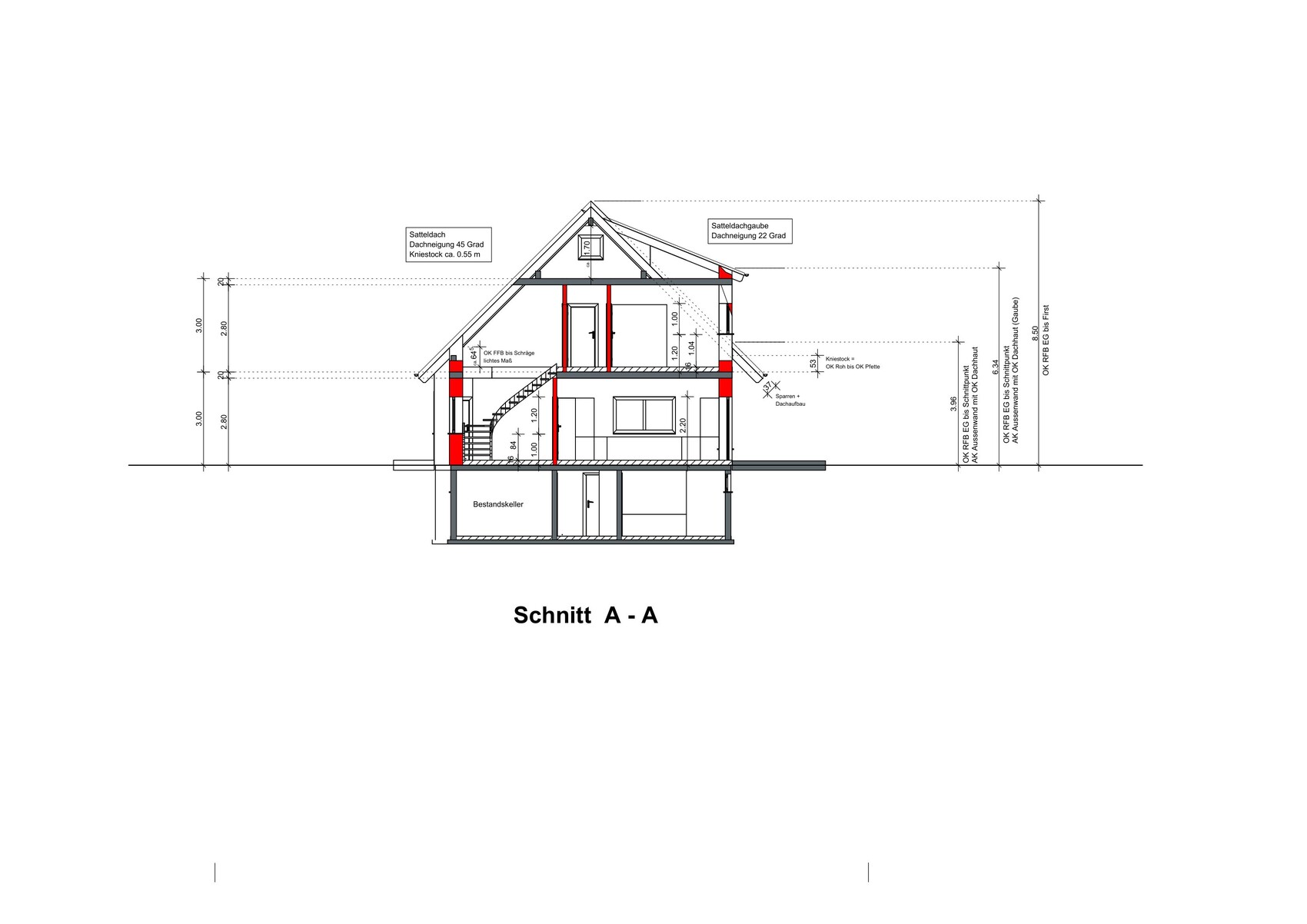
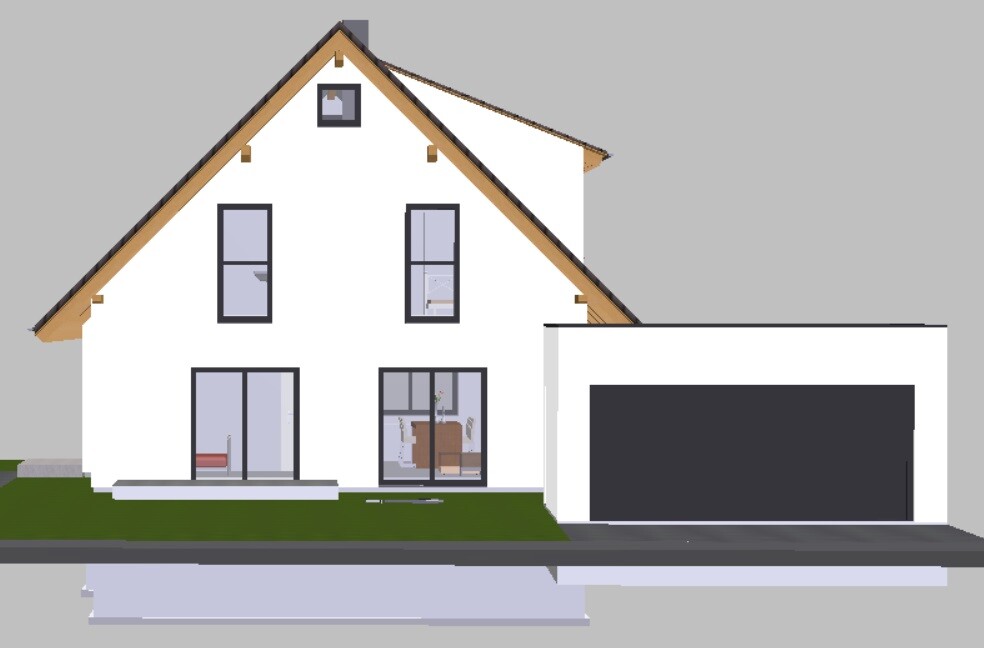
Planned house (basement extends approx. 70cm (28 inches) above ground): eaves height ~7m (23 ft), ridge height 9.2m (30 ft). (All boundary distances are being observed)
I am uncertain how well our house fits into the street under §34 of the German Building Code. Can it be assumed that the building authority will have no objections since the southern neighbor is building even higher? So far, the architect is relaxed about this.
Immediate neighbors: Northern neighbor: 2-story with flat roof. Southern neighbor: 2 stories with hipped roof, Western neighbor: 2.5 stories with gable roof
Client Requirements
Style, roof type, building type: We want to convert the existing bungalow into a classic 1.5-story single-family home with a gable roof and a shed dormer facing south.
Basement, stories: Usable basement (existing, concrete), ground floor (living), attic floor (sleeping), roof peak space
Number of occupants, ages: We are a family of four (ages 32, 30, 2, 0) with another child planned
Space requirements on ground floor (GF), upper floor (UF):
GF: living room, kitchen (with pantry/utility room), room for home office or guest room, guest WC with shower, cloakroom
UF: master bedroom, 3 children’s bedrooms, bathroom
Office: Family use or home office: Home office (100% for me)
Guests per year: Few, fewer than 5 overnight stays
Open or closed layout: Tend to prefer closed layout. Ability to separate dining and living areas desirable (e.g. with sliding or folding door).
Conservative or modern construction: Modern
Open kitchen, kitchen island: Kitchen island is not a must. Partly open kitchen: possibility to separate from living room would be good. Currently planned with kitchen island.
Number of dining seats: 5-8
Fireplace: Only if budget allows, not essential. Currently included.
Music/stereo wall: No
Balcony, roof terrace: Balcony on upper floor facing south desired, in case it becomes a separate living unit later.
Garage, carport: Double garage
Utility garden, greenhouse: No
Additional wishes / special features / daily routine and reasons for including or excluding features: The technical room should be in the existing basement (e.g. in the former oil heating room). A sensible circulation concept is important: front door / stairs to attic / stairs to basement. Ideally, short routes between garage and living area, as well as good accessibility of rooms inside the house.
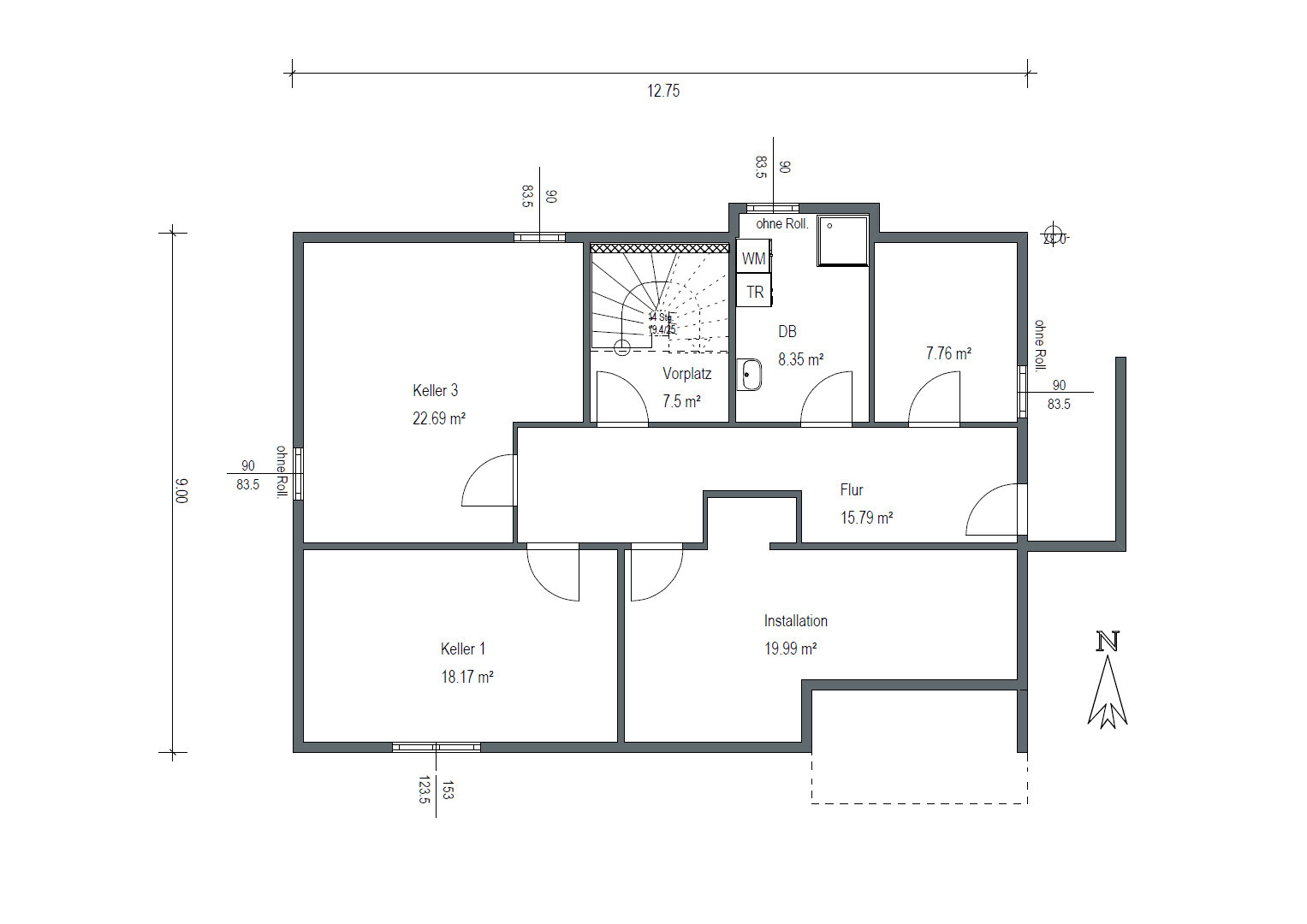
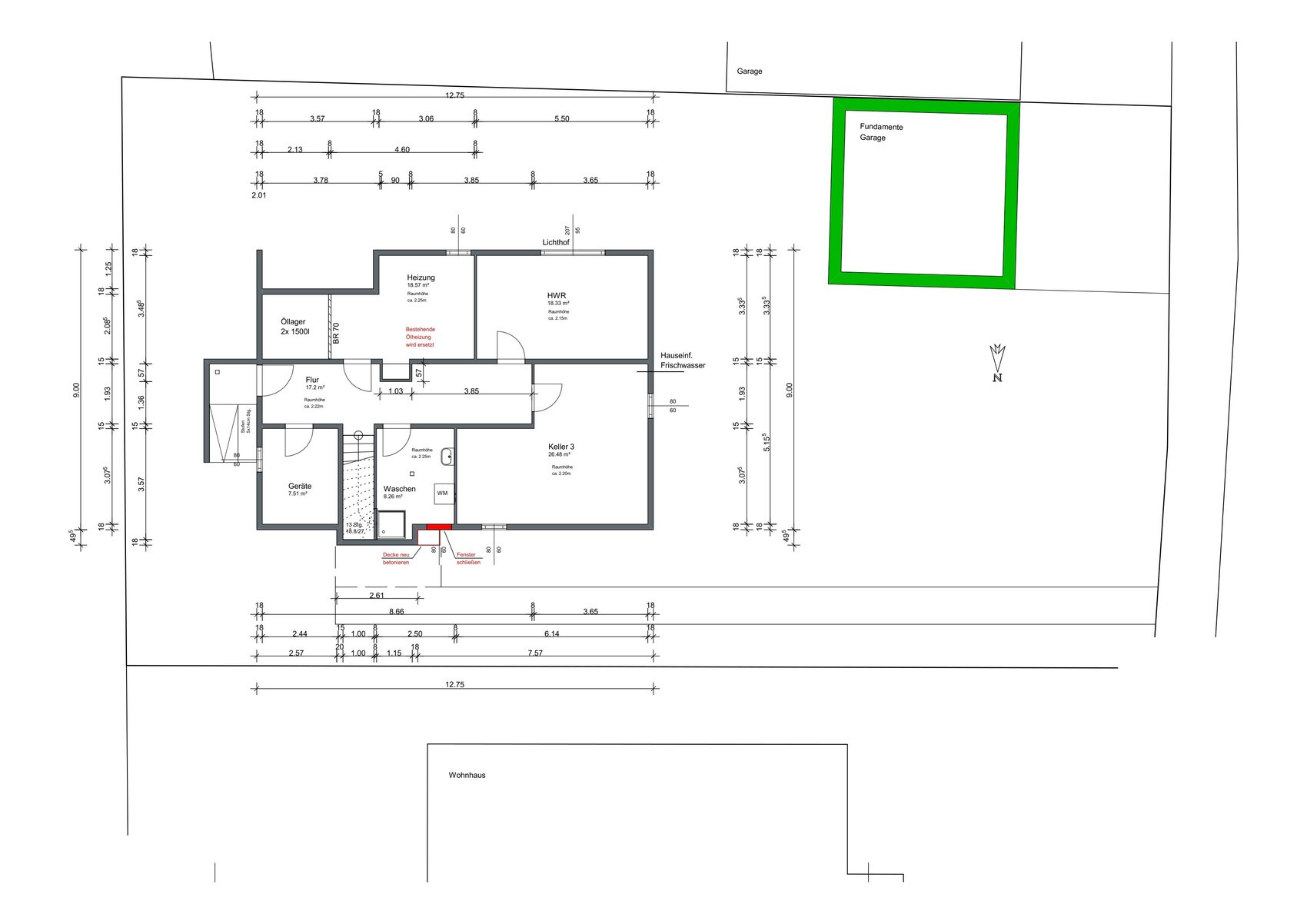
The challenge/special feature in our floor plan is the fixed existing basement. The exterior contours are fixed. The position of the basement stairs is fixed (there should be no alternative stairwell newly created elsewhere).
After consultation with the energy consultant, the basement will be excluded from the thermal envelope of the new building. Therefore, the basement access on the ground floor (door and surrounding basement stairwell) must be well insulated with thick walls. In addition, we are preparing the house for two separate living units (possibility to separate ground floor and attic later). Thus, water and electricity connections and a separate entrance (at the top of the stairs to the attic) must be prepared. This also fixes the positions of the main entrance door and the attic stairway. The goal is a highly energy-efficient house. According to our energy consultant, “KfW40 is possible, KfW55 is certain.”
Is that realistic? Does anyone here have experience with “KfW40/55 new build on a non-insulated existing basement”?
House design
Who designed it: First CAD draft from an architect after several hours of joint sketching
What do you like most? Why?:
What don’t you like? Why?:
Cost estimate from architect/planner: Not yet available. Expensive additional items include photovoltaics, water-to-water heat pump, and central controlled ventilation. We are currently planning with all wishes expressed openly; cost-cutting measures will probably come later.
Personal budget limit for the house, including fixtures and fittings: 700,000 € (rough estimate: demolition to basement top slab: 30,000 €, house: 530,000 €, incidental building costs including basement statics: 50,000 €, double garage: 30,000 €, kitchen/furniture: 40,000 €, landscaping: 20,000 €)
Preferred heating system: Heat pump with underfloor heating. If budget allows: brine-water heat pump with deep borehole.
If you have to give up details/features, which: Reluctantly, in descending order: fireplace, balcony, walkable roof peak space with fixed stairs, pantry/utility room
If you cannot give up: Home office
Why is the design like it is now?
Several hours of joint development of the ideas with the architect using pen and tracing paper. Prior phone calls and an on-site visit (including the energy consultant).
As mentioned before, we plan to build a 1.5-story new building on the existing basement.
After initially planning with a prefabricated house company (post #1), we are now working with an independent architect who, following a discussion and an on-site visit, has provided the first floor plan draft.
The draft generally points in the right direction for us, but the devil is still very much in the details.
To make evaluation easier, I am filling out the questionnaire once more (changes from the questionnaire in post #1 are marked in blue).
I also have specific questions again (highlighted in purple) but generally welcome any feedback!
Thanks in advance.
Development Plan / Restrictions
Plot size: 615m² (6,614 sq ft)
Slope: North/South: <0.5m (1.6 ft) over 18m (59 ft), West-East: approx. 2m (6.6 ft) over 33m (108 ft) (see elevation profile in post #1)
Floor area ratio (FAR): No development plan (according to §34 of the German Building Code). Nearby properties vary, some quite generously built. We do not want to change the footprint of the existing building but plan to add a double garage (currently not present).
Plot ratio (building density): No development plan (§34 German Building Code)
Building window, building line and boundary: No development plan (§34 German Building Code). Property boundaries and existing building shown in aerial photo in post #1
Edge development: The southern neighbor’s garage borders our plot directly (9m / 30 ft). We would like to place our garage adjacent to theirs.
Parking spaces: None currently, double garage planned
Number of stories: 1.5 stories
Roof type: Gable roof
Style: Modern single-family house
Orientation: See aerial photo in post #1, entrance faces north
Maximum heights / restrictions: No development plan
The surveyor recently measured the existing building and the direct neighbors:
- Existing building (bungalow with gable roof): eaves height 4.1m (13.5 ft), ridge height 6.6m (21.7 ft)
- Southern neighbor (2 full stories + hipped roof): eaves height 7.8m (25.6 ft), ridge height 11.9m (39 ft)
- Northern neighbor (2 full stories + shed roof): eaves height 5.4m (17.7 ft), ridge height 6.8m (22.3 ft)
Planned house (basement extends approx. 70cm (28 inches) above ground): eaves height ~7m (23 ft), ridge height 9.2m (30 ft). (All boundary distances are being observed)
I am uncertain how well our house fits into the street under §34 of the German Building Code. Can it be assumed that the building authority will have no objections since the southern neighbor is building even higher? So far, the architect is relaxed about this.
Immediate neighbors: Northern neighbor: 2-story with flat roof. Southern neighbor: 2 stories with hipped roof, Western neighbor: 2.5 stories with gable roof
Client Requirements
Style, roof type, building type: We want to convert the existing bungalow into a classic 1.5-story single-family home with a gable roof and a shed dormer facing south.
Basement, stories: Usable basement (existing, concrete), ground floor (living), attic floor (sleeping), roof peak space
Number of occupants, ages: We are a family of four (ages 32, 30, 2, 0) with another child planned
Space requirements on ground floor (GF), upper floor (UF):
GF: living room, kitchen (with pantry/utility room), room for home office or guest room, guest WC with shower, cloakroom
UF: master bedroom, 3 children’s bedrooms, bathroom
Office: Family use or home office: Home office (100% for me)
Guests per year: Few, fewer than 5 overnight stays
Open or closed layout: Tend to prefer closed layout. Ability to separate dining and living areas desirable (e.g. with sliding or folding door).
Conservative or modern construction: Modern
Open kitchen, kitchen island: Kitchen island is not a must. Partly open kitchen: possibility to separate from living room would be good. Currently planned with kitchen island.
Number of dining seats: 5-8
Fireplace: Only if budget allows, not essential. Currently included.
Music/stereo wall: No
Balcony, roof terrace: Balcony on upper floor facing south desired, in case it becomes a separate living unit later.
Garage, carport: Double garage
Utility garden, greenhouse: No
Additional wishes / special features / daily routine and reasons for including or excluding features: The technical room should be in the existing basement (e.g. in the former oil heating room). A sensible circulation concept is important: front door / stairs to attic / stairs to basement. Ideally, short routes between garage and living area, as well as good accessibility of rooms inside the house.
The challenge/special feature in our floor plan is the fixed existing basement. The exterior contours are fixed. The position of the basement stairs is fixed (there should be no alternative stairwell newly created elsewhere).
After consultation with the energy consultant, the basement will be excluded from the thermal envelope of the new building. Therefore, the basement access on the ground floor (door and surrounding basement stairwell) must be well insulated with thick walls. In addition, we are preparing the house for two separate living units (possibility to separate ground floor and attic later). Thus, water and electricity connections and a separate entrance (at the top of the stairs to the attic) must be prepared. This also fixes the positions of the main entrance door and the attic stairway. The goal is a highly energy-efficient house. According to our energy consultant, “KfW40 is possible, KfW55 is certain.”
Is that realistic? Does anyone here have experience with “KfW40/55 new build on a non-insulated existing basement”?
House design
Who designed it: First CAD draft from an architect after several hours of joint sketching
What do you like most? Why?:
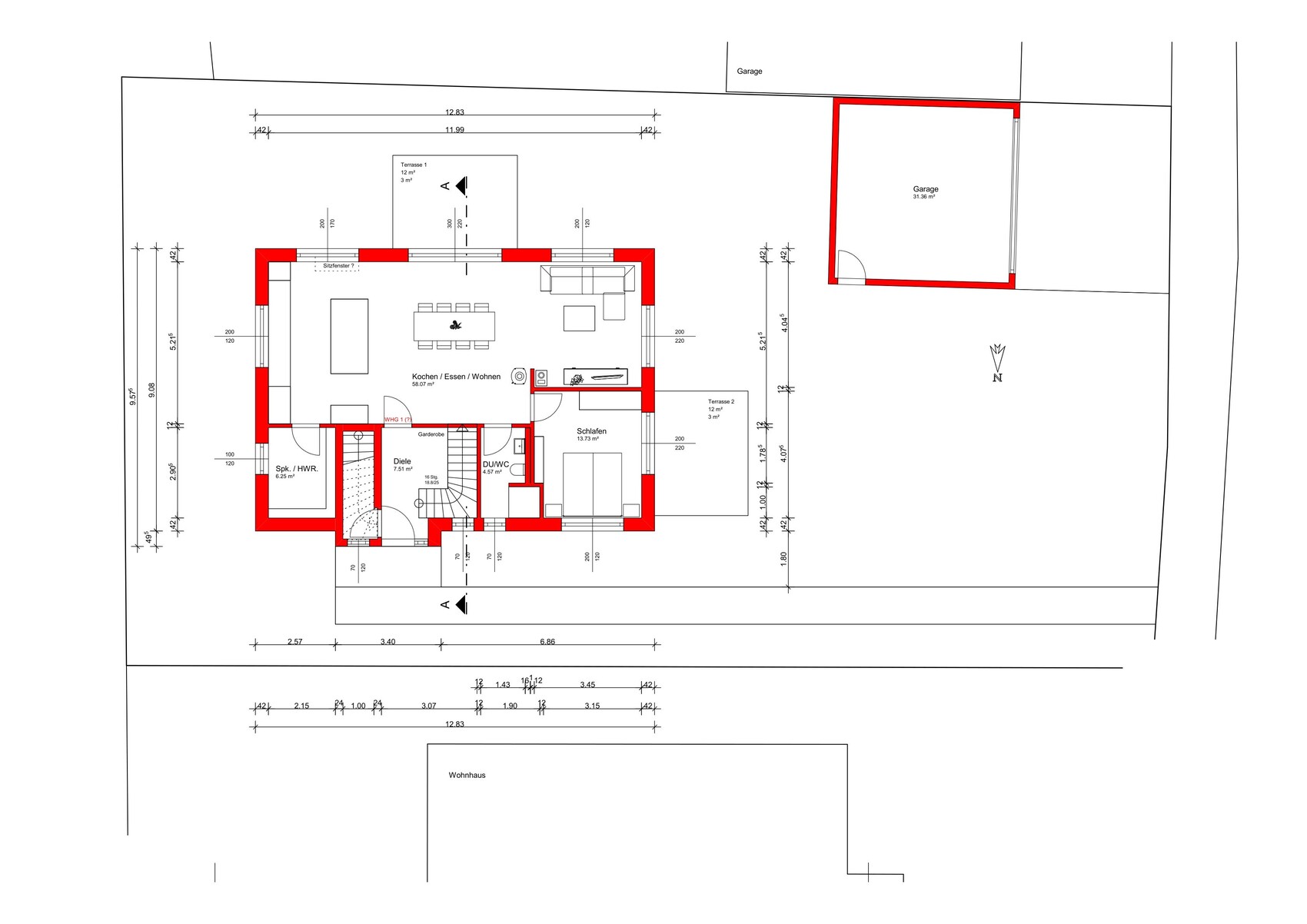
- All requested rooms are included
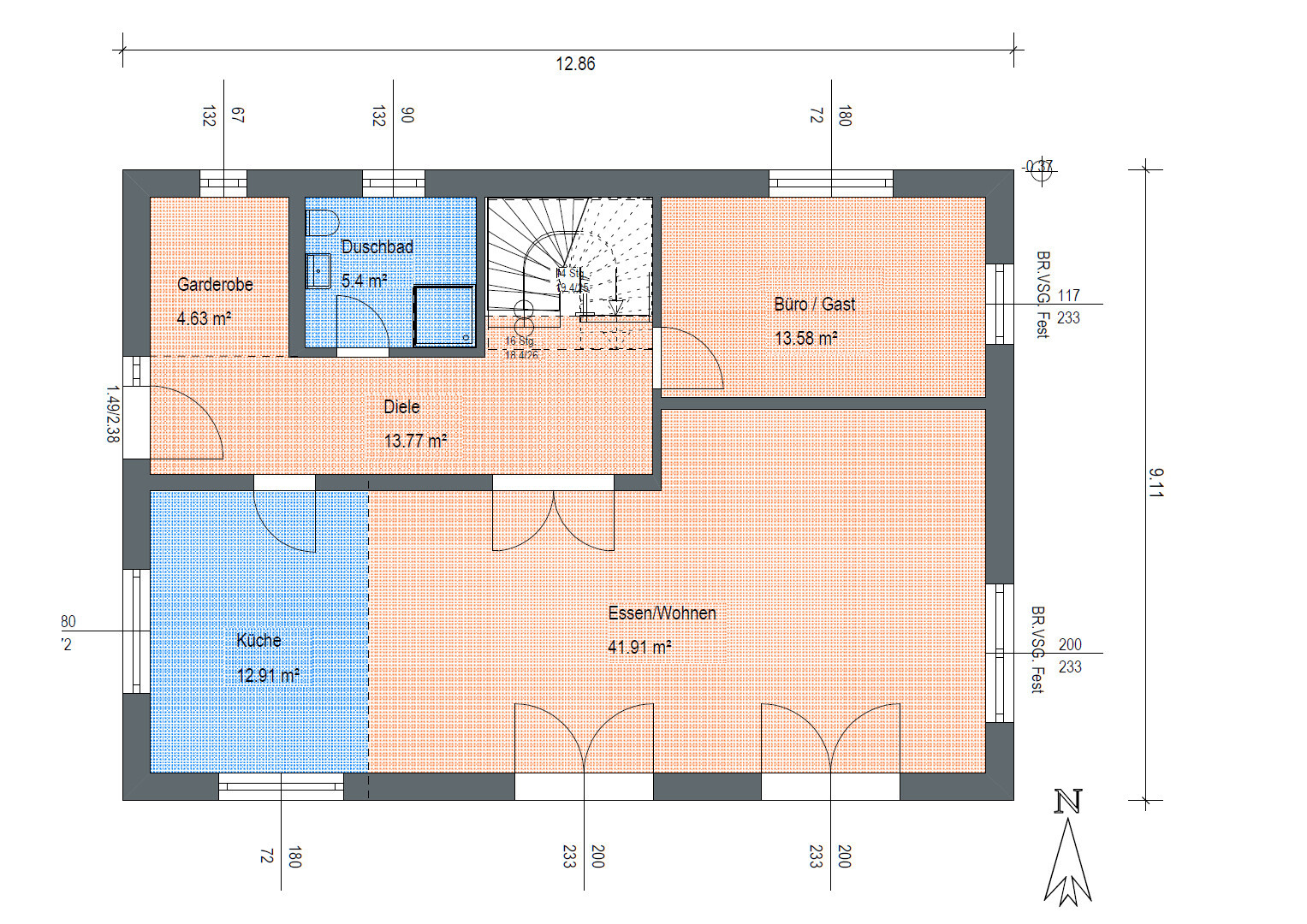
- Relatively spacious cloakroom area created by a “cantilever plate” (extending the entrance area by concreting over the basement ceiling extension)
- Possible separation of the living units (attic and ground floor)
- Overall, we like the ground floor well, especially the lovely kitchen facing southeast with a great view
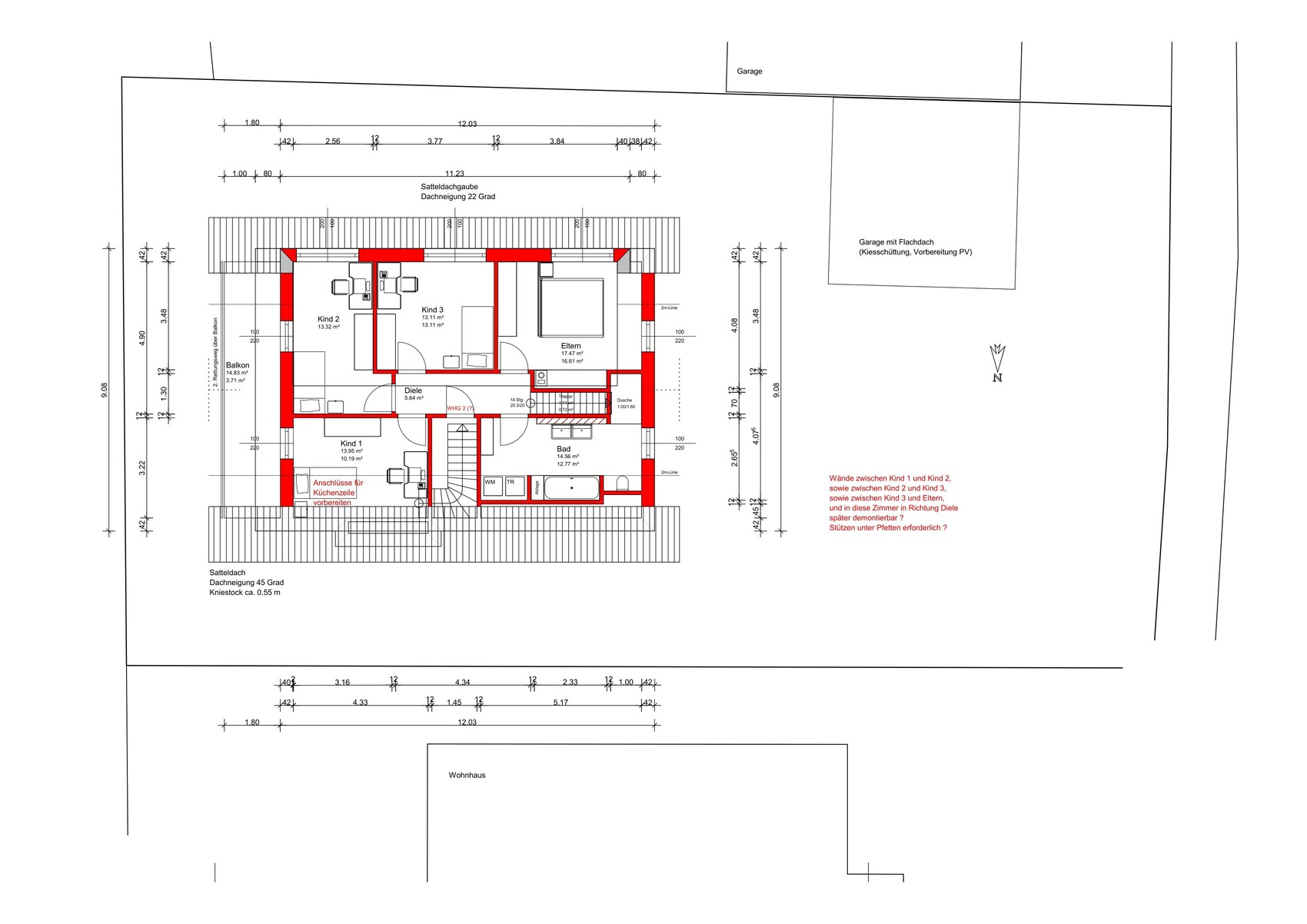
- Washing machine integrated in the attic bathroom (less laundry carrying)
What don’t you like? Why?:
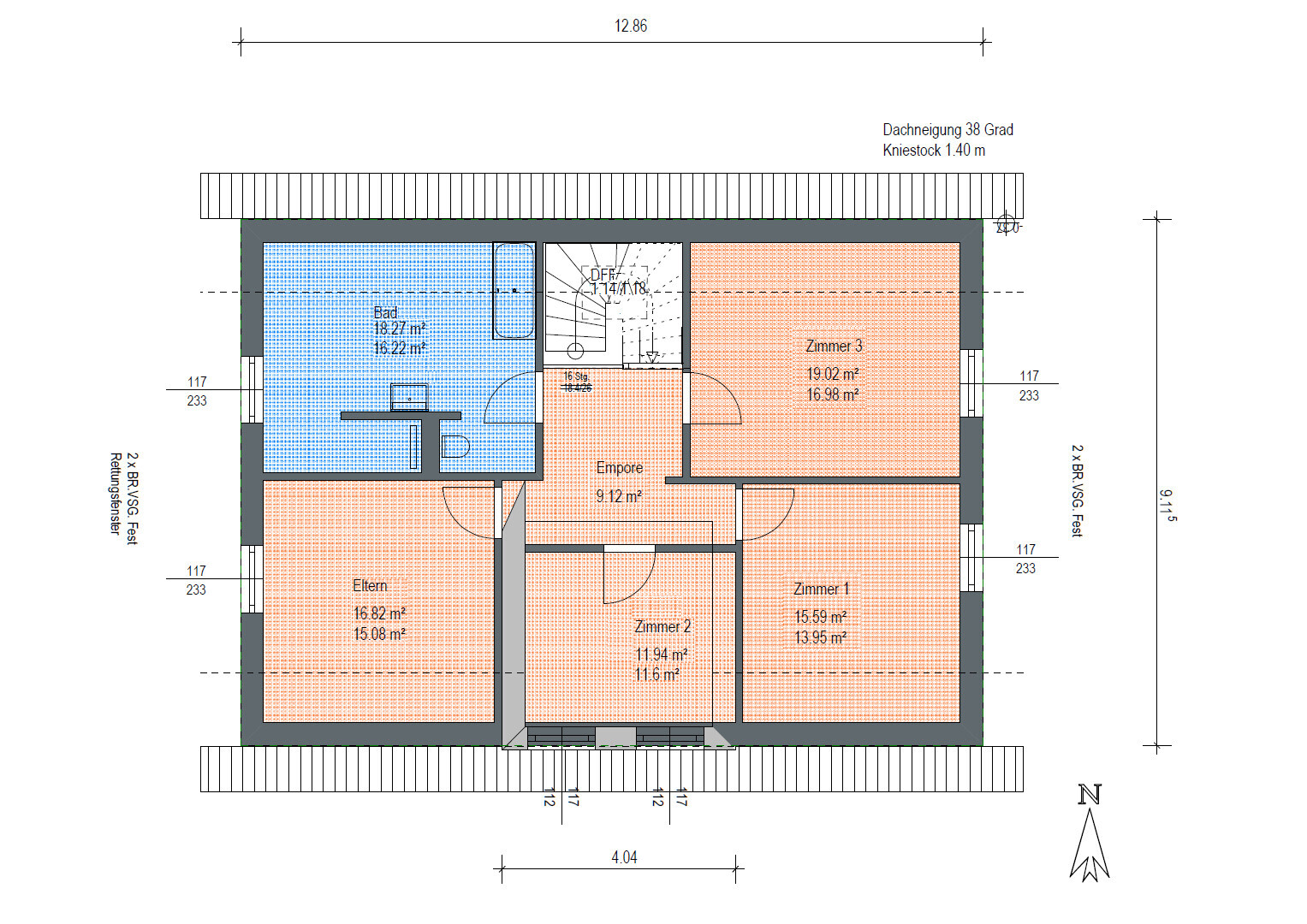
- Knee wall height of 0.65m (clear height) is too low: this costs us 2m² (22 sq ft) in the bathroom and makes it impossible to place a bed against the wall in the children’s room. The knee wall is probably this low so that the window sill height of the dormer windows remains within an acceptable range. However, in my understanding, measures should be taken to set the dormer windows deeper into the roof (e.g. by flashing).
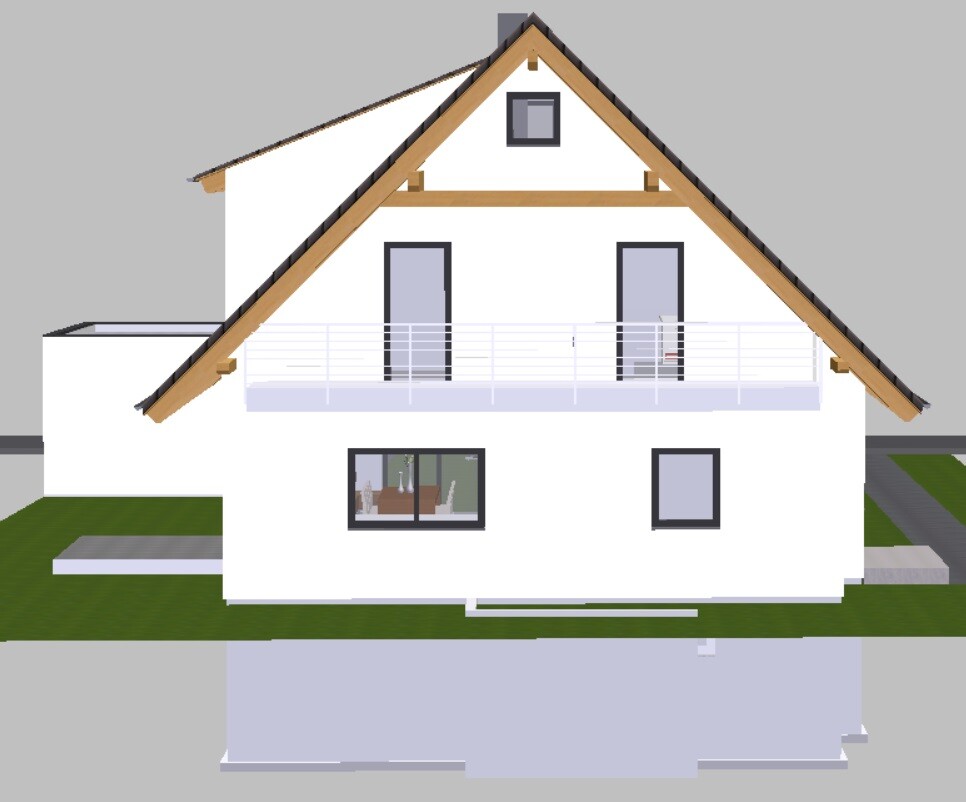
- The roof peak space, due to the low knee wall and the very generous attic room height (less would be fine here), is very small at 1.7m (5.6 ft). Especially the space-saving stair (instead of a pull-out ladder, which is a nice idea) does not make sense here because the exit “far from the ridge” only allows bending to get out.
- The balcony (client’s wish, not the architect’s fault) may take too much space from the children’s rooms and could negatively affect the energy balance
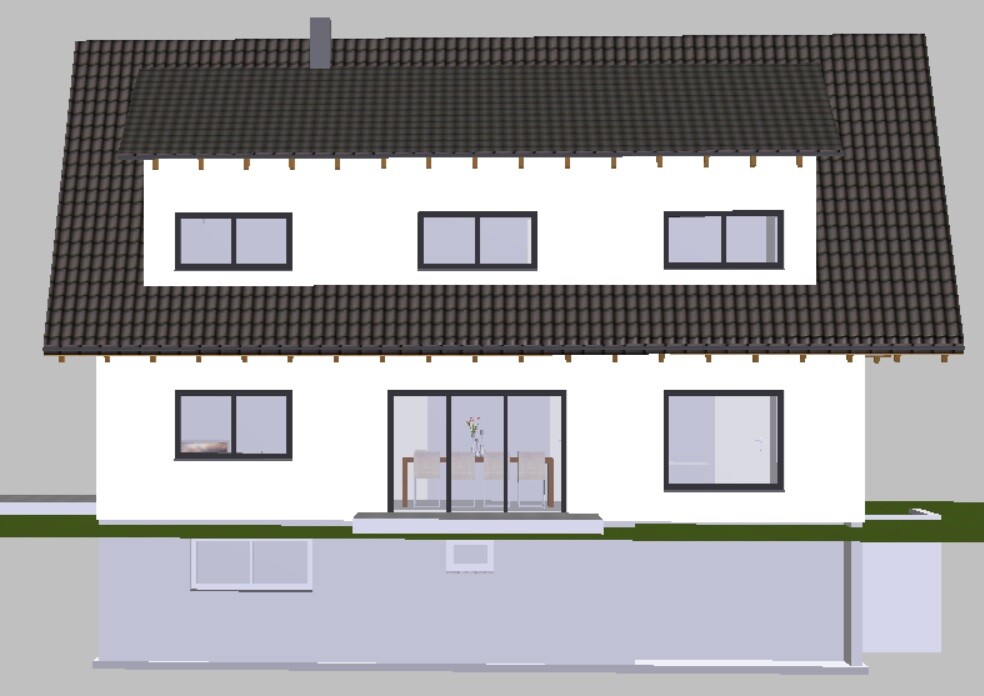
- The shed dormer roof is very shallow at 22°, while we had hoped for about 30° (for appearance and better suitability for photovoltaics). The connection of the dormer to the collar beams would need changing. Currently, there is a lot of facade surface between the dormer window and the dormer roof gutter.
- Wall recesses at the showers on the ground and upper floors: a nice idea in principle, but the recess on the ground floor is only 30cm (12 inches), making it difficult to place furniture in the adjacent office. On the upper floor, the recess is too large; a ~1.1x1.1m (3.6x3.6 ft) enclosed shower would suffice for us.
- The cloakroom area (client’s wish) is still suboptimal within the bedroom. We may have to revert to a traditional bedroom-facing wardrobe.
- Preparation for kitchen connections in child room 2 instead of child room 1 (the attic kitchen is planned later in child 2’s room).
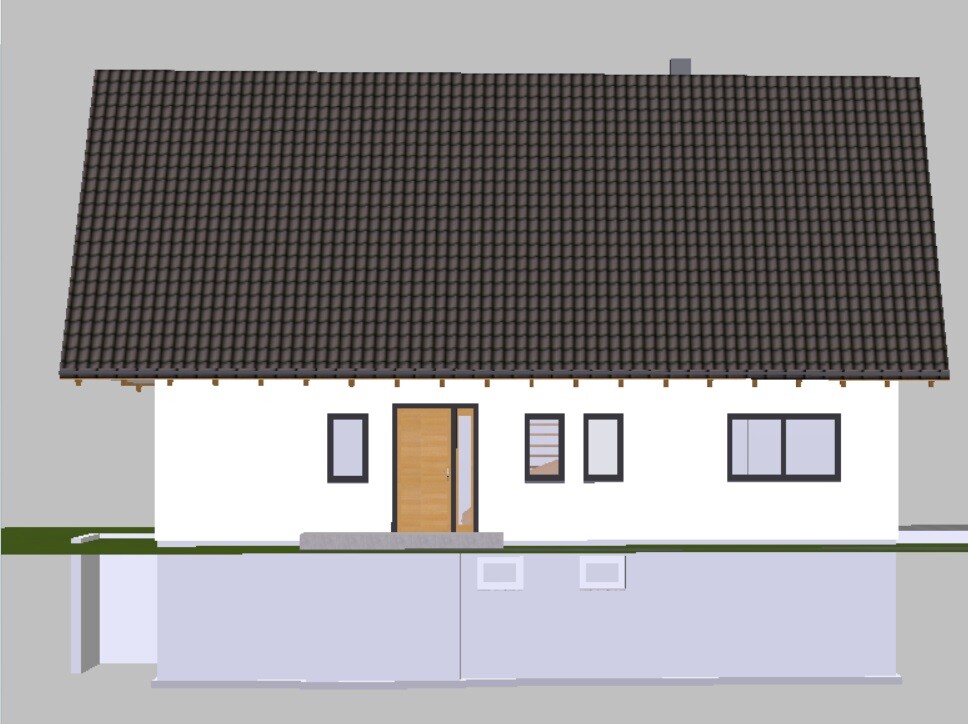
- Ground floor to attic stairs / ground floor hallway: The first step protrudes as a trip hazard in front of the entrance door room. Possibly, the concreted basement ceiling can be extended 1.5m (5 ft) further west (one basement window must be closed anyway) so the stairs can shift more northwards.
- Terrace: One terrace is enough for us, but larger. We prefer terrace 1 away from the street and would remove terrace 2 including the doors into the house.
- Three north-facing roof windows in bathroom, stairwell, and child bedroom 1 would improve the lighting situation, possibly with a skylight above the upper floor hallway door.
- Floor-to-ceiling (instead of conventional) windows in dining room and bathroom are not necessary; we value privacy here and expect enough brightness in combination with dormer window (dining room) or possibly an additional roof window (bathroom).
- The decision between timber or solid construction is still open, but there is a tendency toward solid. The plan is based on 42.5cm (17 inches) aerated concrete blocks as external walls. These overhang the basement ceiling outline by 4cm (1.6 inches) all around. According to local solid construction experts, the blocks can safely overhang the basement by 12cm (4.7 inches). This could provide more space for the floor plan and ease the transition to the planned subsequent external insulation of the basement.
- No concept yet for separating living and dining areas on the ground floor.
Cost estimate from architect/planner: Not yet available. Expensive additional items include photovoltaics, water-to-water heat pump, and central controlled ventilation. We are currently planning with all wishes expressed openly; cost-cutting measures will probably come later.
Personal budget limit for the house, including fixtures and fittings: 700,000 € (rough estimate: demolition to basement top slab: 30,000 €, house: 530,000 €, incidental building costs including basement statics: 50,000 €, double garage: 30,000 €, kitchen/furniture: 40,000 €, landscaping: 20,000 €)
Preferred heating system: Heat pump with underfloor heating. If budget allows: brine-water heat pump with deep borehole.
If you have to give up details/features, which: Reluctantly, in descending order: fireplace, balcony, walkable roof peak space with fixed stairs, pantry/utility room
If you cannot give up: Home office
Why is the design like it is now?
Several hours of joint development of the ideas with the architect using pen and tracing paper. Prior phone calls and an on-site visit (including the energy consultant).
Similar topics