
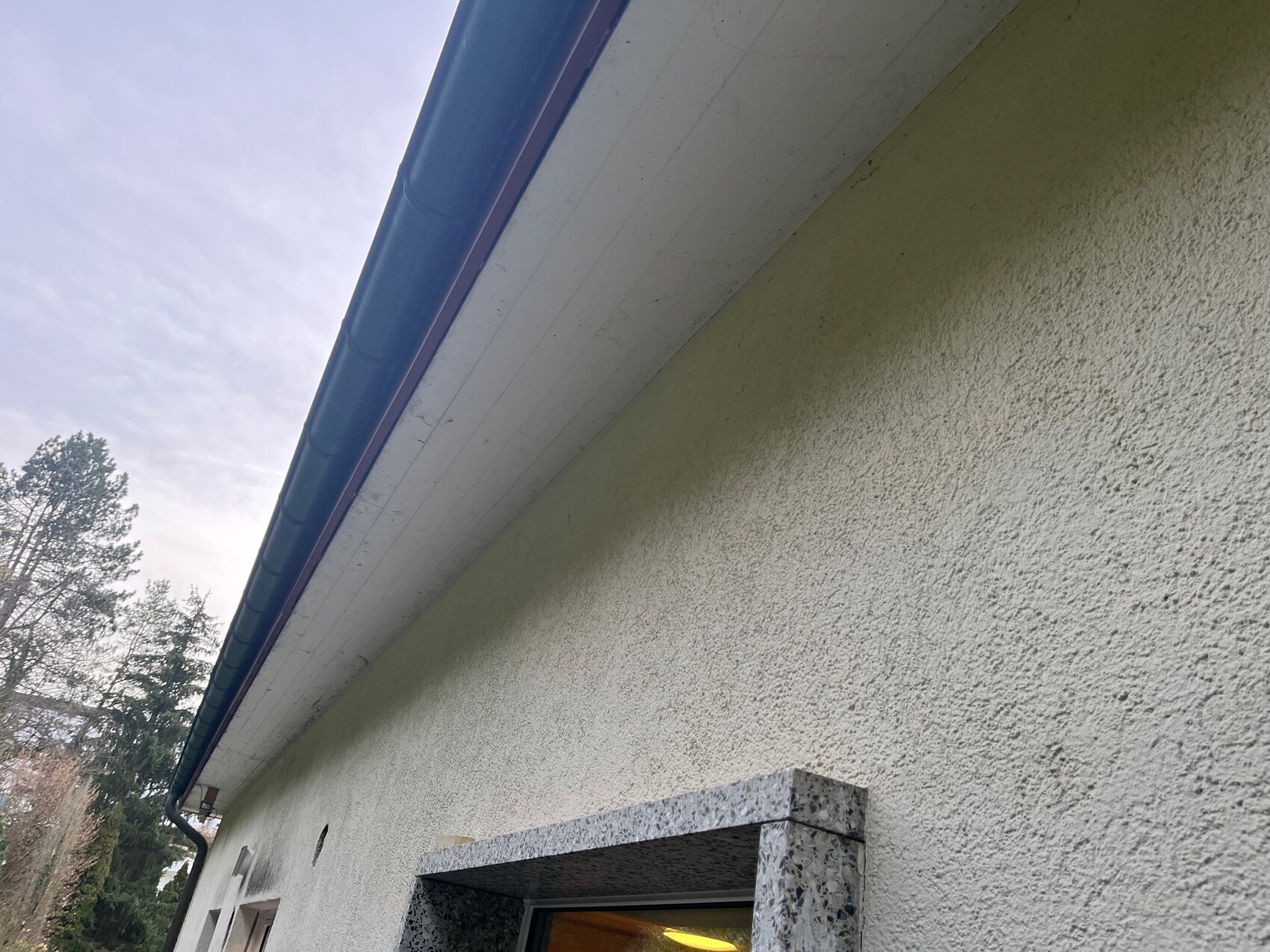
Hello everyone, how should a new ventilated facade with 20 cm (wood fiber, fiber cement panels) be connected to the existing cold roof (hip roof, 11-degree pitch, ventilated) without thermal bridges? I am concerned that the knee wall remains uninsulated, which could lead to mold in the inhabited ground floor below. Is it necessary to remove the eaves? The attic/floor of the old building (1970) was insulated from the inside and is not inhabited (storage room).
Thank you
Thank you

I can only recommend having it professionally planned. I don’t want to say much more. Incorrectly installed insulation (which is also your concern) can cause significant damage and end up costing more than the original investment (e.g., demolition and renovation).
In my opinion, your information is still too limited despite some details.
In my opinion, your information is still too limited despite some details.
Obviously, you (or someone else) have already started. I would prefer to clarify such details beforehand.
Depending on the position of the floor slab and the insulation, the underside of the roof should be removed, and the insulation extended up to the roof decking. On the interior side of the floor slab, it should also be extended up the knee wall by at least 50cm (20 inches), ideally fully enclosing the wall at the top of the knee wall, even if the insulation thickness is only 20mm (0.8 inches). This depends on the wall material and the height of the knee wall.
The wind barrier / underlay membrane of the insulation should also be extended up to the roof decking. For aesthetic reasons, the roof underside can then be reinstalled up to the insulation level, leaving an air gap with a vented grille between the rainscreen cladding and the roof underside.
If you are not experienced in building physics, I would not undertake this without professional guidance. With a rainscreen façade, there is little risk of damage to the building itself, but there is a possibility that all the work could be wasted.
Depending on the position of the floor slab and the insulation, the underside of the roof should be removed, and the insulation extended up to the roof decking. On the interior side of the floor slab, it should also be extended up the knee wall by at least 50cm (20 inches), ideally fully enclosing the wall at the top of the knee wall, even if the insulation thickness is only 20mm (0.8 inches). This depends on the wall material and the height of the knee wall.
The wind barrier / underlay membrane of the insulation should also be extended up to the roof decking. For aesthetic reasons, the roof underside can then be reinstalled up to the insulation level, leaving an air gap with a vented grille between the rainscreen cladding and the roof underside.
If you are not experienced in building physics, I would not undertake this without professional guidance. With a rainscreen façade, there is little risk of damage to the building itself, but there is a possibility that all the work could be wasted.
Thank you very much! The carpenter just planned without opening the cornice. This means the ventilated facade would only extend up to the underside of the roof, and that worries me. An energy consultant was involved, but unfortunately I had to dismiss them—long story. I have dealt with three energy consultants so far, and I have my doubts about their expertise and practical suitability, but that’s a topic for a separate thread.

paulch7 schrieb:
..So far, I have dealt with three energy consultants and have my doubts about the expertise/practical suitability of such people.My first choice would have been a building surveyor / damage assessor. Ours was very knowledgeable about sealing layers, insulation, connections, and so on. Assessing, evaluating, and preventing building defects was his profession.
Similar topics