
ᐅ Extension of a single-story house in bungalow style with a 30-degree hipped roof
Created on: 29 Dec 2022 13:28
M
monty99
Hello,
We built a single-story L-shaped house in 2016 in a bungalow style, meeting the KFW70 standard. The house has approximately 170 m² (1,830 sq ft) of living space, features a reinforced concrete ceiling, and the roof is a hipped roof construction with an extension made of glued laminated timber at a 30-degree pitch.
Originally, the attic was intended only as a storage area, and its height was sufficient for that purpose. Now, however, we want to convert the attic into a living space, which was not planned for originally, but unfortunately, the height is inadequate.
We have considered two solutions so far: a hydraulic roof lift (which is not an option for us) or increasing the knee wall height. (Currently, there is no knee wall.) At the moment, there is a foldable loft ladder, but we have already planned a larger opening in the reinforced concrete ceiling for a proper staircase (now covered).
Since I am not an expert, I was hoping to find some advice and tips here.
In the first few years, the house developed some settlement cracks in the plaster. Because of this, I would like to have the foundation’s strength checked independently from any structural calculations before we even start planning the extension. How is this possible, and what costs should we expect?
The idea is to "remove" the roof and later reuse the usable parts (wooden beams, tiles, etc.). Then, build up the walls to a height of 1.2–1.4 m (4–4.5 ft) (At what point would this count as a second floor?). After that, the roof would be reinstalled as before. If possible, expansions like large roof windows and a photovoltaic system could be added during this process.
The development plan allows for a second floor, but of course, we would submit a building inquiry/planning permission request beforehand.
If it helps, here are some details about the house:
30 cm (12 inches) gravel filter layer under the base slab, delivered, installed, and compacted.
Base slab made of reinforced concrete C 20/25, 20 cm (8 inches) thick, reinforced with 2 layers Q257 plus necessary additions, on existing gravel sub-base including edge formwork and vapor barrier; delivered and installed.
Ceiling 20 cm (8 inches), complete.
Beams B/H 30/25 cm (12x10 inches) reinforced concrete beams including formwork up to 2.5 m (8 ft) height and reinforcement (150 kg/m³).
Reinforced concrete columns B/H 25/25 cm (10x10 inches), C25/30 concrete including formwork (height below 2.6 m / 8.5 ft) and reinforcement (140 kg/m³).
Aerated concrete masonry 36.5 cm (14 inches) GB 2.
Calcium silicate masonry 17.5 cm (7 inches) thick.
Calcium silicate masonry 11.5 cm (4.5 inches) thick.
Flat lintels made of aerated concrete, 17.5 cm (7 inches) thick.
Precast calcium silicate lintels 17.5/11.5 cm.
Details on the roof construction are as follows:
- Delivery, assembly, and raising of a hipped roof structure with an extension made of glued laminated timber.
- Roof pitch 30 degrees.
- Roof overhang 60 cm (24 inches).
- Supply and installation of galvanized metal fittings.
- Use of a mobile crane during roof assembly.
- Tongue-and-groove boarding 19.5 x 121 mm (¾ x 4¾ inches) installed as a cornice box including substructure, extending to the terrace area.
- Terrace beam made of laminated timber.
We plan to carry out the conversion within 1–3 years with a budget of 120,000 to 150,000 euros. Depending on the possibilities, we would like to add 1–2 large windows with access and possibly a photovoltaic system up to 10 kW peak. (An 18 kW peak system is already installed on a second building.)
We already have a brine geothermal heat pump that provides sufficient performance for the ground floor area. The floor will be equipped with full-surface underfloor heating like the ground floor.
I have attached two pictures. The black-and-white photo shows the terrace and the garage on the left side.
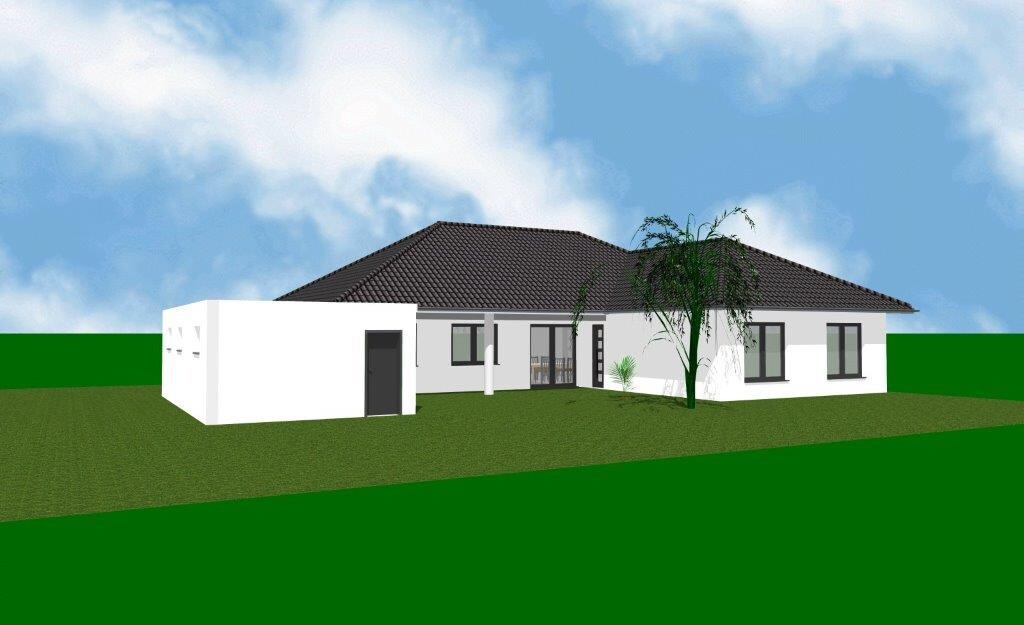
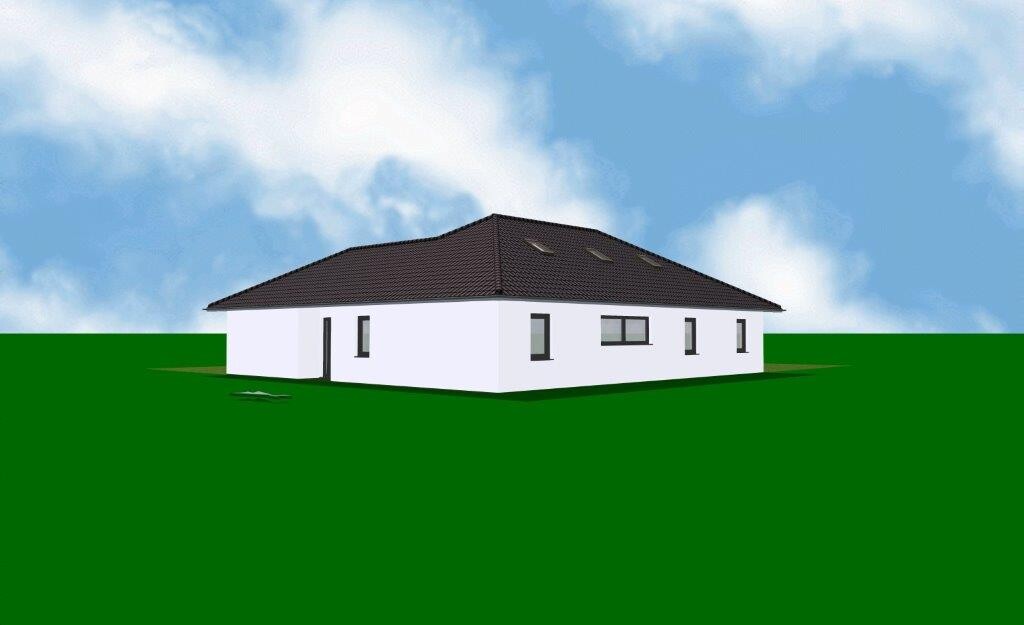
Is our plan feasible? Is the budget roughly sufficient? How can we have the current foundation checked independently of a structural engineer?
Thank you very much for your advice!
We built a single-story L-shaped house in 2016 in a bungalow style, meeting the KFW70 standard. The house has approximately 170 m² (1,830 sq ft) of living space, features a reinforced concrete ceiling, and the roof is a hipped roof construction with an extension made of glued laminated timber at a 30-degree pitch.
Originally, the attic was intended only as a storage area, and its height was sufficient for that purpose. Now, however, we want to convert the attic into a living space, which was not planned for originally, but unfortunately, the height is inadequate.
We have considered two solutions so far: a hydraulic roof lift (which is not an option for us) or increasing the knee wall height. (Currently, there is no knee wall.) At the moment, there is a foldable loft ladder, but we have already planned a larger opening in the reinforced concrete ceiling for a proper staircase (now covered).
Since I am not an expert, I was hoping to find some advice and tips here.
In the first few years, the house developed some settlement cracks in the plaster. Because of this, I would like to have the foundation’s strength checked independently from any structural calculations before we even start planning the extension. How is this possible, and what costs should we expect?
The idea is to "remove" the roof and later reuse the usable parts (wooden beams, tiles, etc.). Then, build up the walls to a height of 1.2–1.4 m (4–4.5 ft) (At what point would this count as a second floor?). After that, the roof would be reinstalled as before. If possible, expansions like large roof windows and a photovoltaic system could be added during this process.
The development plan allows for a second floor, but of course, we would submit a building inquiry/planning permission request beforehand.
If it helps, here are some details about the house:
30 cm (12 inches) gravel filter layer under the base slab, delivered, installed, and compacted.
Base slab made of reinforced concrete C 20/25, 20 cm (8 inches) thick, reinforced with 2 layers Q257 plus necessary additions, on existing gravel sub-base including edge formwork and vapor barrier; delivered and installed.
Ceiling 20 cm (8 inches), complete.
Beams B/H 30/25 cm (12x10 inches) reinforced concrete beams including formwork up to 2.5 m (8 ft) height and reinforcement (150 kg/m³).
Reinforced concrete columns B/H 25/25 cm (10x10 inches), C25/30 concrete including formwork (height below 2.6 m / 8.5 ft) and reinforcement (140 kg/m³).
Aerated concrete masonry 36.5 cm (14 inches) GB 2.
Calcium silicate masonry 17.5 cm (7 inches) thick.
Calcium silicate masonry 11.5 cm (4.5 inches) thick.
Flat lintels made of aerated concrete, 17.5 cm (7 inches) thick.
Precast calcium silicate lintels 17.5/11.5 cm.
Details on the roof construction are as follows:
- Delivery, assembly, and raising of a hipped roof structure with an extension made of glued laminated timber.
- Roof pitch 30 degrees.
- Roof overhang 60 cm (24 inches).
- Supply and installation of galvanized metal fittings.
- Use of a mobile crane during roof assembly.
- Tongue-and-groove boarding 19.5 x 121 mm (¾ x 4¾ inches) installed as a cornice box including substructure, extending to the terrace area.
- Terrace beam made of laminated timber.
We plan to carry out the conversion within 1–3 years with a budget of 120,000 to 150,000 euros. Depending on the possibilities, we would like to add 1–2 large windows with access and possibly a photovoltaic system up to 10 kW peak. (An 18 kW peak system is already installed on a second building.)
We already have a brine geothermal heat pump that provides sufficient performance for the ground floor area. The floor will be equipped with full-surface underfloor heating like the ground floor.
I have attached two pictures. The black-and-white photo shows the terrace and the garage on the left side.
Is our plan feasible? Is the budget roughly sufficient? How can we have the current foundation checked independently of a structural engineer?
Thank you very much for your advice!
X
xMisterDx30 Dec 2022 01:11How do you know for sure that the geothermal heat pump can easily heat an additional 170m² (1830 sq ft)? Do you have this in writing or as a calculation? Or was it just verbally told by the installer, who said something like, "Yeah, you could even heat the attic with it"...
Honestly, I find it hard to believe that the expensive geothermal system was oversized by a factor greater than two.
I assume, since you mentioned rates of 31 EUR (about 34 USD) net, you’re referring to hourly rates, not wages per hour—otherwise, I’d immediately consider working as a tradesperson there.
What you definitely need, in any case, is a structural engineer to calculate whether your foundation can even support your planned construction. There’s no point in discussing further before that. And this is very important to understand: engineers have to design cost-effectively. No one would consider building a foundation for a bungalow that could easily carry a three-story building later on.
Why? Because the general contractor wants to save money... and because the client quickly starts asking awkward questions about why they should pay more for a foundation... "After all, we’re only building a bungalow, not a three-story building........." 😉
Honestly, I find it hard to believe that the expensive geothermal system was oversized by a factor greater than two.
I assume, since you mentioned rates of 31 EUR (about 34 USD) net, you’re referring to hourly rates, not wages per hour—otherwise, I’d immediately consider working as a tradesperson there.
What you definitely need, in any case, is a structural engineer to calculate whether your foundation can even support your planned construction. There’s no point in discussing further before that. And this is very important to understand: engineers have to design cost-effectively. No one would consider building a foundation for a bungalow that could easily carry a three-story building later on.
Why? Because the general contractor wants to save money... and because the client quickly starts asking awkward questions about why they should pay more for a foundation... "After all, we’re only building a bungalow, not a three-story building........." 😉
Cronos86 schrieb:
The report requires a foundation depth of up to 1 meter (3.3 feet) to fully penetrate the organic soil layers down to 0.7 meters (2.3 feet).
I think as an alternative, a soil replacement of at least 0.7 meters (2.3 feet) should have been carried out. So 0.3 meters (1 foot) is definitely not enough.
This would also explain the cracks in the existing structure.
So if the foundation was really constructed like that, it is already insufficient for the existing building. An extension should not be done then... Thanks for the note.
As far as I remember, I still need to find the photos; about 50 centimeters (20 inches) of soil was removed and filled with recycled concrete which was then compacted. Only after this was gravel and the concrete slab placed on top.
I also documented the settlement cracks early on and discussed them with the construction company.
The construction company is very reputable here and has built hundreds of solid masonry houses. Their price was about 20-30% higher than other providers at the time, and we chose them deliberately. Therefore, misconduct would be extremely unusual. The problem is that we are located in a mixed commercial zone where, for example, 40-ton trucks pass very close to the house and cause vibrations. The neighbors all have similar issues.
I spoke with another construction company that recommended opening up the soil at several points around the house exterior to inspect the thickness of the concrete slab and its sub-base. Reinforcements could then be applied if necessary.
How does this process work? Is this a viable solution? Are there rough cost estimates for this?
xMisterDx schrieb:
How do you know that the ground source heat pump can easily heat another 170m² (1,830 sq ft)? Do you have this in writing or as a calculation? Or was it just verbally from the installer who said back then, “Yes, yes, you could also warm the attic with that”...
Honestly, I find it hard to believe that you would size the expensive ground source system for more than double the load.
I assume in the far east you mean hourly rates, not hourly wages, of 31 EUR net... otherwise I’d sign up as a tradesperson there immediately.
What you definitely need is a structural engineer to calculate whether your foundation can even support your plan. There’s no point discussing anything further before that. Because—and this is very important to understand:
Engineers have to plan cost-effectively. Nobody designs a foundation for a bungalow that could later easily carry a three-story building.
Why? Because the general contractor wants to save money... and because the client quickly asks silly questions about why they should pay more for the foundation… “after all, I’m only building a bungalow, not a three-story house........” 😉 I deliberately sized the heat pump back then based on the heating load calculation and a maximum living area of about 270m² (2,900 sq ft).
The heating load was calculated at just under 5.8 kW, and the heat pump is a 9 kW unit.
Converting the attic into usable/living space was always planned, but originally it was not supposed to be a fully functional living area.
However, since we want to keep our severely disabled daughter in the family home and not place her in an institution, the attic will now be converted into living space. It won’t be another full 170m² (1,830 sq ft), but around 100m² (1,080 sq ft) of usable space is planned.
Yes, of course, the 31 € net rate refers to the hourly rate for a skilled construction worker/tradesperson.
Before involving a structural engineer, who ultimately only works on paper, I want to have the slab and soil checked first. Only then would I commission the structural engineer.

monty99 schrieb:
Since we want to keep our severely disabled daughter living in the family home rather than placing her in a care facility, we now plan to convert the attic into a living area. It won’t be an additional 170sqm (1837 sq ft), but about 100sqm (1076 sq ft) of usable space is desired.If you like the current direction of the thread (discussion about subflooring and heating loads), you can of course stick to these sparse details – but please reduce full quotes for the sake of other readers. Alternatively, you can follow my suggestions in post #8 to realize that the professionals gathered here can provide proposals for your extension project. Fait votre Jeux!https://www.instagram.com/11antgmxde/
https://www.linkedin.com/company/bauen-jetzt/
Sorry for only getting back to this now; I didn’t find much peace between the holidays 😉
So, with the additional 50 cm (20 inches) of RC gravel, the whole thing already sounds a bit more solid. In general, all organic soils under the house must be removed. With the extra 30 cm (12 inches) (08/16 or 00/32?), you end up with 80 cm (31 inches), which is quite decent to start with. If no strip foundation or frost skirt is installed, however, the recycled material must be certified as frost protection material. Otherwise, frost heave can cause damage.
The cushion layer is usually over-compacted (confirmed by plate load tests) and absorbs the initial settlements of the ground. That’s why the settlement cracks make me a bit suspicious.
Sandy soils are generally a good building ground. Once the initial settlements are complete, not much usually happens—unless the groundwater level drops dramatically. Were dynamic probing tests also conducted during the soil investigation? These can reveal the density of the layers and whether there is potential for further settlement at depth.
Making changes to the foundation afterwards is very difficult in my opinion. You can’t add more gravel because it can’t be properly compacted then. Underpinning with lean concrete is also problematic, as this must be done monolithically—that means pouring concrete continuously from the slab downwards. The house would need to be excavated in sections, settlements cannot be ruled out, and the achieved bearing capacities are also limited due to the high water table...
In my opinion, ground improvement using an injection method like Uretek is the only option that might work—but that’s something I didn’t want to have to pay for 🤨
Therefore, have a structural engineer calculate everything and hope it works out. It should be checked again why cracks (real settlements?) have already appeared.
Points in favor, in my opinion, are:
- Have all organic soils been completely excavated?
- Was the sand bedding properly re-compacted before installing the gravel? A plate load test is necessary here as well (a falling weight deflectometer is sufficient)
- Check what material was installed (certified frost protection) and in what thickness
- Ask for compaction proof for the gravel cushion layer
Approach the earthworks contractor and ask to see the documentation.
Oh, and Happy New Year!
So, with the additional 50 cm (20 inches) of RC gravel, the whole thing already sounds a bit more solid. In general, all organic soils under the house must be removed. With the extra 30 cm (12 inches) (08/16 or 00/32?), you end up with 80 cm (31 inches), which is quite decent to start with. If no strip foundation or frost skirt is installed, however, the recycled material must be certified as frost protection material. Otherwise, frost heave can cause damage.
The cushion layer is usually over-compacted (confirmed by plate load tests) and absorbs the initial settlements of the ground. That’s why the settlement cracks make me a bit suspicious.
Sandy soils are generally a good building ground. Once the initial settlements are complete, not much usually happens—unless the groundwater level drops dramatically. Were dynamic probing tests also conducted during the soil investigation? These can reveal the density of the layers and whether there is potential for further settlement at depth.
Making changes to the foundation afterwards is very difficult in my opinion. You can’t add more gravel because it can’t be properly compacted then. Underpinning with lean concrete is also problematic, as this must be done monolithically—that means pouring concrete continuously from the slab downwards. The house would need to be excavated in sections, settlements cannot be ruled out, and the achieved bearing capacities are also limited due to the high water table...
In my opinion, ground improvement using an injection method like Uretek is the only option that might work—but that’s something I didn’t want to have to pay for 🤨
Therefore, have a structural engineer calculate everything and hope it works out. It should be checked again why cracks (real settlements?) have already appeared.
Points in favor, in my opinion, are:
- Have all organic soils been completely excavated?
- Was the sand bedding properly re-compacted before installing the gravel? A plate load test is necessary here as well (a falling weight deflectometer is sufficient)
- Check what material was installed (certified frost protection) and in what thickness
- Ask for compaction proof for the gravel cushion layer
Approach the earthworks contractor and ask to see the documentation.
Oh, and Happy New Year!
Cronos86 schrieb:
Sorry for the late reply, didn’t find the time to relax during the holidays 😉
So, adding 50 cm (20 inches) of RC gravel definitely makes the whole thing feel a bit more solid. Generally, all organic soils under the building must be removed. With the additional 30 cm (12 inches) (08/16 or 00/32?), that adds up to 80 cm (31 inches), which is quite decent to start with. If no strip/frost protection edge has been installed, however, the recycled material must be certified as frost protection material. Otherwise, frost heave damage will occur.
The base layer is usually overcompacted (proven by plate load tests) and compensates for the initial soil settlements. That is why the settlement cracks you mention raise some questions for me.
Sandy soils are generally good building ground once the initial settlements have completed, not much happens after that unless the groundwater level drops dramatically.
Were dynamic probing tests performed during the ground investigation? These show the compaction of soil layers and whether there is potential for further settlement at greater depths.
Making changes to the foundation afterwards is very difficult. You cannot add more gravel because it cannot be compacted properly. Underpinning with lean concrete is also problematic as it must be load-bearing, meaning concrete must be poured continuously from the slab downwards. The house would have to be partially excavated section by section, settlement cannot be ruled out, and the bearing capacities achieved are limited due to the high groundwater table…
In my opinion, ground improvement via injection methods like Uretek is the only thing that might work. But honestly, I wouldn’t want to pay for that 🤨
So I would have a structural engineer run the calculations and hope that it works out. The early appearance of cracks (are these really settlement cracks?) should definitely be checked again.
Points to consider in my opinion:
- Have all organic soils been fully excavated?
- Has the sand subgrade been properly recompacted before adding the gravel? A plate load test is necessary here as well (impact plate is sufficient)
- Check what was used (certification for frost protection) and in what thickness
- Request documentation of compaction tests for the gravel base layer
Approach the earthworks contractor and ask to see the documentation.
Oh, and Happy New Year! Happy New Year to you as well.
Thank you very much for the really helpful tips and the detailed explanations. This is exactly the kind of advice I, as a layperson, was hoping to find here on the forum.
Now I know what I need to do to move forward.
It’s a pity many other forum users either assume a lot of specialist knowledge or just post one-liners.
Similar topics