
ᐅ Floor plan: New construction on an existing bungalow basement, one-and-a-half stories
Created on: 19 Dec 2022 01:12
M
Mal Bauen
Hello to all forum members,
We are still relatively early in our building project and have many fundamental questions to clarify. Nevertheless, I would like to introduce the project here.
We recently became owners of a prefabricated bungalow from Streif Haus, built in 1987. It has a full concrete basement (by Betonkemmler).
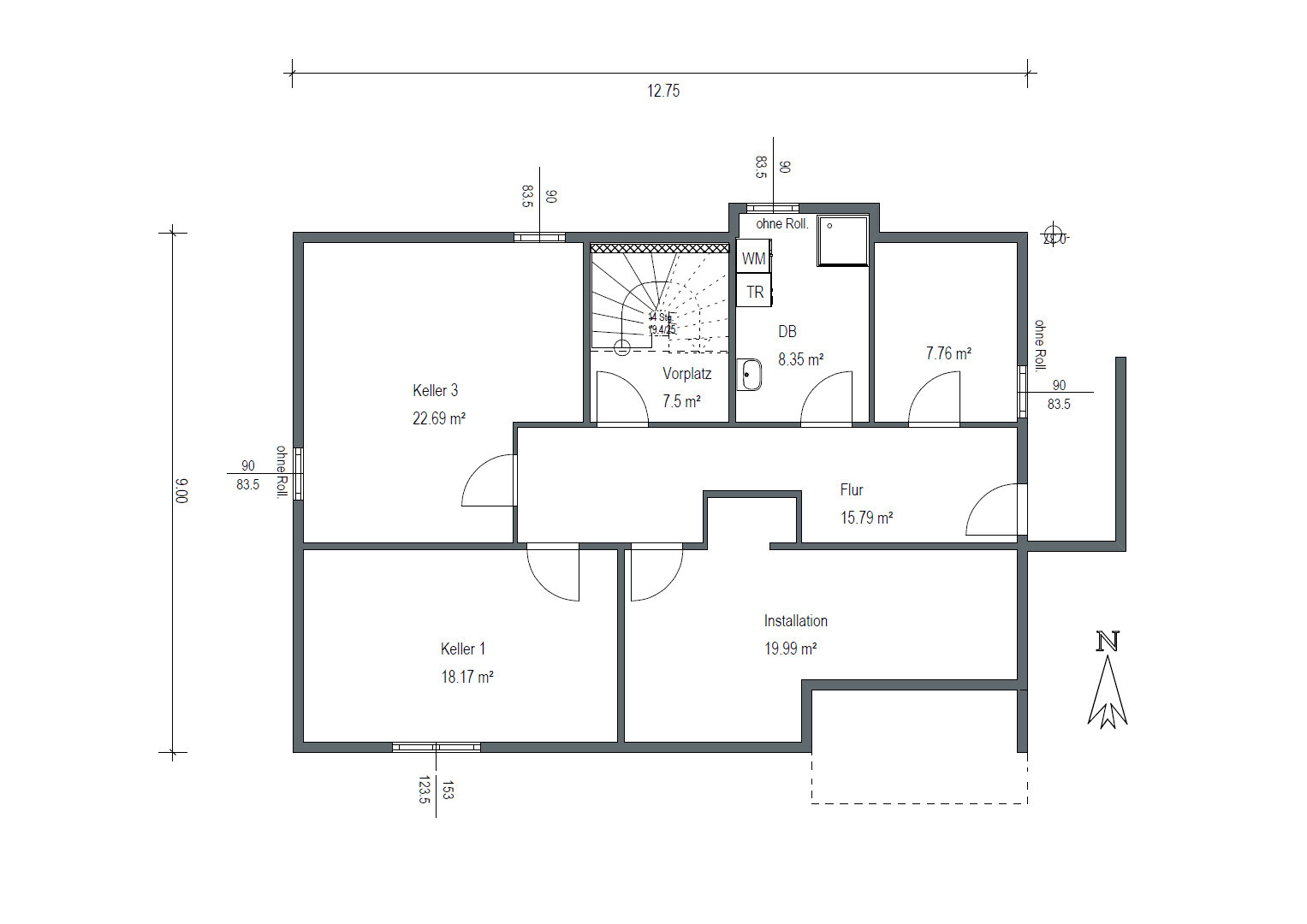
Our plan is to demolish the bungalow down to the top edge of the basement and build a new house for our family (currently four, eventually five) on top. The existing basement (very solid construction) is to be integrated as a utility basement including a technical room. At the same time, the heating system will be modernized from oil heating to a heat pump.
Currently, we are in contact with both prefabricated house suppliers (Weberhaus, Danwood) and solid construction companies (Denkinger). The property is located in Baden-Württemberg (southern Baden).
Even though the floor plan is only a first draft, I would like to present it here for feedback (summary below).
In particular, I hope to get some thoughts on the following basic questions:
Here is the summary sheet (key points).
Many thanks in advance for your input, comments, and critiques. I will gladly report further developments here in the thread.
Development Plan / Restrictions
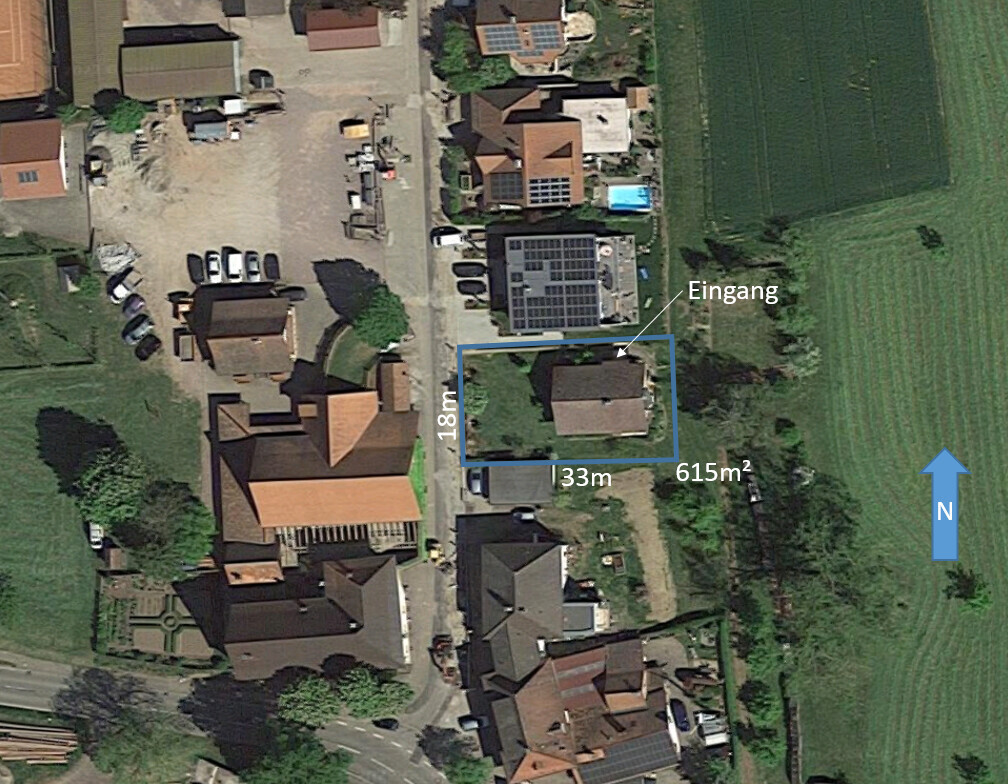
Size of the plot: 615m² (6620 sq ft)
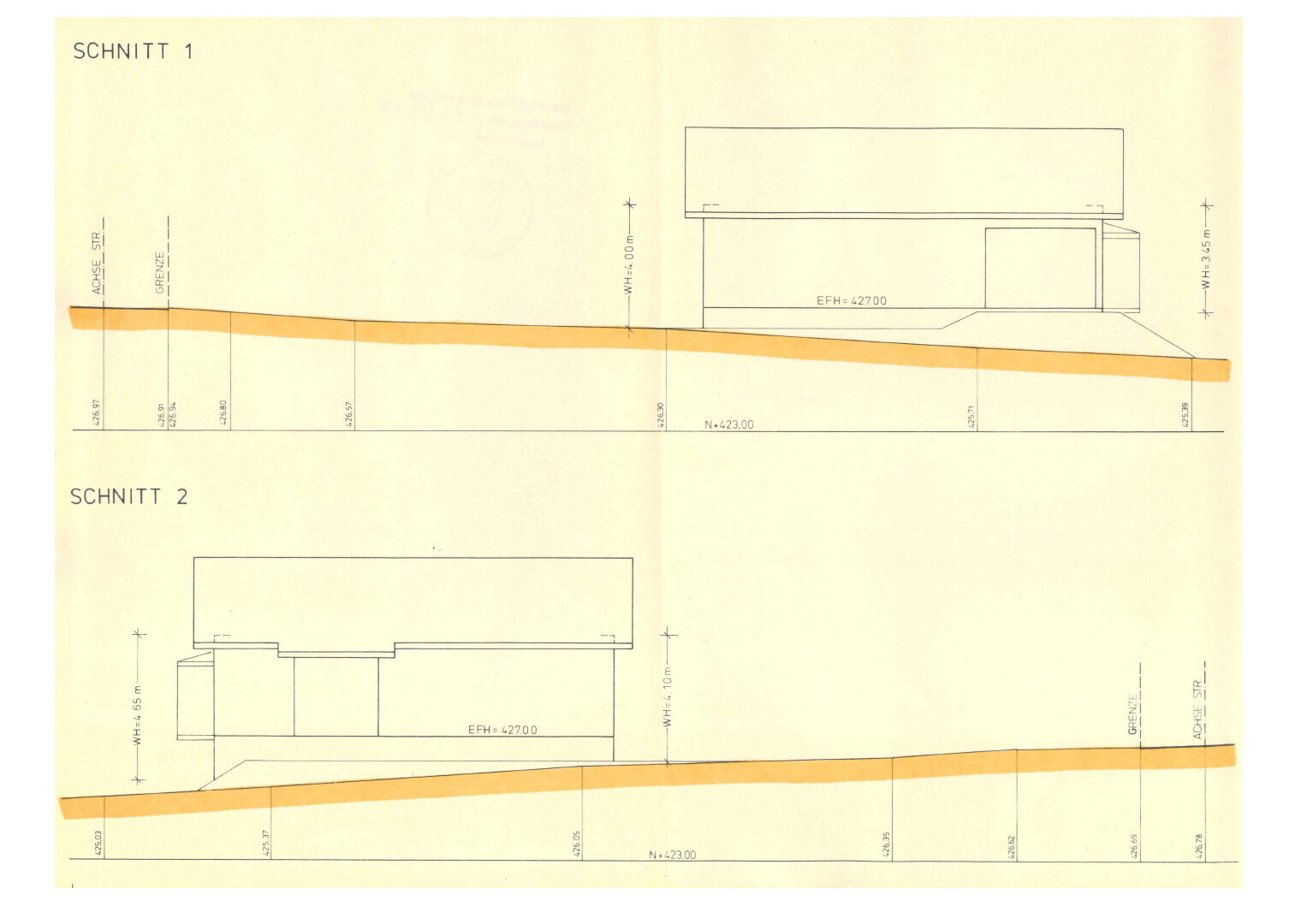
Slope: North/South: <0.5m (1.6 ft) over 18m (59 ft), West-East: approx. 2m (6.6 ft) over 33m (108 ft) (see elevation profile)
Site coverage ratio: No development plan (Section 34 of German Building Code). The immediate neighborhood contains some generously built plots. We do not want to change the building footprint of the existing house but want to add a double garage (not currently present).
Floor area ratio: No development plan (Section 34 of German Building Code)
Building envelope, building line and boundary: No development plan (Section 34 of German Building Code). Property boundaries and existing building shown in aerial photo attached
Edge development: None
Number of parking spaces: None
Number of floors: 1.5 stories
Roof type: Gable roof
Architectural style: Modern detached family house
Orientation: see aerial photo. Entrance (currently): north
Maximum height/limits: No development plan
Immediate neighbors: Northern neighbor: 2 stories with flat roof. Southern: 1.5 stories with hipped roof. Western: 1.5 stories with gable roof.
Client Requirements
Style, roof form, building type: We want to transform the existing bungalow into a classic 1.5-story detached house with a gable roof and possibly shed dormers.
Basement, floors: Utility basement (existing, concrete basement), ground floor (living), upper floor (sleeping)
Number of persons, ages: Our family currently has four members (ages: 32, 30, 2, 0), with another child planned
Space requirements on ground and upper floor:
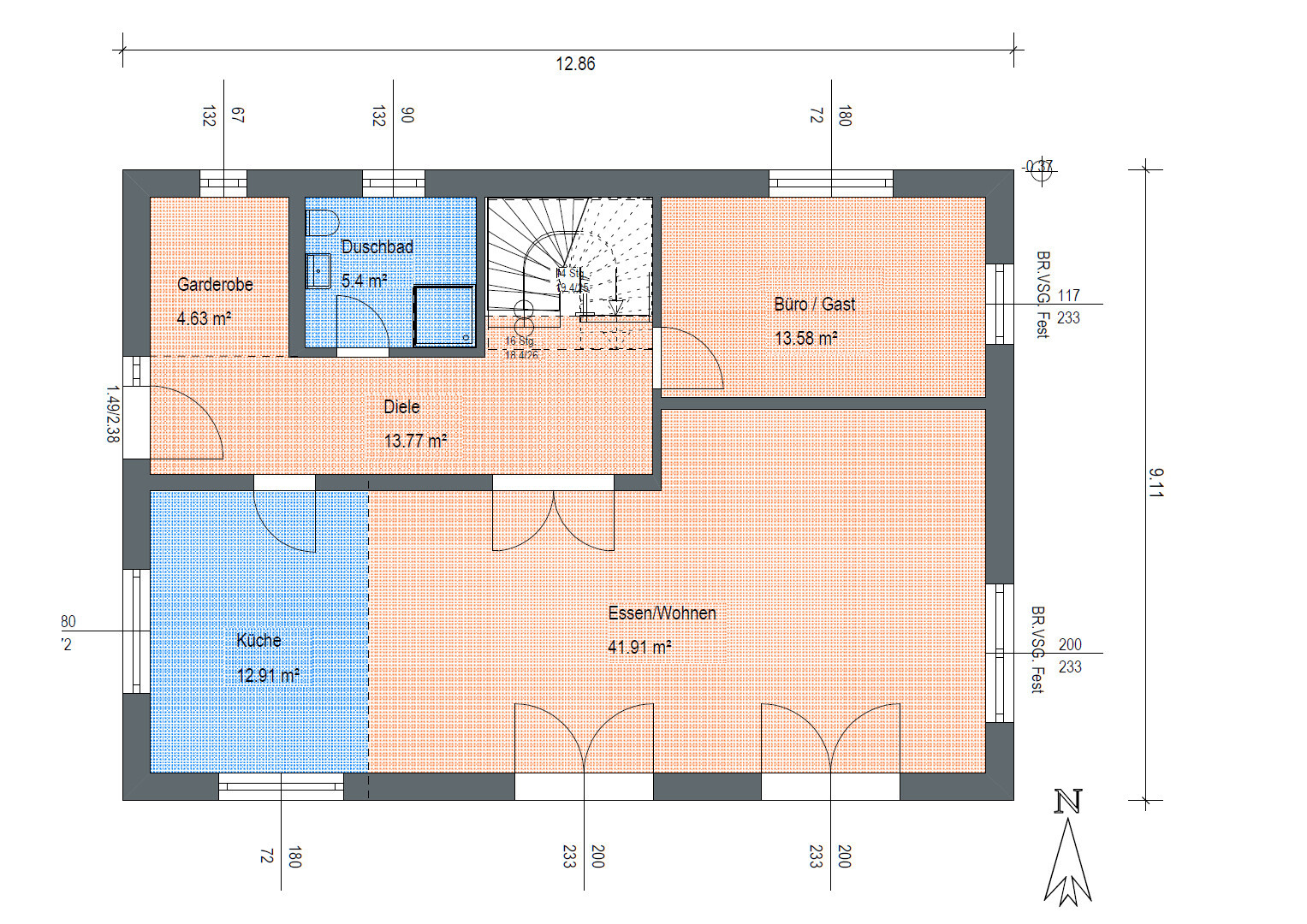
Ground floor: living room, kitchen (possibly with pantry), room for home office or guest room, guest WC with shower, cloakroom
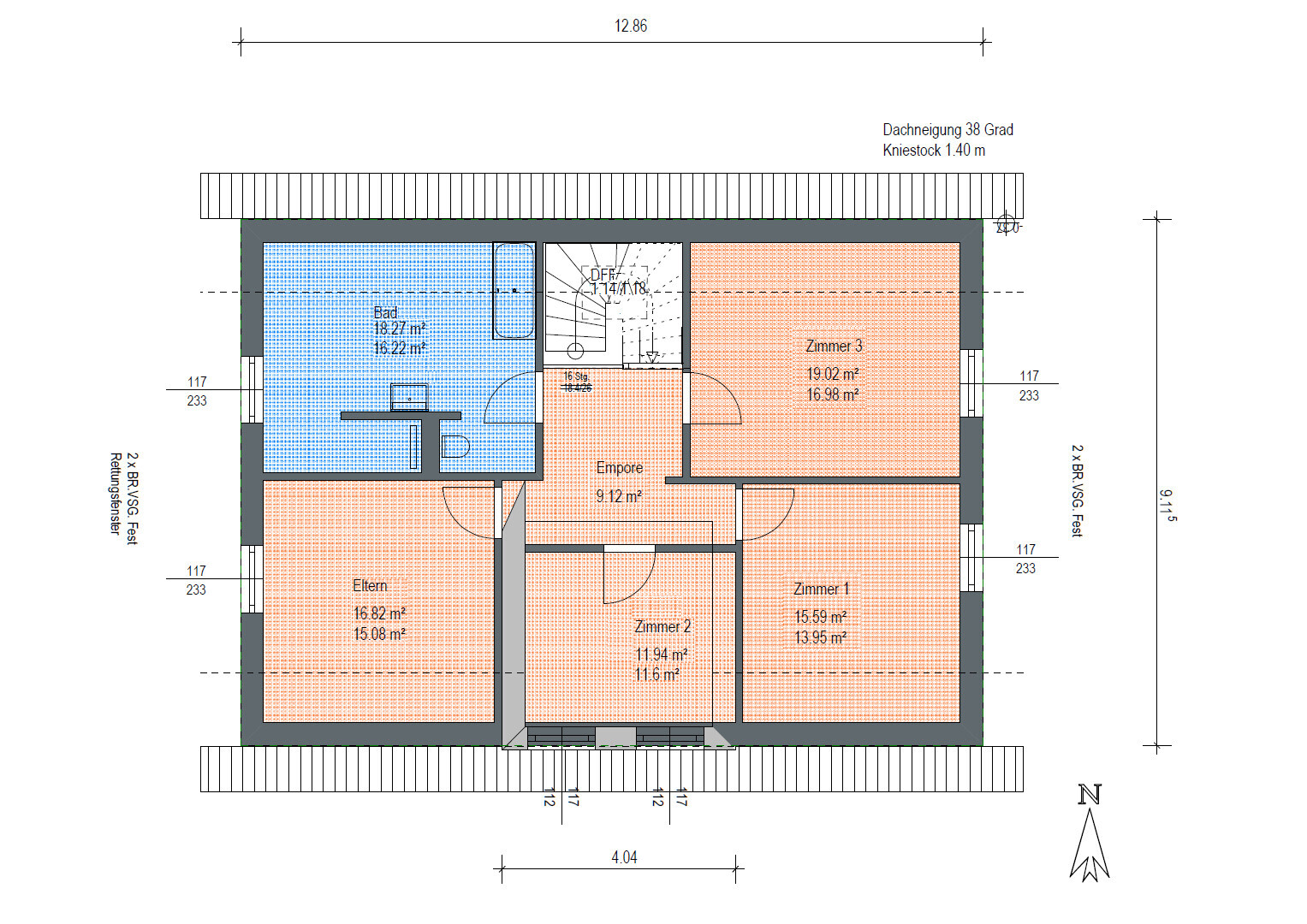
Upper floor: master bedroom, 3 children’s bedrooms, bathroom
Office: family use or home office: Home office (100% for me)
Overnight guests per year: Few, less than 5 guests/nights
Open or closed architecture: Rather closed. Ability to separate kitchen and living room would be desirable.
Conservative or modern design: Modern
Open kitchen, kitchen island: Kitchen island not mandatory. Partly open kitchen: separation from living room would be good.
Number of dining seats: 5-8
Fireplace: Only if budget allows, not mandatory
Music/ stereo wall: No
Balcony, roof terrace: No
Garage, carport: Double garage
Utility garden, greenhouse: No
Further wishes/special features/daily routine, including reasons for preferences or exclusions: The technical room should be located in the existing basement (e.g., in the former oil heating room). A sensible circulation concept is very important: front door/upper floor stairs/basement stairs. Ideally, short distances between garage and house as well as good accessibility of rooms within the house.
House Design
Designed by: Initial draft from the prefab house supplier after first meeting
What do you especially like? Why?: (Almost) all room requests fulfilled. Good accessibility of upper floor rooms via centrally located landing. Short distances from garage to house thanks to new front door position (west instead of north). Spacious cloakroom area. Living room oriented south/east with a nice view.
What do you not like? Why?: The draft was created after an initial discussion of the project. Some ideas and preferences developed or changed later on by us:
- Existing concrete stairs in the basement will not be used, causing extra costs for upgrading the basement (new stairs, new room layout).
- (Small) pantry for food/storage on the ground floor would be great
- Better separation of kitchen and living room is desirable
Price estimate according to architect/planner: 520,000 € (approx. $560,000), turnkey (including 10kWp photovoltaic system with 10kW storage, fresh air heating with air-to-air heat pump), excluding demolition of existing bungalow, double garage, incidental building costs
Personal price limit for house including fittings: 700,000 € (rough estimate: demolition down to top of basement: 30,000 €, house: 530,000 €, incidental costs including basement statics: 50,000 €, double garage: 30,000 €, kitchen/furniture: 40,000 €, landscaping: 20,000 €)
Preferred heating technology: Heat pump with underfloor heating. If budget allows: ground-source heat pump with deep geothermal drilling. The prefab house supplier prefers fresh air heating.
If you had to give up something, which details or add-ons could you do without: Fireplace, new basement stairs
What can you absolutely not do without: Home office
Why is the design like it is now?
Individualized draft by the prefab supplier adapted to the existing basement footprint after discussing our rough (space) requirements.
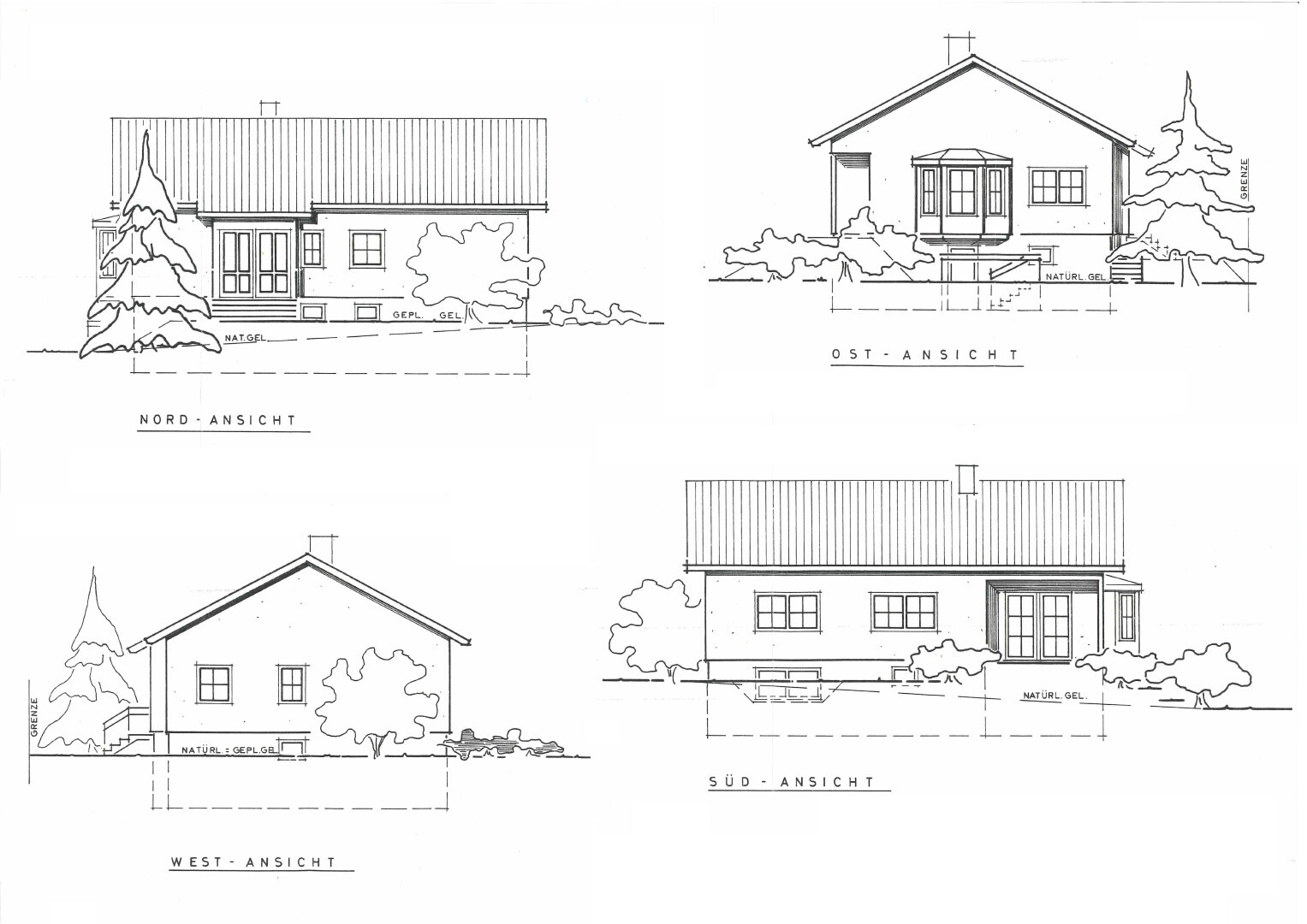
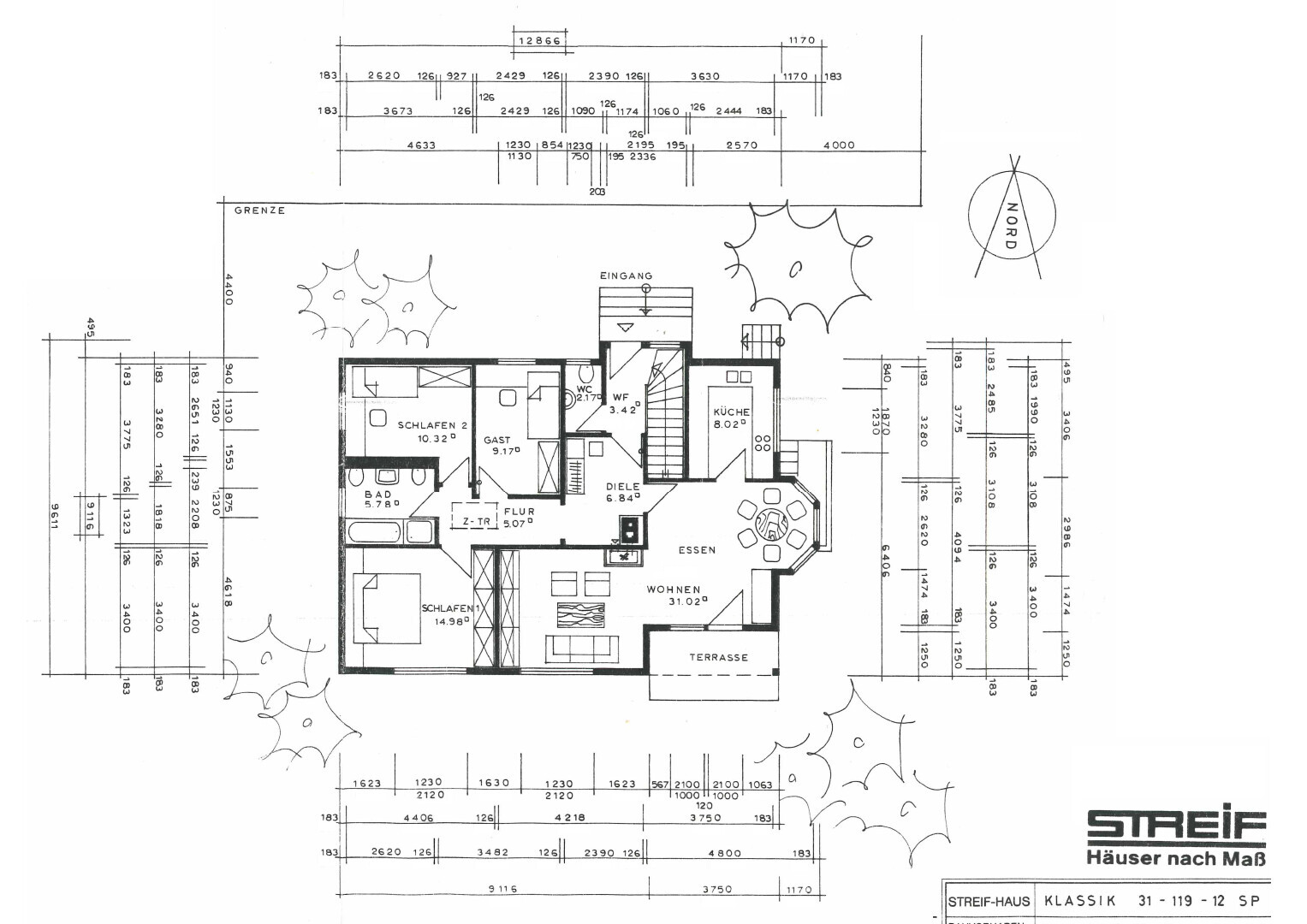
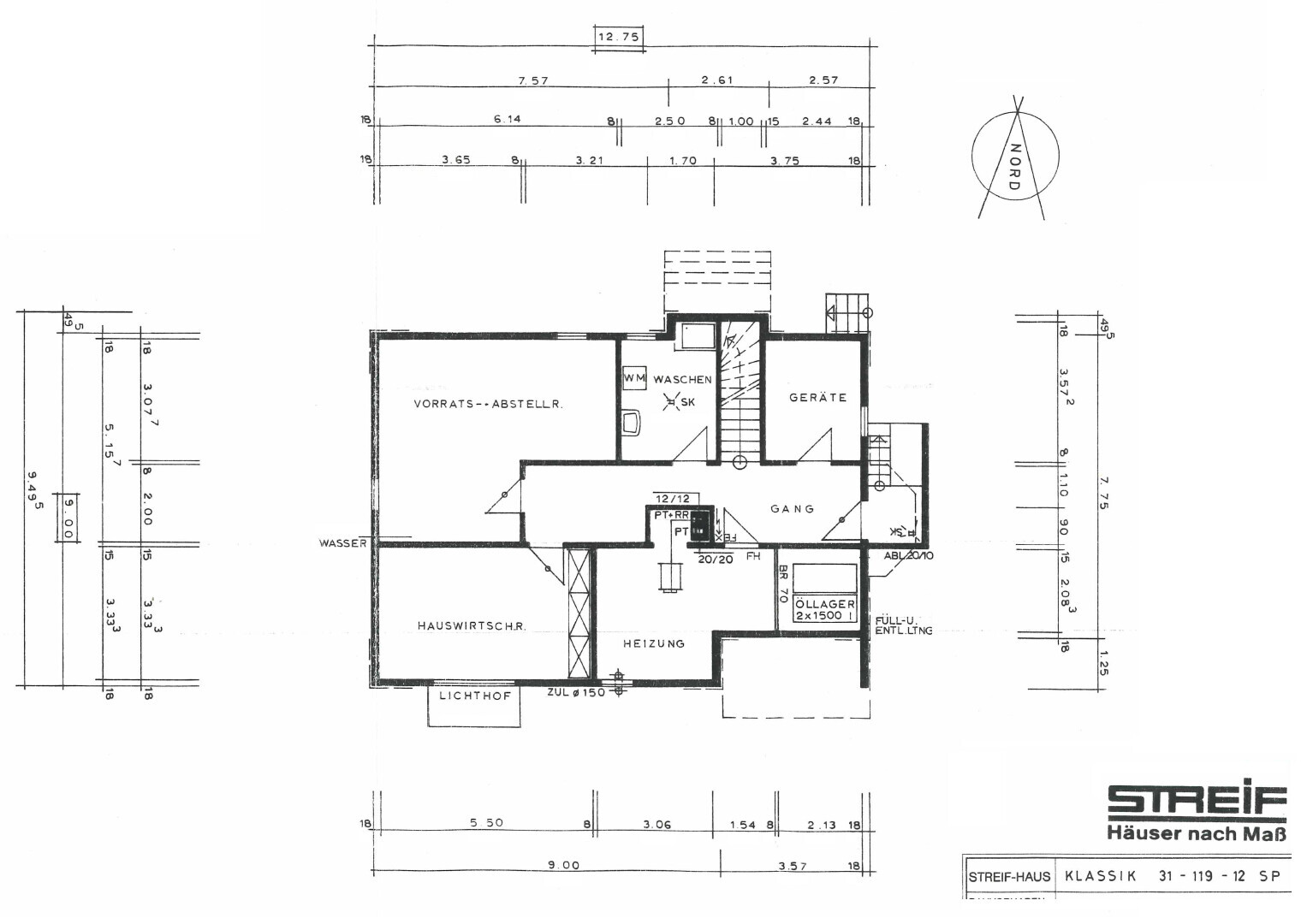
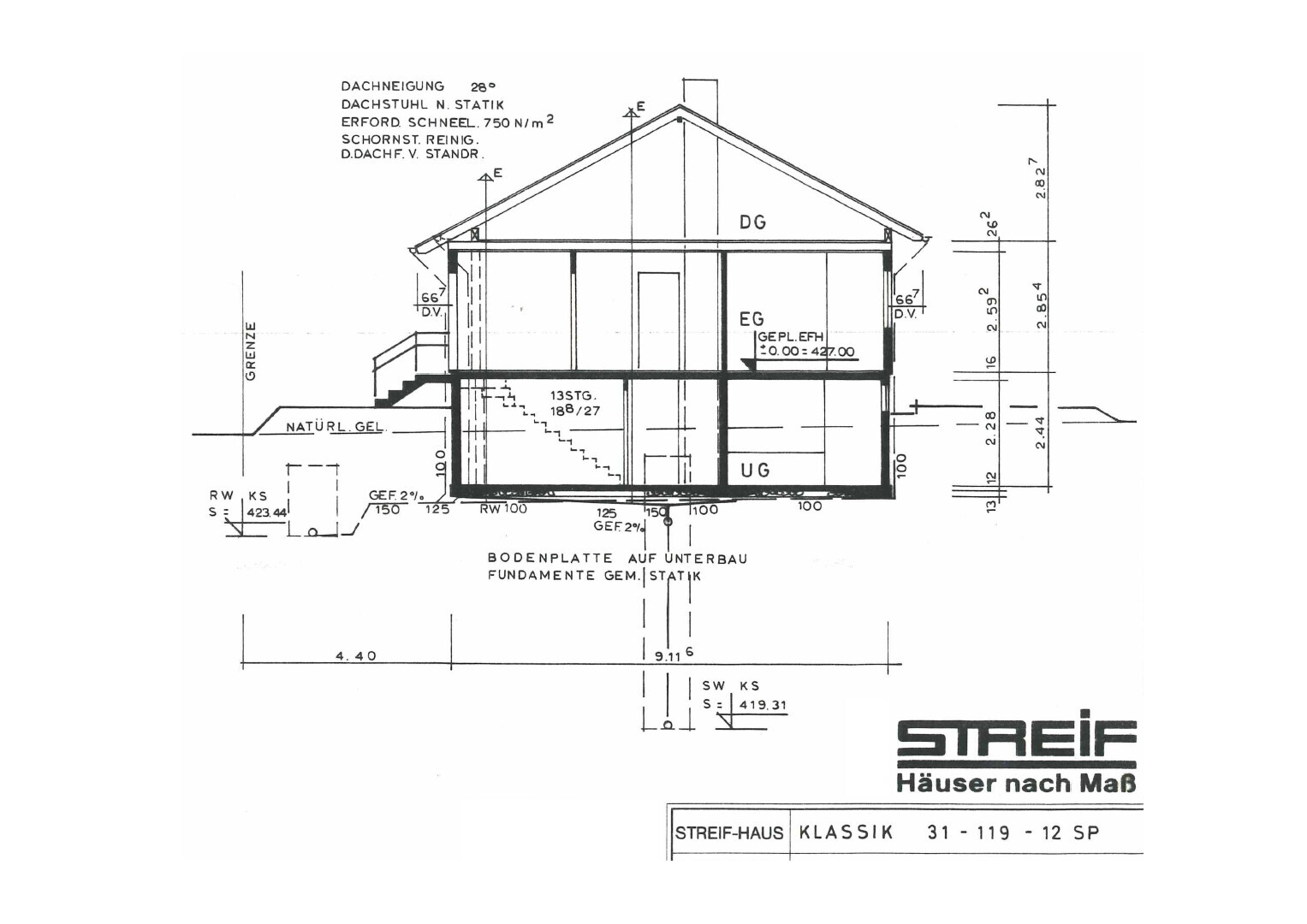
We are still relatively early in our building project and have many fundamental questions to clarify. Nevertheless, I would like to introduce the project here.
We recently became owners of a prefabricated bungalow from Streif Haus, built in 1987. It has a full concrete basement (by Betonkemmler).
Our plan is to demolish the bungalow down to the top edge of the basement and build a new house for our family (currently four, eventually five) on top. The existing basement (very solid construction) is to be integrated as a utility basement including a technical room. At the same time, the heating system will be modernized from oil heating to a heat pump.
Currently, we are in contact with both prefabricated house suppliers (Weberhaus, Danwood) and solid construction companies (Denkinger). The property is located in Baden-Württemberg (southern Baden).
Even though the floor plan is only a first draft, I would like to present it here for feedback (summary below).
In particular, I hope to get some thoughts on the following basic questions:
- Has any forum member gained experience with building on an existing basement?
- Is there generally a preferred construction method for our project? We are still undecided whether to go for a prefab timber frame house or a masonry (brick or block) solid construction.
- So far, we have not discussed a double garage with the builders, but it will be needed. Where does it make more sense: northwest or southwest (directly next to the neighbor’s garage)?
- To what extent can the project be treated as a renovation with partial demolition in terms of building regulations? Background: Are there any possibilities for funding (still) available?
- What we want to achieve with the floor plan is short walking distances inside and around the house. Therefore, the main entrance was moved from the north side to the west side. However, since it is on the short side of the house, this results in more corridor space and longer routes inside (e.g., from the front door to the stairs to the upper floor). But as the saying goes, you have to accept some drawbacks — what is your opinion: front door facing north or west?
Here is the summary sheet (key points).
Many thanks in advance for your input, comments, and critiques. I will gladly report further developments here in the thread.
Development Plan / Restrictions
Size of the plot: 615m² (6620 sq ft)
Slope: North/South: <0.5m (1.6 ft) over 18m (59 ft), West-East: approx. 2m (6.6 ft) over 33m (108 ft) (see elevation profile)
Site coverage ratio: No development plan (Section 34 of German Building Code). The immediate neighborhood contains some generously built plots. We do not want to change the building footprint of the existing house but want to add a double garage (not currently present).
Floor area ratio: No development plan (Section 34 of German Building Code)
Building envelope, building line and boundary: No development plan (Section 34 of German Building Code). Property boundaries and existing building shown in aerial photo attached
Edge development: None
Number of parking spaces: None
Number of floors: 1.5 stories
Roof type: Gable roof
Architectural style: Modern detached family house
Orientation: see aerial photo. Entrance (currently): north
Maximum height/limits: No development plan
Immediate neighbors: Northern neighbor: 2 stories with flat roof. Southern: 1.5 stories with hipped roof. Western: 1.5 stories with gable roof.
Client Requirements
Style, roof form, building type: We want to transform the existing bungalow into a classic 1.5-story detached house with a gable roof and possibly shed dormers.
Basement, floors: Utility basement (existing, concrete basement), ground floor (living), upper floor (sleeping)
Number of persons, ages: Our family currently has four members (ages: 32, 30, 2, 0), with another child planned
Space requirements on ground and upper floor:
Ground floor: living room, kitchen (possibly with pantry), room for home office or guest room, guest WC with shower, cloakroom
Upper floor: master bedroom, 3 children’s bedrooms, bathroom
Office: family use or home office: Home office (100% for me)
Overnight guests per year: Few, less than 5 guests/nights
Open or closed architecture: Rather closed. Ability to separate kitchen and living room would be desirable.
Conservative or modern design: Modern
Open kitchen, kitchen island: Kitchen island not mandatory. Partly open kitchen: separation from living room would be good.
Number of dining seats: 5-8
Fireplace: Only if budget allows, not mandatory
Music/ stereo wall: No
Balcony, roof terrace: No
Garage, carport: Double garage
Utility garden, greenhouse: No
Further wishes/special features/daily routine, including reasons for preferences or exclusions: The technical room should be located in the existing basement (e.g., in the former oil heating room). A sensible circulation concept is very important: front door/upper floor stairs/basement stairs. Ideally, short distances between garage and house as well as good accessibility of rooms within the house.
House Design
Designed by: Initial draft from the prefab house supplier after first meeting
What do you especially like? Why?: (Almost) all room requests fulfilled. Good accessibility of upper floor rooms via centrally located landing. Short distances from garage to house thanks to new front door position (west instead of north). Spacious cloakroom area. Living room oriented south/east with a nice view.
What do you not like? Why?: The draft was created after an initial discussion of the project. Some ideas and preferences developed or changed later on by us:
- Existing concrete stairs in the basement will not be used, causing extra costs for upgrading the basement (new stairs, new room layout).
- (Small) pantry for food/storage on the ground floor would be great
- Better separation of kitchen and living room is desirable
Price estimate according to architect/planner: 520,000 € (approx. $560,000), turnkey (including 10kWp photovoltaic system with 10kW storage, fresh air heating with air-to-air heat pump), excluding demolition of existing bungalow, double garage, incidental building costs
Personal price limit for house including fittings: 700,000 € (rough estimate: demolition down to top of basement: 30,000 €, house: 530,000 €, incidental costs including basement statics: 50,000 €, double garage: 30,000 €, kitchen/furniture: 40,000 €, landscaping: 20,000 €)
Preferred heating technology: Heat pump with underfloor heating. If budget allows: ground-source heat pump with deep geothermal drilling. The prefab house supplier prefers fresh air heating.
If you had to give up something, which details or add-ons could you do without: Fireplace, new basement stairs
What can you absolutely not do without: Home office
Why is the design like it is now?
Individualized draft by the prefab supplier adapted to the existing basement footprint after discussing our rough (space) requirements.
W
WilderSueden20 Dec 2022 11:52[A friend who is a master carpenter advised us against upgrading a bungalow into a one-and-a-half-story house (especially regarding the structural integrity of the ground floor exterior walls and the floor between stories). We even had to convince the prefabricated house supplier to keep the existing basement. Both parties are certainly biased in their own ways. Additionally, there is the emotional factor—the desire to build something new with fewer compromises. However, we are cautiously trying to remove the blinders when it comes to building within an existing structure rather than just on top of it.]
Of course, everyone has their own interests. But you also need to be clear that renovation with a solid existing structure is definitely much cheaper, and that even in a new build, you have to accept compromises—at least financial ones. That brings us to the other topic: obtaining quotes is fine, but it’s not very useful. Looking back, I would not talk to any prefabricated house representative again before I know exactly what I want. Until then, it is a waste of time if everyone tries to convince you of their great system while you end up comparing apples to pears to oranges.
Of course, everyone has their own interests. But you also need to be clear that renovation with a solid existing structure is definitely much cheaper, and that even in a new build, you have to accept compromises—at least financial ones. That brings us to the other topic: obtaining quotes is fine, but it’s not very useful. Looking back, I would not talk to any prefabricated house representative again before I know exactly what I want. Until then, it is a waste of time if everyone tries to convince you of their great system while you end up comparing apples to pears to oranges.

Mal Bauen schrieb:
A master carpenter friend advised against reinforcing a bungalow as a one-and-a-half-story building (especially regarding the structural stability of the ground floor exterior walls and the floor structure). We even had to convince the prefab home provider to keep the existing basement. I (probably already mentioned that I advise prospective builders) can well imagine a divide where the original building’s manufacturer handles the shell construction of the additional floor, and a local carpenter / timber construction general contractor completes the interior finishing.
Mal Bauen schrieb:
The idea was to get a sense of the current price range for our project. Although this is ultimately a rather inadequate approach, it is at least an original justification for comparing two manufacturers from the luxury and economy market segments.
haydee schrieb:
Someone with the “as long as it has four wheels to get me from A to B” attitude will never be willing to pay that much for a Porsche. My first Porsche was actually rented; the one mark per lap was a lot of money for me, but my grandfather paid for it 🙂
xMisterDx schrieb:
And then the children’s rooms with 17, 14, and 11.5m² (183, 151, and 124 ft²)?
Are you trying to provoke a ten-year war over the largest kids’ room? Especially since 11.5m² (124 ft²) really is borderline small for a child’s bedroom. My brother and I had rooms of the same size (totally unfair, since I’m the older one), side by side with a view of the same garden, yet my brother felt disadvantaged. A school friend had an older brother with the smaller room (and still got better final grades). Later, I had a bigger room with a Kim Wilde poster (the reader can guess which factor mattered more). Ceterum censeo, anyone who believes that equal (or even worse: exactly equal) room sizes are the root of world peace probably hasn’t heard their own screw loose.
https://www.instagram.com/11antgmxde/
https://www.linkedin.com/company/bauen-jetzt/
M
Myrna_Loy20 Dec 2022 14:4211ant schrieb:
I (probably already mentioned that I advise people planning to build houses) can well imagine a two-part approach where the manufacturer of the existing building takes care of the shell construction for the extension, and a local carpenter / timber construction contractor completes the interior fit-out.
Although this is ultimately a barely adequate attempt, it at least provides an original reason to compare two manufacturers from the upscale and economy market segments.
My first Porsche was rented, the one mark per lap was indeed a lot of money for me, but my grandfather paid for it 🙂
My brother and I had bedrooms of equal size (totally unfair since I’m the older one), located side by side overlooking the same garden, yet my brother still felt disadvantaged. A school friend of mine had an older brother who even had the smaller room (and still got better grades). Later, I had a larger room in another apartment — with a Kim Wilde poster (readers can guess which aspect was more important). In my opinion, anyone who believes the root of world peace lies in equally sized (or even worse: exactly equally sized) children’s rooms probably hasn’t thought through their own quirks. My brother had the nicer velour carpet and I just had a dull wooden floor with a woven rug. That was the last argument for years whenever it came down to who was being treated unfairly. Yes, kids are crazy.
M
Mal Bauen21 Dec 2022 09:32hanghaus2023 schrieb:
The old floor plan actually has the potential for immediate move-in. You’ll really miss the coziness of the original construction later on.I understand your point, but we would prefer to do a "proper" build/renovation to have peace of mind for a few years afterwards. The existing floor plan would be a downgrade from our current living situation. After many years of being rental nomads, I don’t want to put my family through that anymore and finally want to settle down in the oasis.By coziness, do you specifically mean the feeling of living in a bungalow, that is, all on one level?
hanghaus2023 schrieb:
Are there already two-story houses in the neighborhood?Yes, directly to the north there is a two-story house with a flat roof.hanghaus2023 schrieb:
Show us some pictures of the house.We’ll be on site again over the Christmas weekend, so I’ll take some photos inside and outside then.xMisterDx schrieb:
Wow. You’re planning a new build, also because of the children, and then the kids’ rooms are 17, 14, and 11.5 square meters?Good point. Honestly, I don’t know why the rooms ended up different sizes. In my opinion, there’s no reason the bedrooms can’t be equal (or similar) in size and that should be possible here. The bathroom can also be smaller. The bathtub can be positioned lengthwise in the knee wall space. We’ll optimize this in the next floor plan iteration once the fundamental questions here are clarified.WilderSueden schrieb:
Looking back, I wouldn’t talk to any prefab house representatives before I exactly know what I want. Until then, it’s a waste of time if everyone tries to convince you of their great system and you end up comparing apples, pears, and oranges.For me personally, talking to prefab house people was okay as a starting point. You can discuss many things and give yourself a little kick-start for the project. The demand seems to be decreasing, so everyone took a lot of time with us, including an on-site visit with an architect. Of course, they want to sell something, so you have to be careful not to get dazzled or to lose your creative freedom.11ant schrieb:
I (probably already mentioned that I advise prospective builders) can well imagine a two-part approach, where the manufacturer of the existing building is responsible for the shell construction of the extension, and a regional carpenter / timber construction general contractor handles the interior fit-out.I wanted to message you about this but probably haven’t posted enough yet to do so. When will that be enabled?We have two on-site appointments planned, one before and one right after Christmas, with the local timber builder and a construction engineer. The latter was rather skeptical about the renovation, especially due to the structural calculations. But we’ll take a look and will even open a wall to check the building fabric.
I also spoke to a friendly representative from Streif Haus. In the past, renovations/extensions were done in cooperation with Renopan, but now there is a new, partly in-house company whose name he didn’t know. Our plans from the 1980s are no longer on file at Streif Haus, but requests like mine come up often and they are familiar with them. They now have the documents and will contact us soon. He was generally open to your suggestion of splitting the work (shell: Streif Haus, interior fit-out: regional company).
Mal Bauen schrieb:
I was going to send you a private message about that, but I probably haven’t posted enough yet to be allowed to. When does that get enabled?It should be around 150-200 posts by now.Similar topics