
.... I love brightness and would like to have a light fixture above the shower.
It is clear and sensible that electricity and water must be kept separate.
My plan is to cover the electrical components – including the LED bulb – with an acrylic glass enclosure, so that even if someone directs the shower spray upwards, there would reliably be no contact.
Does anyone know where I can find the regulations, or how I can find out exactly what is actually prohibited?
It is clear and sensible that electricity and water must be kept separate.
My plan is to cover the electrical components – including the LED bulb – with an acrylic glass enclosure, so that even if someone directs the shower spray upwards, there would reliably be no contact.
Does anyone know where I can find the regulations, or how I can find out exactly what is actually prohibited?
 ateliersiegel5 Dec 2022 18:16
It's nice to see what other people are working on 😎
Tomorrow I'll take some photos of the room... (unfortunately, there’s no lighting yet 😉)
Tomorrow I'll take some photos of the room... (unfortunately, there’s no lighting yet 😉)
ateliersiegel6 Dec 2022 12:18Here you can see the planned space for the ceiling light. In the foreground, you are looking through the entrance door. The door is visible from the inside in the mirror.
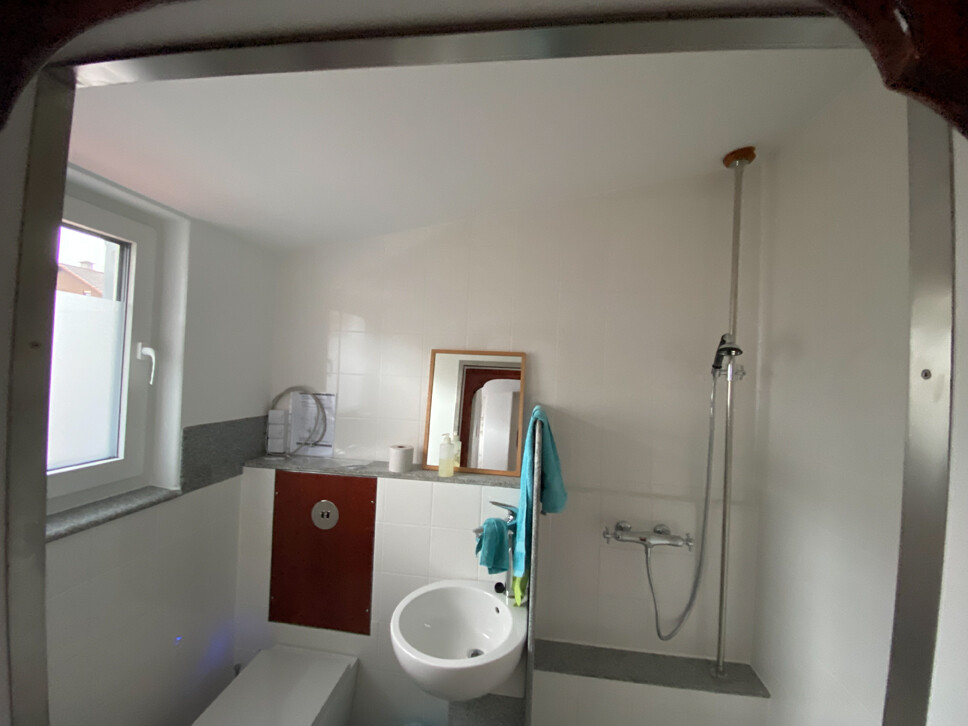
To the left of the window, a bathroom cabinet will be installed above the electrical outlets. Where the mirror is shown, a mirror will be installed reaching all the way up to the ceiling. The room lighting will run from left to right just under the ceiling. The cabinet will have glass shelves so it can be internally lit from above (and because glass is easy to clean).
This is a tiny bathroom, and I’m really happy with the “crammed-in” sink, which does not feel cramped when in use at all.
The first plan described above was to use a few GU10 LEDs behind a frosted acrylic glass panel for sufficient lighting. (Plexiglass can be bent with heat, and the connection from below to the front should be rounded. The switched power cable is coiled and ready.)
Now I am considering a plexiglass tube running the entire width (an impressive 2.15 meters (7 feet)) along the top corner, with an LED strip inside. These strips have become quite bright. (However, finding reliable information about brightness and durability for comparison is not easy, as the details provided by manufacturers are often sparse and inconsistent.)
To the left of the window, a bathroom cabinet will be installed above the electrical outlets. Where the mirror is shown, a mirror will be installed reaching all the way up to the ceiling. The room lighting will run from left to right just under the ceiling. The cabinet will have glass shelves so it can be internally lit from above (and because glass is easy to clean).
This is a tiny bathroom, and I’m really happy with the “crammed-in” sink, which does not feel cramped when in use at all.
The first plan described above was to use a few GU10 LEDs behind a frosted acrylic glass panel for sufficient lighting. (Plexiglass can be bent with heat, and the connection from below to the front should be rounded. The switched power cable is coiled and ready.)
Now I am considering a plexiglass tube running the entire width (an impressive 2.15 meters (7 feet)) along the top corner, with an LED strip inside. These strips have become quite bright. (However, finding reliable information about brightness and durability for comparison is not easy, as the details provided by manufacturers are often sparse and inconsistent.)
ateliersiegel6 Dec 2022 12:56After just searching for acrylic tubes, I now know that there are also thick tubes available, into which I could even install "my" GU10 lamp holders with LEDs sideways.
A tube diameter of 150 to 200 millimeters (6 to 8 inches) is not a problem.
... another lead to follow ...
A tube diameter of 150 to 200 millimeters (6 to 8 inches) is not a problem.
... another lead to follow ...
 ateliersiegel6 Dec 2022 18:10
And another idea:
One (or two) spotlights (floodlights or similar, with a narrow beam angle) on the left, placed behind glass, shining onto mirrors that direct the light downward.
This would solve the safety issue (at least over the shower) and could look interesting.
What seems difficult to me is that the lights could cause glare. I’m not sure whether it makes sense to make the mirrors matte.
One (or two) spotlights (floodlights or similar, with a narrow beam angle) on the left, placed behind glass, shining onto mirrors that direct the light downward.
This would solve the safety issue (at least over the shower) and could look interesting.
What seems difficult to me is that the lights could cause glare. I’m not sure whether it makes sense to make the mirrors matte.
T
Torti2022neu7 Dec 2022 09:04ateliersiegel schrieb:
That would solve the safety issue (at least above the shower) and could look interesting. 1. Which safety issue? Do you actually read the responses you get here?
2. Interesting is the little sister of crap – please forget the idea.
You don’t always have to look for the most unusual solution. Sometimes it helps to just be normal. 😉
Similar topics